Scale Your Project Management Efforts to Maximize Success!
One size does not fit all in project management. Selecting an approach that is appropriate for the size and complexity of a project is essential to achieving success. Over-managing a small project can bog it down in bureaucracy, while a laid-back approach can lead to disaster on a complex project.
Pragmatic Project Management: Five Scalable Steps to Success will help you select the methodologies and tools that will enable you to expend minimum effort to achieve maximum gain on your project. This clearly written guide lays the groundwork with a chapter on project sizing and management scaling and follows with chapters on each of the five essential elements of pragmatic project management:
• The project charter
• The project team
• The project plan
• Project issue management
• Project status tracking and reporting
Practical tips and a checklist are included at the end of each chapter. Use the checklists as you plan and execute your project to keep it on track and to scale.
- 160 pages
- English
- ePUB (mobile friendly)
- Available on iOS & Android
eBook - ePub
Pragmatic Project Management
About this book
Information

Sizing the Project and Adjusting Project Management to Scale
Every project is unique. Some projects are small; others are large. Some are relatively inexpensive and some cost a fortune. Some projects are simple, straightforward, predictable, and well understood; others are highly complex and risky. Each project requires a different level of project management; applying the same amount of attention, resources, and documentation to each project is typically wasteful. Despite this, many organizations and project managers apply project management dogmatically without deviation, instead of scaling efforts appropriately.
The goal of pragmatic project management is to determine the minimum amount of project management effort needed to deliver the maximum benefit for the project. To do this, the project must first be sized according to its specific characteristics.
SIZING THE PROJECT
All projects, regardless of cost, size, complexity, and risk, progress through a standard project lifecycle that includes initial, intermediate, and final phases. The initial phase typically includes the business idea, the project charter, the project team, and the project scope statement. The intermediate phase typically includes the project plan, project baselines, project execution, and project progress tracking and reporting. The final phase includes project approval and closeout.
Pragmatic PM Rule #1: All projects move through a standard, predictable project lifecycle.
The first effort at sizing a project generally takes place early in the initial phase—when the project is simply an undeveloped business idea or concept. At this point, the organization may have only limited information about the project, and it may have to base its initial understanding of the project on assumptions or on historical data from analogous projects. Despite the limited amount of information, the organization should be able to make an initial estimation of the project's relative size, complexity, cost, risk, and organizational impact. Each of these factors will have an effect on project feasibility and, subsequently, the project team's approach.
Pragmatic PM Rule #2: Despite the limited amount of information available during the initial phase of the project lifecycle, the sponsoring organization should be able to make an initial estimation of the project's relative size, complexity, cost, risk, and organizational impact.
The project sizing matrix is a good tool to use in assessing the relative size of a project (Figure 1.1). This tool incorporates major factors affecting project size, including project cost, complexity (the estimated number of tasks), anticipated risk level, and organizational impact.
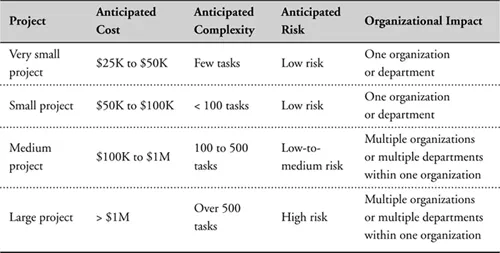
Figure 1-1 The Project Sizing Matrix
Cost estimates in the initial phase of the project lifecycle will be only high-level estimates. As the project evolves through the project lifecycle and the project team refines project objectives, requirements, and resource estimates, cost estimates will become more exact, and the project's true size will become more clear.
Similarly, project complexity estimates in the initial phase will be based only on assumptions about how much work—and what kind of work—the project will entail.
The project manager's assessment of risk must be consistent with what the sponsoring organization constitutes a high, medium, or low risk. Some organizations, for example, define high-risk projects as those with at least a 40 percent probability of failure. For others, a ten percent probability of project failure is considered high-risk.
When a project has an impact across organizational boundaries, the associated challenges and considerations for the project sponsor, PM, and project team increase proportionally. Organizational cultures, management styles, strategies, goals, and objectives can differ markedly from one organization to another and from one department to another within a single organization. In these cases, the project sponsor and PM must spend a great deal of time working with stakeholders from each organization or department to ensure project deliverables meet the needs of all stakeholders. Political considerations in these cases will typically require a more conscientious, sophisticated project approach.
Few projects land exactly within the parameters identified by the project sizing matrix. Consider, for example, a project estimated to cost $100,000, to include one hundred tasks, and to have a relatively low level of risk. According to the project sizing matrix, that project would typically be considered small. But what if that project impacts two organizations, including the project sponsor's agency? Would the project still be considered small? In this case, because many of the indices are right on the border of being typical for medium-sized projects, and because there is a significant political aspect to the project impacting multiple organizations, the PM should probably approach this as a medium-sized project.
SCALING THE WORK
After sizing the project during the initial phase of the project lifecycle, the next step is to tailor the pragmatic PM approach to meet the needs of the project. After making a high-level estimate of the project's size, cost, complexity, risk, and organizational impact, the project team can apply the principles of pragmatic PM to determine just how much project management effort, planning, and documentation are required to support the project.
Applying the five essential elements of pragmatic project management PM to each project will increase the chance of project success. Sizing each project appropriately, adjusting each essential element of pragmatic PM to scale, and tailoring project management efforts to meet the needs of each unique project will ensure efficiency and effectiveness.
The chapters that follow describe how to scale the five essential elements of pragmatic project management to suit each unique project.

Pragmatic PM Element #1: The Project Charter
Projects, by their nature, craft something new. They give rise to new products and solutions, enhance existing processes, and change how people work and live their lives. Managing a project is like navigating a boat through open waters: Even if navigation tools abound, the voyage has inherent risk. An experienced sailor will confirm the benefits of preplanning. In the project management world, preplanning is documented in the project charter. The project charter is the first of the five essential elements of pragmatic project management.
As with sailing through unfamiliar seas, a little planning can help a project manager navigate a project's unknown territory and increase the likelihood of project success. At the very least, project managers must describe the project's main objectives before investing time or money in the effort. Unfortunately, many projects fail because of a lack of clear project direction and planning initially.
THE NEED FOR SPEED VERSUS THE NEED FOR INFORMATION
When a promising new idea excites an organization, it can be difficult to take the time to plan in detail before pursuing the idea. Planning takes time, and everyone wants to get started right away. When time is tight or problems loom large, it is difficult not to just jump into a project or make it up as you go along. Sometimes project particulars seem so obvious that success is simply taken for granted.
Pragmatic PM Rule #3: Projects are always more complex than they seem.
Too often, failing to adequately plan before launching a project ultimately costs the organization a great expense. The truth is that it is difficult to understand exactly how simple or complex an undertaking might be until you take the time to describe it in some detail.
Imagine two hikers looking at the far horizon as they contemplate a short trip across a small valley. The trip is so short that they can see their destination from where they stand. They gaze across the land before them and discuss how they will wind their way down the hillside toward their destination, through the trees, and across a small stream. This couple is in an ideal situation, both as hikers and project managers. Their destination is clear; the trip will be short; they have only two people on their team; and their goal is easy to visualize.
Most projects are more difficult to plan, however, and time always seems tight. Consider the same hikers in a new situation: Now they have a driving need to get out of town and across that valley in a hurry. Even though the couple is somewhat familiar with the route, they have no time to plan. Gathering a few obvious essentials, they get started without checking the weather. A heavy storm develops, and the weather-plagued trek eventually requires more food and equipment than the couple packed.
Pragmatic PM Rule #4: Taking the time to plan prior to undertaking even the smallest projects increases the likelihood of success.
Consider the task of planning a convention for thousands of attendees. The budget is sufficient, and time pressures are minimal. A professional event planner sits down with the project sponsor to work through a long list of considerations as she develops the project charter for the project, including:
- Staff requirements
- Pre- and post-event activities
- Public areas, registration areas, and meeting rooms requirements
- Exhibit hall layout and set-up
- Business licenses, health and fire permits, and food regulations
- Clean-up and trash removal
- Telecommunications/data transmissions requirements
- Audio, visual, and other technological services.
Addressing each topic takes time, but the experienced event manager understands that the time is well invested when the result is a clear, detailed project charter that communicates the project's objectives and resource requirements.
In one respect, a convention for thousands of people is no different than planning a hike for two. If you understand the project sponsor's vision, have a clear set of objectives, and understand the expected deliverables, you can determine how best to execute the project.
Consider a manager who attends a convention and previews a new piece of software. She returns to her office determined to implement the software, convinced it will make her organization more effective and competitive. Without much consideration or planning, she instructs an IT project team to begin work to implement the software.
The software may in fact have considerable promise, but before long the team and the company are bogged down in a seemingly endless, complex software implementation project. The project has cost much more than the manager initially imagined. The manager and the project team are both frustrated, and soon the project is shut down and declared a failure.
Software development and implementation projects are notoriously complex. Project failure rates in the industry are inordinately high and frequently are the result of spontaneous requirements and technology-driven solutions, rather than well-considered goals, objectives, and planning. In the previous example, a few days of deliberate consideration in advance might have established more realistic expectations and resulted in a comprehensive project charter that supported a good project effort, rather than costly, unproductive knee-jerk excitement over the latest technology.
Realistically, schedule demands may be a factor in any project, particularly when the project addresses an important or urgent business problem. The importance of knowing exactly where you are headed before starting any venture cannot be overstated. Planning upfront will save time and money over the long term.
Too many project stakeholders skip this process, however, even when it could save them substantial time, effort, and resources. That is why the project charter is an essential element of pragmatic project management.
THE PROJECT CHARTER
Taking the time to describe a project before undertaking it can go a long way toward ensuring project success. Consider the project sponsor who said that his agency did not have time to develop project charters; instead of excessive advance planning, that time would be better spent getting the work done. His perception had probably evolved from his own frustration with project managers who spent too much time planning and never got to the work. This perception is often accurate when it involves inexperienced project managers who adopt a specific methodology and stick to it relentlessly without regarding the particular needs of each project. If the project planning effort is not scaled to the specific needs of a project, senseless, costly planning can certainly lead to a waste of time and resources.
Pragmatic PM Rule #5: For every project, aim to conduct only a sufficient amount of advance planning needed to ensure the project's success–no more and no less.
Project managers should aim to conduct only a sufficient amount of advance planning needed to ensure the project's success—no more and no less. A clear, sufficiently detailed project charter provides enough direction needed to orient a project team as it prepares to tackle a project. The project charter, regardless of the nature and scope of the project it describes, includes twelve basic elements:
- Vision – The end state produced by the project, as envisioned by the project sponsor.
- Business problem or opportunity – What the project is launched to address.
- Objectives – The value the project will provide to the organization.
- Deliverables – A description of the end product or service generated by the project.
- High-level schedule – A broad, general outline of key dates impacting the project (e.g., start date, end date, intermediate milestones).
- Constraints – Internal and external factors that could limit the project's scope, schedule, or cost.
- Assumptions – Statements about the pr...
Table of contents
- Cover
- Title Page
- Copyright
- Dedications
- Contents
- About the Author
- Preface
- Acknowledgments
- Introduction
- Chapter 1 Sizing the Project and Adjusting Project Management to Scale
- Chapter 2 Pragmatic PM Element #1: The Project Charter
- Chapter 3 Pragmatic PM Element #2: The Project Team
- Chapter 4 Pragmatic PM Element #3: The Project Plan
- Chapter 5: Pragmatic PM Element #4: Project Issue Management
- Chapter 6: Pragmatic PM Element #5: Project Status Tracking and Reporting
- Final Thoughts
- Appendix I: Additional Case Studies
- Appendix II: The 40 Key Rules of Pragmatic Project Management
- Recommended Reading
- Index
Trusted by 375,005 students
Access to over 1.5 million titles for a fair monthly price.
Study more efficiently using our study tools.
Frequently asked questions
Yes, you can cancel anytime from the Subscription tab in your account settings on the Perlego website. Your subscription will stay active until the end of your current billing period. Learn how to cancel your subscription
No, books cannot be downloaded as external files, such as PDFs, for use outside of Perlego. However, you can download books within the Perlego app for offline reading on mobile or tablet. Learn how to download books offline
Perlego offers two plans: Essential and Complete
- Essential is ideal for learners and professionals who enjoy exploring a wide range of subjects. Access the Essential Library with 800,000+ trusted titles and best-sellers across business, personal growth, and the humanities. Includes unlimited reading time and Standard Read Aloud voice.
- Complete: Perfect for advanced learners and researchers needing full, unrestricted access. Unlock 1.5M+ books across hundreds of subjects, including academic and specialized titles. The Complete Plan also includes advanced features like Premium Read Aloud and Research Assistant.
We are an online textbook subscription service, where you can get access to an entire online library for less than the price of a single book per month. With over 1.5 million books across 990+ topics, we’ve got you covered! Learn about our mission
Look out for the read-aloud symbol on your next book to see if you can listen to it. The read-aloud tool reads text aloud for you, highlighting the text as it is being read. You can pause it, speed it up and slow it down. Learn more about Read Aloud
Yes! You can use the Perlego app on both iOS and Android devices to read anytime, anywhere — even offline. Perfect for commutes or when you’re on the go.
Please note we cannot support devices running on iOS 13 and Android 7 or earlier. Learn more about using the app
Please note we cannot support devices running on iOS 13 and Android 7 or earlier. Learn more about using the app
Yes, you can access Pragmatic Project Management by David Pratt PMP in PDF and/or ePUB format, as well as other popular books in Business & Business Strategy. We have over 1.5 million books available in our catalogue for you to explore.