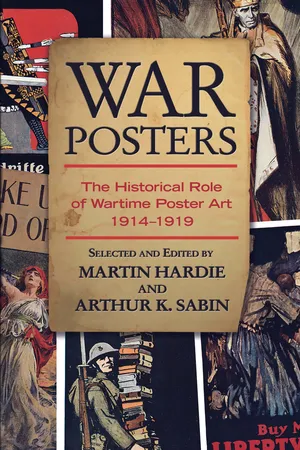
"Take up the sword of justice," commands a vengeful, blade-wielding sea goddess, while a ship resembling the Lusitania hovers on the horizon
"Keep all Canadians busy. Buy 1918 victory bonds," advises a poster bearing a pair of industrious beavers
"Must children die and Mothers plead in vain? Buy more Liberty Bonds," demands a heartrending scene of an overwhelmed woman and her infants
"Books wanted for our men in camp and 'over there' — Take your gifts to the public library," proposes an image of a doughboy balancing a stack of volumes
Striking poster art, featuring exhortations to support the troops and help the suffering, appeared across Europe and North America during World War I. This compilation presents 80 color and black-and-white posters, issued from 1914 to 1919, that include works by Steinlen, Biró, Paul Nash, and other noted artists. Arranged by the country of issue, they comprise examples from Great Britain, France, Germany and Austria/Hungary, the United States, and elsewhere. In addition, a substantial and informative Introduction details the historical role of wartime posters.
eBook - ePub
War Posters
The Historical Role of Wartime Poster Art 1914-1919
- 160 pages
- English
- ePUB (mobile friendly)
- Available on iOS & Android
eBook - ePub
About this book
Information
I.—POSTERS AND THE WAR
NEVER in the history of the world have the accessories of ordinary civilised life met with so searching a test of their essential quality as during the War. All national effort throughout the belligerent countries was organised and directed to serve a single purpose of supreme importance. This purpose in its turn served as a touchstone to sort out whatever was useful and valuable in everyday things, and shaped the selected elements into weapons of immense power. The poster, hitherto the successful handmaid of commerce, was immediately recognised as a means of national propaganda with unlimited possibilities. Its value as an educative or stimulative influence was more and more appreciated. In the stress of war its function of impressing an idea quickly, vividly, and lastingly, together with the widest publicity, was soon recognised. While humble citizens were still trying to evade a stern age-limit by a jaunty air and juvenile appearance, the poster was mobilised and doing its bit.
Activity in poster production was not confined to Great Britain. France, as in all matters where Art is concerned, triumphantly took the field, and soon had hoardings covered with posters, many of which will take a lasting place in the history of Art. Germany and Austria, from the very outset of the War, seized upon the poster as the most powerful and speedy method of swaying popular opinion. Even before the War, we had much to learn from the concentrated power, the force of design, the economy of means, which made German posters sing out from a wall like a defiant blare of trumpets. Their posters issued during the War are even more aggressive; but it is the function of a poster to act as a “mailed fist,” and our illustrations will show that, whatever else may be their faults, the posters of Germany have a force and character that make most of our own seem insipid and tame.
Here in Great Britain the earliest days of the War saw available spaces everywhere covered with posters cheap in sentiment, and conveying childish and vulgar appeals to a patriotism already stirred far beyond the conception of the artists who designed them or the authorities responsible for their distribution.* This, perhaps, was inevitable in a country such as ours. The grimness of the world-struggle was not realised in its intensity until driven home by staggering blows at our very life as a nation. Then, and not till then, a Government which was always halting to “wait and see,” or moving slowly behind the nation, at last got into its stride. Artists understood the call and responded. The poster, inspired by an enthusiasm unknown before, became the one form of Art answering to the needs of the moment, an instrument driving home into every mind its emphatic moral and definite message. It is characteristic that the first truly impassioned posters we saw in England were in aid of Belgian refugees or the Belgian Red Cross. They dealt with the violation of Belgium; and the stirring appeal of the work done by G. Spencer Pryse and Frank Brangwyn, R.A., in those early days will always linger in the memory.
So numerous were the posters issued in every country, both by the Governments concerned and the various committees dealing with relief work and other aspects of the War, that the international collection acquired by the Imperial War Museum exceeds twenty thousand. Large numbers of these, many of them consisting of letterpress only, are outside the scope of the present volume, which is intended to make accessible to the public in a convenient form reproductions of a small selection distinguished for their artistic merit. The collection of original War posters acquired by the Victoria and Albert Museum has provided most of the illustrations. It comprises several hundred posters from Germany, Austria, Hungary, and other countries, in addition to those issued by Great Britain and her Allies; and it illustrates, in a compact form, the finest artistic uses to which colour-lithography was put as a weapon in the World War.
The small collection made for this volume is necessarily arbitrary. Our illustrations are often about one-twelfth the size of the originals, and the limit in size may perhaps be considered to detract from the value of the reproductions. This, however, has been considered, as far as possible, in selecting the examples chosen. A strong, impulsive design does not depend entirely upon size for the force of its appeal, nor does it change in character from being reduced; but a poster badly designed, though passable on a large scale, may be an unintelligible jumble in a small illustration. In many cases a design is knit together by its reduction, and so viewed as a whole more compactly. Its publication in book form gives it also a permanence and ultimately a wider audience than the original can hope to gain.
This thought of the ephemeral character of the poster as such has, in the first instance, prompted the publication of this volume. A poster serving the purposes of a war, even of such a world cataclysm as that during which we have passed during the last five years, is by its nature a creation of the moment, its business being to seize an opportunity as it passes, to force a sentiment into a great passion, to answer an immediate need, or to illuminate an episode which may be forgotten in the tremendous sequence of a few days’ events. In its brief existence the poster is battered by the rain or faded by the sun, then pasted over with another message more urgent still. Save for the very limited number of copies that wise collectors have preserved, the actual posters of the Great War will be lost and forgotten in fifty years.
But we must not forget that in every country concerned the poster played its part as an essential munition of war. Look through any collection of them, and you will see portrayed, in picture and in legend, which he who runs may read, the whole history of the Great War in its political and economical aspects. The posters of 1914-1918 illustrate every phase and difficulty and movement—recruiting for naval, military, and air forces; munition works; war loans; hospitals; Red Cross; Y.M.G.A.; Church Army; food economy; land cultivation; women’s work of many kinds; prisoners’ aid—and hundreds of problems and activities in connection with the country’s needs. The same sequence of needs can be traced in the posters of Germany and Austria, where a stress even greater than our own is revealed, not merely in the urgent appeals for contributions to war loans, but in the sale by German women of their jewels and their hair.
For obvious reasons only a limited number of the posters could be reproduced in colour, the main portion of the plates in the book being in black and white. But since the primary element counting for success in the poster is design, it follows that excellent colouring will not save a badly-designed poster from failure, however much it enhances the power of one already successful. Indeed, we may go further and claim that ineffective or quite bad colouring often fails to mar entirely the success of a good design. The examples selected are not heavy losers by being reproduced mostly in monotone; for they are essentially posters depending on design and not merely pictorial advertisements. Their purpose is innate in their structure; they have their story to tell and message to deliver; it is their business to waylay and hold the passer-by, and to impose their meaning upon him. The best of them have done this brilliantly.
* While this is being written, our authorities are again placarding our walls with indifferent posters showing the advantages of life in the Army as compared with the “disadvantages” of civil life, and embodying an undignified appeal to Britons to join the Army for the sake of playing cricket and football and seeing the world for nothing!
II.—GREAT BRITAIN
SHORTLY after the War began, an “Exhibition of German and Austrian Articles typifying Design” was arranged at the Goldsmiths’ Hall, to show the directions in which we had lessons to learn from German trade-competitors as to the combination of Art and economy applied to ordinary articles of commerce. The walls were hung with German posters, and one felt at once that while our average poster cost perhaps six times as much to produce, it was inferior to its German rival in just those vital qualities of concentrated design, whether of colour or form, and those powers of seizing attention, which are essential to the very nature of a poster.
While we have had individual poster artists, such as Nicholson, Pryde, and Beardsley, whose work has touched perhaps a higher level than has ever been reached on the Continent, our general conception of what is good and valuable in a poster has been almost entirely wrong. The advertising agent and the business firm rarely get away from the popular idea that a poster must be a picture, and that the purpose of every picture is to “point a moral and adorn a tale.” They seldom realise that poster art and pictorial art have essentially different aims. If a British firm wishes to advertise beer, it insists on an artist producing a picture of a publican’s brawny and veined arm holding out a pot of beer during closed hours to a policeman; or a Gargantuan bottle towering above the houses and dense crowds of a market-place; or a fox-terrier climbing on to a table and wondering what it is “master likes so much”—all in posters produced at great expense with an enormous range of colour. The German, on the other hand—there was an example at the Goldsmiths’ Hall—designs a single pot of amber, foaming beer, with the name of the firm in one good spot of lettering below. It is printed at small cost, in two or three flat colours; but it shouts “beer” at the passer-by. It would make even Mr. Pussyfoot thirsty to glance at it.
Our British love for a story in a picture has accounted for an immense amount of ingenious artistry falling into amorphous ineffectiveness. It is the essence of the poster that it should compel attention; grip by an instantaneous appeal; hit out, as it were, with a straight left. It must convey an idea rather than a story. From its very nature it must be simple, not complex, in its methods. If it has something eccentric or bizarre about it, so long as it is good in design, that is a good quality rather than a fault: Even about the best of our war posters one feels...
Table of contents
- Cover
- Title page
- Copyright
- Contents
- Chapter I. Posters and the War
- Chapter II. Great Britain
- Chapter III. France
- Chapter IV. Germany—Austria-Hungary
- Chapter V. United States of America
- Chapter VI. Other Countries
Trusted by 375,005 students
Access to over 1.5 million titles for a fair monthly price.
Study more efficiently using our study tools.
Frequently asked questions
Yes, you can cancel anytime from the Subscription tab in your account settings on the Perlego website. Your subscription will stay active until the end of your current billing period. Learn how to cancel your subscription
No, books cannot be downloaded as external files, such as PDFs, for use outside of Perlego. However, you can download books within the Perlego app for offline reading on mobile or tablet. Learn how to download books offline
Perlego offers two plans: Essential and Complete
- Essential is ideal for learners and professionals who enjoy exploring a wide range of subjects. Access the Essential Library with 800,000+ trusted titles and best-sellers across business, personal growth, and the humanities. Includes unlimited reading time and Standard Read Aloud voice.
- Complete: Perfect for advanced learners and researchers needing full, unrestricted access. Unlock 1.5M+ books across hundreds of subjects, including academic and specialized titles. The Complete Plan also includes advanced features like Premium Read Aloud and Research Assistant.
We are an online textbook subscription service, where you can get access to an entire online library for less than the price of a single book per month. With over 1.5 million books across 990+ topics, we’ve got you covered! Learn about our mission
Look out for the read-aloud symbol on your next book to see if you can listen to it. The read-aloud tool reads text aloud for you, highlighting the text as it is being read. You can pause it, speed it up and slow it down. Learn more about Read Aloud
Yes! You can use the Perlego app on both iOS and Android devices to read anytime, anywhere — even offline. Perfect for commutes or when you’re on the go.
Please note we cannot support devices running on iOS 13 and Android 7 or earlier. Learn more about using the app
Please note we cannot support devices running on iOS 13 and Android 7 or earlier. Learn more about using the app
Yes, you can access War Posters by Martin Hardie,Arthur K. Sabin in PDF and/or ePUB format, as well as other popular books in Art & Art General. We have over 1.5 million books available in our catalogue for you to explore.