The first chapter in this volume (Dr Yousuf Kamal) is set in the context of the Bangladeshi garment industry, while the second chapter (Delphine Gibassier) explores the practice of water accounting. The remainder of this volume presents three chapters from the 3rd French Conference on Social and Environmental Accounting Research, guest edited by Sophie Giordano-Spring, Jonathan Maurice and Charles H. Cho. These chapters consider sustainability in Canadian CPA teaching programmes (Emilio Boulianne and S. Leanne Keddie); mandatory environmental reporting in France (Juliette Senn); and CSR reporting practices in Brazil and South Korea (Hyemi Shin and Adrián Zicari).
eBook - ePub
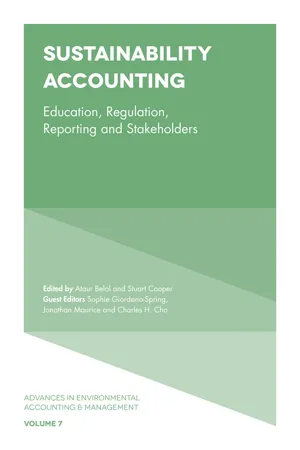
Sustainability Accounting
Education, Regulation, Reporting and Stakeholders
- 176 pages
- English
- ePUB (mobile friendly)
- Available on iOS & Android
eBook - ePub
Sustainability Accounting
Education, Regulation, Reporting and Stakeholders
About this book
Advances in Environmental Accounting & Management aims to advance knowledge of the governance and management of corporate environmental impacts and the accounting for these, including issues related to measurement, valuation, and disclosure. It also aims to increase the awareness of management, accounting practitioners, investors and other stakeholders of the financial and social consequences of corporate environmental impacts, encouraging greater environmental accountability and responsibility.
Information
GUEST EDITORS’ INTRODUCTION TO THE SPECIAL SECTION
This Special Section emanates from the 3rd French Conference on Social and Environmental Accounting Research (3rd CSEAR France Conference) that took place in June 2015 at ESSEC Business School. Many researchers from various nationalities attended the conference and presented stimulating papers in various fields of social and environmental accounting (SEA) research using different methodologies. With the objective to encourage papers on general but recent issues in SEA, we had purposefully left the Call for Papers open to a broad range of topics but with a focus on corporate social responsibility (CSR) practices and/or CSR regulations. The three key topics that eventually emerged at the end of the review process were (1) sustainability in accounting education, (2) the effectiveness of recent CSR regulation, and (3) CSR reporting in late-capitalist economies. It is worth noting that these contributions shed light to various institutional settings in sustainability accounting (Canada, France, Brazil, and Korea).
The first chapter written by Emilio Boulianne and S. Leanne Keddie addresses a key issue in accounting education by investigating the place of sustainability in Canadian CPA (Chartered Professional Accountants) training programs. While there is a growing need to increase the competencies of accountants in the environmental and social spheres (i.e., following calls from the IAESB, the AAA-IMA, and the Pathways Commission, for example), the authors reveal that references to sustainability is shrinking over time in Canadian CPA programs. The authors investigate this striking situation by examining the development of the Canadian CPA Competency Map through the lens of groupthink and stakeholder theory. An analysis of power games around the definitions of this map also helps the authors interpret the failure of CPA Canada to embrace the issue of sustainability (accounting) in accountants’ education.
In the second chapter of this volume, Juliette Senn analyzes the impact of a new CSR reporting regulation in France on the disclosure of environmental accounting information (EAI). This regulation, named Grenelle 2 Law, was enacted in 2012 and introduced the “comply or explain” principle in a code law country. In comparison to the period preceding the enactment of the law, she finds that there is no increase in the number of companies that disclose EAI in their annual reports after 2012. However, a growing number of non-disclosing firms provide justification – hence, companies prefer to explain than to comply. At the same time, the number of non-disclosing companies without any justification significantly dropped after the enforcement of the law. Finally, yet importantly, results indicate a decrease in the quality of EAI by disclosing companies after the Grenelle 2 Law enactment. These results are analyzed within the legitimacy framework and lead to question the concept of normativity.
The last contribution in this volume by Hyemi Shin and Adrián Zicari provides a comparative analysis of the adaptation and evolution of CSR reporting practices in two late-capitalist countries – Brazil and South Korea. They show how global converging pressures (such as the Global Reporting Initiative (GRI) or the UN Global Compact) and local diverging pressures (from the national economic environments) play a role in this adaptation. Particularly, their analysis of CSR reports of four companies from the telecommunications industry suggests that the “surface” (the forms and formats) of these reports tends to be very similar in both countries. In contrast, the authors document various national differences in the content and the way companies address CSR issues. They conclude that CSR reporting practices are influenced simultaneously by two opposite pressures – a global one driving the homogenization in framework of CSR reports, and a national one influencing the way companies consider and “talk” to each stakeholder in their reports.
Overall, the three chapters provide fruitful insights on what can impair the development of SEA in practice. Training accountants in sustainability issues appear to be still far from being sufficient in Canada despite recent calls from many organizations in accounting education. New regulations on CSR reporting in France seem to need time to be fully embraced by companies in their reporting practices, while CSR reporting in late-capitalist economies evolves by fulfilling the growing needs to present CSR information in a worldwide understandable format on one hand, but keeping the national-specific context adapted to the content of this information on the other.
Sophie Giordano-Spring
Jonathan Maurice
Charles H. Cho
Guest Editors
WHERE IS SUSTAINABILITY WITHIN THE CANADIAN CPA EDUCATION PROGRAM?
ABSTRACT
Purpose – This study explores how Canadian CPAs (Chartered Professional Accountants) are trained in sustainability. The main research questions are: What place should sustainability take in the accounting program? What place does sustainability occupy in the CPA accounting program? And, over time, has sustainability gained or lost ground within the Canadian professional accounting education program?
Methodology/approach – Content analysis and interviews.
Findings – We find that sustainability is not a key component of the CPA education program since its sustainability content has shrunk over the years. We believe that the groupthink phenomenon may have influenced the selection of CPA Competency Map participants (whose backgrounds reveal a lack of sustainability expertise) as well as the participants’ discussions. Additionally, a lack of consideration for society as a key stakeholder may have also influenced the shortage of sustainability content. Finally, power dynamics might have contributed to the financial accounting and reporting competencies dominating the new map.
Research limitations – We did not have access to the live meetings when the Map was created, although we conducted interviews with representatives involved in the process. This research is bound by a confidentiality agreement that limits us from providing sensitive details. However, we do not consider that these limitations undermine our contribution or reduce the relevance of our research.
Originality/value – Our research contributes to the under-researched domain of sustainability education and to understanding how groupthink, stakeholder theory and power dynamics may have contributed to the dearth of sustainability coverage in the new Canadian CPA program.
Keywords: Accounting curriculum; sustainability accounting; CPA Competency Map; professional accountants; accounting education
INTRODUCTION
Professional accounting associations, business schools, and accounting professors are faced with an important, and recurring, question: Which competencies should be developed within the education program to ensure adequate training of accountable professional accountants? And, more specifically in today’s context, what level of sustainability education should be included in accounting curricula? To answer these questions, various working groups and committees have been formed around the topic, leading to the publication of a number of reports and frameworks. Of the many reports that have been published by key actors, all stress the importance of providing accountants, particularly future accountants, with an advanced-level education in sustainability to help them make sound decisions, benefitting both businesses and society (Botes, Low, & Chapman, 2014). Accountants are important players in the management team, so their exposure to and knowledge of sustainability is crucial. For instance, the Pathways Commission (2012) and the New Zealand Institute of Chartered Accountants (Chartered Accountants of Australia and New Zealand, 2015) called for the integration of sustainability courses into the curricula to improve professional accountants’ accountability.
However, despite a consensus of key actors, integrating more sustainability content into accounting curricula poses challenges in terms of course development, teaching, updating content, and testing. The development of relevant sustainability courses and hands-on materials is demanding on resources and educators. Developing practical exercises in sustainability consumes academic staff time without certainty of payoff; it may have limited reusability due to the ever-changing nature of sustainability, and may require specific resources in terms of support that are not readily available. An additional significant difficulty in implementing sustainability curricular changes is the lack of recognition of, and incentives for, work related to curriculum development and learning-resource creation. The current strong focus on research as the main or primary criterion in the recruitment, tenure, and advancement of professors may discourage initiatives in the development of sustainability courses and related materials. Although some professors may merely lack the knowledge to invest in sustainability-related courses, those that do have the knowledge are not given incentives to devote their time to this task. This may be related to the strong focus on publications in top research journals (Merchant, 2010). Non-financial accounting courses, such as those on sustainability, may be simply omitted or ignored in accounting programs. This poses challenges for the development of sustainability education in the accounting program.
Our study focuses on the Canadian context. Canada has a strong international reputation in professional accounting training, punching above its weight considering its size in the global market (Villmann, 2014). Canadian professional accountants are highly valued and involved in numerous international education committees, and the Chartered Professional Accountants of Canada (CPA Canada) are committed to the highest international educational standards, reflecting Canada’s status as a leader (CPA Canada, 2013a). The high-quality training standard of Canadian CPAs acquired through rigorous educational requirements, training, exams, and work experience has been recognized by many developed countries through mutual recognition agreements, including the Institute of Chartered Accountants in England and Wales and the American Institute of Certified Public Accountants (AICPA). The Canadian CPA program follows and contributes to the International Education Standards (IES) set by the International Federation of Accountants (IFAC), ensuring that the Canadian standards meet or exceed the international standards (CPA Canada, 2016a). The Canadian CPA also nominates members to serve on the International Accounting Education Standards Board (IAESB) (CPA Canada, 2013a). Following the merger, CPA Canada is now one of the five largest accounting bodies in the world, which should significantly enhance its ability to influence accounting standards (CPA Canada, 2016a).
In 2012, the Canadian Institute of Chartered Accountants (CICA), the Society of Management Accountants of Canada (CMA Canada), and the Certified General Accountants of Canada (CGA-Canada) published a unifying framework. The three national organizations had determined that this unification of the Canadian accounting profession would enhance their ability to meet the changing needs of Canadian accountants and the national and international business communities. The unifying framework included the creation of a new designation, the Chartered Professional Accountant (CPA), and the development of a new competency map and education program. By October 2014, the unification process was finalized for all Canadian provinces and territories.
This study aims to explore how Canadian CPAs are trained in sustainability. Research questions are: What place should sustainability take in the accounting program? What place does sustainability occupy in the CPA program? Over the years, has sustainability gained or lost ground within the Canadian professional accounting education program, namely pre- vs. post-unification? How do the sustainability requirements by CPA Canada compare with international standards and other training organizations? Related questions are: Have the challenges to develop courses and materials to ...
Table of contents
- Cover
- Title Page
- Editors’ Introduction
- Stakeholders’ Perceptions of Social Audit in Bangladesh
- Corporate Water Accounting, Where Do We Stand? The International Water Accounting Field and French Organizations
- Special Section: Csear France 2015
- Index
Trusted by 375,005 students
Access to over 1.5 million titles for a fair monthly price.
Study more efficiently using our study tools.
Frequently asked questions
Yes, you can cancel anytime from the Subscription tab in your account settings on the Perlego website. Your subscription will stay active until the end of your current billing period. Learn how to cancel your subscription
No, books cannot be downloaded as external files, such as PDFs, for use outside of Perlego. However, you can download books within the Perlego app for offline reading on mobile or tablet. Learn how to download books offline
Perlego offers two plans: Essential and Complete
- Essential is ideal for learners and professionals who enjoy exploring a wide range of subjects. Access the Essential Library with 800,000+ trusted titles and best-sellers across business, personal growth, and the humanities. Includes unlimited reading time and Standard Read Aloud voice.
- Complete: Perfect for advanced learners and researchers needing full, unrestricted access. Unlock 1.5M+ books across hundreds of subjects, including academic and specialized titles. The Complete Plan also includes advanced features like Premium Read Aloud and Research Assistant.
We are an online textbook subscription service, where you can get access to an entire online library for less than the price of a single book per month. With over 1.5 million books across 990+ topics, we’ve got you covered! Learn about our mission
Look out for the read-aloud symbol on your next book to see if you can listen to it. The read-aloud tool reads text aloud for you, highlighting the text as it is being read. You can pause it, speed it up and slow it down. Learn more about Read Aloud
Yes! You can use the Perlego app on both iOS and Android devices to read anytime, anywhere — even offline. Perfect for commutes or when you’re on the go.
Please note we cannot support devices running on iOS 13 and Android 7 or earlier. Learn more about using the app
Please note we cannot support devices running on iOS 13 and Android 7 or earlier. Learn more about using the app
Yes, you can access Sustainability Accounting by Ataur Belal, Stuart Cooper, Ataur Belal,Stuart Cooper in PDF and/or ePUB format, as well as other popular books in Business & Accounting. We have over 1.5 million books available in our catalogue for you to explore.