Chapters explore how fathers from different social and economic backgrounds fullfil their roles both within the family and in the workplace, and what support they rely on in combining these roles. Further, the collection explores an area of research that has been little investigated: the role played by organizational cultures and experts (such as obstetricians, gynaecologists, paediatricians and psychologists) in shaping notions of 'good' fatherhood and fathering, to which individuals are required to confirm, and to which they, variously, comply or resist.
eBook - ePub
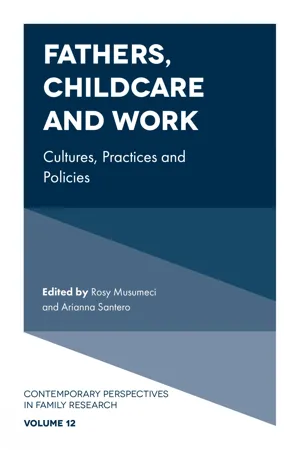
Fathers, Childcare and Work
Cultures, Practices and Policies
- 270 pages
- English
- ePUB (mobile friendly)
- Available on iOS & Android
eBook - ePub
Fathers, Childcare and Work
Cultures, Practices and Policies
About this book
The work-life balance of fathers has increasingly come under scrutiny in political and academic debates. This collection brings together qualitative and quantitative empirical analyses to explore fathers' approaches to reconciling paid work and care responsibilities. Taking a global perspective, contributors explore how fathers realize and represent their gendered work-care balance and how enterprises and experts, in country specific institutional context, provide formal and informal resources, constrains, expectations and social norms that shape their practices.
Information
PART I
FATHERS’ EXPERIENCES, ATTITUDES AND BELIEFS
CHAPTER 1
ANTICIPATING AND PRACTICING FATHERHOOD IN SPAIN
ABSTRACT
Using data from a qualitative longitudinal sample of 31 non-traditional fathers-to-be interviewed in 2011 and then again in 2013, when the child was about 18 months old, we examine the relationship between prenatal anticipation and the development of ‘positive paternal involvement’ (i.e. an engaged, accessible and responsible type of fatherhood). We expect differences with regard to the antenatal development of a non-normative father identity to explain variations in subsequent paternal involvement. While there might be – and there often is – a discrepancy between fathers’ prenatal intentions and actual practices after childbirth, anticipating concrete needs and actively foreseeing particular paid work adaptations favour the development of a positive paternal involvement. Our analysis reveals the importance of anticipation during pregnancy – that is, the development of an identity as a father and of explicit plans for employment adaptations – in facilitating men’s greater implication in care. The empirical findings also show that non-traditional gender attitudes and favourable working conditions facilitate fathers’ involvement, yet are not enough in themselves to guarantee the development of a positive type of fatherhood covering the three noted dimensions of care. Achieving the latter in Spain will likely require the encouragement of shared parenting responsibilities through normative changes in workplaces, the revision of parental leave policies and the integration of fathers-to-be in prenatal education classes. Our research contributes to shedding new light on the elements that favour a positive paternal involvement, which has the potential to enhance both children’s well-being and gender equality.
Keywords: Fatherhood; parental involvement; prenatal intentions; gender attitudes; qualitative longitudinal analysis; Spain
INTRODUCTION
The aim of this chapter is to analyse the construction of fatherhood among first-time Spanish fathers, and, more specifically, the role of prenatal anticipation as a mechanism that encourages the development of a ‘positive paternal involvement’ as originally conceptualized by Lamb, Pleck, Charnow, and Levine (1987). These authors theorize three main components of a positive fatherhood – engagement, accessibility and responsibility – that allow us to explore the ways in which Spanish men are transforming their identities and practices as fathers.1 We want to understand whether the early development of a non-traditional father identity and the elaboration of realistic plans to adapt their working time to care needs – both basic ingredients of prenatal anticipation – are crucial for the adoption of post-birth fatherhood practices that cover the three noted dimensions. In addition, we pay attention to the role of the institutional context – especially in terms of working conditions – in facilitating or hindering the development of positive fatherhood practices. Understanding what promotes the latter is particularly relevant because the empirical evidence has shown that this type of paternal involvement is beneficial for both gender equality and children’s socio-emotional and cognitive abilities (Deutsch, Servis, & Payne, 2001; McMunn, Martin, Kelly, & Sacker, 2017; Pleck, 2010; Waldfogel, 2006).
Our study draws on a longitudinal qualitative analysis of 31 men who were interviewed – along with their partners – on two separate occasions: when they were expecting their first child in 2011 and when the child was approximately 18 months old in 2013. We selected these fathers from a broader sample of men in dual-earner couples on account of their maintaining a non-traditional gender division of labour during pregnancy. We specifically expect them to be more prone to developing a ‘positive father involvement’ than men in more traditional couple configurations. In couples with a traditional gendered division of unpaid work, women tend to be the main carer provider, whereas the transition to the first child produces a ‘traditionalization’ effect even among couples with an egalitarian division of labour (Domínguez-Folgueras, 2015; Grunow, Schulz, & Blossfeld, 2012). It is therefore more appropriate to focus on non-traditional couples and analyse how they evolved over time. We are not interested in fathers who engage in childcare out of necessity, but in fathers who originally have all of the conditions to be fully involved but end up playing a secondary role. This study contributes to current literature by explaining the possibility of discrepancies between intentions and practices in caring among these non-traditional couples.
1. EARLIER RESEARCH AND THEORETICAL FRAMEWORK
Paternal involvement in childcare can be measured in multiple ways, depending on whether quantitative time-use surveys or qualitative data are used. The latter have also given rise to diverse and complex classifications of fathers’ engagement in care activities (see Habib, 2012; Hofferth, 2003). Among the most enduring ones to date is the approach that was developed by Lamb et al. (1987); see also Pleck (2010). These authors originally identified three components or dimensions of what has been labelled as ‘positive paternal involvement’: (i) engagement, which entails direct interaction with the child in the form of caregiving, play or leisure; (ii) accessibility, which entails time availability to be with the child and to respond to her or his needs and (iii) responsibility, which is defined as ensuring that the child is well taken care of and actively arranging for the necessary resources to do so (e.g. making medical appointments, determining when the child needs new clothes, arranging for non-parental care, etc.). This latter ability to take initiative and monitor what is needed has also been referred to as ‘process responsibility’ (Coltrane, 1996) or ‘parental consciousness’ (Walzer, 1996). It is particularly distinctive of non-traditional fatherhood, as fathers have proven to be generally less attentive than mothers to what needs to be done and more prone to waiting for instructions and explicit directions to perform certain tasks (Craig, 2006).
Interestingly, the recent literature has shown that men’s and women’s parental involvement not only differs in terms of total time investments and the dimensions of care in which they engage but also with regard to the mental and emotional processes that are experienced with respect to the anticipation of parenthood. In a qualitative study of childless young adult couples, Bass (2014) identified related gender gaps even within couples that hold egalitarian gender attitudes. Women proved to be more likely than men to consider parenthood when they were asked to describe their imagined work trajectories. Consequently, women were also more likely to express emotional stress in relation to balancing their career aspirations with the future parenthood. Crucially, the anticipation of work-family conflict came to affect their aspirations and career choices, which resulted in the relinquishment of certain occupational and professional opportunities. Men’s ambitions and employment decisions, in contrast, were significantly less likely to be influenced by similar dilemmas. In summary, the gender differences that involve the anticipation of parenthood and its implications are one of the mechanisms that perpetuate post-birth inequalities in the gender division of labour.
Could it be possible that prenatal anticipation is a key for the development of a positive type of paternal involvement that covers the three dimensions noted above? This seems to be a particularly pertinent issue to explore in the case of Spanish fathers, as the earlier research on the determinants of their care involvement has been largely focussed on situational socioeconomic variables, such as both parents’ employment dedication and educational level. It has been found that highly educated fathers in Spain and those with full-time employed female partners are most likely to adhere to ‘new fatherhood’ practices, engaging in the physical and routine care activities that are usually performed by women (Gracia, 2014). In recent years, some attention has been paid to the subjective processes that lead to the adoption of less traditional paternal models. Nevertheless, the focus has been on the weight of non-normative gender attitudes (Abril, Jurado-Guerrero, & Monferrer, 2015), without enough attention to the specific mechanisms through which such attitudes translate into innovative behaviours. Against this backdrop, it is of interest to examine whether the anticipation of fatherhood-related dilemmas and needs during pregnancy, which give rise to active preparation by fathers, encourage a greater and more comprehensive participation in care once the child is born. In fact, while it has already been acknowledged that paternal involvement may begin prenatally (Fenwick, Bayes, & Johansson, 2012; Marsiglio, 2003), the exact mechanisms through which this happens are not well understood (Cabrera, Fagan, & Farrie, 2008; Eastlick Kushner, Pitre, Williamson, & Breitkreuz, 2014).
The qualitative evidence from the field of social psychology on early parenting experiences reveals that fathers who feel scant support and inclusion during pregnancy often lack confidence in their parenting abilities after childbirth (Kowlessar, Fox, & Wittkowski, 2015). The quantitative studies also find a positive association between fathers’ prenatal involvement and later levels of care engagement (Cabrera et al., 2008, Cook, Jones, Dick, & Singh, 2005; Habib, 2012). Several explanatory factors have been proposed in this respect. It has been suggested that performing tasks in preparation for the baby and directly experiencing the unborn child (e.g. during medical appointments or prenatal classes) helps men to develop a relationship with the child (Cabrera et al., 2008). Some authors have found that fathers’ prenatal expectations with regard to both their instrumental and affective involvement with the child predict post-birth engagement (Cook et al., 2005; Machin, 2015). Others have referred to pregnancy as a time for acquiring a father identity and making decisions about employment and personal behaviour (Cabrera et al., 2008; Roy, 2005). These two latter aspects, which are closely intertwined, might crucially explain differences in paternal involvement across men after transition to parenthood.
According to identity theory, individuals internalize identities that consist of sets of meanings, roles and expectations (e.g. provider, caregiver, etc.) that go together with particular statuses (e.g. being a father). Individual behaviour would, in turn, seek to validate the internalized identities through social interactions (for reviews of this theory, see Cabrera et al., 2008; Henley & Pasley, 2005). Since individuals will simultaneously have different statuses and associated identities, the concept of centrality – which reflects the hierarchical importance that is conferred by an individual to a given identity compared to others (Henley & Pasley, 2005; Rane & McBride, 2000; Stryker & Serpe, 1994)2 – is a key in this theoretical framework. A central identity will be associated with a greater motivation to enact the roles that are connected with it. In the same line, other authors have underscored the importance of commitment to the identity, which translates into decisions to adopt the behaviours and make investments that are associated with it (Fox & Bruce, 2001).
Given the above, we expect that men who have internalized a non-traditional identity as fathers, demonstrate commitment to the latter and...
Table of contents
- Cover
- Title
- Introduction: Caring Fathers in Discouraging Contexts? a Multidimensional Theoretical Framework
- Part I: Fathers’ Experiences, Attitudes and Beliefs
- Part II: Work Organizations and Childcare Experts Cultures
- Part III: Culture, Policies and Practices on Fathers’ Work and Childcare in Japan: A New Departure from Old Persistence?
- Index
Trusted by 375,005 students
Access to over 1.5 million titles for a fair monthly price.
Study more efficiently using our study tools.
Frequently asked questions
Yes, you can cancel anytime from the Subscription tab in your account settings on the Perlego website. Your subscription will stay active until the end of your current billing period. Learn how to cancel your subscription
No, books cannot be downloaded as external files, such as PDFs, for use outside of Perlego. However, you can download books within the Perlego app for offline reading on mobile or tablet. Learn how to download books offline
Perlego offers two plans: Essential and Complete
- Essential is ideal for learners and professionals who enjoy exploring a wide range of subjects. Access the Essential Library with 800,000+ trusted titles and best-sellers across business, personal growth, and the humanities. Includes unlimited reading time and Standard Read Aloud voice.
- Complete: Perfect for advanced learners and researchers needing full, unrestricted access. Unlock 1.5M+ books across hundreds of subjects, including academic and specialized titles. The Complete Plan also includes advanced features like Premium Read Aloud and Research Assistant.
We are an online textbook subscription service, where you can get access to an entire online library for less than the price of a single book per month. With over 1.5 million books across 990+ topics, we’ve got you covered! Learn about our mission
Look out for the read-aloud symbol on your next book to see if you can listen to it. The read-aloud tool reads text aloud for you, highlighting the text as it is being read. You can pause it, speed it up and slow it down. Learn more about Read Aloud
Yes! You can use the Perlego app on both iOS and Android devices to read anytime, anywhere — even offline. Perfect for commutes or when you’re on the go.
Please note we cannot support devices running on iOS 13 and Android 7 or earlier. Learn more about using the app
Please note we cannot support devices running on iOS 13 and Android 7 or earlier. Learn more about using the app
Yes, you can access Fathers, Childcare and Work by Rosy Musumeci, Arianna Santero, Rosy Musumeci,Arianna Santero in PDF and/or ePUB format, as well as other popular books in Social Sciences & Workplace Culture. We have over 1.5 million books available in our catalogue for you to explore.