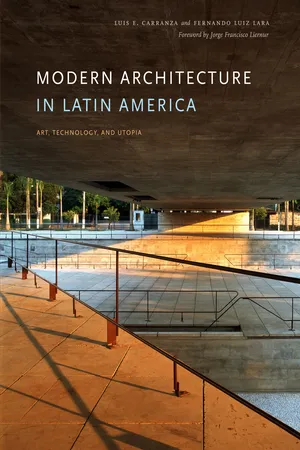
Modern Architecture in Latin America
eBook - ePub

Modern Architecture in Latin America

Art, Technology, and Utopia

  1. 406 pages
  2. English
  3. ePUB (mobile friendly)
  4. Available on iOS & Android
eBook - ePub

Modern Architecture in Latin America

Art, Technology, and Utopia

About this book

Designed as a survey and focused on key examples and movements arranged chronologically from 1903 to 2003, this is the first comprehensive history of modern architecture in Latin America in any language.

Runner-up, University Co-op Robert W. Hamilton Book Award, 2015

Modern Architecture in Latin America: Art, Technology, and Utopia is an introductory text on the issues, polemics, and works that represent the complex processes of political, economic, and cultural modernization in the twentieth century. The number and types of projects varied greatly from country to country, but, as a whole, the region produced a significant body of architecture that has never before been presented in a single volume in any language. Modern Architecture in Latin America is the first comprehensive history of this important production.

Designed as a survey and focused on key examples/paradigms arranged chronologically from 1903 to 2003, this volume covers a myriad of countries; historical, social, and political conditions; and projects/developments that range from small houses to urban plans to architectural movements. The book is structured so that it can be read in a variety of ways—as a historically developed narrative of modern architecture in Latin America, as a country-specific chronology, or as a treatment of traditions centered on issues of art, technology, or utopia. This structure allows readers to see the development of multiple and parallel branches/historical strands of architecture and, at times, their interconnections across countries. The authors provide a critical evaluation of the movements presented in relationship to their overall goals and architectural transformations.

Trusted by 375,005 students

Access to over 1.5 million titles for a fair monthly price.

Study more efficiently using our study tools.

Information

Year
2015
Print ISBN
9780292762978
9780292758650
eBook ISBN
9780292768185

Table of contents

  1. Cover
  2. Frontispiece
  3. Series Page
  4. Title Page
  5. Copyright
  6. Dedication
  7. Contents
  8. Foreword
  9. Acknowledgments
  10. (Notes Toward An) Introduction
  11. 1903 Francisco Pereira Passos begins a project to “civilize” Rio de Janeiro by applying Baron Haussmann’s ideas as an answer to the tropical (lack of) urbanism.
  12. 1904 Víctor Meano, Francisco de Oliveira Passos, and Emile Jéquier build a Latin American character with a classical vocabulary.
  13. 1906 JuliĂĄn GarcĂ­a NĂșñez’s Hospital Español defines a characteristic search for a new language: Secession/Art Nouveau.
  14. 1914 JesĂșs T. Acevedo and Federico Mariscal lecture in Mexico on the character, importance, and role of the Spanish colonial legacy.
  15. 1915 Antonin Nechodoma introduces the Prairie style to Puerto Rico.
  16. 1922 In an attempt to create a building expressive of the “cosmic race,” JosĂ© Vasconcelos inaugurates in Mexico City the headquarters of the SecretarĂ­a de EducaciĂłn PĂșblica and formalizes the muralist project.
  17. 1923 Mario Palanti: Palacio Barolo and Palacio Salvo
  18. 1924 Martín Fierro presents Alberto Prebisch and Ernesto Vautier’s Ciudad Azucarera en Tucumán and formalizes the connections and interests in architecture among the literary and artistic avant-gardes.
  19. 1925 Modern architecture begins with Gregori Warchavchik and Rino Levi publishing manifestos on the new architecture; catching up to the 1922 Semana de Arte Moderna.
  20. 1925-A EstridentĂłpolis en 1975: Literary Architecture and the Avant-Garde
  21. 1925-B José Villagrån García, Instituto de Higiene y Granja Sanitaria
  22. 1928 The Columbus Memorial Lighthouse Competition sparks an investigation into what architecture for Latin America should be like.
  23. 1929-A The Ibero-American Exhibition opens in Seville, revealing the complex and contradictory relations between Spain and its former American colonies.
  24. 1929-B Le Corbusier’s first encounters with South America: lectures and early projects for Argentina, Brazil, and Uruguay
  25. 1929-C With the History of the Skyscraper, Francisco Mujica articulates the skyscraper’s Latin American dimension.
  26. 1929 Sergio Larraín and Jorge Arteaga’s Oberpauer Building initiates a new direction in Chilean architecture.
  27. 1930-A GetĂșlio Vargas takes power in Brazil and appoints twenty-eight-year-old LĂșcio Costa as director of the Escola Nacional de Belas Artes (ENBA).
  28. 1930-B Commemorating the centenary of its independence, Uruguay takes the first Soccer World Cup at home, and Montevideo is at the center of its modern ambitions.
  29. 1930 Flávio de Carvalho, “City of the Naked Man”
  30. 1931 Juan O’Gorman, Diego Rivera and Frida Kahlo Houses and Studios
  31. 1933 In his Pláticas sobre arquitectura lecture, Juan O’Gorman highlights the existing polemics between functionalism and academic architecture.
  32. 1936 Le Corbusier is back in Rio de Janeiro.
  33. 1936-A The Kavanagh Building is finished, becoming the tallest skyscraper in Latin America.
  34. 1936-B Francisco Salamone: Fascism and Monumental Architecture in the Pampa
  35. 1936-C Julio VilamajĂł, School of Engineering
  36. 1937 Wladimiro Acosta’s Vivienda y ciudad highlights the relationship between ecology, new forms of leisure, the house, and the city. 88
  37. 1937 Cine Gran Rex and Argentine Classicist Modernism
  38. 1938 Characteristic of the growing reach of surrealism into architecture and Latin America, the Chilean architect-trained artist Matta publishes “Sensitive Mathematics—Architecture of Time” in Minotaure.
  39. 1938 JoaquĂ­n Torres-GarcĂ­a, Monumento cĂłsmico, Montevideo, Uruguay
  40. 1939 The European diaspora brings architectural talents to Latin America on an unprecedented scale.
  41. 1939 The Brazilian pavilion at New York World’s Fair
  42. 1941 Pampulha represents an encounter that would change the future of Brazil.
  43. 1942 Amancio Williams, Casa sobre el Arroyo
  44. 1943-A The Brazil Builds exhibition at the Museum of Modern Art in New York highlights the architectural and political interests of U.S. relations with Brazil.
  45. 1943-B Town Planning Associates (TPA) is commissioned to design a new Brazilian town around an airplane factory, Cidade dos Motores. This will be the beginning of TPA’s involvement with Latin America that will include not only plans for Chimbote, Peru, but also master plans for Medellín and Bogotá, Colombia, and Havana, Cuba.
  46. 1944 Henry Klumb moves to Puerto Rico and formalizes investigations of modern architecture in the tropics.
  47. 1945 Antoni Bonet, Punta Ballena, Uruguay
  48. 1946 Affonso Reidy’s Popular Housing Blocks
  49. 1947-A Luis BarragĂĄn and Max Cetto, the Ă©migrĂ© German architect, begin working on the design of the first houses in Mexico City’s Jardines del Pedregal subdivision.
  50. 1947-B Seeking to symbolize postwar efficiency and organization, Latin American cities embrace the North American “architecture of bureaucracy.”
  51. 1947-A Oscar Niemeyer sketches the UN building in New York but takes no credit.
  52. 1947-B Mario Pani—Multifamiliares
  53. 1947-C AgrupaciĂłn Espacio
  54. 1949 La ciudad frente al río is released, showing the transformations of Le Corbusier’s plan for Buenos Aires.
  55. 1950 Public housing reaches a monumental scale: Mario Pani, Carlos RaĂșl Villanueva, Affonso Reidy, Oscar Niemeyer.
  56. 1951-A Carlos RaĂșl Villanueva, Villanueva Residence
  57. 1951-B PROA magazine publishes Arquitectura en Colombia, articulating an identity that survived the second half of the century.
  58. 1951-C Lina Bo Bardi inaugurates her Casa de Vidro.
  59. 1952 The debates of plastic integration, modern architecture, and the development of new city forms come to the forefront in two major universities: the UNAM in Mexico City and the Universidad Central in Caracas, Venezuela. The first exemplifies figurative, legible, and socially conscious art; the second, abstraction.
  60. 1952 Eladio Dieste, Iglesia de Cristo Obrero, AtlĂĄntida, Uruguay
  61. 1953-A Affonso Reidy: halfway between the Carioca school and the Paulista school
  62. 1953-B El Eco Experimental Museum in Mexico City opens its doors, advocating for an “emotional architecture.”
  63. 1953-C Max Bill’s critique of the SĂŁo Paulo Biennial has a significant impact in Brazil: Oscar Niemeyer writes a “mea culpa,” SĂ©rgio Bernardes invests in designing a technological utopia, and JoĂŁo Filgueiras Lima devotes his life to prefabrication.
  64. 1953-A Félix Candela, Church of Our Lady of the Miraculous Medal, Mexico City
  65. 1953-B Mario Roberto Álvarez, Teatro General San Martín, Buenos Aires
  66. 1954 Le Corbusier, Curutchet House, La Plata, Argentina
  67. 1955 Eladio Dieste—Tectonics driving the accidental architect
  68. 1955-A Fruto Vivas, Club TĂĄchira
  69. 1955-B The Helicoide in Caracas: The Ultimate Parking and Shopping Center
  70. 1955-C Gio Ponti, Villa Planchart
  71. 1956 BrasĂ­lia: A modernist utopia?
  72. 1957-A Mies van der Rohe, BacardĂ­ Buildings for Havana, Cuba, and Mexico City
  73. 1957-B Lina Bo Bardi, SĂŁo Paulo Museum of Art
  74. 1959 The appeal of Corbusian monumentality and bĂ©ton brut: Clorindo Testa’s Government Building in La Pampa and, with SEPRA, the Bank of London and South America in Buenos Aires
  75. 1961-A Fidel Castro, in conversation with Ernesto “Che” Guevara, decides to convert a golf course into art schools in Cuba.
  76. 1961-B JoĂŁo Batista Vilanova Artigas and Paulo Mendes da Rocha articulate the Paulista school: free ground plan, generous social spaces, and opaque envelopes.
  77. 1961 JoĂŁo Batista Vilanova Artigas, School of Architecture and Planning, University of SĂŁo Paulo
  78. 1962 Nelson Bayardo, Columbarium, Montevideo
  79. 1963 In BogotĂĄ, Rogelio Salmona takes old bricks to a new dimension in Torres del Parque.
  80. 1964-A The military dictatorship ends Delfim Amorim and Acácio Gil Borsoi’s investigations into an architecture for the Brazilian northeast.
  81. 1964-B Pedro RamĂ­rez VĂĄzquez, Museo Nacional de AntropologĂ­a, Mexico City
  82. 1964-C MartĂ­n Correa and Gabriel Guarda, Las Condes Benedictine Monastery Chapel
  83. 1965-A Parque do Flamengo: Roberto Burle Marx redefines the Brazilian landscape by rediscovering the country’s own local species.
  84. 1965-B The (re)invention of Curitiba: from the plan of Jorge Wilheim to the implementation by Jaime Lerner
  85. 1965 Juan Borchers, Cooperativa Eléctrica de Chillån, Chile
  86. 1966 United Nations as client and advocate: Emilio Duhart’s CEPAL Building in Santiago
  87. 1967 Hélio Oiticica builds Tropicålia, challenging the traditional boundaries between art, popular culture, construction, and architecture.
  88. 1967 JesĂșs Tenreiro-Degwitz—Venezuelan Postmodernism
  89. 1968 The Olympic Games provide Mexico City with opportunities for new forms of national representation through architecture; deadly student protests highlight the contested use of public space.
  90. 1969-A Inventing new educational paradigms, Alberto Cruz Covarrubias and Godofredo Iommi (poetically) found the Ciudad Abierta in Chile.
  91. 1969-B PREVI: Two opposing governments in Peru bring in the best architects in the world to address squatter settlements.
  92. 1969 Francisco Bullrich publishes on Latin American architecture.
  93. 1971 Formalizing the legacy of the MadĂ­ (Movimiento de Arte de InvenciĂłn) and utopian urban projects, Gyula Kosice proposes a hydrospatial city.
  94. 1971 National Theater, Guatemala
  95. 1974 Teaching under duress: La Escuelita, dictatorship, and postmodernism in Argentina
  96. 1975 Filgueiras Lima, Capela do Centro Administrativo da Bahia
  97. 1976 Mexican postmodernism: Teodoro GonzĂĄlez de LeĂłn’s Colegio de MĂ©xico expresses modern architecture’s new historicizing sensibilities.
  98. 1977-A Éolo Maia, Capela de Santana ao PĂ© do Morro
  99. 1977-B Bruno Stagno House, Costa Rica
  100. 1979 Pampulha magazine is launched in Minas Gerais, marking the beginning of Brazilian postmodernism.
  101. 1980 The Pritzker Architecture Prize is awarded to Luis BarragĂĄn, and photography is at the center of the myth.
  102. 1983 Niemeyer returns to Rio de Janeiro to design the SambĂłdromo and the CIEPs: architecture gets closer to popular needs.
  103. 1983-A Ramón Gutiérrez publishes Arquitectura y urbanismo en Iberoamérica.
  104. 1983-B Severiano Porto, Balbina Environmental Protection Center, Brazil
  105. 1985-A In the midst of a “not-so-lost” decade . . .
  106. 1985-B Lina Bo Bardi and the SESC Pompéia inaugurate an interest in adapting existing structures.
  107. 1988 Brazilian Museum of Sculpture
  108. 1990 Chilean postmodernism is challenged by José Cruz and Germån del Sol.
  109. 1991 Angelo Bucci and Alvaro Puntoni win the competition for the Brazilian pavilion at Seville Expo 1992, marking the end of the postmodern reign and the beginning of neomodernism.
  110. 1993 Pablo Beitia, Xul Solar Museum (Pan Klub Foundation) 326
  111. 1994-A Quae sera tamen: Architecture for the Favelas
  112. 1994-B As a model for internationalization, NAFTA becomes emblematic of the new character of late-twentieth-century Mexican architecture.
  113. 1997 Smiljan Radic, Charcoal Burner’s Hut
  114. 2000 Colombian Renaissance: In BogotĂĄ and MedellĂ­n, mayors and architects work together to create better cities.
  115. 2000 Alberto Kalach, GGG House, Mexico City
  116. 2001 Solano Benítez’s Tomb for His Father, Paraguay
  117. 2002 Rafael Iglesia, Pavilions at Parque Independencia
  118. Provocations For a Conclusion: Islands No More
  119. Notes
  120. Bibliography
  121. Illustration Credits
  122. Index

Frequently asked questions

Yes, you can cancel anytime from the Subscription tab in your account settings on the Perlego website. Your subscription will stay active until the end of your current billing period. Learn how to cancel your subscription
No, books cannot be downloaded as external files, such as PDFs, for use outside of Perlego. However, you can download books within the Perlego app for offline reading on mobile or tablet. Learn how to download books offline
We are an online textbook subscription service, where you can get access to an entire online library for less than the price of a single book per month. With over 1.5 million books across 990+ topics, we’ve got you covered! Learn about our mission
Look out for the read-aloud symbol on your next book to see if you can listen to it. The read-aloud tool reads text aloud for you, highlighting the text as it is being read. You can pause it, speed it up and slow it down. Learn more about Read Aloud
Yes! You can use the Perlego app on both iOS and Android devices to read anytime, anywhere — even offline. Perfect for commutes or when you’re on the go.
Please note we cannot support devices running on iOS 13 and Android 7 or earlier. Learn more about using the app
Yes, you can access Modern Architecture in Latin America by Luis E. Carranza,Fernando Luiz Lara in PDF and/or ePUB format, as well as other popular books in Architecture & Architecture General. We have over 1.5 million books available in our catalogue for you to explore.