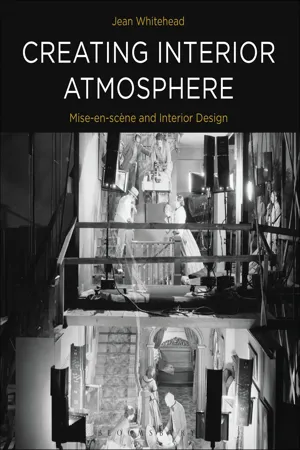
This book sets out to explore the creation of interior atmosphere as seen through the lens of mise-en-scène. You will learn how this film theory informs the concept of 'staged space' translated through the narrative and expressive qualities of a particular scene.
Jean Whitehead quickly takes this concept beyond the screen and considers its application to the interior 'setting'. By learning to use the ingredients that inform an 'interior' mise-en-scène such as its backdrop, choice of props, use of special effects alongside the application of colour, pattern, graphics, light and shadow, an immersive atmospheric experience can be created. Packed with inspiring examples and case studies, ranging from cinematic interiors and art installations, to the work of notable interior designers, stylists and architects with an interior interest, this book broadens current thinking around the design of the decorated interior. It will help you to embrace the concepts that underpin an interior mise-en- scène through the use of softer decorative techniques and concerns.
- 176 pages
- English
- ePUB (mobile friendly)
- Available on iOS & Android
eBook - ePub
About this book
Information
1
Creating interior atmosphere
An introduction
We perceive atmosphere through our emotional sensibility – a form of perception that works incredibly quickly, and which we humans evidently need to help us survive … We are capable of immediate appreciation, of a spontaneous emotional response, of rejecting things in a flash.1
(Zumthor, [2006] 2015: 13)

Figure 1.1
Burke and Gable – Clark Gable and Billie Burke act out a scene in the back seat of a limousine for the romantic comedy Forsaking All Others, directed by W. S. Van Dyke.
By considering the theatrical origins and cinematic context of mise-en-scène the notion of ‘staged space’ can theoretically be applied to the consideration and design of interior atmosphere.
Introduction
What is this book about? In essence, this book aims to revisit interior decoration, an often marginalized aspect of interior design, by exploring the notion of the decorated interior as one of staged space. In fact, it would be even more accurate to say that this book examines and is naturally drawn to theatrical examples of staging within a cinematic context, largely because of the affinity of the stage set and production design with the study of interiors. But this is about more than just the ‘physicality’ of the stage set. By gazing at interior space through the lens of ‘mise-en-scène’ (pronounced meez-ahn-sen), this book aims to show how this can simultaneously increase your understanding of the interior setting, whilst contributing to the creation of an intense interior atmosphere. Workable definitions of mise-en-scène are many and varied, and they will be discussed in more detail in later chapters, but the simplest definition owes much to an audience’s perception of a given scene, so:
mise-en-scène is indeed the art of framing, choreographing and displaying – and an essential part of this, in many films of many different kinds, happens in what is staged (predominantly, actors in an environment) for a camera.2
(Martin, 2014: 15)
This suggests that an interior setting in the cinema is designed to be expressive; you could argue that this has become its second nature. It aims to set the scene, deepening our understanding of the characters, whilst the use of narrative or storytelling forms an integral component of this type of environment. Production designers working alongside directors create illusory filmic settings in which we as the audience can emotionally invest. Carefully constructed man-made sets or adapted locations undoubtedly help to set the tone of a film by spatially reinforcing its narrative or characterization. This approach to the interior could easily be referred to as one of ‘staged space’.
Interiors can also be coaxed to tell a story and this becomes yet another point of reference to mise-en-scène. Narrative is increasingly used by interior designers; within the commercial sector it is harnessed to convey the essence of a brand. Retail ‘brand-scapes’ are deliberately aspirational, often memorable, aiming to communicate the brand ethos through a carefully considered arrangement of graphics, lighting and setting that aims to appeal to the core customer. The work of ‘experience’ designers Bompas and Parr and of exhibition designers Traast + Gruson falls readily into this category.
Interiors also have the power to surprise and delight, welcome, intimidate or even subdue. As designers we can create spaces that are more than the sum of their built parts. We can put together an interior ‘setting’ that aims to evoke a certain feeling or emotion through its harnessing of interior atmosphere. This is just another type of narrative albeit a psychological one, a form of interior storytelling as expressed by a certain ambience or notion of habitation. Maggie’s Cancer Caring Centres in Britain offer support to anyone with, or affected by, cancer. They have successfully assimilated the archetypal qualities of the domestic home into the design of their interiors, in the creation of a psychologically familiar and inviting space. The work of the architect Daniel Libeskind, especially the interiors of his Jewish Museum in Berlin, or his evocative reworking of the heart of Ground Zero in New York, resonates with this approach.
So, is it all questions of semantics – does space communicate? It certainly does not speak in the literal sense, but it can murmur softly in our ear, whispering suggestions, conjuring a mood, evoking emotions and responses. This book will explore a way of thinking about, analysing, and creating interior space for the interior designer that owes a debt to the world of film. This will begin through an analysis and evaluation of mise-en-scène’s relevance to the interior. It aims to place interior decoration as the lost prodigal son squarely back into any discussion regarding interior design.
What is interior design?
An interior designer is a creative problem solver who can think three-dimensionally and has mastered the atmospheric potential of interior space.
The prevailing focus for this chapter is highlighted next, which will begin through a response to the question ‘what is interior design?’.
Questions often asked by students and other interested parties are ‘what does an interior designer do?’ and ‘what is the scope of their work?’. The answers are surprisingly complex, and rather contentious, as there is a general air of confusion over the terms ‘interior designer’, ‘interior decorator’ and ‘interior architect’. In reality, the difference between these three terms is not finite as it alters in response to the country any designer is operating from. For example, some countries regulate their interior design profession whilst others do not. The British Institute of Interior Design (BIID) recently adopted the International Federation of Interior Architects/Designers (IFI) description in an attempt to define the role of the interior designer. This becomes a useful starting point and their definition is as follows:
Identify, research and creatively solve problems pertaining to the function and quality of the interior environment. Perform services relating to interior spaces including programming, design analysis, space planning, aesthetics and inspection of work on site, using specialized knowledge of interior construction, building systems and components, building regulations, equipment, materials and furnishings. Prepare schematics, drawings and documents relating to the design of interior space, in order to enhance the quality of life and protect the health, safety, welfare and environment of the public.3
(IFI World, n.d.)
CHAPTER FOCUS
•An examination of the specialism of interior design and the role of the interior designer.
•An introduction to the concept of ‘staged space’ within interior design.
•An exploration of the term ‘atmosphere’ within the context and study of interior design.
This description serves as an introduction to the professional world of the interior designer and provides a sharp contrast to the role of the interior decorator as a clear distinction can now be made. Whilst the decorator typically concentrates solely on the look and feel of an interior environment, they are less concerned with developing a cohesive site and user response as this is seen as the preserve of the designer.
Within the profession certain specialisms exist, defined by an interior designer’s personal preferences, or perhaps dictated by the type of work the design consultancy that employs them are known for. The two main sectors remain ‘residential’ (concentrating on all permutations of the domestic sphere) versus ‘commercial’ (typically retail, exhibition design, hospitality and entertainment, healthcare or educational, as well as workplace design). In the quest to create useful working definitions that relate to the interior decorator, the interior architect and the interior designer, it will be relevant to explain each title or role separately. Because of the protected status relating to the title of ‘architect’, the term interior architect does not exist professionally within Britain (although once again this varies depending upon where you are geographically). The three suggested categories are deliberately broad in their definition and are written with the proviso that there are always exceptions to any given rule; they simply offer a differing career specialism for any budding interior designer.
Interior decoration and the interior decorator
Like it or loathe it, this is most people’s first impression of interior design because it dominates the television schedules and glossy, coffee-table magazines. Almost everyone has a home they enjoy tinkering with and updating in line with current trends, so does that make everyone an interior decorator? Interior decoration has certainly become synonymous with the home through the refurbishment of residential design schemes. It can, however, easily spill over into other design sectors, especially if the budget is limited and only a purely decorative approach can be undertaken or is required to refresh the space. It concentrates on the application of surface finish and colour, the acquisition of furniture, lighting and accessories to create a specific look. The chosen decoration can be closely aligned with the personal style of a specific designer or the prevailing taste of a client, whilst it is not uncommon for a realized scheme to closely follow particular fads or fashions. There is also a strong link to home-styling shops with the interior decorator often operating from a base that is part design studio, part office and part retail environment.
Decorators tend to work closely with their clients, taking a brief and developing mood boards and drawings to communicate their ideas; they are adept ‘shoppers’, understanding how to ‘assemble’ an interior through carefully selected props and accessories. The refitting of a kitchen, bathroom or other built-in fixtures (often bespoke), whilst working alongside a builder, is not uncommon in this sector. The predominance of ‘softer’ materials such as textiles, the use of paint and wall coverings, through to the selection of furniture and lighting are all central to this approach. Interior decoration has a strong association with the theatrical ‘staging’ of space in the creation of interior atmospheres through memorable ‘scenes’ or rooms.
Interior architecture and the interior architect
Interior architecture, in contrast, approaches the design of the interior through its relationship to, and interdependence with, architecture. It aims to promote a holistic design solution that is embedded in its understanding of a specific site (or building). Interior architecture sought to differentiate itself from the role of the decorator at a time when interior decoration and interior design had become increasingly confused professionally. By carefully considering the original building, interior architecture aims to develop an appropriate architectural response rather than one of ‘superficial’ applied ornamentation – an accusation often levelled at the interior decorator. Clearly, this approach has a close association with certain architectural theories, principles and tactics, and this knowledge typically informs how interior space is discussed, analysed and conceived. This is often reflected in the scope and ambition of the project. The resultant design proposal often seeks to form a ‘symbiotic’ or harmonious relationship whereby a careful contextual ‘reading’ of the site (through a site analysis) will suggest a way forward.
This initial architectural response develops through complex planning that considers the adaption of the existing (or new) space through the placement of newly created partitions, openings or voids as well as any bespoke interior fixtures. The scheme is developed to be sympathetic to the user and its new function. Detailed decisions regarding materials, furniture, lighting and graphics, especially how they will be ‘read’ against the shell of the building, still need to be made. Architecturally ‘hard’ materials such as ...
Table of contents
- Cover
- Title Page
- Dedication
- Contents
- Chapter One Creating interior atmosphere
- Chapter Two What’s in a room?
- Chapter Three The interior setting
- Chapter Four What is an interior ‘prop’?
- Chapter Five Special effects
- Chapter Six Light and shadow
- Chapter Seven Colour
- Endnotes
- Bibliography
- Index
- Picture credits
- Acknowledgements
- eCopyright
Trusted by 375,005 students
Access to over 1.5 million titles for a fair monthly price.
Study more efficiently using our study tools.
Frequently asked questions
Yes, you can cancel anytime from the Subscription tab in your account settings on the Perlego website. Your subscription will stay active until the end of your current billing period. Learn how to cancel your subscription
No, books cannot be downloaded as external files, such as PDFs, for use outside of Perlego. However, you can download books within the Perlego app for offline reading on mobile or tablet. Learn how to download books offline
Perlego offers two plans: Essential and Complete
- Essential is ideal for learners and professionals who enjoy exploring a wide range of subjects. Access the Essential Library with 800,000+ trusted titles and best-sellers across business, personal growth, and the humanities. Includes unlimited reading time and Standard Read Aloud voice.
- Complete: Perfect for advanced learners and researchers needing full, unrestricted access. Unlock 1.5M+ books across hundreds of subjects, including academic and specialized titles. The Complete Plan also includes advanced features like Premium Read Aloud and Research Assistant.
We are an online textbook subscription service, where you can get access to an entire online library for less than the price of a single book per month. With over 1.5 million books across 990+ topics, we’ve got you covered! Learn about our mission
Look out for the read-aloud symbol on your next book to see if you can listen to it. The read-aloud tool reads text aloud for you, highlighting the text as it is being read. You can pause it, speed it up and slow it down. Learn more about Read Aloud
Yes! You can use the Perlego app on both iOS and Android devices to read anytime, anywhere — even offline. Perfect for commutes or when you’re on the go.
Please note we cannot support devices running on iOS 13 and Android 7 or earlier. Learn more about using the app
Please note we cannot support devices running on iOS 13 and Android 7 or earlier. Learn more about using the app
Yes, you can access Creating Interior Atmosphere by in PDF and/or ePUB format, as well as other popular books in Architecture & Interior Design. We have over 1.5 million books available in our catalogue for you to explore.