Interaction Design explores common pitfalls, effective workflows and innovative development techniques in contemporary interaction design by tracking projects from initial idea to the critical and commercial reception of the finished project. The book is divided into six chapters, each focusing on different aspects of the interaction design industry. Exploring design projects from around the world, the authors include examples of the processes and creative decisions behind: – Apps, games and websites
– Responsive branding
– Complex, large-scale services
– Interactive museum installations
– Targeted promotions
– Digital products which influence real-world situations Each case study includes behind-the-scenes development design work, interviews with key creatives and workshop projects to help you start implementing the techniques and working practices discussed in your own interaction design projects. From immersive tourist experiences, to apps which make day-to-day life easier, the detailed coverage of the design process shows how strategists, creatives and technologists are working with interactive technologies to create the engaging projects of the future.

- 232 pages
- English
- ePUB (mobile friendly)
- Available on iOS & Android
eBook - ePub
Interaction Design
About this book
Information
CHAPTER ONE | INTRODUCTION
WELCOME TO AN UPSIDE-DOWN WORLD…
Our world is constantly changing because of the new ways in which we choose to interact with one another. Often led by technology but always shaped by people, the digital means by which we communicate and their impact on how we live, work and play are in perpetual flux.
Step back for a moment and think how upside-down our world has become: Our phones are used as clocks, smart watches stream music, MP3 players show videos and we talk to friends and family through our TVs.… Our offices are often social spaces, bars and coffee shops hold work meetings, our beds have become desk spaces and local libraries sell us cakes while we use their free Wi-Fi to read online.…
Technological innovation is a key disruptor in our lives. And yet it seems to make sense to us, or at least it works, even if we don’t buy into it all. The way we have harnessed new technology to shape our world and change our behaviour would not have been achieved as effectively without the influence of interaction design.
Interaction design defines the structure and behaviour of interactive systems, products, services and experiences. It sits within the broader field of user experience design, utilises user research, focuses on user interface design and extends to visual design. Its theory and practice are continually evolving, fusing borrowed principles and processes from graphic design, product design, human-computer interaction (HCI) and cognitive psychology with new ones of its own.
Whilst working predominantly in a digital domain, interaction designers are increasingly designing interactive products and systems that form part of larger services and immersive experiences that live in the physical world too. Booking a place to stay in someone else’s house, getting your groceries delivered or planning a trip to a theme park invariably rely on more than the design of a website or a touch screen interface. As a result, an interaction designer’s work can often bleed into defining the whole ‘user experience’ or extend to mapping the even broader ‘customer experience’.
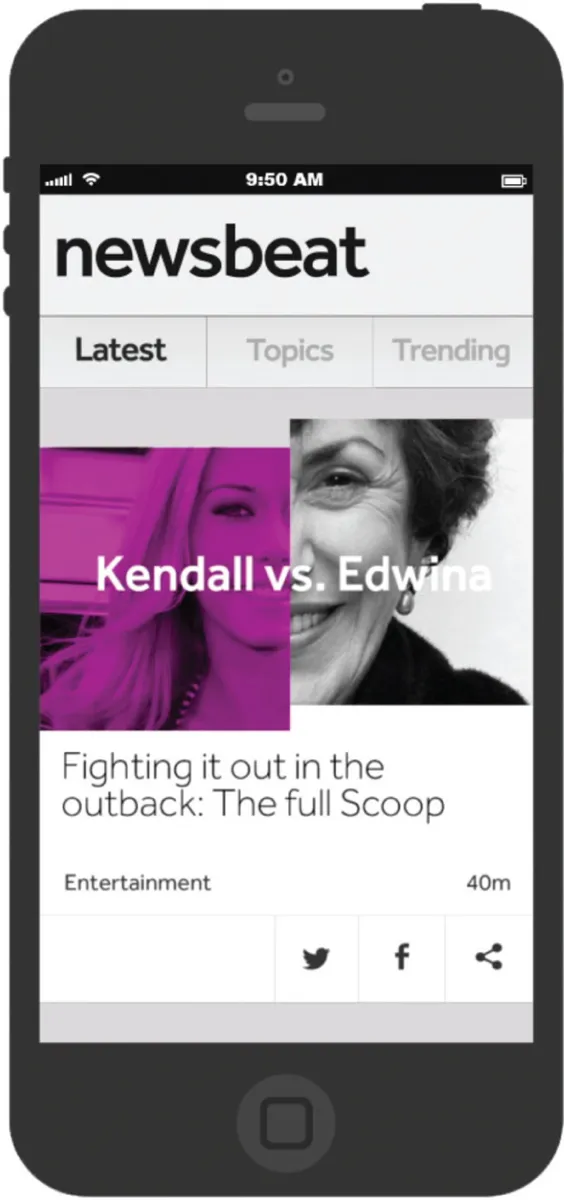
1.1 BBC Newsbeat Rebrand and App
The BBC Newsbeat editorial team wanted to rebrand and rethink the delivery platform for their youth news service. Moving Brands created a stylish and visually sophisticated brand, whose values were also reflected in its interactive behaviours.
Its breadth of application is enormous, from the design of responsive websites and quantified-self apps to fully immersive museum experiences and machine-to-machine communication to support the burgeoning ‘Internet of Things’. As a consequence, the knowledge, experiences, methods and skills of interaction designers naturally vary. What unites us is a shared mindset, where understanding the needs of the users and helping them achieve their goals are the central focus of our work.
This focus is important because the challenges that we face are often difficult, but to the end user our solutions must appear easy, give delight or remain ‘invisible’. The complexity of most interaction projects has led many designers to compare them to ‘icebergs’ as only 10 per cent of the design is actually visible.1 Yet despite this emergent discipline’s popularity and prominence, there are very few books that actually dive below the surface and make visible their iterative design processes.
This book documents a variety of state-of-the-art interaction design projects through twelve individual case studies, making observable the design and development pathways, processes and decision points, challenges and triumphs. It is intended to complement rather than replicate many of the leading methods books available, such as Alan Cooper et al.’s About

1.2 Bio Design Studio
The Bio Design Studio was created by Local Projects to introduce visitors to the concept of synthetic biology at the Tech Museum of Innovation in San Jose, California. The exhibition consisted of four different interactive installations aimed at conveying different biological concepts.
Face: The Essentials of Interaction Design and Jenny Preece’s Interaction Design: Beyond Human-Computer Interaction, by providing detailed cross-sections through these projects. In the process, the reader will follow the story of each project’s development both visually and verbally through interviews and insights from their creative teams. Our aim is to shine a light on the various guises that interaction design projects take and the different ways in which they are addressed.

1.3 SG Heart Map
To celebrate Singapore’s fifty years of independence, the government commissioned BLACK and ONG&ONG to create a range of ambitious year-long events that required a seamless online/offline dialogue with the Singaporean public.
This book is targeted at design students and early career designers who already understand what interaction design is and may know how to create basic projects but now want to learn holistically about the development of a diverse range of interaction design and the teams that created them, from their initial conception to creative completion.

Project Facts
The seven icons represent the agency, client, business sector, duration, relative cost, key team roles, development methodology and the final deliverables, such as an app, a website, and so on.
Project Stages
Details the key milestones, phases and general stages within the project.
1.4 Overview Spread
Summarises the project’s challenge, outcome and learning insights.
WHAT THIS BOOK COVERS
The book’s scope builds on Cooper et al.’s classic definition of interaction design as the ‘practice of designing interactive digital products, environments, systems, and services’.2 However, this definition has been extended to include newer notions of digital identity and promotion. These identified areas of practice or categories form six distinct but interrelated chapters.
PRODUCTS
The digitisation of physical products from books and music collections to spirit levels and clocks has made many of us question the ingrained value we place on objects. This chapter illustrates the development of two very different kinds of interactive projects: a guidebook app and an online children’s game.
SERVICES
The digital age is revolutionising the public and private services that we use. Some services are using the web to improve both efficiency and effectiveness; others leverage web 2.0 technologies to create more disruptive new services. This chapter follows two public-facing projects, both with a theme of travel.
SYSTEMS
Our daily lives involve interacting with sophisticated software systems such as ATMs or ticketing machines that remain largely invisible to us. This chapter shadows two projects that illustrate the dedication and attention to detail required to make great system designs that strive to work ‘invisibly’.
EXPERIENCES
Thankfully, our love of small personal screens is not all-consuming; there is also a significant growth in more immersive and event-driven communication. This chapter shares two case studies that utilise interactive technology to create compelling visitor experiences in an aquarium and a museum.
IDENTITIES
The digital world is continually challenging our notions of identity as our personal and professional, and physical and virtual lives blur. This chapter follows two projects that demonstrate how interactive behaviours and generative design triggered by sound are becoming branding touch points.

Team Roles & Skills
Shows the key team membe...
Table of contents
- Cover
- Title Page
- Contents
- Chapter 1 – Introduction
- Chapter 2 – Products
- Chapter 3 – Services
- Chapter 4 – Systems
- Chapter 5 – Experiences
- Chapter 6 – Identities
- Chapter 7 – Promotions
- Chapter 8 – Appendix
- Glossary
- Bibliography
- Useful Resources
- Picture Credits
- Acknowledgements
- eCopyright
Trusted by 375,005 students
Access to over 1.5 million titles for a fair monthly price.
Study more efficiently using our study tools.
Frequently asked questions
Yes, you can cancel anytime from the Subscription tab in your account settings on the Perlego website. Your subscription will stay active until the end of your current billing period. Learn how to cancel your subscription
No, books cannot be downloaded as external files, such as PDFs, for use outside of Perlego. However, you can download books within the Perlego app for offline reading on mobile or tablet. Learn how to download books offline
Perlego offers two plans: Essential and Complete
- Essential is ideal for learners and professionals who enjoy exploring a wide range of subjects. Access the Essential Library with 800,000+ trusted titles and best-sellers across business, personal growth, and the humanities. Includes unlimited reading time and Standard Read Aloud voice.
- Complete: Perfect for advanced learners and researchers needing full, unrestricted access. Unlock 1.5M+ books across hundreds of subjects, including academic and specialized titles. The Complete Plan also includes advanced features like Premium Read Aloud and Research Assistant.
We are an online textbook subscription service, where you can get access to an entire online library for less than the price of a single book per month. With over 1.5 million books across 990+ topics, we’ve got you covered! Learn about our mission
Look out for the read-aloud symbol on your next book to see if you can listen to it. The read-aloud tool reads text aloud for you, highlighting the text as it is being read. You can pause it, speed it up and slow it down. Learn more about Read Aloud
Yes! You can use the Perlego app on both iOS and Android devices to read anytime, anywhere — even offline. Perfect for commutes or when you’re on the go.
Please note we cannot support devices running on iOS 13 and Android 7 or earlier. Learn more about using the app
Please note we cannot support devices running on iOS 13 and Android 7 or earlier. Learn more about using the app
Yes, you can access Interaction Design by Jamie Steane, Joyce Yee in PDF and/or ePUB format, as well as other popular books in Design & Design General. We have over 1.5 million books available in our catalogue for you to explore.