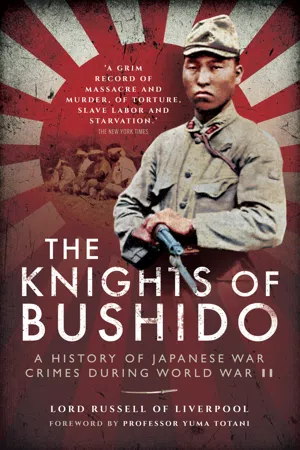
The war crimes trials at Nuremberg and Tokyo meted out the Allies' official justice; Lord Russell of Liverpool's sensational bestselling books on the Axis' war crimes decided the public's opinion. The Knights of Bushido, Russell's shocking account of Japanese brutality in the Pacific in World War II, describes how the noble founding principles of the Empire of Japan were perverted by the military into a systematic campaign of torture, murder, starvation, rape, and destruction.Notorious incidents like the Nanking Massacre and the Bataan Death March emerge as merely part of a pattern of human rights abuses. Undoubtedly formidable soldiers, the Japanese were terrible conquerors. Their conduct in the Pacific is a harrowing example of the doctrine of mutual destruction carried to the extreme and begs the question of what is acceptable and unacceptable in total war.
eBook - ePub
The Knights of Bushido
A History of Japanese War Crimes during World War II
- 384 pages
- English
- ePUB (mobile friendly)
- Available on iOS & Android
eBook - ePub
The Knights of Bushido
A History of Japanese War Crimes during World War II
About this book
Information
Subtopic
Japanese HistoryIndex
HistoryCHAPTER IX
THE PRISON CAMPS
THE general attitude of the Japanese to Allied prisoners of war has already been described in Chapter III, and other chapters have dealt with the murder of captured aircrews, the transport of prisoners by sea in appalling conditions, the so-called ‘Death Marches’, work on the Burma-Siam Railway and the massacre of Allied prisoners on or shortly after capture.
This final chapter on the treatment of Allied prisoners of war describes conditions in some of the many prison camps in which thousands lost their lives, and where death was often a merciful release from unendurable suffering.
Early in 1942 the Japanese Government undertook to take into consideration the national customs and racial habits of their prisoners and internees when supplying such things as food and clothing, but this promise was never kept. When large numbers of prisoners began to die or become ill from malnutrition it must have been obvious to the Japanese authorities that one of the causes was that owing to their different national dietary customs and habits, the American, Australian, British, Dutch, and French prisoners could not remain healthy on the rations issued.
In October 1942 orders were issued to all commandants of prisoner of war camps that ‘in view of the consumption of rice and barley by the workers in heavy industries in Japan’, the rations for prisoners of war and civilian internees, who were officers or civilian officials, should be reduced to a maximum of four hundred and twenty grams a day. Eighteen months later the ration was further reduced, and although by this time deficiency diseases were widespread, the well-known ‘no work, no food’ instructions were issued by Tojo to all camp commandants.
The Japanese Army and Navy’s own prisoner of war regulations required them to keep a reserve supply of medicines and medical equipment sufficient for one year’s use. These regulations were frequently observed only by confiscating Red Cross supplies, and even then most of these were used for the benefit of the Japanese. The failure to provide the prisoners with adequate medical supplies was common to all prisoner of war camps without exception and was a contributory cause of the deaths of many thousands of prisoners and internees.
The Japanese prisoner of war regulations also provided that barracks, temples and other buildings should be used as camps, and that those who employed the prisoners on war production should provide them with shelter from the elements. In many camps both the shelter and the sanitation were inadequate. Atap huts with mud floors furnished the only accommodation in most of the camps situated on islands in the Pacific.
Furthermore, it was the common practice to make the prisoners build their own camps in such places, and until the huts or shelters were completed the prisoners had to live in the open and were exposed to the weather at all times.
Sometimes, indeed, the prisoners were spared the labour of building their own camp by taking over a site previously used for another purpose, but this could, also, have its disadvantages. A former Japanese labour camp at Lahat in the Molucca Islands was converted into a prisoner of war camp in August 1944, but when the British and Dutch prisoners arrived to occupy it they found it full of dead Javanese, its former occupants.
Anything was good enough for an Allied prisoner of war. When Itagaki was planning to house two thousand British and American prisoners in three theological schools in Korea, the Vice-Minister of War, Kimura, inquired whether the intended accommodation was not too good for them.
The terrible conditions in some of these camps, and the miserable existence which their occupants led, are described below.
AMBOINA
On 3rd February 1942, when the island of Amboina, which is south of Ceram in the Molucca Archipelago, fell to the Japanese, eight hundred and nine Australians and three hundred Dutch prisoners of war were captured, and taken to Tan Toey Barracks, two miles outside the town of Ambon. The two nationalities were separated inside the barrack compound by a barbed wire fence. Eight months later five hundred of these prisoners were removed to Hainan Island. The others, except for those who were killed or died, remained on the island until they were liberated on 10th September 1945.
For the first few months the food was adequate and reasonably good. After that, until July 1943, it was enough to keep the prisoners in moderate health, but insufficient to keep them fit enough for the hard work which they had to do. After July 1943 the ration scale fell rapidly, and latterly each prisoner received no more than four ounces of rice and four ounces of sweet potatoes per day. During this period of scarcity of the prisoners’ food the Japanese fed well, never less than fifteen ounces of rice per day, a liberal ration of fish, and plenty of vegetables.
Malnutrition became serious in 1945 and forty-two prisoners died in May, seventy-two in June, and ninety-four in July.
Accommodation also was very good in the early stages, for the prisoners were confined in the same barracks which they had occupied before the Japanese invasion. But that enviable state of things, unusual enough in a Japanese prison camp, was not to endure for long. In July 1942 eight of the huts were taken over by the Japanese and used for storing ammunition, and four months later a bomb dump of two hundred thousand pounds of high explosive and armour piercing bombs was established inside the camp area. The dump was situated within a few yards of the camp hospital, within a few feet of the Australian officers’ sleeping quarters, and only twenty-five yards away from another compound in which were interned two hundred and fifty Dutch women and children.
Protests made to the authorities through the camp interpreter about the location of the dump were met with the reply, ‘Remember your status as prisoners of war. You have no rights. International Law and the Geneva Convention are dead.’ A request for the camp hospital to be marked with the Red Cross was also refused.
On 15th February 1943 at 11.30 a.m. the dump was bombed by Allied aircraft. The first string of bombs fell on one of the huts used as a bomb store and set it on fire, but the dump did not explode immediately. There was clearly little time to lose, and every effort was made to evacuate the hospital and remove a number of Dutch women and children injured. There were about fifty patients in the hospital several of whom could only be removed as stretcher cases.
Before much could be done the dump blew up. Six Australian officers, four other ranks and twenty-seven Dutch women and children were killed, and twenty more Australian prisoners of war were badly wounded.
The camp itself was almost completely devastated and the surviving Dutch civilians were moved to the town and quartered in the Bethany Church. Here they were very overcrowded, there were no adequate sanitary arrangements and the church was in a part of the town which became a continual target for Allied aircraft. In August 1944 the Ambon area suffered another heavy aerial bombardment when it was attacked by twenty-four Liberators, and there were many more casualties among the prisoners of war.
From the end of 1943 onwards the physical condition of the prisoners of war inevitably deteriorated, as food became scarcer and disease more prevalent. All were thin and emaciated, many could only walk with the aid of sticks and crutches, and the average loss of weight was about eighty pounds. Nevertheless the prisoners, despite their weakness, were still worked as hard as ever and many died from sheer exhaustion.
What the prisoners called ‘long carry’ was one of the main causes of the rise in the death roll. ‘Long carry’ was described by a witness who gave evidence in the Tokyo trial in these words:
The ‘long carry’ was a name which the prisoners gave to the task of carrying cement and bombs between two villages, approximately eight miles apart, and the route was over a very tortuous track. The prisoners were required to carry, firstly, ninety-pound bags of cement over this track, and when the first task was completed, and it took them about three weeks, they had to carry a large number of one hundred and fifty pound bombs over the same route, one bomb between two men. They were kept at it from 6.30 a.m. until 5.30 p.m., seven days a week. The prisoners on this work were driven on like slaves by the Japanese guards, and the ground over which they had to move was so rough that sometimes they could only manage it on all fours.
After a week of this back breaking work none of the men was fit to continue, but there was no respite, and they were made to carry on until they dropped. Many prisoners collapsed unconscious.
Each day the Japanese requisitioned at least fifteen men more than it was possible to supply. The Japanese then called out all the sick, and selected the other fifteen from those they considered capable of doing the job. Many of them could only walk with the aid of sticks, yet they were forced to take these heavy weights over the ‘long carry’ course.
The guards who accompanied these working parties were armed with pistols, and each carried a pick handle or its equivalent and the prisoners were driven along with blows when necessary.
A prisoner named Wilkinson who should really have been in hospital was one of those whom the Japanese officer in charge of working parties forced to work on ‘long carry’, though palpably unfit. One morning, when the working party was found to be below the requisitioned strength, the Japanese guards went the rounds of the sleeping quarters and any prisoner who was found lying on his bed was beaten until he got up and joined the parade. A guard saw Private Wilkinson lying on his bed covered with a blanket. He pulled the blanket off and had struck several blows before he realized that Wilkinson was dead. He had died of malnutrition, the effects of beri-beri and utter exhaustion. At least sixty per cent of the men engaged on ‘long carry’ were dead within three months of its completion.
The most trivial disciplinary offences were dealt with by corporal punishment, or minor forms of torture. A defaulter would be forced to stand in front of the guard with a heavy boulder held high above his head for any period from an hour to two or three hours, forced to stand to attention for long periods but with the knees slightly bent, or forced to assume the ‘press up’ position and hold it for a long time until, at last, he collapsed. The Kempei Tai cigarette end torture was also very popular with the guards. Such punishments were a daily occurrence.
A Private Tait, while on a working party, attempted to steal a pair of binoculars belonging to one of the Japanese guards. He was caught in the act and beaten by the guards who were on the spot. On the return of the working party to camp the offence was reported to the commandant who ordered that Tait be again punished, and that the punishment should be administered publicly outside the guardroom.
An eye-witness has given the following account of this incident.
I was forced to be present throughout the whole of the punishment which consisted of one hundred strokes with a pick handle. When Tait was no longer able to stand he was beaten whilst on the ground. When he lost consciousness he was doused with cold water in an attempt to bring him to. Efforts to get the punishment reduced met with no success, and I was twice beaten for trying to intervene.
Twice he became unconscious and twice he came to again. On the second occasion I got permission for him to be admitted to the camp hospital.
Next morning the camp manager, Ikenchi, visited the hospital and saw Tait in bed. He beat him up with a walking stick, and then gave an order that he should lie on the concrete floor with one blanket. This outrageous ill-treatment aggravated the beri-beri from which Tait was suffering at the time of the assault. Six months later he was dead.
When the Allied forces reached Amboina on 10th September 1945, after Japan had capitulated, of the five hundred and twenty-eight Australians who stayed there after the two large drafts went to Hainan Island on 26th October 1942, only one hundred and twenty-three were still alive.
HAROEKOE
In April 1943 there were indications in Sourabaya that there was shortly to be a big movement of Allied prisoners of war. A mammoth medical parade had been held whose object was clearly to select all prisoners who could conceivably be considered fit for work. A board of Japanese medical officers had sat behind a table, past which all the prisoners had to file, stripped to the waist. Only the halt, the maim, and the very sick were not selected.
After a voyage of about seventeen days aboard the Amagi Maru, in the usual appalling conditions prevalent on all the Japanese transports for prisoners of war, the draft arrived at the island of Haroekoe and in pouring rain its human cargo, some two thousand British and Dutch prisoners, was ferried ashore to the new camp.
Forwarding a report on the ‘Treatment of Allied POWs on the Island of Haroekoe’ to the Air Officer Commanding, Royal Air Force, Java, in November 1945, the former Allied commanding officer of the camp, Squadron-Leader Pitts of the RAF, wrote, ‘the treatment meted out to prisoners of all ranks was so barbarous and inhuman that it is to be hoped that action will be taken against the individuals who were responsible and whose names are listed in Appendix “E”’.1
This was no exaggeration. From the moment the prisoners left Sourabaya their treatment by the Japanese guards had been fiendish. As one of them, Dr Springer,2 wrote in a report made from extracts from his diary, ‘officers, doctors and soldiers were beaten and kicked throughout the voyage, mostly without understanding the reason for the punishment’. Nevertheless, they fondly hoped that conditions ashore would be better.
We still believed in humanity even from the Nips, but that proved to be silly. Even now, while writing this report [November 1945] and reading my notes I get the impression that the Nips were out for wilful murder. When we told them our fear for the future regarding the danger of spreading an epidemic of dysentery, and that we expected many death cases, we often got the answer, ‘nice when dead’.
The transfer of all these prisoners of war from Sourabaya to Haroekoe, a small island south of Ce...
Table of contents
- Cover
- Title
- Copyright
- PREFACE
- ACKNOWLEDGMENTS
- CONTENTS
- ILLUSTRATIONS
- FOREWORD TO THE 2016 EDITION
- THE KNIGHTS OF BUSHIDO
- I FROM MUKDEN TO PEARL HARBOUR
- II THE CHINA INCIDENT
- III THE GENERAL TREATMENT OF PRISONERS OF WAR
- IV THE MURDER OF CAPTURED AIRCREWS
- V LIFE AND DEATH ON THE BURMA-SIAM RAILWAY
- VI THE MASSACRE AND MURDER OF PRISONERS OF WAR
- VII THE PRISON HULKS
- VIII THE DEATH MARCHES
- IX THE PRISON CAMPS
- X THE CIVILIAN INTERNMENT CAMPS
- XI WAR CRIMES ON THE HIGH SEAS
- XII CANNIBALISM, VIVISECTION AND MUTILATION
- XIII ATROCITIES AGAINST THE CIVILIAN POPULATION UNDER JAPANESE OCCUPATION
- XIV THE KEMPAI TAI
- XV RETRIBUTION
- APPENDIX: SOME LEGAL ASPECTS OF WAR CRIMES TRIALS
- Plate section
Trusted by 375,005 students
Access to over 1.5 million titles for a fair monthly price.
Study more efficiently using our study tools.
Frequently asked questions
Yes, you can cancel anytime from the Subscription tab in your account settings on the Perlego website. Your subscription will stay active until the end of your current billing period. Learn how to cancel your subscription
No, books cannot be downloaded as external files, such as PDFs, for use outside of Perlego. However, you can download books within the Perlego app for offline reading on mobile or tablet. Learn how to download books offline
Perlego offers two plans: Essential and Complete
- Essential is ideal for learners and professionals who enjoy exploring a wide range of subjects. Access the Essential Library with 800,000+ trusted titles and best-sellers across business, personal growth, and the humanities. Includes unlimited reading time and Standard Read Aloud voice.
- Complete: Perfect for advanced learners and researchers needing full, unrestricted access. Unlock 1.5M+ books across hundreds of subjects, including academic and specialized titles. The Complete Plan also includes advanced features like Premium Read Aloud and Research Assistant.
We are an online textbook subscription service, where you can get access to an entire online library for less than the price of a single book per month. With over 1.5 million books across 990+ topics, we’ve got you covered! Learn about our mission
Look out for the read-aloud symbol on your next book to see if you can listen to it. The read-aloud tool reads text aloud for you, highlighting the text as it is being read. You can pause it, speed it up and slow it down. Learn more about Read Aloud
Yes! You can use the Perlego app on both iOS and Android devices to read anytime, anywhere — even offline. Perfect for commutes or when you’re on the go.
Please note we cannot support devices running on iOS 13 and Android 7 or earlier. Learn more about using the app
Please note we cannot support devices running on iOS 13 and Android 7 or earlier. Learn more about using the app
Yes, you can access The Knights of Bushido by Lord Russell of Liverpool in PDF and/or ePUB format, as well as other popular books in History & Japanese History. We have over 1.5 million books available in our catalogue for you to explore.