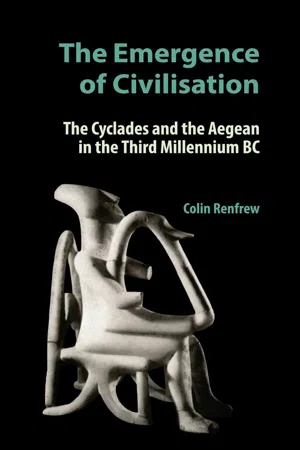
Unavailable for too long, this new edition reprints the original text of Renfrew's groundbreaking study, supplemented with a new introduction by the author and a foreword by John Cherry, in order to make this landmark publication available once again.
- 650 pages
- English
- ePUB (mobile friendly)
- Available on iOS & Android
eBook - ePub
The Emergence of Civilisation
About this book
Trusted by 375,005 students
Access to over 1.5 million titles for a fair monthly price.
Study more efficiently using our study tools.
Information
Subtopic
Ancient HistoryIndex
HistoryPART 1
Culture Sequence
Chapter 5
The Neolithic Background
During the neolithic period in the Aegean, many of the features observable in the succeeding early bronze age and developing to the full in the palace civilisations, made their appearance. Since it is a major theme of the present work that there is considerable continuity in the Aegean from the early neolithic period to the full development of civilisation, this neolithic background is very relevant.
The neolithic period of Greece which covered a span of at least 3,000 years has been divided by Weinberg (1942; 1965a) into three parts, early, middle and late. Of these, the early phase corresponds to Phase II of the sequence outlined in Chapter 4, and the middle and late stages to Phase III.
In the short outline which follows, these sub-divisions are considered in turn. A further phase, the final neolithic, is then introduced to fill the evident gap in the sequence between what is generally termed late neolithic in southern Greece and the early bronze age cultures, which developed several centuries later.
The introduction of simple village farming: the early neolithic
Evidence for the palaeolithic period in Greece has come from a number of sites in Thessaly, south Greece, and especially in Epirus (Weinberg 1965a; Higgs 1968). In two areas only have finds been reported which can be recognised as belonging to the neo-thermal period, and yet to antedate the introduction of farming.
The term ‘mesolithic’ is here avoided, being best applied to regions where the neo-thermal climatic changes had very marked ecological effects, transforming the subsistence patterns of the inhabitants. In the Old World, this may be seen in northern Europe, but the evidence for such a change is less marked in the Mediterranean region. At the Franchthi Cave in the Argolid an apparently continuous transition from the Upper Palaeolithic period to neothermal times has been observed in the stratigraphy (Jacobsen 1969). Before the first domestic animals, sheep and goat, appear in the record, red deer is the dominant faunal species. Sometime before 7000 BC, in radiocarbon years, fishing became important, and at this period obsidian was obtained from the Cycladic island of Melos. By about 7000 BC abundant sheep and goat remains, presumably domestic, are found, although without pottery This apparently aceramic neolithic phase is overlain by deposits with early neolithic pottery which appears by about 5800 BC. Early neothermal finds have been reported also from Thessaly, notably, at the site of Voivi (Theochares 1967).
An aceramic neolithic phase in mainland Greece is now attested also at Argissa Maghoula (Milojčić, Boessneck and Hopf 1962) and several other Thessalian sites including Souphli, and Sesklo (Theochares 1958; 1967). In each case, however, the excavated area is rather small and it is conceivable that pottery was already used in small quantities at some of these sites (Rodden 1970). The lowest level at neolithic Knossos with a date of 6100 BC (BM.124) is likewise without pottery. The grains from this site include emmer, naked hexaploid wheat, hulled barley and lentils (Evans 1964a, 140; 1968) to which can be added einkorn, millet, oats, vetch, peas and acorns for the corresponding Thessalian finds (J. M. Renfrew 1966). Domestic sheep, goat, cow and pig were kept at Argissa, as well as wild animals, and the same domesticates occur at Knossos. The rather similar proportions of these species at Nea Nikomedeia, which also resemble those seen later at Saliagos and Sitagroi, suggest that the relative importance of these animals may not have changed very significantly between the early neolithic period and the present.
The earliest dated pottery in Greece comes from Nea Nikomedeia in Macedonia with radiocarbon dates between 6200 and 5300 BC for the early levels. The red-on-white painted ware and indeed some of the small objects resemble finds in Anatolia (Rodden 1965), while the impressed ware and white painted ware has parallels in the Balkans. At present it seems safest to assume the arrival of the earliest farmers with their domestic sheep and goats and their domesticated cereals, emigrants from Anatolia. Similar finds have been made in Thessaly—the Proto-Sesklo culture. Further south it seems that there may be no painted pottery in the earliest phases, but in general the finds are similar to those of Thessaly. The houses at Nea Nikomedeia were rectangular in plan, between 8 and 11 m in length, built of posts and plastered pisé mud. As Rodden has pointed out, the open plan contrasts with early neolithic sites in Anatolia and compares rather with neolithic sites in Yugoslavia, Romania and Bulgaria (fig. 5.1).
In Crete the earliest date for the pottery neolithic levels is 5620 BC (BM.272). The Cretan neolithic pottery is quite different from that of mainland Greece. Copper ores are already found in these early levels, and a curiosity is the baked mud brick used in house construction, together with the unbaked pisé or tauf (plastered mud) which was elsewhere more usual.
No early neolithic finds are known yet in regions of north Greece east of Nea Nikomedeia, or from west Anatolia. Only at the Aghio Gala cave on the off-shore island of Chios have finds been made which may date from this time (Furness 1956). Although no early neolithic finds have been made in the Cyclades, the island of Melos was certainly already being visited for its obsidian, which reached the Franchthi Cave before neolithic times, and Thessaly and Crete from the very beginning of the neolithic period
The neolithic occupation of Greece had thus begun by about 6000 BC, and using Weinberg’s convenient classification (and his radiocarbon dates for Elateia) the end of the early neolithic period may be set perhaps a little before 5000 BC (radiocarbon years).
Diversification in village farming pattern: the middle and late neolithic
The classic neolithic sequence in the Aegean is that of Thessaly, first established by Tsountas and conveniently revised by Milojčić, on the basis of his recent excavations (Tsountas 1908; Milojčić 1959). Tsountas’s Thessalian A, now termed the Sesklo culture, begins the middle neolithic of Thessaly. Although some authors have argued that a change of population took place at this time, there are elements of continuity in the pottery and figurines, and reservations are permissible concerning the suggested Anatolian or Near Eastern influences. In southern Greece the attractively painted ‘neolithic Urfirnis’ ware is common at sites like Franchthi, Hagiorgitika and Lerna, while in central Greece, at Elateia, the Proto-Sesklo tradition continues with some changes.
Towards the end of this period at Elateia and Corinth a new class of black-burnished pottery emerges, and with it appear the first arrowheads, and some curious four-legged vessels which are of great interest (Weinberg 1962). Very closely similar forms—and the shape is an odd one—have been found at sites of the Kakanj and Danilo cultures of Yugoslavia, and some contact between the two areas is likely.
At this time the village settlements, in Thessaly at least, were still on the open plan with separate house units. The houses were either square (as at Tsangli and Otzaki), or rectangular (as at Sesklo) and up to 20 m long.
The nature of the middle neolithic in north Greece has been clarified by the excavations at Sitagroi in east Macedonia. The first phase there has resemblances with the Vesselinovo culture of Bulgaria. Paradimi, further east in Thrace, has finds in its earlier levels which may be equated with the first and second phases at Sitagroi, including ‘black topped’ ware. Whether the similarities between the Sitagroi and Bulgarian finds at this time can be explained by Aegean ‘influence’ on the Balkans or vice versa, or perhaps Anatolian influence on them both, remains to be established.
The middle neolithic of Crete shows almost complete continuity with the preceding phases, to the extent that a quantitative analysis was needed to distinguish effectively between them (Evans 1964a, 203). The only clear contact with the remainder of the Aegean is established by the continuing presence of Melian obsidian.
The middle neolithic of west Anatolia is very little understood. The only well-stratified settlement is at Emborio in Chios: the succession there is discussed in the next section.

FIG. 5.1 Complete village plan of the later neolithic period. The Gumelnitsa culture site of Căscioarele in Romania, showing houses, in some cases with interior hearths. Later neolithic tell villages of north Greece were rather similar (after Dumitrescu).
The Cycladic islands were occupied during the later part, at least, of the middle neolithic period. Finds of the Saliagos culture have been made at the type site, and at Vouni, both in Antiparos (Evans and Renfrew 1968), at Mavrispilia in Mykonos (Belmont and Renfrew 1964) and at Agrilia in Melos (Renfrew 1965, 34). The culture is quite distinct from the other cultures of the period, although there are similarities with the later middle neolithic finds at Elateia. Radiocarbon dates set its duration between 4200 BC and 3700 BC. There is thus an overlap both with the Early Neolithic II of Knossos (3730 BC: BM.279) and the late neolithic Dhimini culture of Thessaly (3680 BC, cf. Milojčić in Germania 1961, 446). This is not so much an inconsistency as an illustration of the arbitrary nature of the division into ‘early’ ‘middle’ and ‘late’. These terms are used only for convenience and do not imply any very strict contemporaneity between areas.
The middle neolithic period may be said to cover, very approximately, in radiocarbon years, the fifth millennium BC.
By common consent the Dhimini culture, Tsountas’s Thessalian B, has long been taken to mark the late neolithic period. The classic Dhimini pottery itself, as Weinberg rightly points out, has held an exaggerated importance in the literature. Its bi- and trichrome spirals were at first thought to indicate some contact with the Danubian lands—for example with the Petreşti and Ariusd cultures of Romania. In fact it is limited in its distribution, and its local origins and development have been made abundantly clear in Milojčić’s recent excavations (1959). Quite which phase of the culture is dated by the radiocarbon determination quoted above has not been stated.
But the radiocarbon dates for the early bronze age Eutresis culture at Eutresis itself, 2492 BC (P.307) and 2496 BC (P.306), which like all the others may be much earlier in calendar years, suggest a much longer duration for this neolithic phase than is usually admitted. Since in Thessaly and Macedonia there is evidence for at least two culture phases in the later neolithic, it is proposed here to follow the implications of Milojčić’s excavations and to divide this rather long period into an earlier (‘late neolithic’) and a later (‘final neolithic’) phase. The term ‘final neolithic’, an improvement on a previous suggestion, ‘latest neolithic’ (Renfrew 1964, 119), has been proposed by Mr Bill Phelps on the basis of his study of the neolithic of southern Greece (oral communication, July 1968).
The late neolithic, whose duration may be set from c. 4000 BC or a little later (in radiocarbon years on the 5568 half-life) to around 3300 BC or a little later, is represented by matt-painted or polychrome wares over much of mainland Greece. Milojčić has shown that in eastern Thessaly these make their appearance before the classical Dhimini pottery with its elaborately painted spirals. He has divided this late neolithic period into four sub-phases. The best account of this period is still that given by Tsountas, and his finds reveal a very different settlement plan from the well-spaced rectangular houses of Nea Nikomedeia or the square houses of Tsangli (Wace and Thompson 1912, 115). The most important site of this period is ...
Table of contents
- Cover
- Title
- Copyright
- Dedication
- Contents
- List of Illustrations
- Notes to the Illustrations
- Site map
- Foreword, by John Cherry (2010)
- Preface and Introduction (2010)
- Preface (1972)
- Acknowledgements (1972)
- Introduction
- Part I Culture Sequence
- Part II Culture Process
- Appendixes
- Bibliography
- Full Captions to the Plates
- Plates
Frequently asked questions
Yes, you can cancel anytime from the Subscription tab in your account settings on the Perlego website. Your subscription will stay active until the end of your current billing period. Learn how to cancel your subscription
No, books cannot be downloaded as external files, such as PDFs, for use outside of Perlego. However, you can download books within the Perlego app for offline reading on mobile or tablet. Learn how to download books offline
Perlego offers two plans: Essential and Complete
- Essential is ideal for learners and professionals who enjoy exploring a wide range of subjects. Access the Essential Library with 800,000+ trusted titles and best-sellers across business, personal growth, and the humanities. Includes unlimited reading time and Standard Read Aloud voice.
- Complete: Perfect for advanced learners and researchers needing full, unrestricted access. Unlock 1.5M+ books across hundreds of subjects, including academic and specialized titles. The Complete Plan also includes advanced features like Premium Read Aloud and Research Assistant.
We are an online textbook subscription service, where you can get access to an entire online library for less than the price of a single book per month. With over 1.5 million books across 990+ topics, we’ve got you covered! Learn about our mission
Look out for the read-aloud symbol on your next book to see if you can listen to it. The read-aloud tool reads text aloud for you, highlighting the text as it is being read. You can pause it, speed it up and slow it down. Learn more about Read Aloud
Yes! You can use the Perlego app on both iOS and Android devices to read anytime, anywhere — even offline. Perfect for commutes or when you’re on the go.
Please note we cannot support devices running on iOS 13 and Android 7 or earlier. Learn more about using the app
Please note we cannot support devices running on iOS 13 and Android 7 or earlier. Learn more about using the app
Yes, you can access The Emergence of Civilisation by Colin Renfrew, John Cherry in PDF and/or ePUB format, as well as other popular books in History & Ancient History. We have over 1.5 million books available in our catalogue for you to explore.