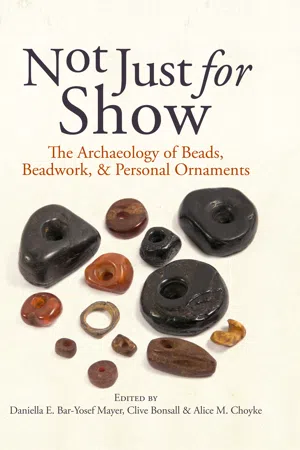
Beads, beadwork, and personal ornaments are made of diverse materials such as shell, bone, stones, minerals, and composite materials. Their exploration from geographical and chronological settings around the world offers a glimpse at some of the cutting edge research within the fast growing field of personal ornaments in humanities' past. Recent studies are based on a variety of analytical procedures that highlight humankind's technological advances, exchange networks, mortuary practices, and symbol-laden beliefs. Papers discuss the social narratives behind bead and beadwork manufacture, use and disposal; the way beads work visually, audibly and even tactilely to cue wearers and audience to their social message(s). Understanding the entangled social and technical aspects of beads require a broad spectrum of technical and methodological approaches including the identification of the sources for the raw material of beads. These scientific approaches are also combined in some instances with experimentation to clarify the manner in which beads were produced and used in past societies.
eBook - ePub
Not Just for Show
- 224 pages
- English
- ePUB (mobile friendly)
- Available on iOS & Android
eBook - ePub
About this book
Trusted by 375,005 students
Access to over 1.5 million titles for a fair monthly price.
Study more efficiently using our study tools.
Information
Subtopic
Art GeneralIndex
Social Sciences1
Introduction: The Archaeology of Beads, Beadwork and Personal Ornaments
Beads are commonly defined as being small ornaments perforated through their centers and small enough to be worn on the body. Beads sewn on clothing, parts of composite body decoration from anklets, to bracelets, to girdles, to necklaces and to headbands may be identical or mixed in their size, shape and raw material (Dubin 2009). Beads can be strung in a series on a thread, sewn individually onto clothing, or traded as separate objects that can be counted. They can be dismantled from garments and body ornaments and shared between individuals or given from the living to the dead as part of burial ritual. Pendants are a type of bead that is perforated at one or both ends rather than symmetrically through the middle (Kenoyer 1991). They also can be part of a series of similar objects strung together on a filament of sorts or one of a kind, meant to be accentuated in a special way.
For anyone seriously studying beads, especially with the archaeological material, there is a frustration that most papers dealing with all their various manifestations tend to be scattered in isolated articles. This disarticulated publication record makes it particularly hard to see past the huge diversity of beads and bead use throughout human history. It becomes almost impossible to see patterning of any sort in the way humankind treated with this kind of ornamentation during its long history down to the present day. Theoretical modelling for tackling bead studies becomes extremely difficult and methodologies continue to be invented and re-invented. Consensus is virtually non-existent because of this lack of any sort of serious academic forum, at least within the world of archaeology. This volume of collected articles is intended to bring together specialists from diverse backgrounds and intellectual approaches, working on geographically separated bead material from the deep past as well as more historic material. The volume is intended to continue and reinforce a serious dialogue between practitioners. The approaches found here are all different but the intent is remarkably uniform. The authors all strive to understand the social forces at work behind the technical strategies, utilization and re-utilization of ornamentation in their particular part of the world and time period.
Beadwork in all its many and diverse manifestations, is a craft involving the creation of planar decoration on a flexible surface such as hide or textile clothing or bands from uniting many beads, often of identical size but also frequently of varying size and shape (Hector 2005). These beads can be sewn, twined, plaited, woven, netted into or glued onto the foundation surface. Designs are created through size, color and texture and the methods used to bring them together. Juxtapositions of beads from particular raw materials may embody their own meanings.
Beads, beadwork and other kinds of personal ornaments (henceforth beads) are among the earliest known symbolic expressions of modern humans and represent an important tool for identification of thinking and cognition in archaeological sciences. Over the past decade, it has become clear that beads first appear within the material culture “package” of early modern humans as early as 100,000 years ago (e.g. Bar-Yosef Mayer 2005; Vanhaeren et al. 2006).
Fowler (2004: 40, 75) has pointed out that the fractal nature of beads, whether in beadwork patterns or in necklaces, other dress ornaments or sewn on clothing, means they can be assembled and reassembled, divided, shared and merged to create and embody a variety of social relationships between individuals in different social contexts.
The ability to think in an abstract manner tells us about the development of modern human cognitive processes connected to social complexity and, perhaps, the intensity of human-to-human interaction in emerging and developing social groups. Through their raw materials, color, size and shape, body ornaments can signal identity between groups or social status and rank within a group (e.g. Kuhn 2014; Malafouris 2003). Beads are meant to be seen, heard, touched, divided and shared. They send signals directed at a particular audience who are capable of interpreting the meaning correctly because they share similar social traditions. By the Upper Paleolithic, when modern humans spread throughout the Old World, such finds appear regularly on archaeological sites although it has only been recently that their study has intensified. The Magdalenian hunter-gatherers of the Paris Basin were shown by Peschaux et al. (Ch. 3) to produce beads during the “off-season” of hunting. This is the first time it has been demonstrated that there were some populations for whom bead production was a seasonal activity. Beads become increasingly more numerous and more complex in number, variety and technique of production with the onset of agriculture, and even more elaborate within urban societies (Wright and Garrard 2003).
A unique study in this volume by Shaham and Belfer-Cohen represents a relatively new field of archaeological study, sound. They propose that Natufian bone pendants were in fact worn around the hips to provide a rhythmic sound during the dance (Ch. 7). Beads can have a decorative as well as an amuletic function representing a dialogue of sorts between the wearer and supernatural forces (Choyke 2010). They are entangled in a web of individual desires and social prerogatives.
Beads and other forms of personal adornment were made from a wide array of raw materials. These include materials of biological origin such as mollusk shell, ostrich egg shell, ivory, bone, tooth, antler, horn, feathers, wood and seeds, stones and minerals in various colors and with different physical properties such as apatite, malachite, turquoise, ocher, basalt, obsidian, limestone, lapis lazuli and carnelian, and composite materials that require more human intervention to produce, including ceramics, various metals, glazed enstatite, faïence and glass (Bar-Yosef Mayer 2014). Mueller-Epstein discusses a wide array of beads made from different materials among Great Basin hunter-gatherers that were used in life-cycle events, health treatments, gaming, arbitration, economic currency and adornment (Ch. 6), showing once again that choice of raw materials may embody more than simple decorative preference.
Difficulties in collecting beads in their original positions during excavation have often meant that this kind of data is lost to researchers who receive these finds in the laboratory. Likewise, beadwork rarely survives intact in archaeological settings for taphonomic reasons; although where it does, it provides clearer insight into the society inhabited by its makers. Bos had the opportunity to study a well-preserved tunic with elaborate beadwork worn by Tutankhamun. Close study of the beadwork revealed manipulation by craftspeople just prior to the pharaoh’s interment (Ch. 9) creating a more dynamic picture of the burial ritual surrounding the young pharaoh.
Wearing particular ornaments binds us in groups and divides us as individuals. Beads and ornaments are about different kinds of social identity as well as personal preference and enhancement of physical appearance. The limitations and possibilities of these objects are manifold and so each period and settlement needs to be considered on its own merit before more sweeping generalizations can be made about the meaning of beads and ornament production and use within a region or over long swathes of time. Apparent parallelism between forms does not necessarily represent the same kind of ideas. Identical forms can be transmitted but understood and used in very different ways. The value of individual bead types can be acknowledged over large geographical areas even while their local symbolic interpretations and use in individual identity formation vary.
At the same time, because of their fractal nature, beads especially represent an excellent medium for construction of value, trade and exchange within economic networks discussed in several papers in this volume. Spatz studied Neolithic shells in the Levant that were traded from either the Mediterranean or the Red Sea, some of which arrived at inland settlements as raw materials while others came to the settlement as finished beads (Ch. 5). Beads produced in one area from unique raw materials can be ascribed an accepted equivalency commodity value over vast different areas. The earliest case presented in this volume relates to 35,000-year-old shell beads from Australia that were studied by Balme and O’Connor. Those were taken inland from a distance of 150–500 km and were used in both secular and ceremonial contexts (Ch.2). Another extraordinary example of long-distance and short-distance movement of shell beads is the use of Mediterranean gastropods found in the Mesolithic Danube gorges. Because they were introduced into the sites from large distances, Cristiani and Borić propose that the long-distance beads refer to origin myths, while the beads made from local cyprinid pharyngeal teeth and freshwater snails resonate with personhood (Ch. 4). In fact, distance and rarity as well as personal associations can also enhance the value of ornaments that on face value may appear simply decorative (e.g. Sciama 1998).
The history of bead and ornament study is filled with descriptive generalizations based on color and morphology. Beads, beadwork and pendants are visually seductive. They not only had an effect on the people who used them, but on the archaeologists who discovered them. This led to simple description of their raw material, color and morphology and sometimes context (mortuary, elite construction, etc.); however, rarely were attempts made to study them more deeply. Recently, with advances in microscopic studies for manufacture and use-wear analysis, digital technology, chemical analyses and closer attention to raw materials, the social plasticity of this kind of object has begun to reveal itself in assemblages from our distant and not-so-distant past. Again, new technologies enable us to look more deeply at the wear on beads and other ornaments, which gives clues to differences in their life histories. Van Gijn, studied beads’ biographies under high magnification and was able to show changes in their wear patterns over time. Middle Neolithic Dutch beads were treated on a personal level, whereas the later Funnel Beaker specimens were reworked to express collective identity (Ch. 8). Now, with improved digital photography in the field and lab and recognition that sequence may be important, ancient technology is revealed. Schneider and Hager use the recently developed technology of Reflectance Transformation Imaging to show that soapstone disk beads were produced both by craft specialists and by non-specialists in the prehistoric Napa Valley in northern California (Ch. 11), while Velázquez-Castro et al. used scanning electron microscopy to study the carving technology of prestige goods in Formative Period Mexico (Ch. 10).
Reproduction experiments are another tool to better understand past technologies. This approach was used by Campbell to demonstrate how very thin (1–3 mm long) tusk shell beads were produced in the Epipaleolithic of the Levant (Ch. 13). Gurova and Bonsall were able to differentiate between the production of soft stone beads (up to 5 on the Mohs scale) in the Neolithic of the Balkans, and the production of beads from harder materials (above 5.5 on the Mohs scale). The former could have been produced by non-specialists, while the latter required specialist expertise (Ch. 12). The interpretative devil often really does lie in the detail when it comes to the study of archaeological beads.
The original idea for a session at the SAA came from discussions between Daniella Bar-Yosef Mayer and Alice Choyke about how we could promote the study of beads and other body ornaments in archaeology. Following the session, we added papers from scholars to round off the three areas of study we thought should be promoted and expanded: socio-cultural reflections; audio and visual social cues; and methodological approaches and experimentation. These categories represent the three sections of the volume. However, most papers in this volume have a multidisciplinary approach incorporating both the technological aspects of bead or ornament manufacture as well as their broader social, cognitive and economic implications.
Thus, the papers in this volume cover many thousands of years of human prehistory. They extend geographically from North and Central America to Australia, the Near East, Egypt and Europe. This was no accident. The editors have tried to present a wide variety of case studies from different times, places and approaches to a subject that is far more about the way people relate and associate with each other than it was ever about simple decoration for decoration’s sake. Traditional descriptions of beads and ornaments in most archaeological reports only scratch the surface of what this class of artifact can tell archaeologists about how people interacted with each other through time and in particular locations. This volume is a first step in the creation of an academic forum comprised of scholars interested in exploring the way beads have been used, not only to please the eye but as material expressions of social relations.
References
Bar-Yosef Mayer, D. E.
2005 The Exploitation of Shells as Beads in the Palaeolithic and Neolithic of the Levant. Paléorient 31(1):176–185.
2014 Stone Beads. In Encyclopaedia of the History of Science, Technology, and Medicine in Non-Western Cultures, 3rd ed., edited by H. Selin. Springer, Berlin. doi:10.1007/SpringerReference_382837
Choyke, A. M.
2010 The Bone is the Beast: Animal Amulets and Ornaments in Power and Magic. In Anthropological Approaches to Zooarchaeology: Colonialism, Complexity, and Animal Transformations, edited by D. Campana, P. Crabtree, S. D. DeFrance, J. Lev-Tov, and A. Choyke, 197–209. Oxbow Books, Oxford.
Dubin, L. S.
2009 The History of Beads: From 100,000 B.C. to the Present, rev. ed. Abrams, New York.
Fowler, C.
2004 The Archaeology of Personhood: An Anthropological Approach. Routledge, London and New York.
Hector, V.
2005 The Art of Beadwork. Watson-Guptill Publications, New York.
Kenoyer, J. M.
1991 Ornament Styles of the Indus Valley Tradition: Evidence from Recent Excavations at Harappa, Pakistan. Paléorient 17(2):79–98.
Kuhn, S. L.
2014 Signaling Theory and Technologies of Communication in the Paleolithic. Biological Theory 9:42–50.
Malafouris, L.
2008 Beads for a Plastic Mind: The “Blind Man’s Stick” (BMS) Hypothesis and the Active Nature of Material Culture. Cambridge Archaeological Journal 18(3):401–414.
Sciama, L. D.
1998 Gender in the Making, Trading and Uses of Beads: An Introductory Essay. In Beads and Bead-Makers: Gender, Material Culture and Meaning, edited by L. D. Sciama and J. B. Eicher, 1–46. Berg, Oxford.
Vanhaeren, M., F. d’Errico, C. Stringer, S. L. James, J. A. Todd, and H. K. Mienis
2006 Middle Paleolithic Shell Beads in Israel and Algeria. Science 312:1785–1788.
Wright, K., and A. Garrard
2003 Social Identities and the Expansion of Stone Bead-Making in Neolithic Western Asia: New Evidence from Jordan. Antiquity 77(296):267–284.
Part 1
Socio-Cultural Reflections
2
Traditions and Change in Scaphopod Shell Beads in Northern Australia from the Pleistocene to the Recent Past
Abstract: Shell beads were made in Australia from about 35,000 years ago. They include perforated marine gastropods and intentionally fractured segments of scaphopods. While some of the oldest Australian examples are in archaeological sites that were close to the Pleistocene coastline, in the southern...
Table of contents
- Front Cover
- Half-Title Page
- Title Page
- Copyright Page
- Table Of Contents
- List of Contributors
- 1. Introduction: The Archaeology of Beads, Beadwork and Personal Ornaments
- Part 1: Socio-cultural Reflections
- Part 2: Audio and Visual Social Cues
- Part 3: Methodological Approaches
- Part 4: Experimentation and Technology
Frequently asked questions
Yes, you can cancel anytime from the Subscription tab in your account settings on the Perlego website. Your subscription will stay active until the end of your current billing period. Learn how to cancel your subscription
No, books cannot be downloaded as external files, such as PDFs, for use outside of Perlego. However, you can download books within the Perlego app for offline reading on mobile or tablet. Learn how to download books offline
We are an online textbook subscription service, where you can get access to an entire online library for less than the price of a single book per month. With over 1.5 million books across 990+ topics, we’ve got you covered! Learn about our mission
Look out for the read-aloud symbol on your next book to see if you can listen to it. The read-aloud tool reads text aloud for you, highlighting the text as it is being read. You can pause it, speed it up and slow it down. Learn more about Read Aloud
Yes! You can use the Perlego app on both iOS and Android devices to read anytime, anywhere — even offline. Perfect for commutes or when you’re on the go.
Please note we cannot support devices running on iOS 13 and Android 7 or earlier. Learn more about using the app
Please note we cannot support devices running on iOS 13 and Android 7 or earlier. Learn more about using the app
Yes, you can access Not Just for Show by Daniella Bar-Yosef Mayer, Alice M. Choyke, Daniella Bar-Yosef Mayer, Clive Bonsall, Alice M. Choyke in PDF and/or ePUB format, as well as other popular books in Social Sciences & Art General. We have over 1.5 million books available in our catalogue for you to explore.