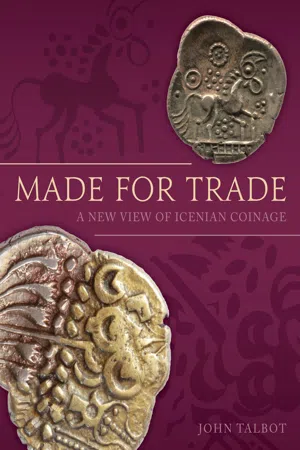
The Late Iron Age coinage of England has long been recognized as an invaluable potential source of information about pre-Roman Britain, although its purpose has been much debated and never clearly established. Most research using this source material has been either detailed numismatic studies, which seek to categorize and tabulate the types of coin and order them chronologically based on stylistic change, or more general attempts to draw out meaning from the imagery or inscriptions on the coins. In Made for Trade, John Talbot presents the findings of a decade-long investigation that has challenged many preconceptions about the period. The coinage of the Iceni in East Anglia was used as the raw material with a view to establishing its original purpose and what it can tell us about society and the use of coinage in the Late Iron Age of this region. A die-study was performed on every known example – over 10, 000 – coins. Each coin was created by a metal pellet being struck by two dies, and the die-study sought to identify the dies used in each of the 20, 000 strikes. Because dies wear, change and are replaced, this enabled definitive chronologies to be constructed and the underlying organization of the coinage to be fully appreciated for the first time. It is believed to be one of the largest such studies ever attempted and the first of this scale for British Iron Age coinage. Talbot further explores production, weight and metal content as the coinage evolved, the use of imagery and inscriptions, and patterns of hoarding. These various threads demonstrate that the coinage was economic in nature and reflected development of a more sophisticated monetary society than had previously been thought possible, contradicting many previous assumptions.
- 320 pages
- English
- ePUB (mobile friendly)
- Available on iOS & Android
eBook - ePub
Made for Trade
About this book
Trusted by 375,005 students
Access to over 1.5 million titles for a fair monthly price.
Study more efficiently using our study tools.
Information
Subtopic
ArchaeologyIndex
Social SciencesChapter 1
Introduction
1.1 Background and introduction
The English Late Iron Age saw the introduction of coinage across much of England – that much is clear. What is less clear is what this change tells us. Does the start of coinage reflect the creation of a hierarchical society, as is often thought? Was it issued by political leaders? It has even been proposed that the images of horses and men on the coins are symbols of the right to rule. How were the coins used? Were they simply used for military purposes or were they prestige gifts? Is it true that the quality of the imagery on the coins gradually degenerates and follows different rules to other forms of Late Iron Age art?
This book attempts to answer some of these questions by using evidence from my study of Icenian coinage. As we shall see, some of the results are surprising and many assumptions about the coinage need to be reconsidered.
1.2 The broad aims of the book
When I started to work on Icenian coinage my original objective was simply to understand how it was organised and the relative chronology of the various types of coin. In order to achieve this I undertook a die-study of all 10,000 known Icenian coins, identifying the individual dies that struck each coin. Key information about each coin, such as weight, findspot and dies were entered into an Access database. I was able to meet my objectives and obtained long chronologically ordered sequences of dies for many types. With the data from the die-study I realised that I had an opportunity to take the study further and examine the coinage’s scale, imagery, distribution, manufacturing accuracy and patterns of hoarding and how these changed with time.
This book records how this information was used as the evidence for broader conclusions about the use of the coinage, the organisation and location of its manufacture, and its original purpose in Late Iron Age East Anglia. It also examines what the coinage can tell us about the nature and organisation of society, and how that society and its belief systems may have been changed by its introduction. I have also attempted to see whether the echoes of historical events can be detected in the coinage and the extent to which it reveals the influence of Rome.
1.3 The structure of the book
Chapters 2 and 3 provide an overview of the structure of Icenian coinage, which was the original objective of the die-study. Chapter 2 mainly discusses the earliest Icenian coinages, but begins with a summary of even earlier coinages, which appear to have been present in East Anglia but were minted elsewhere. Chapter 3 covers the coinage of the denominational periods. In this I discuss the three main mints: how I identified them, their relative size, and the scale and distribution of their Issues. The types that make up each Issue are briefly discussed.
Chapters 4 to 6 each deal with specific features of the entire coinage, pulling the relevant evidence together in order to extract the maximum information. Chapter 4 deals with production and addresses the scale of the coinage; it covers metallurgy, weight accuracy, and the relationship between the various denominations. It also considers plated forgeries which provide evidence about early coinage use. Chapter 5 examines imagery and the inscriptions on the coinage. Key aspects of the imagery are each addressed, including hidden faces and a consideration of how imagery changed with time. I discuss the introduction of inscriptions on Icenian coinage and refer to previous etymological studies. Chapter 6 covers deposition; it summarises the data that I was able to extract from hoards and examines the nature of hoarding. This chapter provides many clues as to the nature and purpose of the coinage and shows that, contrary to expectations, hoarding was intermittent in East Anglia. The finds from two unusual sites are analysed, as are differences between the mix of coinage from hoards and site scatters. I consider overall coinage distribution as well as distribution by period, mint and denomination.
Chapter 7 summarises current thinking about Late Iron Age society, ancient economies and the use of early coinage. This is then considered in conjunction with the key findings from earlier chapters, and conclusions are drawn about the nature of Icenian coinage. It also addresses some broader questions about the Late Iron Age and the extent to which this study has provided additional insights and evidence.
A number of appendices are included that supplement the evidence detailed in this book. Appendix I is particularly important as it is the photographic record of the die-study. The plates in Appendix I follow the order of Chapters 2 and 3 and illustrate each die used in the coinage. The illustrations of coins throughout this book are not to scale, however 1.4x scale images of each die are presented in Appendix I. They show the number of known examples of each die combination and of brockages. Many examples of plated forgeries are also illustrated. Appendix IV provides a statistical summary of the die-study and the Esty forecasts of original die numbers (Esty formulae estimate original die numbers from surviving populations of dies and their applicability to Icenian coinage is discussed in Chapter 4). A glossary of terms used in the book is included as Appendix VII. This is intended to help readers who are unfamiliar with some of the numismatic terms used; the glossary includes a discussion about findspots and the sources of this information.
The chapters are referred to by Arabic numerals and are sub-divided into sections and sub-sections. The appendices have a similar structure but use Roman numerals for the appendix number. Cross-references within the book usually omit the words ‘chapter’ or ‘appendix’; these are readily identifiable by the type of numeral. The numbering of figures and tables is similar, using the appropriate form of numeral for chapter or appendix.
The remaining sections of this chapter give an overview of the background to the study. I begin with the Iceni and what has been learned from archaeology and other sources about East Anglia in the Late Iron Age. I explain, for those who have not studied coinage, why a die-study is such a valuable tool for extracting evidence from ancient coins. I briefly discuss previous work on Icenian coinage and finally provide an overview of the structure and scale of Icenian coinage as an introduction to the more comprehensive information in Chapters 2 and 3.
1.4 The Iceni and East Anglia in the Late Iron Age
The Iceni is the name commonly used for the inhabitants of Late Iron Age northern East Anglia. Most ancient references to the tribe relate to the period following the Roman conquest and particularly to the Boudiccan revolt of AD 60–1. The earliest reference to the tribe is probably as the Cenimagni, one of the five groups that surrendered to Caesar (The Gallic War 5.21). The next reference is not until after the conquest when Tacitus refers to the tribe of the Iceni revolting against their disarmament in AD 47, noting that the tribe had never previously fought against Rome (Annals 12.31).
Late Iron Age East Anglia has suffered from a lack of excavation and its major sites are poorly understood. Metal detecting and fieldwalking have revealed an extensive area of activity in and around Saham Toney on the northern edge of Breckland (Brown 1986; Davies 2008, 124–25), which has never been thoroughly investigated. Only limited excavation has been conducted at the famous site of Snettisham (Stead 1991; Hutcheson 2011; British Museum in preparation). Rescue archaeology resulted in the comprehensive excavation of a ritual site at Fison Way in Thetford (Gregory 1991), although this is within another major area of largely un-investigated Late Iron Age activity (Davies 2008, 120–25). The lack of attention afforded to East Anglia is starting to change as a result of the work by John Davies and others. Davies (2008, 109–18) emphasises the distinctive nature of Icenian culture, with unenclosed settlements and hillfort-type enclosures in west Norfolk and distinctive decoration on coinage and other artefacts.
There is little evidence of Icenian engagement with Rome: early amphorae are not present as they are to the south, and there is little obvious Roman influence upon the coinage. The region does seem to have been rich in horse equipment. Natasha Hutcheson (2004, 95–96), who has studied the metalwork of the region, speculates that wealth may have been displayed through ‘native’ artefacts and display, rather than Roman commodities.
Icenian coinage was struck in four denominations: Staters and Quarter Staters in gold alloy and Units and Half Units in silver or silver alloy (Fig. 1.1). It was produced for about a century up to the Boudiccan Revolt of AD 60/61. The coinage includes a number of inscribed types that bear a variety of names including Anted and Ecen, but there are no clear references to kingship.
Late Iron Age coinage distribution is commonly used to demonstrate the discrete identity of different regions, such as that inhabited by the Iceni (Fig. 1.2). The map shows all Icenian coinage finds (red dots), revealing a distribution across Norfolk, northern Suffolk and parts of fenland Cambridgeshire. It also shows the locations of the principal sites, areas and rivers discussed in this book. As we shall see, Icenian coinage was not a single coinage produced at a regional level on behalf of a tribe, but its overall distribution was reasonably consistent throughout its period of issue. It is not known if the Late Iron Age people of the region recognised themselves as part of a single tribe or grouping and if they did, whether they called themselves Iceni. Nevertheless, I will use the term Iceni, or Icenian, as convenient shorthand for both the inhabitants and their coinage. Similarly, I call the region East Anglia when discussing the more restricted geographic area in which the coinage circulated. The neighbouring region to ...
Table of contents
- Cover
- Title
- Copyright
- Contents
- Acknowledgements
- List of figures and tables
- Chapter 1. Introduction
- Chapter 2. The early local Icenian coinage and its predecessors
- Chapter 3. The mints and coinages of the denominational periods
- Chapter 4. Production: metallurgy, weight accuracy, minting and scale
- Chapter 5. Art, imagery and inscriptions
- Chapter 6. Searching for evidence from hoards and coin scatters
- Chapter 7. Conclusions
- References
- Appendix I. The die-study
- Appendix II. Metal analysis of silver coinage
- Appendix III. Metal analysis of gold coinage
- Appendix IV. Statistical summary of die-study and Esty estimates of die numbers
- Appendix V. Hoards
- Appendix VI. Concordance
- Appendix VII. Glossary
Frequently asked questions
Yes, you can cancel anytime from the Subscription tab in your account settings on the Perlego website. Your subscription will stay active until the end of your current billing period. Learn how to cancel your subscription
No, books cannot be downloaded as external files, such as PDFs, for use outside of Perlego. However, you can download books within the Perlego app for offline reading on mobile or tablet. Learn how to download books offline
We are an online textbook subscription service, where you can get access to an entire online library for less than the price of a single book per month. With over 1.5 million books across 990+ topics, we’ve got you covered! Learn about our mission
Look out for the read-aloud symbol on your next book to see if you can listen to it. The read-aloud tool reads text aloud for you, highlighting the text as it is being read. You can pause it, speed it up and slow it down. Learn more about Read Aloud
Yes! You can use the Perlego app on both iOS and Android devices to read anytime, anywhere — even offline. Perfect for commutes or when you’re on the go.
Please note we cannot support devices running on iOS 13 and Android 7 or earlier. Learn more about using the app
Please note we cannot support devices running on iOS 13 and Android 7 or earlier. Learn more about using the app
Yes, you can access Made for Trade by John Talbot in PDF and/or ePUB format, as well as other popular books in Social Sciences & Archaeology. We have over 1.5 million books available in our catalogue for you to explore.