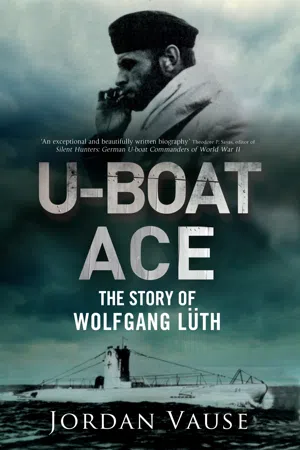
Wolfgang Luth was one of only seven men to win Germany's highest combat decoration. He operated in almost every theater of the undersea war from Norway to the Indian Ocean and he was the second most successful German U-boat ace in World War II. Luth is credited with sinking 47 Allied ships and a submarine – a record topped only by Otto Kretschmer. In 1944, after 16 war patrols, including one that lasted a record 203 days at sea, he was named the youngest Commandant of the German Naval Academy at age 30. Until the publication of this comprehensive study his accomplishments were overshadowed by other aces, to correct the neglect, Jordan Vause provides an entertaining, authoritative biography. Vause was intrigued after seeing a portrait of Luth as a midshipman on display and set out to learn all he could, tracking down some of Luth's crewmen and fellow U-boat commanders. He draws on their firsthand information and a variety of written documents to provide a fascinating character analysis. In doing so, he encapsulates the paradoxes inherent in so many German submarine commanders, men spawned by the Nazi regime yet not entirely of it. Vause portrays Luth as a man of contradictions: an agent Nazi ideologue who could bend the rules for a slack sailor, a U-boat ace who could treat survivors of his attacks with clemency but then impetuously gun down other victims in cold blood. Even his best friend admitted that Luth had no remorse for the misery he inflicted on the crews of sunken ships. On the night of May 13th 1945 he was accidentally shot and killed by a German sentry. On May 16th 1945 he was given the Third Reich's last state funeral.
- 256 pages
- English
- ePUB (mobile friendly)
- Available on iOS & Android
eBook - ePub
About this book
Information
Subtopic
Military BiographiesIndex
History1
Preparation
An early spring day in the North Atlantic, nothing in sight except the sea and the clouds. The sea was black and quietly speckled with moonlight, and the gray clouds only half concealed the stars in the sky. It was cold, very cold.
U-43 was four days out of port. The lookouts, four of them, yawned as they scanned the horizon in every direction. They were tired and they were wet, but still they stood and watched. They watched the water not for its beauty but for ships, the clouds not for birds but for bombers. The North Atlantic in 1941 was a killing ground. They were the hunters; they were the quarry.
“Ship!” called one of them suddenly. “Red Six Zero.” He pointed and the three beside him turned and looked. “I see it,” said another with a quiet whistle of amazement. Not a tanker, this one, not a tired old tramp; she was a fully rigged sailing ship, a big three-masted schooner. He called down the alarm.
Almost at once another man emerged. He had a dirty white cap on his head and a cigar in his mouth. “Good,” he shouted, clapping his hand on the lookout’s back, eyes following the boy’s outstretched arm. “What do you have for me?”
The boy grinned proudly. “A sailing ship, Herr Kaleu.” Wolfgang Lüth raised his binoculars. From the distant darkness the ship approached him soundlessly, a spirit of the sea. “About a mile,” he said through his cigar. “Very pretty.”
Two officers had followed Lüth up to the bridge. Hans-Joachim Schwantke, his second watch officer, had a look. “She is a pretty ship,” he agreed. The second man, a Konfirmand, a commander in training along only for the one patrol, asked if they were going to sink her.
“Of course,” replied Lüth impatiently. “But she isn’t worth a torpedo. “Schwantke, call away the gun crews. All of them. Get Becker up here. Let’s give him something to shoot at.”
The word was passed. A mad invisible scramble ensued belowdecks, then the gunners came up. They climbed down and out to the guns, putting on their lifejackets and buckling themselves into their lifelines. Boxes of ammunition were taken from the magazines and placed in the control room. The men formed a human chain from the control room to the bridge and from there to the gun mounts, ferrying up the boxes hand to hand. The bridge watch was doubled. Gunnery Officer Richard Becker and Obersteuermann Theodor Petersen appeared, Becker with glasses so that he could spot, Petersen with a megaphone so that he could relay Becker’s commands to the gun crews.
The sailing ship waited serenely; she and U-43 were now only 500 meters apart. “Watch,” said Lüth to the Konfirmand at his elbow. “I’m going to give the order to fire and when I do there’ll be hell on that ship.” Lüth stared at the sailing ship, completely absorbed, as the ammunition boxes were passed up around his legs.
“Clear for firing!” called Becker from the weather deck.
Lüth kept his eyes on the ship. He hesitated briefly, then cried, “Open fire!”
With a roar and a flash, the 105-mm cannon forward of the tower opened up on the sailing ship. The first shot was short; the second misfired. “Damn!” hissed Becker. The 20-mm machine gun in the bridge wouldn’t fire either. “Wet ammunition,” someone remarked laconically.
The silence resumed as U-43 moved closer to her target. A new box of 20-mm shells came up the chain. In flagrant disregard of established procedure the faulty shell was extracted from the cannon, carried hot across the deck, and tossed overboard. A new one was loaded.
“Clear for firing,” called Becker, this time not so loudly.
The cannon roared again, then a bang and a stutter heralded the two after guns, a machine gun in the bridge and a 37-mm gun on the main deck aft. The gun crews in U-43 were stale but they had no trouble finding their range. The schooner was almost on top of them and the first shot from the cannon hit her pilot house. It collapsed in a puff of smoke.
Now the besieged ship came alive, men pouring from her smoking interior. “Look,” shouted someone in the bridge, “they’re trying to launch their boats.” The third shot started a fire on the schooner’s decks. It spread quickly up the masts and into the rigging, burning hard and roaring higher with each additional shell until the entire ship was aflame.
No effort was made to save her. Two lifeboats got away safely, floating in a sea made orange by ashes and embers raining down from the sky. A column of smoke rose above the burning deck and into the clouds. “The foremast is going,” called a voice after several minutes. “The mizzenmast …”
“Like the Flying Dutchman,” the Konfirmand said nervously, but Lüth didn’t hear him. At that moment a freak wave swept up and over U-43’s tower. As it subsided, so did the deafening sound of the U-boat’s three guns. Turning toward the 105-mm cannon, Lüth saw that it was unmanned. The wave had washed one of its crew straight over the side. He was hanging by his lifeline and the rest were struggling to pull him in.
“What the hell are you doing?” Lüth screamed into the spray, jabbing a finger at the bonfire in the distance. “Keep shooting and let that bastard swim!”
“One of ours, Herr Kaleu,” Schwantke told him quickly.
The gunners hauled their shipmate back on board and scampered to their posts. The gun resumed firing, one round every minute with a high explosive followed by an incendiary. Meanwhile the two after guns continued with their driving barrage.
And they continued for almost an hour. The gun crews were soaked with sweat. Their backs hurt, their arms ached. The sailing ship was burning at the waterline, smoke billowing from her shattered hull. She was dying. After a while she rolled gently on her side. And still Lüth’s guns fired into the tangled wreckage, round after round, as she burned and he watched and all the men labored.1
What happened in the last six years of Wolfgang Lüth’s life, the war years, is as clear as the image of that ship he set burning one night in May 1941. The war itself has seen to it. His first twenty years are more obscure: “I was born on 15 October 1913, in Riga (Russia), the son of August Lüth. During the war I lived with my mother and my four brothers and sisters in Breslau, while my father was interned in Siberia. In 1921 we returned to Riga. I was educated there and completed my Abitur [exams] at a German high school, and I entered the German Navy in early 1933. In late 1936 I was promoted to Leutnant zur See, and in 1937 I entered the U-Bootwaffe as a watch officer. …”2 This single, sparse paragraph was written in 1942; it is what Lüth himself thought worth mentioning about his life. A few details can be added. Lüth was the fourth son and youngest child of August and Elfriede Lüth. His father operated a small business in Riga, a factory that produced fine knitwear. His grandfather Friedrich, for whom the business was named, had started it after moving east from Lübeck in the mid-nineteenth century. Among August Lüth’s customers was the Imperial Russian Army; Russian soldiers may have been wearing Friedrich Lüth’s clothing when World War I began in 1914. Nevertheless, August Lüth was interned in Siberia and his family evacuated to Breslau for seven years.
From the day they returned in 1921 until the day Wolfgang Lüth entered the navy in 1933, he lived in Riga. He was educated at the local Gymnasium until 1927, getting his Reifezeugnis, the equivalent of a highschool diploma, in 1929, and entering the prestigious Gottfried Herder Institute in 1931 to study law.3 His career seemed assured. Then, on 1 April 1933, only two months after Adolf Hitler became chancellor of Germany, Lüth left the institute to join the Reichsmarine.
He reported on that day to Stralsund, on the Baltic coast southeast of Denmark, and was assigned as a recruit to a small, scrubby island called Dänholm for basic infantry training. Stralsund was the first stage in the well-established, comprehensive training program for German naval officers; it was designed to ensure that only the best would make it to the second stage.
The three-month training at Stralsund was hard, conducted much like a modern-day boot camp. The recruits were treated as soldiers. They dressed in field gray, boots, and helmets, and they were issued rifles (all sailors, whether fresh recruits or not, were regarded primarily as soldiers in the Wehrmacht). They lived in barracks, drilled on parade fields, ran in formation, and scrambled through obstacle courses while drill instructors screamed at them. Not until they had successfully completed basic training were the new recruits even allowed to wear a naval uniform. Wolfgang Lüth completed the course.
After Stralsund came three months of training under sail, and for this Lüth was sent to the Reichsmarine training ship Gorch Fock. It would be interesting to know more about this stage of Lüth’s life. The experience of sailing on a tall ship is something a man never forgets, and it certainly has a formative effect on his career. Unfortunately there is no record of Lüth’s performance in Gorch Fock, or at Stralsund for that matter. Everything was lost or destroyed in the war.
To imagine him as a young seaman, one must draw on information from more informal sources. Lüth probably looked much as he did in later photographs. He was of medium height, slender, with blue eyes and a rather large nose. Perhaps he had more hair in his youth; during the war he was bald except for a band of hair around his head that made him look like a tonsured monk. His smile revealed a wide gap between his two front teeth. When he let his beard go during long war patrols, it grew from the jawline and left his cheeks bare. He was distinctive rather than handsome – once at a lecture on racial theory he was told he had the typical elongated head and facial features of the Bavarian nobility. This amused him to no end.4
Several members of Crew 33 remembered Lüth as a young man. Jürgen Oesten, also a successful U-boat commander, thought him quiet, almost introverted. He was not a cheerful person, but he did not lack for humor. “Lüth was a Balt,” wrote Oesten without elaboration, as if this simple fact of his birth explained everything about him.5 Perhaps it did.
Riga was a major Baltic port and a primary outlet for products like Russian lumber and furs. Merchant ships left its docks every day for Western Europe and beyond. The Germans had lived in Riga since the days of the Teutonic Knights; they were responsible for its position as a trading center since the days of the Hanseatic League, four centuries later. By 1913 the German community represented a large section of Riga’s population.
Riga was also the capital of Latvia, a small Baltic province of the vast and decaying Russian Empire. When Lüth was born in 1913, Russia was celebrating 300 years of Romanov rule, the last fifty years of which were a trying experience for the Baltic states in general and for the German community of Riga in particular. Friedrich Lüth had arrived in Riga just at the inception of Tsar Alexander III’s policies of “russification,” that is, his systematic search for and destruction of all that was foreign to Russian culture and tradition. Although Latvia and the two other Baltic states, Lithuania and Estonia, were given their independence at the end of the war, repression did not end. The old policy of russification became the new one of “latvianization” – a more benign form of persecution, but similar in its ends.
A large number of Baltic Germans, including the Lüths, were nevertheless determined to stay. To live in Riga as a German, in a society within a society and continually under siege, was bound to have its effect upon a young man like Wolfgang Lüth. Most people who knew him agree; and his Baltic roots are usually invoked when he is discussed. In particular, it may explain his wholesale embrace of National Socialism.
During Lüth’s childhood the German nation had been transformed. The old empire was gone, swept away in World War I. Germany had been defeated in battle, humiliated by the terms of peace, and bankrupted by the awful reparations it was forced to pay. It had been divided physically, and without having moved a step, many of its citizens now lived in foreign, often hostile, countries. The republican leaders of postwar Germany tried to restore their people’s vanquished pride and national identity, but in this they failed. By the time Lüth entered law school, Germany was heading toward National Socialism. Both he and his country had been ready to accept it for some time.
National Socialism lifted the banner of a united German nation, the elusive Grossdeutschland in which all true Germans dwelt and from which all minorities, undesirables, and non-Germans were to be excluded. Presumably this nation would include the German-speaking regions of Eastern Europe. Those who had persecuted the German people within their own boundaries – including Latvia and certainly the Soviet Union – could expect to be punished. National Socialism offered a remedy to the shame of Versailles, an injustice that was never really in dispute and that grated on Germans outside as well as inside the fatherland’s official boundaries.
Apparently, the new doctrine was accepted with various degrees of enthusiasm in the family of August Lüth.6 Wolfgang himself wholeheartedly embraced National Socialism; this is evident in his later writings. It was probably no coincidence that he entered the service so soon after a National Socialist government was formed in Germany.
After his training in Gorch Fock, Lüth was sent to the light cruiser Karlsruhe, a training ship in which cadets of the Reichsmarine became, for a while, ordinary seamen. That they should experience the “other side” of life in the navy and thus better understand those whom they would eventually have to command was considered necessary for officer candidates. Lüth embarked on 23 September 1933, newly promoted to Seekadett. Between October 1933 and June 1934, as he and his classmates toiled on her deck plates and in her engine rooms, Karlsruhe sailed around the globe, from Germany, through the Straits of Gibraltar and the Mediterranean Sea, to Aden, Calcutta, Brisbane, Honolulu, and Boston.
The cruise aboard Karlsruhe was probably the greatest learning experience of Wolfgang Lüth’s life. During those eight months he walked the streets of port after port, where he came face to face with his future enemies – men who were friendly, men who had families like his, and men who were as prepared to die as he. An unpublished Kriegsmarine manuscript describing the training of a German naval officer had this to say about world cruises of German ships: “Of other nations and always outside the vision of one’s own, the young seaman stands as a representative of his people. He knows that his country is judged as he is judged, and he therefore recognizes early on the importance of strict self-discipline and an increased sense of personal responsibility. The impressions he gets of other lands and other peoples, their circumstances, their opinions and peculiarities, teach him to look upo...
Table of contents
- Cover
- Title
- Dedication
- Copyright
- Contents
- List of Equivalent Ranks (World War II)
- 2018 Foreword to U-Boat Ace
- Foreword
- Preface
- Introduction
- Chapter 1 Preparation
- Chapter 2 All Beginnings Are Difficult
- Chapter 3 The Iron Cross Boat
- Chapter 4 A Night of Long Knives
- Chapter 5 The Balt and His Men
- Chapter 6 The End of Happy Times
- Chapter 7 Problems of Leadership
- Chapter 8 “Good Luck and Good Shooting!”
- Chapter 9 The Second Lüth
- Chapter 10 Death and Flying Fishes
- Chapter 11 The Long Patrol
- Chapter 12 Evening Song
- Chapter 13 Afterword
- Notes
- Bibliography
Trusted by 375,005 students
Access to over 1.5 million titles for a fair monthly price.
Study more efficiently using our study tools.
Frequently asked questions
Yes, you can cancel anytime from the Subscription tab in your account settings on the Perlego website. Your subscription will stay active until the end of your current billing period. Learn how to cancel your subscription
No, books cannot be downloaded as external files, such as PDFs, for use outside of Perlego. However, you can download books within the Perlego app for offline reading on mobile or tablet. Learn how to download books offline
Perlego offers two plans: Essential and Complete
- Essential is ideal for learners and professionals who enjoy exploring a wide range of subjects. Access the Essential Library with 800,000+ trusted titles and best-sellers across business, personal growth, and the humanities. Includes unlimited reading time and Standard Read Aloud voice.
- Complete: Perfect for advanced learners and researchers needing full, unrestricted access. Unlock 1.5M+ books across hundreds of subjects, including academic and specialized titles. The Complete Plan also includes advanced features like Premium Read Aloud and Research Assistant.
We are an online textbook subscription service, where you can get access to an entire online library for less than the price of a single book per month. With over 1.5 million books across 990+ topics, we’ve got you covered! Learn about our mission
Look out for the read-aloud symbol on your next book to see if you can listen to it. The read-aloud tool reads text aloud for you, highlighting the text as it is being read. You can pause it, speed it up and slow it down. Learn more about Read Aloud
Yes! You can use the Perlego app on both iOS and Android devices to read anytime, anywhere — even offline. Perfect for commutes or when you’re on the go.
Please note we cannot support devices running on iOS 13 and Android 7 or earlier. Learn more about using the app
Please note we cannot support devices running on iOS 13 and Android 7 or earlier. Learn more about using the app
Yes, you can access U-Boat Ace by Jordan Vause in PDF and/or ePUB format, as well as other popular books in History & Military Biographies. We have over 1.5 million books available in our catalogue for you to explore.