eBook - ePub
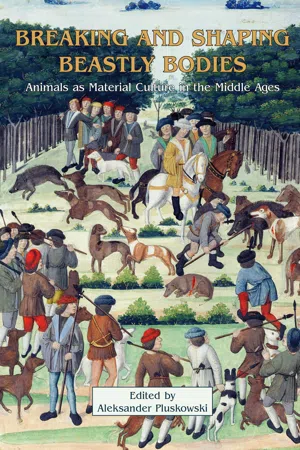
Breaking and Shaping Beastly Bodies
Animals as Material Culture in the Middle Ages
- 240 pages
- English
- ePUB (mobile friendly)
- Available on iOS & Android
eBook - ePub
Breaking and Shaping Beastly Bodies
Animals as Material Culture in the Middle Ages
About this book
An important human trait is our inclination to develop complex relationships with numerous other species. In the great majority of cases however, these mutualistic relationships involve a pair of species, whose co-evolution has been achieved through behavioural adaptation driving positive selection pressures. Humans go a step further, opportunistically and, it sometimes seems, almost arbitrarily elaborating relationships with many other species, whether through domestication, pet-keeping, taming for menageries, deifying, pest-control, conserving iconic species, or recruiting as mascots. When we consider medieval attitudes to animals we are tackling a fundamentally human, and distinctly idiosyncratic, behavioural trait. The sixteen papers presented here investigate animals from zoological, anthropological, artistic and economic perspectives, within the context of the medieval world.
Information
Subtopic
AnthropologyIndex
Social SciencesChapter 1
Thinking About Beastly Bodies
Terry O’Connor
People’s attitudes to animal bodies go right to the heart of the business of being human. Our increasingly detailed, yet spectacularly incomplete, knowledge of the behavioural complexity of other species has serially quashed many of the claims that have been made for human uniqueness. We use the manufacture of simple artefacts as a proxy indicator of human-like behaviour amongst early hominins, yet Man the Tool-Maker shares that skill with, amongst others, chimpanzees, crows and sea-otters (Boesch 2003). Similarly, as the fossil record pushes upright walking further back into the Pliocene, Man the Biped no longer looks quite so clever (Harcourt-Smith and Aiello 2004). Is there anything, apart from industrialised warfare and cricket, which our species is uniquely good at?
An important human trait is our inclination to develop complex relationships with numerous other species. In its simplest form, this is not unique. Mutualism exists throughout the biosphere, with some pairs of species, such as ants and aphids, evolving elaborate and highly successful relationships to mutual benefit (De Mazancourt et al. 2005). In the great majority of cases, however, these mutualistic relationships involve a pair of species, whose co-evolution has been achieved through behavioural adaptation driving positive selection pressures. Humans go a step further, opportunistically and, it sometimes seems, almost arbitrarily elaborating our relationships with many other species, whether through domestication, pet-keeping, taming for menageries, fetishising, deifying, anthropomorphising, exterminating vermin, conserving iconic species, or recruiting as mascots (what is it about military regiments and goats?). That complex web of relationships extends after the death of the animal, ranking some animal foods or particular skins and furs above others. In some instances, we can argue that these rankings reflect availability or some particular functional attribute of a raw material. A well-known example is the selection of reindeer and wolverine fur for different components of the traditional Inuit parka, making optimal use of the different insulating properties of two readily-available animal resources (Cotel et al. 2004). In other instances, restricted availability may cause a raw material to be ranked more highly than one of almost indistinguishable appearance and working properties. Thus, a netsuke figure carved from the upper incisor tooth of an elephant will be prized over one carved from a tangua nut, which in turn outranks one cast from plastic (fig. 1.1). Human attitudes to other animals, it seems, are characteristically complex and range from the strictly utilitarian to the highly conceptualised and culture-specific. When we consider medieval attitudes to animals before and after death, therefore, we are tackling a fundamentally human, and distinctly idiosyncratic, behavioural trait.
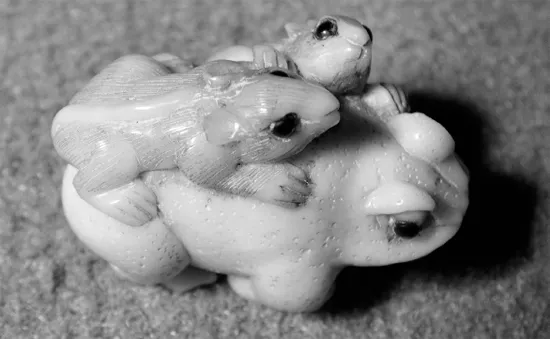
Fig. 1.1. Frog and mouse figure, carved in tangua nut to mimic ivory.
A zooarchaeological perspective
Those of us who approach medieval animals primarily through the zooarchaeological record of old bones have to balance three strands of investigation. The bones are the fossils of long-dead animals, which had their own distinctive biology and ethology. Their death assemblage, and therefore the recovered assemblage that we study, will to some degree reflect that biology and ethology. For example, bones of frogs are occasionally very abundant in medieval archaeological deposits (e.g. O’Connor 1988, 106–7, 113). We do not need to postulate mysterious anuran cults to explain this phenomenon: frog behaviour and ecology lead them to be locally abundant in life and particularly susceptible to catastrophic death en masse. The same does not apply to cats, so a concentration of cat bones in a medieval pit would require a different form of explanation (Luff and Moreno-Garcia 1995). The bones are also sediment clasts, sometimes the most abundant large particles in an archaeological sediment (Wilson 1996). A range of familiar geomorphic processes, such as downslope colluviation and hydrodynamic sorting, will cause the differential movement of different particle sizes, and may thus bring about patterning in the distribution of bones in the archaeological record. Although the world of medieval archaeology may seem somewhat removed from the more familiar terrain of geomorphology, those same processes will be acting on dumps and yard surfaces and in pitfills. We need a taphonomic analysis of our medieval material just as much as we would for a Lower Palaeolithic assemblage, in order to identify the signature that the processes of death, biostratinomy and diagenesis have left on our assemblage. Finally, of course, the bones are the residue of past human activity, susceptible to archaeological study, and reflecting the decisions and pre-occupations of people of a particular time and place. That decision-making will have influenced the composition of the life-assemblage from which our archaeological sample derives (e.g. by deciding that a particular species shall be excluded from the diet), and it will have affected the post-mortem taphonomy of the bones (e.g. by imposing rules regarding the disposal of organic refuse). As zooarchaeologists, our distinctive challenge is to understand bones as fossils and clasts, in order to understand them all the more clearly as evidence of that decision-making, and thus as archaeology.
Attitudes to animals
Like charity, ethnography begins at home. Our own attitudes to animals as food, labour, clothing and symbol make a useful starting point for discussing medieval beasts. Even the familiar role of animals as food is richly complex and contentious. In some contemporary societies, many individual people and certain religious sects contend that the use of animals for food is essentially immoral. The time-depth of vegetarianism on moral precepts is unknown, and this is not the place to plumb that particular abyss. We should note, however, that intermittent avoidance of meat on fast days has long been a feature of western Christendom, and thus of medieval Europe. How far that avoidance was driven by a sense of moral obligation towards the beasts, and how far by the need to manifest social identity by the imposition of consumption laws, is a matter for debate. Even the decision to eat or to avoid meat is tempered by pragmatism or indecision. In early 21st-century Britain, some ‘vegetarians’ will consume fish and shellfish, thus apparently making a distinction between endothermic and ectothermic animals, with a lessened moral obligation towards the latter. Others will even eat poultry whilst avoiding ‘red’ meats such as beef or lamb, implying a yet more subtle categorisation that owes little to biological taxonomy. Similar decisions are made by omnivores, too: the writer of this paper will cheerfully eat rabbit or horse, but not veal.
The avoidance of some foods on ethical or religious grounds (and the followers of a religion will generally assert that their practices are grounded in ethics) is sufficiently well-known to have had some archaeological investigation (Daroczi-Szabo 2004). A good example is Ijzereef’s work in Amsterdam (Ijzereef 1989). From an analysis of pit-fills from tenements in a neighbourhood known to have had a substantial Jewish population, Ijzereef was able to show that some refuse assemblages lacked bones of pork and eel, both of which are forbidden by Jewish dietary prohibitions (Leviticus chap. 11; Deuteronomy chap. 14). Species-specific prohibition is thus identifiable in the zooarchaeological record, at least given high context integrity and excellent standards of archaeological recovery. Fast-day avoidance of all meat would seem to be logically impossible to detect, but for the helpful fact that Christianity not only does not classify the flesh of fishes as ‘meat’, but goes a step further by grouping a number of marine birds and mammals as honorary fish. This raises the intriguing possibility that the refuse of particularly observant Christian households or communities would occasionally include assemblages rich in the bones of fish, barnacle geese, and maybe the odd beaver. But could we recover and recognise such assemblages? The taphonomic trajectory would be crucial, as any time-averaging or spatial mixing of refuse before or during final deposition would blur the distinctive attributes of the original refuse assemblages. The debris of religious houses would seem to offer the best chance of finding such examples. However, even the Dominican Friary at Beverley, East Yorkshire, failed to give an unambiguous ‘Christian fast’ assemblage, despite excellent context integrity and excavations in and around the kitchens (Gilchrist and O’Connor 1996). Ironically, it may be that dedicated adherence to a religious ethic is to blame, with ‘meat’ meals being prepared for charitable distribution even while the brothers were making do with salt herring. In short, were it not for the historical record, the adherence of medieval Christianity to Lenten and Friday fasts would not be inferred from the zooarchaeological record alone.
Apart from religious and ethnic identity, animals as food serve to signify other, often subtle, distinctions of region, wealth and status (which may or may not be the same as wealth). The regional associations of certain foodstuffs are familiar enough. Within England, the bovine stomach – tripe – is generally associated with the urban north, as part of a cultural package that includes whippets, flat caps and rugby league. The fact that all of those ‘northern’ attributes are to be found fairly generally throughout the country has done little to weaken the association. In fact, there are two quite different aspects to regionalisation in animal foods, both of which have the potential to be recognised archaeologically. First, there is the simple matter of some parts of a larger region favouring certain joints of meat or particular edible offal, leading to the possibility that bones butchered in a distinctive way will be encountered commonly in one region but not in another. This has interesting ramifications for the academic process: it is common for colleagues working on assemblages that originated in sites many miles apart to meet up at conferences and workshops to discuss the detail of their old bones. Evidence of regional identities in butchery may show up at such discussions in the form of cut-marks or element distributions that are familiar to one zooarchaeologist but quite unfamiliar to others working on material of similar date. We return to an example of distinctive butchery below.
The second aspect of food regionalisation is familiar from the present day, yet lacks serious archaeological analysis. When people migrate from their ‘homeland’ into an unfamiliar host culture, they tend to retain some familiar cultural attributes from that homeland, and food is often an expression of that retention (Wikkramatileke and Singh 1970; Sheikh and Thomas 1994; Wyke and Landman 1997). Present-day North American cuisine (salt beef, bagels, burgers, tacos) reflects the origins of many of the groups that have colonised that continent, and the assimilation of the South Asian curry into the British diet, although in part a hang-over from Imperial times, is largely a consequence of immigrant groups retaining something familiar from home. The archaeology of this process is seriously under-studied, perhaps because the topic of migration is seen as a relic of a culture-historical paradigm which archaeology would like to think it has outgrown. However, we know for a plain historical fact that people moved around Europe between the 8th and 16th centuries, and there is at least the possibility of investigating the movement of regionally-distinctive foods and means of food preparation. Urban assemblages from eastern England rarely show much of a change in animal utilisation across the mid-11th century, suggesting that the Norman Conquest involved comparatively small numbers of influential people, rather than the substantial migration that might have brought a distinctive cuisine in its wake. However, this association of an altered cuisine with a migrating people may itself be too simplistic. Recent European history shows that cultural influences from one region to another, without substantial migration, may trigger different gastronomic responses in those keen to adopt the new influences and those who wish to conspicuously reject them. Le Blanc (1999) discusses the subject in the context of mid-19th century Russia, showing how food choices became a means of showing one’s acceptance or rejection of the pervasive French influence, to such an extent that the food choices of fictional characters could be used to signal their cultural attitudes. At times of cultural change or exogenous influence, here is another potential cause of intra-site variation in the use of beastly bodies.
Other attitudes to animals may be susceptible to change across regions and through quite short periods of time. Within this writer’s lifetime, the wearing of fur has moved from being a luxury to which to aspire to becoming a highly contentious act that invites forceful objection. This change in attitude has been rapid, and its archaeological correlates have been few and often distant from the craft itself. A future zooarchaeologist noting the sharp decline of water vole (Arvicola terrestris) in the late-20th century would be unlikely to make the link with a decline in the wearing of fur. However, large numbers of mink have been ‘liberated’ from fur-producers into the surrounding countryside by anti-fur activists. Mink are highly effective predators of water voles, and their impact on vole populations is likely to be one of the most visible and long-lasting effects of the change in attitudes to wearing fur. Over a similarly short period of time, attitudes to the use of animals for labour have changed. In the early-20th century, ponies worked in mines, horses hauled carts and ploughs, and mules moved field artillery around the battlefield. By the end of the century, attitudes in northern Europe had changed to such an extent that attempts were commonly made to export that same level of concern for equine welfare to parts of the world where horses and donkeys were still a vital source of haulage. An interesting footnote to this change of attitude lies in our zoological museums. Across Europe and North America through the later 19th and 20th centuries, hundreds of thousands of mules were used and died, yet only a handful of their skeletons persist in museums, far fewer than, say, the skeletons of gorillas. Peculiar attitudes to dead beasts persist even in modern scientific institutions!
The medieval period: does familiarity breed disrespect?
None of the above is altogether surprising. We know from our own lives and experiences that attitudes to animals, live and dead, are regionally-specific and subject to rapid change. Why is it, then, that we so often transfer contemporary value-judgements (prime meat joints, waste, high-status foods) onto the medieval world?
Maybe the problem is that the medieval period is too recent, too familiar, too nearly contiguous with our own. In England, we are dealing with a period that is deceptively familiar from the survival of medieval buildings, from school history lessons, from more-or-less authentic period reconstructions, and from the survival of later medieval texts that are in something almost recognisable as English. The medieval period is a part of our modern world, most obviously in towns such as York or Chester, and it is so very easy to project onto that world our own attitudes and values. There is a major problem, too, with the casual way that we refer to ‘the medieval period’ to encompass some eight centuries of cultural upheaval and social change. To a zooarchaeologist with an interest in this island’s natural history, the landscape of Tudor England seems quite familiar, whereas the patterns of land-use and the flora and fauna of 9th century England would probably have looked very unfamiliar. ‘The medieval period’ is the time in which all of that changed, and during which many of the introductions and extinctions that made our contemporary natural history happened.
Apart from differences in farming strategies and wildlife, our transference of values into the medieval centuries assumes a familiarity with the medieval mind that we would not assume for prehistoric periods. Is that justifiable? This is where we need all of the other disciplines that study the medieval world. Do the plot-lines of medieval romances suggest similar minds at work? Does the art speak to us as it presumably did to its contemporary audience? In the latter case, probably not, as the apparent weirdness of thought portrayed by artists such as Hieronymus Bosch (c. 1450–151...
Table of contents
- Cover
- Title
- Copyright
- Contents
- 1 Thinking About Beastly Bodies (Terry O’Connor)
- 2 Medieval Bone Flutes in England (Helen Leaf)
- 3 The Middle Ages on the Block: Animals, Guilds and Meat in the Medieval Period (Krish Seetah)
- 4 Communicating through Skin and Bone: Appropriating Animal Bodies in Medieval Western European Seigneurial Culture (Aleksander Pluskowski)
- 5 Taphonomy or Transfiguration: Do we need to Change the Subject? (Sue Stallibrass)
- 6 Seeing is Believing: Animal Material Culture in Medieval England (Sarah Wells)
- 7 The Beast, the Book and the Belt: an Introduction to the Study of Girdle or Belt Books from the Medieval Period (Jim Bloxam)
- 8 The Shifting use of Animal Carcasses in Medieval and Post-medieval London (Lisa Yeomans)
- 9 Hunting in the Byzantine Period in the Area between the Danube River and the Black Sea: Archaeozoological Data (Luminiţa Bejenaru and Carmen Tarcan)
- 10 Chasing the Ideal? Ritualism, Pragmatism and the Later Medieval Hunt in England (Richard Thomas)
- 11 Taking Sides: the Social Life of Venison in Medieval England (Naomi Sykes)
- 12 Animals as Material Culture in Middle Saxon England: The Zooarchaeological Evidence for Wool Production at Brandon (Pam Crabtree)
- 13 Animal Bones: Synchronous and Diachronic Distribution as Patterns of Socially Determined Meat Consumption in the Early and High Middle Ages in Central and Northern Italy (Marco Valenti and Frank Salvadori)
- 14 People and Animals in Northern Apulia from Late Antiquity to the Early Middle Ages: Some Considerations (Antonella Buglione)
- 15 Animals and Economic Patterns in Medieval Apulia (South Italy): Preliminary Findings (Giovanni de Venuto)
- 16 Breaking and Shaping Beastly Bodies: Animals as Material Culture in the Middle Ages: Final Discussion (Pam Crabtree)
Trusted by 375,005 students
Access to over 1.5 million titles for a fair monthly price.
Study more efficiently using our study tools.
Frequently asked questions
Yes, you can cancel anytime from the Subscription tab in your account settings on the Perlego website. Your subscription will stay active until the end of your current billing period. Learn how to cancel your subscription
No, books cannot be downloaded as external files, such as PDFs, for use outside of Perlego. However, you can download books within the Perlego app for offline reading on mobile or tablet. Learn how to download books offline
We are an online textbook subscription service, where you can get access to an entire online library for less than the price of a single book per month. With over 1.5 million books across 990+ topics, we’ve got you covered! Learn about our mission
Look out for the read-aloud symbol on your next book to see if you can listen to it. The read-aloud tool reads text aloud for you, highlighting the text as it is being read. You can pause it, speed it up and slow it down. Learn more about Read Aloud
Yes! You can use the Perlego app on both iOS and Android devices to read anytime, anywhere — even offline. Perfect for commutes or when you’re on the go.
Please note we cannot support devices running on iOS 13 and Android 7 or earlier. Learn more about using the app
Please note we cannot support devices running on iOS 13 and Android 7 or earlier. Learn more about using the app
Yes, you can access Breaking and Shaping Beastly Bodies by Aleksander Pluskowski in PDF and/or ePUB format, as well as other popular books in Social Sciences & Anthropology. We have over 1.5 million books available in our catalogue for you to explore.