A look at how warfare affected—and was affected by—women in ancient times.
Although the conduct of war was generally monopolized by men in the Greco-Roman world, there were plenty of exceptions, with women directly involved in its direction and even as combatants—Artemisia, Olympias, Cleopatra, and Agrippina the Elder being famous examples. And both Greeks and Romans encountered women among their barbarian enemies, such as Tomyris, Boudicca, and Zenobia.
More commonly, of course, women were directly affected as noncombatant victims of rape and enslavement as spoils of war, and this makes up an important strand of the author's discussion. The portrayal of female warriors and goddesses in classical mythology and literature, and the use of war to justify gender roles and hierarchies, are also considered. Overall, this is a landmark survey of women's role in, and experience of, war in the Classical world.
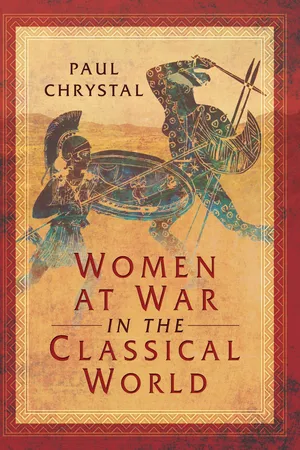
- 272 pages
- English
- ePUB (mobile friendly)
- Available on iOS & Android
eBook - ePub
Women at War in the Classical World
About this book
Information
Subtopic
Ancient HistoryIndex
HistoryPART ONE
GREECE
Chapter 1
Goddesses and War in Greek Mythology
Greek goddesses play a significant role in the prosecution of war among mortals. Enyo, Athena, Hera and Thetis all have a major responsibility for aspects of warfare. Victory too, Nike, was a female goddess. However, despite the pre-eminence of female divinities, the father of the gods himself, Zeus, had some patronising advice for Aphrodite (Iliad 5.330–430) when she emerged injured from the battlefıeld wounded by Diomedes: war is not for you, my child: you stick to the marriage bed – Ares and Athena will look after military affairs.
Enyo was goddess of war and calamitous destruction, partner of the war god Ares. She is also his sister Eris, and daughter of Zeus and Hera.1 She is the mother of the war god Enyalius, god of soldiers and warriors, by Ares.2 The wholesale destruction of cities was Enyo’s speciality; she is ‘supreme in war’ and a frequent fighter alongside Ares.3 She was particularly active during the fall of Troy, where she handed down terror and carnage along with her dreadful stable mates Eris (Strife), Phobos (Fear) and Deimos (Dread), the latter two being two sons of Ares. Eris, and the two sons of Ares, are depicted on Achilles’ shield.
Enyo was implicated in the Seven Against Thebes and in Dionysus’ war with the Indians.4 When she elected not to take sides in the battle between Zeus and the monster Typhon, it was because this decision would extend the duration of the conflict, so much so did she delight in war: ‘Eris (Strife) was Typhon’s partner in the melee, Nike (Victory) led Zeus into battle … impartial Enyo held equal balance between the two sides, between Zeus and Typhon, while the thunderbolts with booming shots danced like dancers in the sky’.5 Enyo was one of the three Graiae – three grotesque-looking sisters who shared one eye and one tooth between them.6 Aeschylus describes them best in a horrid vignette:
the Gorgonean plains of Kisthene where the daughters of Phorkys dwell, ancient maids (δηvαιαι κoραι), three in number, shaped like swans (κʋκνηoρϕoι), possessing one eye among them and a single tooth; neither does the sun beam down on them, never the nightly moon. And near them are their three winged sisters, the serpent-haired Gorgons, hated by mankind: no mortal will look at them and live to tell the tale.7
Athena was something of a paradox: her divine portfolio included wisdom, inspiration, enlightenment, law and justice, mathematics, the arts, crafts and skill – all peaceful, all constructive and civilising. She was patroness of weaving, that badge of the ideal Greek wife, mother and homemaker. However, she was also goddess of military strategy, and she takes credit, as Athena Hippeia, as inventor of the chariot, and was patroness of the metals used for weaponry, thus adding a bellicose aspect to her currulum vitae. Indeed, when Athena was born from Zeus’ head, not only was she already fully grown, but she emerged wearing a full suit of armour. As Athena Promachos she was Athena ‘who fights from the front’. When her attempts at diplomacy to prevent the Trojan War failed, she was on the side of the Greeks giving sound advice and encouragement, especially to Achilles; she saved Menelaos from the arrow of Pandaros, and diverted the spear of Diomedes to injure Ares. The mighty bronze Athena Promachos statue fashioned by Pheidias from the Persian spoils at the Battle of Marathon showed Athena standing with her shield resting upright against her leg, and a spear in her right hand; it towered between the Propylaea and the Parthenon on the Acropolis, a highly visible symbol of female belligerence. In contrast, however, with her more violent, blood-crazed brother, Ares, Athena showed a more considered and analytical attitude to war in her role as military strategist. Conflict and war were last options for Athena, deployed only when all diplomacy had proved unsuccessful.
Hera too played a major part in the Trojan War and in its depiction by Homer in the Iliad; she loathed the Trojans with a vengeance after Paris decided that Aphrodite, and not her, was the most beautiful goddess; accordingly, she spent the next ten years doing her best to disadvantage the Trojan forces and support the Greeks during the war. She persuaded Athena to side with the Greeks and in Book 5, conspires with Athena to harm Ares, who was assisting the Trojans. Book 8 sees Hera attempting to enlist Poseidon’s support for the Greeks but he refuses. Hera’s machinations continue in Book 21 when she orders Hephaestus to prevent the river from harming Achilles. Hephaestus sets the battlefıeld on fire; the river implores Hera to stop the attack with the promise to help the Trojans.
Thetis was a Nereid, but our interest in her is as the divine mother of Achilles, and how she influenced the actions of her son in the Trojan War. Achilles, in Book 1 (1.400f.) of the Iliad describes Thetis’ credentials as a warlike goddess when she defended Zeus in an attempted coup by three Olympians, namely Hera, Poseidon and Pallas Athene, by installing the terrifying Giant ‘monster of the hundred arms whom the gods call Briareus’ as a guard. She was, of course, implicated in the cause of the Trojan War since it was her wedding to which Eris was not invited which led to the fateful Judgement of Paris and the Trojan War itself. Thetis plays a major and significant role advising Achilles during the final year of the war, particularly after the death of Patroclus. She advises patience and caution to which Achilles adheres, even when urged by Hera, via Iris, to rejoin the fray. Thetis is also instrumental in having a splendid suit of armour made for Achilles by Hephaestus – greaves, shield, helmet and breastplate – armour that helps him to slay Hector. She was there for him when he was utterly demoralised by the loss of Briseis, the love of his life. She was there for him when he fretted about the decomposition of Patroclus’ body and embalmed the corpse with preserving ambrose and nectar. She was there for him when he risked annoying the gods by retaining Hector’s corpse – intending to mutilate it, only releasing it when Thetis, on the bidding of the gods, advises him to do so.
Enyo, Athena, Hera and Thetis were not the only female divinities associated with war. As in many other aspects of ancient Greek life, a whole host of goddesses and female spirits were on hand to oversee and patronise the minutiae of war and conflict; a selection of these are described below.
Alala, spirit of the war cry from the onomatopoeic ἀλαλή (alalē) and the verb ἀλαλάζω (alalazō), ‘to raise the war-cry’, reputed to be from the eerie sound owls make. Pindar references her: ‘Listen! O Alala, daughter of Polemos! Prelude of spears! To whom soldiers are sacrificed for their city’s sake in the holy sacrifice of death.’8 She is the daughter of Polemos and niece to Enyo; her uncle was Ares.
The Androktasiai were the female spirits of battlefıeld slaughter; Hesiod in the Theogony gives their mother as Eris, Strife, and some fairly unsavoury siblings as Ponos (Hardship), Lethe (Forgetfulness), Limos (Starvation), Algae (Pains), Hysminai (Battles), Makhai (Wars), Phonoi (Murders), Neikea (Quarrels), Pseudea (Lies), Logoi (Tales), Amphillogiai (Disputes), Dysnomia (Anarchy), Ate (Ruin) and Horkos (Oath).
Bia was the spirit of force and violent compulsion. She and her sister and brothers, Nike, Kratos (Strength) and Zelos (Rivalry), were constant companions of Zeus, an honour accorded after they helped Zeus in the war against the Titans.9
Erida was twin sister of Ares and goddess of hatred and blood-lust.
Eris, goddess of discord, chaos and strife, notably in battle – one of two goddesses of that name, the other being much more benign than ours, whom Homer in Book 4, 440 of the Iliad describes as: ‘Strife whose wrath is relentless, is the sister and companion of murdering Ares, she who is only a little thing at first, but then grows until she strides the earth with her head striking heaven. She then hurls down bitterness equally between both sides as she walks through the slaughter making men’s pain heavier. She also has a son whom she named Strife.’
The Hysminai were female spirits of fighting and combat descended from Eris. Quintus Smyrnaeus described them vividly in his Fall of Troy: ‘Around them hovered the relentless Fates; beside them Battle incarnate pressed forward yelling, and from their limbs streamed blood and sweat’.10
The Keres were female spirits of violent or cruel death, including death in battle and death by accident, murder or ravaging disease. They are characterised as dark beings with gnashing teeth and claws and with a thirst for human blood, hovering over the battlefıeld in search of dying and wounded men. A description of the Keres is in Hesiod’s Shield of Heracles: ‘The black Dooms – gnashing their white teeth, grim-eyed, fierce, bloody, terrifying – fought over the dying men: they were all longing to drink dark blood. As soon as they caught a man who had fallen or one newly wounded, one of them clasped her great claws around him and his soul went down to Hades, to cold Tartarus. And when they had sated their hearts with human blood, they would toss that one behind them and rush back again into the battle and the tumult.’11
There may be a link between Keres and various Celtic battlefıeld deities and the Norse Valkyries.12 The Makhai were spirits of fighting and combat, sons or daughters of Eris.13 Nike was a goddess who personifıed victory and was the divine charioteer, flying round battlefıelds rewarding the victors with glory and fame, in the shape of a wreath of laurel leaves. Otrera, wife of Ares, was goddess of violence and chaos, mother of the Amazons, daughter of Eurus, the east wind. Palioxis was the spirit of flight, and retreat from battle while Proioxis was spirit of battlefıeld pursuit.14
Chapter 2
Warlike Women in Homer
The eighth century brings us to Homer and his description of the Trojan War as fought out 500 years earlier in the thirteenth century BCE.
It is with Homer that we first meet the widely held axiom of the classical Greek and Roman worlds that war is man’s work while wool-working is the preserve of women: the two lie at opposite poles of Greek and Roman societal and gender convention and, according to most Greeks and Romans, never should the two meet or be confused. The one informs men, the other women; war is a badge of maleness, wool an emblem of the good wife and homemaker. Hector and Telemachus vocalise it quite clearly in Homer, and ever since it has echoed down through classical life and literature as a mantra to normal life and the much desired status quo. At the same time, though, it came under attack from a momentous gender role reversal in which some women went off warring and, occasionally, men are left holding the bobbins and shuttles. Like the stereotypes, it first manifests in Homer, specifically with Penthesilea the Amazon fighting Achilles.
The world, as we know, is not always normal. Herodotus is staggered to report that Egyptians are all crazy: ‘the women go to market and men stay at home and weave [the exact opposite to Greek practice]. Women even urinate standing up and men sitting down.’1 Aristophanes’ Lysistrata attests that war is as much the responsibility of women as it is of men, she turns the state upside down when she dresses up the proboulos (deputy) in women’s clothes and teaches him the ways of wool while she and her comrades take over the running of the city, the complicated affairs of which include the Peloponnesian War, a conflict that can be disentangled as a ball of wool (Lysistrata, 567ff). Elsewhere, an armoured Athena, female goddess, protects Athens while effeminate Cleisthenes has his shuttle; Diodorus (3.53) reports that the Amazon men of Libya stay at home, weave and look after the children while the women go out fighting wars; Pindar’s Cyrene eschews the loom and prefers to slay wild beasts with her sword (Pythian, 9.19–22); Euripides’ Ague goes one better, getting self-fulfilment by killing animals with her bare hands (Bacchae, 1236); the Bacchants too have deserted the loom for a life much more challenging; when he observes Artemisia’s military excellence and belligerence, a bemused Xerxes reflects that his men are acting like women and she like a man. The warlike Amazons consign their men to a life of woolworking. Throughout Greek and Roman history exceptional women are described as exhibiting andreia or virtus (bravery), with all the connotations of manliness and bravery.
It is this gulf between the norm and the reality, this ‘world-on-its-headness’, that provides the essence of this book: women who do war.
Men, of course, were the protagonists in the Trojan War: Homer’s Iliad tells of the ten-year conflict with Achilles, Patroclus, Hector, Agamemnon, Ajax, Aeneas and Deiphobus among the many alpha male warriors. But there would not have been a Trojan War without the involvement of women, both as the very casus belli itself and as characters who influenced the action and direction of the war. Helen, Queen of Sparta must take responsibility for causing the war when she allowed herself to be abducted by Paris, while Briseis and Chryseis both played a role far more influential than their status as spoils of war would suggest. Hector’s wife, later war widow, Andromache, tried to influence her husband’s actions and strategy, while ever-patient, faithful army wife Penelope, in the Odyssey, endured virtual widowhood for twenty years as she waited, and waited, in the hope that Odysseus would come back to her and dispel the repellent suitors circling around her shark-like, with an eye on her virtue. Achilles’ mother, Thetis, was, as we have seen, a significant influence in her son’s agonising decision – to fight or not to fight in the war against Troy.
Women, though, have no active role on this battlefıeld, with the notable exception of the Amazon, Penthesilea. However, Athena can be found there supporting her favourite heroes and Thetis it was who gave Achilles back his weapons to enable him to resume fighting. After Penthesilea, the nearest we come to active participation ...
Table of contents
- Cover
- Dedication
- Title
- Copyright
- Contents
- List of Plates
- Acknowledgements
- Abbrevations
- Introduction
- Women and War in Earlier Ancient Civilisations
- Part One: Greece
- Part Two: Women as Victims of War
- Part Three: Rome
- Part Four: Warrior Women in the Arts and Entertainment
- Epilogue
- Notes
- Bibliography
- Plate section
Trusted by 375,005 students
Access to over 1.5 million titles for a fair monthly price.
Study more efficiently using our study tools.
Frequently asked questions
Yes, you can cancel anytime from the Subscription tab in your account settings on the Perlego website. Your subscription will stay active until the end of your current billing period. Learn how to cancel your subscription
No, books cannot be downloaded as external files, such as PDFs, for use outside of Perlego. However, you can download books within the Perlego app for offline reading on mobile or tablet. Learn how to download books offline
Perlego offers two plans: Essential and Complete
- Essential is ideal for learners and professionals who enjoy exploring a wide range of subjects. Access the Essential Library with 800,000+ trusted titles and best-sellers across business, personal growth, and the humanities. Includes unlimited reading time and Standard Read Aloud voice.
- Complete: Perfect for advanced learners and researchers needing full, unrestricted access. Unlock 1.5M+ books across hundreds of subjects, including academic and specialized titles. The Complete Plan also includes advanced features like Premium Read Aloud and Research Assistant.
We are an online textbook subscription service, where you can get access to an entire online library for less than the price of a single book per month. With over 1.5 million books across 990+ topics, we’ve got you covered! Learn about our mission
Look out for the read-aloud symbol on your next book to see if you can listen to it. The read-aloud tool reads text aloud for you, highlighting the text as it is being read. You can pause it, speed it up and slow it down. Learn more about Read Aloud
Yes! You can use the Perlego app on both iOS and Android devices to read anytime, anywhere — even offline. Perfect for commutes or when you’re on the go.
Please note we cannot support devices running on iOS 13 and Android 7 or earlier. Learn more about using the app
Please note we cannot support devices running on iOS 13 and Android 7 or earlier. Learn more about using the app
Yes, you can access Women at War in the Classical World by Paul Chrystal in PDF and/or ePUB format, as well as other popular books in History & Ancient History. We have over 1.5 million books available in our catalogue for you to explore.