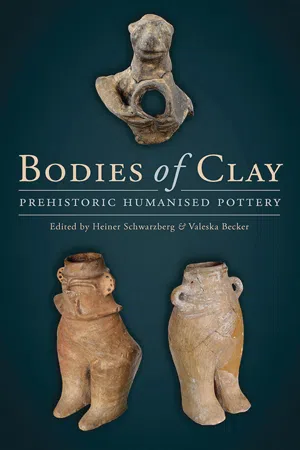
Since the earliest use of pottery, vessels have been associated with both the general shape and specific parts of the human body. The production of human-shaped pottery might be understood as one element of the spectrum of figural art in prehistoric communities. The idea of studying anthropomorphic pottery and the return of human beings into a body made of clay, which forms the core theme of this collection of 12 papers, stems from work on anthropomorphic features of Neolithic communities between the Near East and Europe. Contributors are engaged in questions about the analysis of human features and characteristics on vessels, their occurrence, function and disposal. Beginning with the European Neolithic and moving on through the Bronze and Iron Ages, papers focus on diachronic archaeological patterns and contexts as well as on the theoretical background of this particular type of container in order to shed light on similarities and differences throughtheages and to understand possibilities and limits of interpretation.
- 160 pages
- English
- ePUB (mobile friendly)
- Available on iOS & Android
eBook - ePub
Bodies of Clay
About this book
Trusted by 375,005 students
Access to over 1.5 million titles for a fair monthly price.
Study more efficiently using our study tools.
Information
Subtopic
European HistoryIndex
Social SciencesTable of contents
- Cover
- Title
- Copyright
- Dedication
- Contents
- Preface
- List of contributors
- 1. Water into wine? Carrying vessels in the European Neolithic and Chalcolithic: H. Schwarzberg
- 2. The anthropomorphism of human-like-pots: Circular paths in the archaeological thought: E. Voulgari
- 3. The corporeality of vessels: Neolithic anthropomorphic pottery in the Republic of Macedonia: G. Naumov
- 4. Face vessels and anthropomorphic representations on vessels from Neolithic Italy: V. Becker
- 5. The vase, the body: Between filial relationship and original complex: J. Recchia-Quiniou
- 6. The social role of Neolithic face pots: I. Pavlů and R. Šumberová
- 7. Figurines and other bodies: A matter of scale: D. Hofmann
- 8. Post-LBK anthropomorphic vessels from Poland: J. Pyzel
- 9. Clay anthropomorphous images of the Jomon period, Japan: E. Solovyeva
- 10. Vessels decorated with stylised “pillar-like” anthropomorphic representations from the Precucuteni settlement of Baia–În Muchie (Suceava county, Romania), 2012–2014: C.-E. Ursu, S. Ţerna and C. Aparaschivei
- 11. Human-shaped pottery from the tell settlement of Sultana-Malu Roşu: V. Opriș, T. Ignat and C. Lazăr
- 12. Faces from the past: Face urns of the Pomeranian Culture and an idea of humans in the early Iron Age: K. Ślusarska
Frequently asked questions
Yes, you can cancel anytime from the Subscription tab in your account settings on the Perlego website. Your subscription will stay active until the end of your current billing period. Learn how to cancel your subscription
No, books cannot be downloaded as external files, such as PDFs, for use outside of Perlego. However, you can download books within the Perlego app for offline reading on mobile or tablet. Learn how to download books offline
Perlego offers two plans: Essential and Complete
- Essential is ideal for learners and professionals who enjoy exploring a wide range of subjects. Access the Essential Library with 800,000+ trusted titles and best-sellers across business, personal growth, and the humanities. Includes unlimited reading time and Standard Read Aloud voice.
- Complete: Perfect for advanced learners and researchers needing full, unrestricted access. Unlock 1.5M+ books across hundreds of subjects, including academic and specialized titles. The Complete Plan also includes advanced features like Premium Read Aloud and Research Assistant.
We are an online textbook subscription service, where you can get access to an entire online library for less than the price of a single book per month. With over 1.5 million books across 990+ topics, we’ve got you covered! Learn about our mission
Look out for the read-aloud symbol on your next book to see if you can listen to it. The read-aloud tool reads text aloud for you, highlighting the text as it is being read. You can pause it, speed it up and slow it down. Learn more about Read Aloud
Yes! You can use the Perlego app on both iOS and Android devices to read anytime, anywhere — even offline. Perfect for commutes or when you’re on the go.
Please note we cannot support devices running on iOS 13 and Android 7 or earlier. Learn more about using the app
Please note we cannot support devices running on iOS 13 and Android 7 or earlier. Learn more about using the app
Yes, you can access Bodies of Clay by Heiner Schwarzberg, Valeska Becker in PDF and/or ePUB format, as well as other popular books in Social Sciences & European History. We have over 1.5 million books available in our catalogue for you to explore.