- 180 pages
- English
- ePUB (mobile friendly)
- Available on iOS & Android
eBook - ePub
About this book
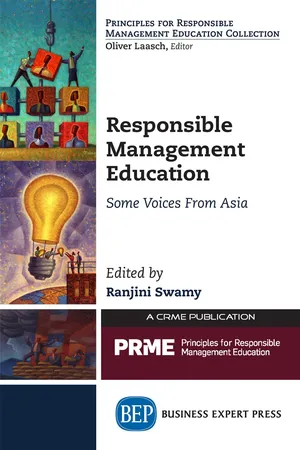
This edited collection emerged from the need to know how business schools in Asia are inculcating responsible management. Data for the book was sourced from (a) the workshop proceedings of the 6th PRME Asia Forum held in November 2015 and (b) case studies submitted as part of the Forum. Academics from India, China, Philippines, New Zealand, USA and Hong Kong (who taught in Asia) contributed to the workshop / the case studies. The book describes how some Asian business schools are incorporating ethics, social responsibility and sustainability into their curricular and extra-curricular activities. It identifies the challenges faced in providing such education and the implications thereof. In the process, it captures the unique flavour of Asian business schools. Business schools in Asia appear to have introduced several stand-alone courses on ethics and corporate responsibility. They have adopted pedagogies suited to the profile of their students. Many have promoted a concern for the poor through volunteering, projects or internships with NGOs. However, few have made responsible management a central part of their business school curriculum. Greater integration of responsible management into the curriculum requires supportive administrative policies, greater cross-functional interaction and the development of context-appropriate learning materials.
Trusted by 375,005 students
Access to over 1.5 million titles for a fair monthly price.
Study more efficiently using our study tools.
Information
CHAPTER 1
Responsible Management: Drivers and Responses Discussed at the Pre-Forum Workshop in the 6th PRME Asia Forum
Goa Institute of Management
Introduction
In the last decade,1 there have been shifts in the top ten global risks that are reported annually by the World Economic Forum (WEF). Earlier, the risks were geopolitical (e.g., terrorism) and economic. In recent times, many of these are environmental, societal, or geopolitical risks. In 2015 for instance, the top ten global risks reported as most likely to occur include extreme weather events, natural catastrophes, failure of climate change adaptation, and water crisis.
The changing nature of global risks is a reflection of the new normal that business is experiencing and recognizing. These changes could potentially impact the continued economic growth of society and of corporate sector. According to Mr P.S. Narayan, Vice President and Head of Sustainability at Wipro Ltd., the top question for business is, “Can we remain isolated from these risks to society and the environment, or do we need to engage with these in a constructive manner? Do we have to choose between economic growth and sustainable progress?” There are several more fundamental and related questions:
• First, what is it that business owes society and planet, if anything at all? (Some suggest that it is enough to create jobs and pay taxes.) Why should an organization think and worry about being responsible? Does this responsibility toward society have strategic fit at all?
• Second, is it possible to be a strong company in a weak society? A company could be a great company but if the society in which it exists is weak, what does that mean for the company? What professional or moral dilemmas does such a situation pose to that company?
• Third, what should be the boundaries of a company’s business responsibilities? Where do business responsibilities end and social responsibilities start? Or is that a wrong question? Should it be a spectrum? Two concepts—circular economy and product stewardship—suggest that everyone involved in the life span of the product has to take up responsibility to reduce its adverse environmental, health, and safety impacts.
• Fourth, how can business decisions be informed by long-term forces that are seemingly invisible and peripheral today? A greater understanding of the relationship among the economic, social, and environmental well-being is critical. Are these mutually exclusive or mutually reinforcing?
• Fifth, how should business act toward the social and environmental risks? Are there opportunities embedded that companies or businesses can enrich? How does one integrate social and environmental challenges into business strategy? How can leaders reconcile and find an optimum balance between goals that are seemingly conflicting?
• Sixth, should businesses be led by logics of the markets at all times? How does a company navigate uncertain terrains?
The current measure of economic growth—the Gross Domestic Product (GDP)—does not consider the costs of “externalities” such as pollution and ecosystem loss while calculating growth. As a result, the GDP measure of economic growth could be inflated. New measures of growth, such as the Genuine Progress Indicator (GPI), have emerged in response. The GPI is a weighted index that measures a combination of the costs of pollution, unemployment, ecosystem loss, and so on, and adjusts economic growth against such costs. While the GPI is still work-in-progress, its measure of economic growth diverges from that of the GDP. While economic growth as measured by GDP shows an increasing trend, the growth as measured by GPI does not show such a trend. It appears that the costs borne by society and the environment are increasing.
Drivers of Responsible Management
Intergovernmental agencies like the United Nations have brought together several stakeholders (national governments, civil society, and business) to develop a vision of a safe, just, inclusive and sustainable planet. They identified critical global challenges to attaining this vision—such as extreme poverty, environmental degradation, and unsustainable production/consumption—and have developed sustainable development goals to address each of these. Achieving these goals requires the cooperation of business, government, civil society, and educational institutions. The United Nations has initiated partnerships and dialogues with these stakeholders for the purpose.
Some of the more advanced economies have acknowledged the responsibility of business to society and translated this into new regulatory norms. According to Professor June Qian, School of Economics and Management, Tsinghua University, China, Asian companies desiring to export their products to these advanced economies need to adapt to the new regulatory norms. Adopting the tried-and-tested norms of the home country in the new markets may obstruct performance. Understanding the principles for responsible management prepares Asian businesses for conducting business in the more advanced economies.2
Responsible management can also help a business to manage its risks and avail of opportunities while contributing to the sustainable development of society. To achieve this, business needs to review its net impact on society and environment, and take corrective action where needed. Unfortunately, there are several challenges in assessing the net impact of business on society and environment. Professor Raghuram Tata of XLRI Jamshedpur, India, shared some of these challenges during the course of his presentation:3
• First, many industry-generated costs, such as destruction of forest cover, are discussed in technical, nonmonetary terms, while many industry-generated benefits are discussed in monetary terms. The lack of comparable language and metrics makes it difficult to accurately assess the net impact of business on society.
• Second, assessments of business impact based on the current anthropocentric definition of sustainability could be partial or incomplete. Such a definition implicitly regards humankind as the central or most important element of existence, especially as opposed to other species.4 Given this definitional bias, the impact of business on ecosystems beneficial to humankind (such as crops and livestock) could be assessed while its impact on ecosystem services not directly instrumental to humankind may not be assessed. The latter may be incidental to humankind but critical for the survival of other species.
If a business enterprise requires diversion of forest land for its activities, the net present value of the forest land is computed on the basis of the monetary value of seven ecosystem services in the forest including timber and fuel wood, nontimber forest products, fodder, bioprospecting,5 flagship species, 6 and carbon sequestration.7 Based on the value of these ecosystem services, forest land in India is valued at about Rupees 770,000 per hectare. This valuation excludes other ecosystem services that are not directly useful to humankind.
• Third, the assumptions underlying the valuation of such ecosystem services are contested. In 1997, for instance, a robust global monetized account of the value of the world’s ecosystem services and natural capital was proposed. The value of the world’s ecosystem services was estimated to be in the range of $16 trillion to $54 trillion per year,8 the average being around $33 trillion per year. The assumptions underlying such a valuation were not accepted by other economists. The impact of business on the ecosystem services thus remains contentious.
Corporate Responses
Despite the difficulties of measuring impact, there is an increasing acknowledgment that business is impacting and can significantly impact the natural and social systems. If some of the adverse impacts of business are not addressed, survival could be at risk. Some companies have therefore developed policies to address these risks proactively. The following three examples are illustrative:
Coca-Cola has developed a global integrated water strategy to become water neutral by 2020. To achieve this, they engage with other stakeholders who are involved in water management or water use.
Wipro Ltd. has programmes to improve the biodiversity on its campuses.
ITC Ltd., a diversified Indian company, has invested in a social forestry initiative to ensure sustained supply of raw materials for its paper division. It collaborates with communities to raise plantations of soft wood that the company uses as raw material. There are several business benefits: (a) an assured supply of raw material; (b) a reputation as carbon-positive and water-positive company.9 For the past five years, they are also a waste-neutral company.
Many companies are now capturing the value created through such initiatives either in their sustainability reports or (less frequently) in their profit and loss accounts. Besides recognition in the markets, the sustainability reports also serve as signaling devices to the stakeholders. A few companies like PUMA have gone beyond such reports. In 2011, PUMA became the first company in the world to develop and report the “environmental profit and loss account.” It reports the environmental externalities caused in its entire supply chain, puts a monetary value to these externalities, and identifies where these externalities are concentrated. The company committed itself to reduce its global ecological footprints by 25 percent by the year 2015 and achieved most of the goals. They have helped other companies like Wipro Ltd. to do such an exercise.
The question is why would companies like PUMA reveal everything about their adverse impact on the environment? They could restrict themselves to producing a sustainability report. It raises very interesting questions in the classroom: Is there a strategic reason behind these initiatives? Who drives the initiative—external stakeholders or internal stakeholders like the chief executive officer (CEO)? If it is a single leader’s initiative, say the CEO’s, will this get institutionalized? How can the outcomes of such initiatives be measured? Can all the outcomes be converted into accurate monetary measures? More generally, can industry realize “zero footprint” on the ecology? This may require that the materials and resources move seamlessly across the economy. That would be a big challenge for the global companies.10
Businesses are taking more interest in the emerging ecosystem services markets. One such market—Bioprospecting—has some pharmaceutical companies paying the tribals in Amazon forests to not destroy forests, because the industry realizes that future biochemicals might come from that forest. Bioprospecting has made a beginning in India also.
Implications for Education
Educational institutions can promote responsible management and thereby contribute to the development of an inclusive, safe, just and sustainable society. Asian business schools, for instance, can help generate and disseminate knowledge regarding why responsible management is important in the Asian context, what it means to be responsible and how business can contribute to the betterment of society. They can help inculcate the appropriate competencies among future managers through revised curricula. What competencies must be inculcated among future managers to ensure that they take responsibility for the wellbeing of business, society and the natural environment?11 The following competencies were presented during the workshop:
• The ability to understand the complex inter-linkages among the natural systems like energy, water etc., that exist independent of human involvement and between the natural, human and economic systems.
• An awareness of the externalities created by business and their impact on business, society and the natural environment.
• The ability to think about and act upon complex problems in a holistic manner. This could require drawing on multiple stakeholder perspectives to diagnose complex problems and develop action plans to resolve them.
• Compassion and an empathy for people who experience inequity or unfairness in society.
Institute-Level Responses of Business Schools
Inculcat...
Table of contents
- Cover
- Half-title Page
- Title Page
- Copyright
- Contents
- Introduction
- The Six Principles of PRME
- Chapter 1 Responsible Management: Drivers and Responses Discussed at the Pre-Forum Workshop in the 6th PRME Asia Forum
- Part I Case Studies on Institute-Level Interventions to Promote Responsible Management
- Part II Case Studies on Course-Level Interventions to Promote Responsible Management
- About the Authors
- Index
- Backcover
Frequently asked questions
Yes, you can cancel anytime from the Subscription tab in your account settings on the Perlego website. Your subscription will stay active until the end of your current billing period. Learn how to cancel your subscription
No, books cannot be downloaded as external files, such as PDFs, for use outside of Perlego. However, you can download books within the Perlego app for offline reading on mobile or tablet. Learn how to download books offline
Perlego offers two plans: Essential and Complete
- Essential is ideal for learners and professionals who enjoy exploring a wide range of subjects. Access the Essential Library with 800,000+ trusted titles and best-sellers across business, personal growth, and the humanities. Includes unlimited reading time and Standard Read Aloud voice.
- Complete: Perfect for advanced learners and researchers needing full, unrestricted access. Unlock 1.5M+ books across hundreds of subjects, including academic and specialized titles. The Complete Plan also includes advanced features like Premium Read Aloud and Research Assistant.
We are an online textbook subscription service, where you can get access to an entire online library for less than the price of a single book per month. With over 1.5 million books across 990+ topics, we’ve got you covered! Learn about our mission
Look out for the read-aloud symbol on your next book to see if you can listen to it. The read-aloud tool reads text aloud for you, highlighting the text as it is being read. You can pause it, speed it up and slow it down. Learn more about Read Aloud
Yes! You can use the Perlego app on both iOS and Android devices to read anytime, anywhere — even offline. Perfect for commutes or when you’re on the go.
Please note we cannot support devices running on iOS 13 and Android 7 or earlier. Learn more about using the app
Please note we cannot support devices running on iOS 13 and Android 7 or earlier. Learn more about using the app
Yes, you can access Responsible Management Education by Ranjni Swamy in PDF and/or ePUB format, as well as other popular books in Business & Business Ethics. We have over 1.5 million books available in our catalogue for you to explore.