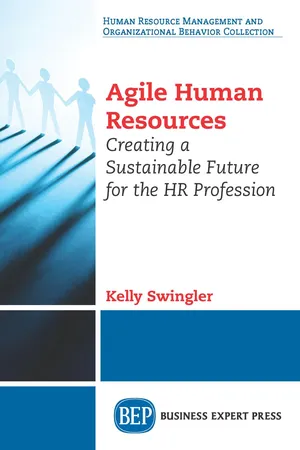
Over the last 20 years, the topic of conversation when it comes to HR, is whether or not it should even exist. The name of the function is ever changing, but are the outcomes and results evolving in the right way? Over the last 5 years, the author has been designing and implementing HR solutions focused on doing things differently, and the creation of her AGILE HR framework is well received by all of her clients. Agile HR helps organizations manage, motivate, engage, inspire, and lead their people in the best possible way by treating them, first and foremost, as able adults that come to work to do a good job. Mainstream HR, however, works from the perspective of policing employees through policies and procedures that suffocate and restrict employees and hinder creativity and innovation at work. This book provides hints, tips, and examples of how to implement Agile HR solutions into your organization that will help HR professionals and senior leaders implement people-focused solutions to increase productivity. It is time to put the human touch back into human resources.
Trusted by 375,005 students
Access to over 1.5 million titles for a fair monthly price.
First, thank you for buying this book. I’m so pleased that you are interested in doing HR differently and that you want to create a sustainable future for the HR profession.
When I started in HR, I was passionate about wanting to create better places to work, where I did not have to sit at the pub, or in the hairdressers’ and hear about the problems that my friends, friends of friends, and family were having at work—the difficulties they faced with managers, the long-winded and policy-driven ways of doing HR, and what I call the Monday to Friday dying syndrome, where you spend all week at work waiting for the weekend, and then, do the same the week after, and the week after that.
You have heard about it or experienced it yourself, right?
Monday – The dread of going to work fills you from head to toe. You drag yourself out of bed, and are already counting down the days until the weekend. You arrive at work, you cannot focus. People ask you if you have had a good weekend, and you say things such as, “Yes, great, thanks, but it wasn’t long enough.” It is not a productive day. You have got the rest of the week to get done what you need to get done.
Tuesday – Thank goodness, it is not Monday anymore; the week is moving forward. You start to really think about all of the things that you need to complete that week. Then, you spend the afternoon clearing your emails. Research has shown that marketing emails have the greatest chance of success if sent on Tuesday afternoons!
Wednesday (Or “Humpday”) – You have survived the week so far; you are halfway there and already thinking about what you will be doing at the weekend. You have a lot of meetings today; everyone must be feeling the same way. You push through.
Thursday – Mad rush. Everything needs to be completed today, or so it appears. It is a last-minute rush to achieve what needs to be achieved by the end of the week. Why does it always feel like your organizations leaves things until the last minute? You stay late as you have lots to get through (if only you had made better use of the earlier part of the week!).
Friday – Woohoo, it’s the weekend. You fly through your work, or look at what can wait until next week. Maybe you can leave the office early; after all, you have so much to plan and do for the weekend and you could do with getting out early. You take a longer lunch. You watch the clock and you can finally escape.
Saturday – What a great day—no work!
Sunday – Great day, but you cannot get the thoughts out of your head that you are back to work tomorrow. Oh, no!
Another week, the cycle repeats, over and over and over again.
We spend more than half our lives at work—more than half. And yet, many of us go through this cycle over and over again, and it needs to change.
The more I progressed and the more senior I got, it was more and more visible that the reasons these policies—and the Monday-to-Friday dying—were happening was because senior leaders did not trust their staff, their managers, and had little respect for the HR function. And HR functions were implementing policies and procedures in the hope of making a difference to the organization and gaining credibility from senior leaders, but usually without taking into account what managers—and more importantly, what employees—actually wanted.
When you think of the HR function in your organization, do you think of them being flexible, adaptable, speedy, and responsive?
No. Nor do many other companies, and sadly, HR is the one department that shoulders the blame and nobody bats an eyelid. “It’s HR’s fault” is common parlance.
The reality is that much of the time, it is not HR’s fault; managers are not managing, leaders are not leading, but instead of HR looking at why people are not following procedures or trying to simplify policies to make them easy to implement, much of what we have created over the years as part of our training and development—and based on the management tools designed in the 1980s—is not fit for purpose. It is not agile; it does not make things easy for people; and it does not empower anyone in the workplace.
When I was appointed as the UK’s Youngest HR Director, I was convinced I could make a BIG change in the way that HR designed and implemented solutions, and I could change the perception of the HR function. I believe that in the right company, I could have achieved this, but I realized that for me, in order to truly drive change, to start doing HR differently, and to help my clients do the same, without them wasting time or money, I needed to start my own consultancy.
In 2013, I left my corporate HR role and started my own consultancy with a passion for—and a commitment to—creating better places to work and practice HR, learning, and leadership differently.
My company has gone from strength to strength over the last 4 years, and I am now delighted that our approach and some of the new ways of thinking from Silicon Valley, other forward-thinking organizations in the UK, and consultancies such as HR Disrupted have been brought together in this book, along with our online program, workshop, and diagnostic tool.
So, what will this book cover?
We will look first at why HR needs changing, and then, I will introduce you to the AGILE model, before we move onto the employee lifecycle and see how AGILE HR fits into this.
We will then look at the overarching factors to consider before we move on to the future being Agile and how you can start to create and implement change in your own organizations.
You will also find throughout the book that you will be introduced to case studies and examples of new ways of thinking, tools and resources, videos, audios, and some questions to get you thinking.
You can dip in and out of the book at any point to suit you, although I do recommend starting from the beginning and working through it at your own pace, and then, dipping in and out as and when you need to, to help you create sustainable change.
If you have attended one of the workshops or completed the online program, then do use this book as a resource tool to keep your learning fresh, and I hope you will also learn something new as you progress through.
There is also plenty of opportunity for you to make use of the online community of like-minded professionals that are in the HR Hub to test and share your thinking and ideas, so do say Hi, interact and collaborate as much as you can. As social creatures and social learners, this can help improve your experience no end.
I hope you enjoy the book; a lot of love, thought, and creativity have gone into it and I look forward to hearing your thoughts as you move through it.
And now, if you are ready to start doing HR differently, let us get started.
Happy reading
CHAPTER 2
Why HR Needs to Change?
Since the management thinking of the 1970s, 1980s, and 1990s, lifestyles, businesses, technology, and people themselves have changed, yet our ways of working have not. Since starting my career in HR in the late 1990s, we have changed our designation—Personnel, HR, and now, we are starting to move into the designation “People,” and even—as I saw recently—Head of Employee Happiness. Yet, with these name changes and new buzzwords such as “Employee Engagement,” for the most part, we still recruit, induct, train, develop, pay, and promote our people in much the same way.
And it is simply not working.
Treating employees as individuals is a big part of AGILE HR also, yet we continue to create one-size-fits-all approaches to managing and developing our people.
People want to work with more flexibility, more autonomy; they want to be creative and recognized for their hard work and efforts. They want to be thanked for doing a good job and have goals and objectives that are relevant. They do not want to fear being disciplined or dismissed for making a mistake, but be given the opportunity and support to learn from these. Our people want to be treated like people, not numbers, and they want us to care.
And yet, our policies—from dress code, to working from home (WFH), to how to book and take your annual leave, how to record sickness absence, and how you will rate on your performance review—are not what people want.
Will some employees push the boundaries as much as possible if you are more lenient, or if you trust them more, or give them greater accountability?
Possibly, yes.
But, we have to give it a try.
I know people that string work out all of the time to make it last as long as possible, who arrive late, always take their hour for lunch, and then, leave early all of the time, who want to do the bare minimum, day in and day out. These people will not last long in my organization or under my leadership because that is not the way we do things around here.
And if you have these people in your organization, then what is needed is more effective adult-to-adult conversations that take place on a regular basis, or bigger projects, or tighter deadlines, and certainly, more effective management if this style of working bothers you.
What is needed is more effective management, and more effective leadership and HR processes, policies, and procedures that support the leadership of the organization. A new HR policy is not the answer to someone becoming more effective at work.
What we can do is make sure that our HR practices are not pages and pages and pages of jargon and micromanagement guidelines that set boundaries so tight that people cannot breathe; they need to be simple and easy to digest.
I started a new position with a company where all of the policies were so long and complicated that even with over 10 years of experience, I could neither understand the steps that had already been taken nor advise them on what to do next. In my first week, I was handed a complex employee relations case; it had everything in it from performance issues, complaints, harassment, bullying, fraud and conspiracy allegations and had been going on for months. The people who had been dealing with it previously had left and I was asked to pick up the pieces. It was a minefield. I met with the people concerned, and started the process again. It was resolved quickly, and while not to everyone’s satisfaction, it came to a conclusion, but I had to practically ignore the policy in order to make things happen.
As we move to more or even totally online working, we can work from anywhere, literally anywhere, and as long as we get the job done, what does it matter what is in a policy? Yet, I have seen so many WFH policies that make me shudder, that the thought of WFH would terrify me into going into the office every day, where I can hot-desk at the same desk that I have always used, not really engage with anyone, and then, go home again.
Organizations are always looking for ways to do more for less, to save costs and drive efficiencies. Technology has changed the way we work, live, and think, and who knows what the future political landscape will look like and how it will impact businesses and our people?
But even with all of this change and uncertainty going on in the world in which we live and work, HR has changed very little, and if we do not change, I do not believe we have a future.
Radical change—and some of what we will cover will sound radical—or even any change, for that matter, does not happen overnight; it will take time. You are likely to be challenged (a lot), possibly even have your ideas rubb...
Table of contents
Cover
Half Title Page
Title Page
Copyright Page
Contents
Chapter 1 Introduction
Chapter 2 Why HR Needs to Change?
Chapter 3 Introduction to AGILE HR
Chapter 4 Employee Life Cycle
Chapter 5 Overarching Factors
Chapter 6 Putting It into Practice
Chapter 7 Diagnostic Introduction
Chapter 8 Case Studies
Chapter 9 Resources
Chapter 10 Summary—Reflections
Index
Frequently asked questions
Yes, you can cancel anytime from the Subscription tab in your account settings on the Perlego website. Your subscription will stay active until the end of your current billing period. Learn how to cancel your subscription
No, books cannot be downloaded as external files, such as PDFs, for use outside of Perlego. However, you can download books within the Perlego app for offline reading on mobile or tablet. Learn how to download books offline
Perlego offers two plans: Essential and Complete
Essential is ideal for learners and professionals who enjoy exploring a wide range of subjects. Access the Essential Library with 800,000+ trusted titles and best-sellers across business, personal growth, and the humanities. Includes unlimited reading time and Standard Read Aloud voice.
Complete: Perfect for advanced learners and researchers needing full, unrestricted access. Unlock 1.5M+ books across hundreds of subjects, including academic and specialized titles. The Complete Plan also includes advanced features like Premium Read Aloud and Research Assistant.
Both plans are available with monthly, semester, or annual billing cycles.
We are an online textbook subscription service, where you can get access to an entire online library for less than the price of a single book per month. With over 1.5 million books across 990+ topics, we’ve got you covered! Learn about our mission
Look out for the read-aloud symbol on your next book to see if you can listen to it. The read-aloud tool reads text aloud for you, highlighting the text as it is being read. You can pause it, speed it up and slow it down. Learn more about Read Aloud
Yes! You can use the Perlego app on both iOS and Android devices to read anytime, anywhere — even offline. Perfect for commutes or when you’re on the go. Please note we cannot support devices running on iOS 13 and Android 7 or earlier. Learn more about using the app
Yes, you can access Agile Human Resources by Kelly Swingler in PDF and/or ePUB format, as well as other popular books in Business & Human Resource Management. We have over 1.5 million books available in our catalogue for you to explore.