This book explores how to conduct information system (IS) research using various approaches that are grounded in proven scientific methods. It is primarily for consumers of IS research and for individuals involved in any type of academic research across various disciplines. This book is designed to enable IS researchers and consumers to make more professional and scientific decisions about evaluating, locating, reading, and critiquing the findings of scientific research. It has been shown that many IS research community lacks its own scientific theories and models. It has also been shown that workable research problem, purpose, method, design, instruments, samples, population, data collection, and processing used in other fields are also applicable to research in IS. Thus, the stages of scientific research from problem conception to analysis and interpretation will be discussed in the context of IS research.
- 154 pages
- English
- ePUB (mobile friendly)
- Available on iOS & Android
eBook - ePub
Information System Research
About this book
Information
CHAPTER 1
INTRODUCTION TO RESEARCH IN INFORMATION SYSTEMS
1.1 LEARNING OBJECTIVES
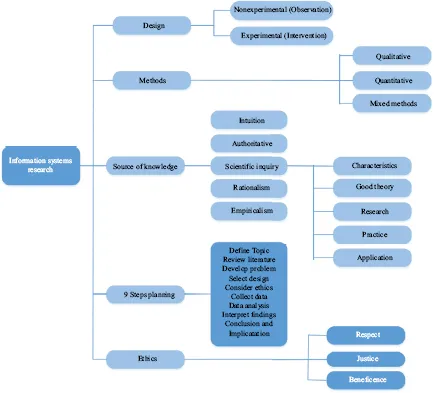
After reviewing this chapter readers should:
• Understand the functions of computer scientists in the technology ecosystem.
• Understand the importance of the role of a computer scientist in research.
• Understand the need for using the most reliable source of knowledge.
• Be able to identify five sources of knowledge.
• Understand the influence of philosophical assumptions on the scientific source of knowledge.
• Be familiar with the nature of good scientific theory in the context of IS research.
• Understand the relationship among theory, research, and practice.
• Be familiar with the application process of scientific inquiry to the IS science research process.
• Be familiar with the importance of performing research in an ethical and safe way.
• Understand the difference between the use of quantitative and qualitative research methods.
1.2 THE FIELD OF INFORMATION SYSTEM (IS) RESEARCH
The Information Systems (IS) discipline has been widely criticized for its lack of serious theory formulation and scientific research (Gholami, Watson, Molla, Hasan, and Bjørn-Andersen 2016). Some researchers have criticized IS literature as being “rather verbose and make it difficult to form a global picture of the social phenomena being researched” (Klein and Huynh 1999, p. 79). If IS researchers are not enlightened in scientific methods of how to perform research in the IS discipline, knowledge in the IS field will continue to develop in the footsteps of other disciplines such as social and behavioral sciences. In the light of this, a guide on how to perform IS research is required to ensure the prospective and junior scholars design research studies from the IS consumers’ community perspective. Information system (IS) research is the nucleus of many ongoing, ever-evolving digital revolution, producing knowledge in ways that contribute to entirely new information technology (IT) practices and dramatically improving the quality of life and organizational performance.
IS research is a multidisciplinary field of study and new areas continue to evolve as advances are made in technology, from algorithms, artificial intelligence, the Internet of things (IoT), big data, and databases to wearable technology. While some IS research areas are theoretical in nature and involve developing and analyzing new theoretical algorithms, theories, and computing techniques, other research is more applied, involving the identification of certain technology concepts that can be used directly in solving real-world problems. In every case, IS researchers seek to improve the quality of society and organizational performance. IS investigators formulate and design new methods of computing technology and find more innovative practices for existing innovations. Many companies and governments employ IS researchers to solve complex problems, while laying the groundwork for better performance in business, science, medicine, and other areas.
While some IS are at the cutting edge of new paradigms that advance computing theories, enable new modes of thought, and ultimately are available for application in the context of an organization, and within its information systems; IS research advances our knowledge in the appropriate use of new technology to improve organizations’ performance and ultimately the quality of life. IS researchers are aimed at solving large and complex interdisciplinary problems. These go beyond the practical use and application of new findings to our daily lives, IS research has become central to almost every aspect of the survival of modern organizations. IS research is frequently being used in silico experimentations that are carried out within computer models rather than within the context of the real world. For example, research in climate change where it is not practical to design and carry out an experiment to evaluate the effects of carbon emissions on the environment, computer-based models and approaches are necessary. Another important use of findings from IS research is in the field of biology.
Molecular and cellular experimental biologists generate large amounts of data, which increasingly requires computational biology to manage it. These models and the evidence they generate must offer robust and rigorous solutions to problems faced by professional practitioners and policymakers operating in a wide range of interdisciplinary fields. The robustness and rigor in professional practice are inherited from the same robustness of empirical IS research that might involve hypothesis testing and falsifications. The guidance offered to the pragmatic world must not only be robust and rigorous, but should also be reliable to qualify as useful knowledge. Additionally, there is a renewed call for findings that are not only supported by robust and rigorous processes, but also findings that are reliable in terms of evidence. Accordingly, future IS research should not only focus on rigor and robustness, but also reliability as qualifying elements of new knowledge as well as source of knowledge.
1.3 SOURCES OF KNOWLEDGE
Empirical knowledge is what most modern research in IS aims at establishing; to “know” requires a combination of beliefs and valid justification to establish what is known as justified belief. Scientific propositions are based on justified belief. Justified belief originates through reliable cognitive processes and is based on the possession of creditable evidence. Accordingly, to make good judgments based on reliable knowledge, sources of knowledge must be sought that originate from reliable processes and empirical evidence. Reliable knowledge comes from many different sources. The study of epistemology recognizes at least four sources of knowledge: intuitive, authoritative, logical, and empirical. But are all four of these sources equally reliable? The reply is yes in many respects, but their reliability is not equal across all four.
1.3.1 INTUITION
People describe intuition in numerous ways. For example, it may be referred to as creativity, a direct knowledge, “gut instincts,” awareness, sensory perception, natural knowledge without evidence, or may take the form of a belief, faith, or instinct. Intuition, overall, is generally based on feelings rather than hard facts. Nevertheless, whatever means our knowledge may relate to a situation, an object, or an experience, the way it immediately relates to them is generally referred to as intuition. Thus, intuition in this sense is the association of an individual’s experience with a particular subject area. Further, intuition is a key characteristic in obtaining expert knowledge in a specific subject area. A technologist can use intuition to see relationships between innovations that no one else can see. For example, in a situation whereby a programmer is led by “gut instinct” to recognize that the value of an array might result in a program that is semantically incorrect, that cannot be verbalized, or rather it is verbalized with difficulty.
Nevertheless, intuition cannot be relied upon to consistently solve complex real-world problems because it is difficult to share this source of knowledge or explain it to others. There are several other limitations to using intuition as a source of knowledge. However, intuition does allow for the exploration of options because a “gut feeling” may result in a desire to stick with the first idea, limiting the exploration of alternative options and/or proceeding with impartiality.
1.3.2 AUTHORITATIVE
For concepts or ideas that are difficult to know by intuition, people frequently turn to authoritative sources. Individuals and institutions, such as schools and universities with special knowledge, authoritative opinion, decision, or precedent can provide knowledge. The concept of authority as the source of knowledge involves trust and acceptance that something is valid based on the credibility of the authority. If valid, then knowledge can be expanded by using that authority as a baseline to build upon. For example, the National Institute of Standards and Technology (NIST) is one of the globally recognized authorities on standards and guidelines for cloud computing and the Cloud Security Alliance has developed a widely adopted catalog of security best practices that are based on NIST cloud computing models. Nevertheless, although knowledge can be expanded by combining authorities, the disadvantage with using an authority as a source of knowledge is that it is not always reliable. Closely related to authority is tradition, which consists of the doctrines and practices transmitted from one generation to another over a period of time. Tradition has been a strong influence on many figure of authorities, including institutions, church, and governments. However, research has shown that many traditional practices of institutions and governments have been wrong for years; thus, authority as a source of knowledge may not be nationally accepted or may not be the most reliable information to solve today’s modern complex problems.
1.3.3 RATIONALISM
Acquiring knowledge through sources of deductive logical reasoning involves rationalism. With this approach, the criteria of identifying truth is not through intuitive or authoritative sources, but rather intellectual and deductive reasoning. Rationalism postulates that reason is far superior to any other way of acquiring knowledge and focuses on reason as the best path to knowledge. Rational reasoning is frequently articulated in the form of a syllogism, also known as a rule of inference, and is a formal logical scheme used to draw a conclusion from a set of premises. For example, technology is a product of people’s culture. A people’s culture is an emergent factor of systems. Therefore, systems drive technology. The conclusion is logically derived from the minor and major premises in the syllogism.
However, there are issues with gaining knowledge through rationalism. Consider the syllogism: Computers are reliable. A Mac is a computer. Therefore, a Mac computer is reliable. Although the syllogism is logically sound, the content of both premises is not necessarily true. Logic in rationalism only deals with the form of the syllogism and not the content of the syllogism. Clearly, both form and content must be valid to be a reliable source of knowledge.
1.3.4 EMPIRICAL
Acquiring knowledge through empirical sources involves gaining knowledge through experience and observation, especially sensory perception, such as touching, tasting, and hearing, smelling, and seeing. The limitation of empirical sources of knowledge is that it only generates a long list of facts collected. If empiricism is to be a reliable source of knowledge, the list of facts will need to be organized and inductive or induction reasoning applied, which would allow generalizations and predictions to be formed. Some of the things rationalis...
Table of contents
- Cover
- Half-title Page
- Title Page
- Copyright
- Contents
- List of Figures
- List of Tables
- Acknowledgments
- About the Author
- 1 Introduction to Research in Information Systems
- 2 Research Problems, Purpose, Variables, and Hypotheses
- 3 Research Method and Design
- 4 Information System Research Instruments
- 5 Ethical Challenges in is Research
- 6 Population, Participants, and Sampling
- 7 Data Collection and Processing
- 8 Exploring Inferential Analysis
- Index
- Backcover
Trusted by 375,005 students
Access to over 1.5 million titles for a fair monthly price.
Study more efficiently using our study tools.
Frequently asked questions
Yes, you can cancel anytime from the Subscription tab in your account settings on the Perlego website. Your subscription will stay active until the end of your current billing period. Learn how to cancel your subscription
No, books cannot be downloaded as external files, such as PDFs, for use outside of Perlego. However, you can download books within the Perlego app for offline reading on mobile or tablet. Learn how to download books offline
Perlego offers two plans: Essential and Complete
- Essential is ideal for learners and professionals who enjoy exploring a wide range of subjects. Access the Essential Library with 800,000+ trusted titles and best-sellers across business, personal growth, and the humanities. Includes unlimited reading time and Standard Read Aloud voice.
- Complete: Perfect for advanced learners and researchers needing full, unrestricted access. Unlock 1.5M+ books across hundreds of subjects, including academic and specialized titles. The Complete Plan also includes advanced features like Premium Read Aloud and Research Assistant.
We are an online textbook subscription service, where you can get access to an entire online library for less than the price of a single book per month. With over 1.5 million books across 990+ topics, we’ve got you covered! Learn about our mission
Look out for the read-aloud symbol on your next book to see if you can listen to it. The read-aloud tool reads text aloud for you, highlighting the text as it is being read. You can pause it, speed it up and slow it down. Learn more about Read Aloud
Yes! You can use the Perlego app on both iOS and Android devices to read anytime, anywhere — even offline. Perfect for commutes or when you’re on the go.
Please note we cannot support devices running on iOS 13 and Android 7 or earlier. Learn more about using the app
Please note we cannot support devices running on iOS 13 and Android 7 or earlier. Learn more about using the app
Yes, you can access Information System Research by Matthew Taylor in PDF and/or ePUB format, as well as other popular books in Computer Science & Computer Science General. We have over 1.5 million books available in our catalogue for you to explore.