Spectrum sensing deals with several subjects, that range from statistical and probability theory to radio propagation and signal processing, with cognitive radio playing an important role to the evolution and dissemination of new applications in the area. The objective of this book is to connect the basic statistical formulation, the fundamental concepts from signal detection and spectrum sensing, cognitive radio and dynamic spectrum access, leading to an interesting, robust, and illustrative content, with recent practical applications of cognitive radio and spectrum sensing.
eBook - ePub
Spectrum Sensing Techniques and Applications
- 122 pages
- English
- ePUB (mobile friendly)
- Available on iOS & Android
eBook - ePub
Spectrum Sensing Techniques and Applications
About this book
Trusted by 375,005 students
Access to over 1 million titles for a fair monthly price.
Study more efficiently using our study tools.
Information
CHAPTER 1
COGNITIVE RADIO
1.1 INTRODUCTION
The allocation of the electromagnetic spectrum among several telecommunications services is a complex task. Different technologies, based on the transmission of guided waves or free space propagation share the available frequency bands. The Radiocommunication Sector of the International Telecommunication Union (ITU-R) is responsible for recommendations regarding the international frequency allocation.
Several countries also established regulatory agencies, for telecommunication services and distribution of frequency bands. These agencies manage the spectrum occupation for different services. The Federal Communications Commission (FCC) in the United States, the National Telecommunications Agency (Anatel—Agência Nacional de Telecomunicações) in Brazil, and the Federal Office of Communications (OFCOM) in Switzerland are examples of these agencies (Alencar and da Rocha Jr. 2005).
In general, international regulatory authorities frequently allocate only one service per frequency band. As new services are licensed, new frequency bands are also licensed (Tandra et al. 2009). This allocation policy is static and inadequate for the current scenario, in which new technologies are competing to occupy the spectrum.
A survey of the recent literature indicates that the electromagnetic spectrum is crowded in some spectrum bands, while other bands are vacant or present scarce use (Raychaudhuri and Mandayam 2012). In the United States the spectrum occupation ranges from 15% to 85% in some frequency channels (Umar and Sheikh 2013). Measurements of the spectral use, during a three year period in the city of Chicago, shown an average occupation of only 14% in the band from 30 MHz to 3 GHz. The FM radio frequency (between 87.9 MHz and 107.9 MHz) presented an average occupation of about 80%, while the Industrial, Scientific, and Medical (ISM) band at 2.45 GHz presented an average occupation of only 20%.
The consolidation of digital television systems around the world pushed some countries to turn off the analog transmission of TV signals. Countries, such as the United States, in 2009, and part of the European Union, in 2012, disallocated frequency bands in the Very High Frequency (VHF) and Ultra High Frequency (UHF) ranges (Carvalho et al. 2015c).
Because of the nonefficient spectrum allocation in combination of the availability of frequency bands from the analog TV, the FCC proposed to regulate the Dynamic Spectrum Allocation (DSA), to allow an opportunistic access to the spectrum (Carvalho et al. 2015c).
The users in the system are classified as primary and secondary, or cognitive users (Ghasemi and Sousa 2007). The Primary Users (PU) are those who acquired a license to use a specific frequency band, allocated by the national regulatory agency, while the Secondary Users (SU) can opportunistically use the frequency band (Akyildiz et al. 2006a).
The cognitive users should be able to monitor the frequency spectrum and, from the observations, determine if there is a primary user occupying a certain frequency band. The verification of the spectral occupancy is possible, thanks to the cognitive radio emergence.
1.2 FUNDAMENTALS OF COGNITION
The cognitive radio technology promises some new and interesting advantages for radio users. In this regard, Software-Defined Radio (SDR) is a natural platform on which to build in new cognitive features (SDR Forum 2008), and some new concepts emerge from the amalgamation of communications and software.
An Adaptive Radio (AR) is a communications system that monitors its own operation, using a predefined set of metrics and rules, and modifies certain operating parameters to improve its performance. It is the basis upon which cognitive and intelligent radios are designed.
Cognitive Radio (CR) is a technique for wireless communication, in which a transceiver can intelligently, another anthropomorphism widely used in the area, detect the communication channels that are in use, and transmit using blank, or vacant, channels, also called spectrum holes, while avoiding occupied ones. This optimizes the use of the available radio frequency (RF) spectrum and minimizes the interference with other receivers. Figure 1.1 illustrates the concept of spectrum holes (Akyildiz et al. 2006b).
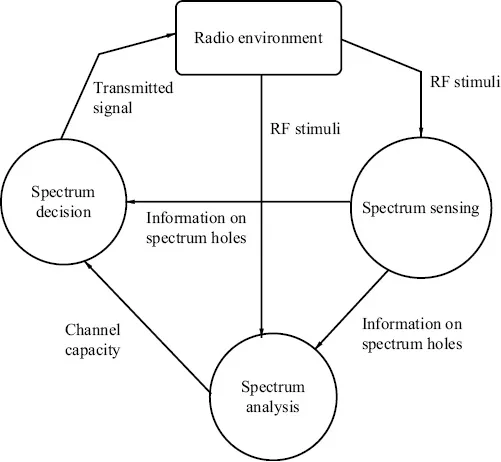
Figure 1.1. The dynamics of the spectrum hole concept. Based on (Akyildiz et al. 2006b).
Intelligent Radio (IR) is a type of cognitive radio that is capable of machine learning. This allows the cognitive radio to improve the ways in which it adapts to changes in performance and environment to improve the quality of service of the end user.
1.3 HISTORY OF COGNITIVE RADIO
The current concept of cognitive radio was proposed by Joseph Mitola III, in a seminar at the Royal Institute of Technology in Stockholm, in 1998, and published in an article by Joseph Mitola III and Gerald Q. Maguire, Jr., in 1999 (Mitola III and Gerald Q. Maguire 1999).
Cognitive radio was considered a novel approach in wireless communications, which Mitola later described as:
The point in which wireless Personal Digital Assistants (PDAs) and the related networks are sufficiently computationally intelligent about radio resources and related computer-to-computer communications to detect user communications needs as a function of use context, and to provide radio resources and wireless services most appropriate to those needs.
It is usually seen as an objective toward which an SDR platform should evolve: a reconfigurable wireless transceiver that automatically adapts its communication parameters to support different network functions and user demands.
1.4 SOFTWARE-DEFINED RADIO FUNDAMENTALS
A cognitive radio is defined as a transmitting equipment that is aware of the surrounding radioelectric environment. Based on software-defined objectives, it can implement decisions that lead to use the available spectrum in the most appropriate way.
Cognitive radio is a hybrid technology that involves concepts from SDR and Wireless Sensor Network (WSN). Possible functions of cognitive radio include the ability of a transceiver to determine its geographic location, identify and authorize its user, encrypt or decrypt signals, sense neighboring wireless devices in operation, adjust output power, and change modulation characteristics.
There are two main types of cognitive radio, full cognitive radio and spectrum sensing cognitive radio. Full cognitive radio takes into account all parameters that a wireless node or network can be aware of. Spectrum sensing cognitive radio is used to detect channels in the RF spectrum. It can be done as a two-layer mechanism, Physical (PHY) layer sensing, which focuses on detecting the primary user signal, and Medium Access Control (MAC) layer sensing, which determines the channels that should be sensed by the secondary users, to minimize the sensing delay (Xiang et al. 2010).
Cognitive radio uses a number of technologies that includes AR, in which the signal processing system monitors and modifies the performance of the communications equipment, and SDR, in which the usual hardware devices, including filters, mixers, modulators, and amplifiers are replaced by computer routines.
In the context of WSNs, the cognitive radio is a tool that allows to change the transmission parameters from the interaction of the radio and the environment (Akyildiz et al. 2008). The use of cognitive communications contributes with the reliability of the network as well as with the cost of the sensors (Vijay et al. 2010). The cognitive networks could provide, to the users, a large bandwidth by using techniques to dynamic access of the electromagnetic spectrum (Sousa 2013).
1.5 DEFINITION OF SPECTRAL HOLES
In general, the cognitive radio may be expected to deal with parameters such as channel occupancy, available channels, the type of data to be transmitted, and the modulation types that may be used. It must also consider the requirements and rules established by the regulatory bodies.
The cognitive radio is able to identify spectral holes, defined as the frequency bands that are allocated to a primary user but, for a given time and a given location, are not used by those users, or attend a minimum interference criterion (Haykin 2005).
The spectral holes can occur in time, in frequency, or space (Tandra et al. 2009). Models for spectral occupancy take into consideration those factors (Lopez-Benitez and Casadevall 2014). Information about the propagation of t...
Table of contents
- Cover
- Half-title Page
- Title Page
- Copyright
- Dedication
- Contents
- List of Figures
- List of Table
- List of Symbols
- List of Acronyms
- Preface
- Acknowledgments
- 1 Cognitive Radio
- 2 Spectrum Sensing and Detection
- 3 Distributed Sensing
- 4 Spectrum Sensing Applications
- 5 Important Distributions Used in Spectrum Sensing Theory
- About the Authors
- References
- Index
- Backcover
Frequently asked questions
Yes, you can cancel anytime from the Subscription tab in your account settings on the Perlego website. Your subscription will stay active until the end of your current billing period. Learn how to cancel your subscription
No, books cannot be downloaded as external files, such as PDFs, for use outside of Perlego. However, you can download books within the Perlego app for offline reading on mobile or tablet. Learn how to download books offline
Perlego offers two plans: Essential and Complete
- Essential is ideal for learners and professionals who enjoy exploring a wide range of subjects. Access the Essential Library with 800,000+ trusted titles and best-sellers across business, personal growth, and the humanities. Includes unlimited reading time and Standard Read Aloud voice.
- Complete: Perfect for advanced learners and researchers needing full, unrestricted access. Unlock 1.4M+ books across hundreds of subjects, including academic and specialized titles. The Complete Plan also includes advanced features like Premium Read Aloud and Research Assistant.
We are an online textbook subscription service, where you can get access to an entire online library for less than the price of a single book per month. With over 1 million books across 990+ topics, we’ve got you covered! Learn about our mission
Look out for the read-aloud symbol on your next book to see if you can listen to it. The read-aloud tool reads text aloud for you, highlighting the text as it is being read. You can pause it, speed it up and slow it down. Learn more about Read Aloud
Yes! You can use the Perlego app on both iOS and Android devices to read anytime, anywhere — even offline. Perfect for commutes or when you’re on the go.
Please note we cannot support devices running on iOS 13 and Android 7 or earlier. Learn more about using the app
Please note we cannot support devices running on iOS 13 and Android 7 or earlier. Learn more about using the app
Yes, you can access Spectrum Sensing Techniques and Applications by Marcelo Sampaio de Alencar, Fabricio Braga Soares de Carvalho, Waslon Terllizzie Araújo Lopes in PDF and/or ePUB format, as well as other popular books in Technology & Engineering & Electrical Engineering & Telecommunications. We have over one million books available in our catalogue for you to explore.