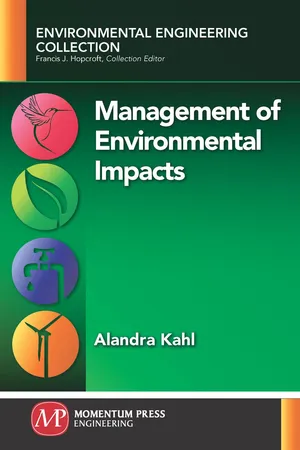
In Management of Environmental Impacts, various types of environmental impacts of projects are discussed in sufficient detail, to provide a concise and useful overview for the graduate or professional student. Subjects approached herein include impacts on water bodies, generation of hazardous materials, and alternative energy sources and their impacts, and management of sustainable projects. The intent of this text is to provide a repository of general information for consultation and reference of the user.
- 138 pages
- English
- ePUB (mobile friendly)
- Available on iOS & Android
eBook - ePub
Management of Environmental Impacts
About this book
Information
CHAPTER 1
Introduction
The management of environmental impacts is a topic that is critical to the health of the greater environment as well as relevant to science, engineering, and industry. To best ensure a sustainable world for the future, the impacts of industry on the environment need to be effectively managed and assessed. Most major industries have an assessment framework in place that aims to assess and reduce their impact on the environment. This framework frequently includes an environmental impact assessment plan and individuals devoted to the compliance and management of environmental regulations.
The assessment of environmental impact entails evaluation of potential harm to the environment from a project as well as the repair of previous impacts from earlier projects. Impact statements may address one or both of these aspects. Assessment of environmental impacts is done with regard to impacts of all aspects of the environment, including species harm, land, water, and air impacts. Each of these aspects must be enumerated fully for an environmental impact statement to be complete.
Environmental impact studies ensure that developers take responsibility for the safe protection of the environment during their proposed actions as well as those actions that may take place in the future by the same individuals on the same site. They also require that any impacts that may occur during the lifetime of the project are properly managed and mitigated. Environmental issues that arise during a project review may include managements of waste products, habitat impacts, or land and air impacts, such as particulate pollution.
Assessment and management of environmental impacts inform regulators and developers about the viability and longevity of a proposed development as well as whether that project should proceed. In order to move forward, a project must effectively balance the health of the environment with the growth of the industry. This includes compliance with and management of local, state and federal environmental regulation.
Effective monitoring of environmental conditions is a key component of the management of environmental impacts. Monitoring can be on a small scale for an individual site, or a large scale for a facility. Examples of monitored conditions include water quality metrics, soil analysis, and air quality. Data from these studies inform decisions related to project outcomes and goals. Environmental monitoring is also an important aspect of permitting and regulatory compliance, which are important to the effective management strategy for the environmental impacts of a project.
Community and stakeholder views are also an important part of the management of environmental impacts as these groups inform and drive the management process. Stakeholders include both the developers and the local community which are impacted by the development of a project. It is important to engage all groups in the management and assessment of the long-term vision of a project to best inform environmental decisions. The evolution of the environmental impacts from a project can also be driven by stakeholder views as these views shape the regulatory framework and can determine the proper pathway for management and assessment.
CHAPTER 2
Ecological Impacts of Projects
2.1 CONSTRUCTION IMPACTS
2.1.1 Projects on Land
Construction projects can cause significant disruption to the environment and ecology of a site, if not managed properly. Land impact can vary from small impacts such as blowing dust to large impacts such as habitat or ecological community loss. All impacts should be properly studied prior to the commencement of a project so that a proper management plan can be written.
One of the largest areas of construction impacts on land is that of road building. The United States contains over 4 million miles of roadways which take up an estimated 20% of the available land area. Roads are important to new development as they provide access to areas that were previously unable to be accessed by vehicles. Road building is a significant area of growth and impacts, with an estimated 60,000 roads to be constructed by the U.S. Forest Service alone in the next 50 years (US EPA 1994).
Impacts of road building are varied. For mammals, building a road can affect travel, breeding, and foraging habits as well as increase animal mortality. In fact, road mortality is the leading cause of animal mortality on roads in the United States, with an estimated 1 million vertebrate animals killed by drivers each year (Noss 2002). Some populations can be significantly impacted by roads if they pass through pristine habitat. For example, when interstate 75 was completed through a major deer wintering area in northern Michigan, deer mortality increased by 500% (Noss 2002). Vertebrate populations are the most visibly affected fauna by road construction; however, invertebrates are also affected by being run over or smashed onto windshields. These invertebrate populations can also increase vertebrate mortality, however, as predators follow prey into roadways. For example, the chimney swift follows insects close to the ground. When these birds follow prey over roads, it increases their chances of being struck by a vehicle. Natural defense mechanisms also cause animal deaths. For example, turtles perceive cars as a threat and draw into their shells to protect themselves, which increases the time they take for them to leave the roadway. On highway 27 in Florida, which passes over a lake that is important turtle habitat, the rate of mortality is very high due to this defense mechanism. Snakes also become immobilized when threatened and will often rely on their venom rather than movement for defense. It may take up to a minute for a frightened snake to leave a roadway after a car passes.
Roads are attractive to wildlife, which also leads to increases in their mortality rates. Reptiles and other ectotherms gravitate toward sun-warmed roadways to bask. Unfortunately, the numbers of snakes and other reptiles killed on roads are not well tallied. Herpetologists have made some estimates, however. On the highway passing through Paynes Prairie State Preserve, an area known for its diversity of snakes, herpetologists noted an important decline in the volume and variety of species when the four-lane highway opened (Field et al. 2016). Mortality of other species increases due to attractive behavior as well. For example, birds go to roadways to retrieve pebbles and seeds to aid in digestion, whereas other larger mammals are attracted to road salt and deicing fluids. Browsing herbivores such as deer often find attractive forage next to roadways due to tree clearing, and small mammals seek roadsides for habitat use.
Road mortality rates are also linked with migration and movement patterns. Animals may move to new habitat to mate or seek diverse sources of nutrition which can increase their mortality if a road must be crossed. Hatchings of large populations of animals such as reptiles will increase in mortality if near a roadway as the young disperse when leaving the nest. Animals with large ranges will also be impacted by roadways as they must inevitably cross a roadway at some point in their roaming. An example of an animal with large range would be the Florida panther, whose range has been measured to up to 630 km2. Large mammals often have greater forage ranges, making them vulnerable to becoming roadkill.
Species fragmentation due to migration is also an important impact on the overall animal populations. Migrating female turtles for instance can affect species balances as the numbers of the females decrease while the males who do not migrate remain steady. These demographic shifts can directly exacerbate population declines and threaten population viability. Populations with unequal demographics are vulnerable to genetic deterioration and stochasticity (variation in age and sex ratios).
Habitat fragmentation is another important side effect of roads. Some individuals will not cross roads, resulting in smaller populations and fragmentation of species. Population isolations can reduce species variability and viability. Some animals such as snakes have shown documented avoidance behaviors of roads, which will limit their range of predation. This can lead to over-predation of an area and proliferation of a single species that can unbalance an ecosystem. Birds that typically fly short distances from tree to tree may be hesitant to cross the large open space of a road resulting in longitudinal rather than lateral populations. When species are isolated by roads, gene flow is restricted. In a study of timber rattlers, genetic diversity was found to be lower in isolated populations when compared to contiguous populations (Didham 2010).
Habitat fragmentation can be especially impactful when considering the effects of climate change. Populations that cannot or will not cross roads cannot adapt to the effects of climate change, such as reaching a water source on the opposite side of a roadway when a local source dries up, resulting in extinction or severe decline. Limited genetic variation due to habitat fragmentation can also prevent animals from adapting rapidly enough to prevent extinction due to climate change. This type of decline and fragmentation can also extent to plant populations that depends on animals for dispersal. Animals that are isolated by roadways cannot disperse seeds beyond their home range, resulting in lower plant diversity near the roadway as well.
Another land impact during construction is pollution. This type of ecological impact can range from an auditory impact (noise from construction equipment) to physical impact such as grading of the land. Noise in construction project persists after the project is complete as well. Vehicle traffic along new roads or new parking lots, industrial sounds from rail line or conveyors, all contribute to noise pollution on the land. Auditory pollution can be detrimental to humans if exceeding EPA levels, and can also impact local wildlife. Birds may find it difficult to mate if their calls cannot be heard, and other predators that use sound to locate prey may die off as well. Pollution from land project can also take the form of air pollution. Vapors from construction vehicles may be harmful to the environment as they degrade air quality by producing greater quantities of carbon monoxides and smog. Cars on roadways give off heavy metals from oxidation during combustion processes. Lead from gasoline persists for long periods in soils and may even now be found near highways. It also has long-term toxic effects, increasing mortality rates and disrupting reproductive cycles. Motor oil contains zinc, cadmium, and nickel, all of which have been shown to bioaccumulate in low food-chain organisms such as earthworms. Animals consuming the contaminated earthworm also ingest these heavy metals and may be affected.
Roadways and access pathways can also be a conduit for pollutants to enter the environment. Deicing fluids and road salts used in winter leach into waterways, for example. These additives to make travel safer have been shown to decrease survivorship of wood frogs and spotted salamanders in adjacent ponds. Deicing fluid has also been shown to cause skeletal abnormalities in frogs and negatively alter their locomotor performance. This can decrease agility in catching prey and running from predators which increases mortality and survival of the population. Animals are also attracted to the salt added to roads for deicing, increasing roadside mortality. Runoff from sodium chloride ice melt causes eutrophication of water bodies, increasing algal blooms in ponds and streams that receive runoff.
Animals that rely on light patterns and control for biological activities are also impacted by roadways. For example, robins use morning sunlight as a cue to sing and may become confused by highway lights, singing in the middle of the night. Bats are also affected by artificial light and will alter their feeding pathways and flight routes to avoid it. Hatching sea turtles navigate toward the ocean by following sunlight and may mistake car headlights for the route to the sea. When these animals navigate toward roads rather than water, they become stranded and die, impacting the overall population.
Construction projects also facilitate the spread of invasive species. Seeds or burrs from a species may hitchhike on construction equipment and be spread into pristine areas. Mud on vehicles may contain spores or pods which become enmeshed in local soil and cause nonnative plants to grow. These nonnative plants can crowd out local vegetation and alter the local community, causing a ripple effect on vertebrate and invertebrate populations which rely on plants for nutrition. Decreased competition from plants in a cleared area allows invasive species to thrive. Once an invasive species has gaining a foothold, it can be very difficult to remove. For example, buffel grass, originally planted as livestock forage, is now crowding out native species in the Sonoran Desert. This grass can only be eliminated by pulling it out by the roots and requires many volunteers many hours to contain in order to preserve native plant life. It burns hotter than the local grass, red brome, which means that native plants are eliminated in Australia; the cane toad has used roadways to increase its range, crowding out local frogs. When a grasslands fire occurs, the buffel grass survives. The hardy plant does not provide cover or seed for local species and thereby has a negative effect on the local ecosystem. Invasive species are not only plants, but they can also be mammals.
The phenomenon known as edge effect is a negative impact of land construction. When a road is built through a forest, it creates an edge. This edge invites weedy plants and opportunistic roadside species such as mice and voles that would not normally be present in the forest area. This zone of influence may extend into the forest interior, altering the native plant community and local habitats. Shade intolerant plants, as well as weedy plant species, alter the native vegetation and forest composition. This edge habitat is its own microclimate which then impacts the species and plant life present in the forest. Some animals, such as the cowbird, take advantage of the edge habitat and forest fragmentation to further than own range. The cowbird is a brood parasite, laying its eggs in the nests of other birds. The other birds raise the young as their own, crowding out their offspring from the nest and decreasing their reproductive success. Forest birds may experience serious declines in areas where cowbirds have become common as they are not well adapted to their breeding tactics. In addition, opportunistic nest predators such as raccoons and opossums are common in roadside environments. These predators attracted to the area to feed on carrion will also prey on edge nests, decreasing local bird populations.
Another area of potential impact is that of cultural artifacts. In areas with either current or prior indigenous populations, it is important to be aware of any significant land areas during construction. In areas undergoing topographic reformation or soil erosion, care must be taken to avoid impacts that affect land masses or erode culturally significant areas such as trails or footprints. Increases in site access due to construction may also affect culturally significant resources. Access to areas or artifacts must be reduced or avoided if possible to ensure that no artifacts or valuables go missing. Any artifacts found on site must be carefully documented and recorded, along with the appropriate authorities and groups notified. Failure to properly care for a culturally significant site can carry severe penalties and impede construction projects, sometimes permanently. Care must be taken to be sensitive to the needs of the indigenous people for whom the site has significance as well as to be mindful of the greater community, which is also a stakeholder in the area. A sacred landscape or trail can also be negatively affected by construction as it may remove previous visual elements or increase sight lines in a way that was not there previously. This can result in erosion and increased site access which may also negatively affect the site.
Soil and geologic resources in a land area may also be affected by construction. Excavation of topsoil can result in soil erosion, and the removal of rock for road building can disturb the geologic profile of an area. Sand and gravel used for road building generate dust and rock tailings that will impact the local geology, as well as changing the plant profile of the landscape in areas where roads are built. Laying down rock impedes the growth of low-level foliage and reduces the available green space for seeds to spread. This results in forest edges, which reduce the tree cover of any area and available nesting space. Imported rock and gravel do reduce soil erosion in graded areas, however, which keeps current soil intact. If local rock and sand are used, then care must be taken to avoid increasing erosion in areas mined for these resources. Cutting of hillsides for site access can increase instability of slopes and alter drainage patterns. A newly toposcaped area must be carefully monitored after a heavy rain for landslides and earth movement. In areas with soils having special properties, such as cryptobiotic soils, care must be taken to protect the local microbiotic community. The soil microbes are very important to the internal health of the local ecologic community, and altering the soil may cause later impacts. Therefore it is important to keep local soils in place during construction projects and avoid bringing in other soils if possible. Removal of soils will result in nutrient loss and can also affect local water bodies, if erosion in an area is severe. Lost nutrients can be amended (for instance, if the area is to be farmed), but it is generally less costly, environmentally and financially, to keep original nutrient profiles and communities in place.
Visual resources of an area are often affected by construction on land. In sacred areas, this must be avoided if possible. Areas that affect visual resources include access roads, right of way variations, and parking areas. All of these increase open space in an area and disturb the view with light and vehicle pollution. Dust and dirt from local traffic may cause a haze in an area, if it is severe and will need to be managed. The most common way to reduce dust in a construction zone is by water misting from a tanker. Water can be imported or local, and it is important not to spray too much as that will increase erosion by turning the area into mud. Large excavations, such as mining or trenching for electrical lines, can leave visual scars on the landscape which may persist for years to come (particularly in the case of mining). These areas must have reclamation plans to allow the land to recover. In some highway areas where the hillsides have been cut, the local concrete is painted to resemble the rock strata underneath, thereby reducing the visual impact.
A number of mitigation strategies to reduce environmental impacts have been implemented, with varied success. In some areas where roads cross routes of wildlife migration, these roadways are closed during breeding and hatching season. In Florida, this has been particularly successful in increasing the breeding success of frogs and turtles, both of whom are disproportionately affected by roadway mortality (Field et al. 2016). In other areas where snakes are kille...
Table of contents
- Cover
- Half Title Page
- Title Page
- Copyright Page
- Contents
- List of figures
- Acknowledgments
- Chapter 1 Introduction
- Chapter 2 Ecological Impacts of Projects
- Chapter 3 Agricultural Practices Management
- Chapter 4 Resource Extraction Issues
- Chapter 5 Risk Perception and Management
- Chapter 6 Scheduling for Impact Mitigation
- Chapter 7 Ecological Resource Restoration
- Bibliography
- Author Biography
- Index
Trusted by 375,005 students
Access to over 1.5 million titles for a fair monthly price.
Study more efficiently using our study tools.
Frequently asked questions
Yes, you can cancel anytime from the Subscription tab in your account settings on the Perlego website. Your subscription will stay active until the end of your current billing period. Learn how to cancel your subscription
No, books cannot be downloaded as external files, such as PDFs, for use outside of Perlego. However, you can download books within the Perlego app for offline reading on mobile or tablet. Learn how to download books offline
Perlego offers two plans: Essential and Complete
- Essential is ideal for learners and professionals who enjoy exploring a wide range of subjects. Access the Essential Library with 800,000+ trusted titles and best-sellers across business, personal growth, and the humanities. Includes unlimited reading time and Standard Read Aloud voice.
- Complete: Perfect for advanced learners and researchers needing full, unrestricted access. Unlock 1.5M+ books across hundreds of subjects, including academic and specialized titles. The Complete Plan also includes advanced features like Premium Read Aloud and Research Assistant.
We are an online textbook subscription service, where you can get access to an entire online library for less than the price of a single book per month. With over 1.5 million books across 990+ topics, we’ve got you covered! Learn about our mission
Look out for the read-aloud symbol on your next book to see if you can listen to it. The read-aloud tool reads text aloud for you, highlighting the text as it is being read. You can pause it, speed it up and slow it down. Learn more about Read Aloud
Yes! You can use the Perlego app on both iOS and Android devices to read anytime, anywhere — even offline. Perfect for commutes or when you’re on the go.
Please note we cannot support devices running on iOS 13 and Android 7 or earlier. Learn more about using the app
Please note we cannot support devices running on iOS 13 and Android 7 or earlier. Learn more about using the app
Yes, you can access Management of Environmental Impacts by Alandra Kahl in PDF and/or ePUB format, as well as other popular books in Technology & Engineering & Environmental Management. We have over 1.5 million books available in our catalogue for you to explore.