- 100 pages
- English
- ePUB (mobile friendly)
- Available on iOS & Android
eBook - ePub
A Refresher in Financial Accounting
About this book
This fresher guide is designed for students who took accounting in their freshman year but struggled with double-entry bookkeeping or have forgotten it and need a quick revision of key accounting adjustments such as accrued expenses, prepaid expenses, bad debt expense, depreciation techniques, inventory valuation, and unearned revenue. The author also discusses the preparation and interpretation of financial statements including the income statement, statement of retained earnings, balance sheet, and cash flow statement. Corporate accounting is introduced, especially the impact of tax, dividends, and the changes to the income statement, statement of retained earnings, and balance sheet. The book is packed with worked examples and four comprehensive case studies that apply the aforementioned accounting concepts. After working through this text, the student should be better prepared for intermediate financial reporting classes.
Information
CHAPTER 1
Fundamentals of Accounting
The practice of accounting goes back thousands of years. It started because people needed to record business transactions and to know if their businesses were financially viable. Invoices (each of which highlights the details of a transaction) and receipts (each of which verifies that a payment has been made) were kept and then given to an accountant to calculate the net income or loss of the business up to some point in time.
The accountant would convert the financial transaction data (i.e., the data recorded on invoices and receipts) into accounting information. More often than not it would be the owner of the business who executed all the accounting tasks or an employee would be given the task of maintaining the accounting records.
The fundamental principles of accounting as outlined by the Father of Accounting, namely, Fra Luca Pacioli in his seminal—“Summa de arithmetica, geometria. Proportionietproportionalita” (Summary of Arithmetic, Geometry, Proportions and Proportionality) —have not changed in essence since 1494, and these rules still form the basis of modern accounting.
As businesses grew in size, it became less common for the owner of the business to maintain the accounting records and were delegated to an employee known as an accounts clerk. Companies began to dominate the business environment; managers became separated from owners—the owners of companies (stockholders or shareholders) often have no involvement in the day-to-day running of the business. This required monitoring of the manager, and auditing of the financial records by accountants became established and laid the foundation of the accounting profession.

Portrait of Luca Pacioli (c.1445–c.1514), mathematician and friend of Leonardo da Vinci, 1495 by Jacopo de’Barbari (1440/50–c.l515), Museo e Gallerie Nazianale di Capodimonte, Naples, Italy/Bridgeman Art Gallery
The accounting profession is now highly regulated and controlled, and there are established techniques and conventions for all the traditional accounting tasks. The environment within which accounting exists is formally known as the accounting information system.
1.1 Accounting Information System
A system is a group of elements that are formed and interact to achieve objectives. It can be observed that human beings spend their lives within systems, for example, in the home or workplace. An organization is a system in which a group of people work together to achieve common objectives such as profit maximization.
Within each system, there are sub- or smaller systems. Within a company, there are subsystems called departments that can be broken down into smaller systems to individual employees.
All systems are located in an environment. An input enters a system from something located in its environment. A system administers its input and then transmits its output to its environment. Thus, a business receives inputs to its system in the shape of raw materials from suppliers, payments from customers, etc. The business converts the inputs into goods and services and sends its outputs (goods and services) into its environment (to its customers). It records these input and output activities in its accounting. The following figure is an example of a simple accounting information system.
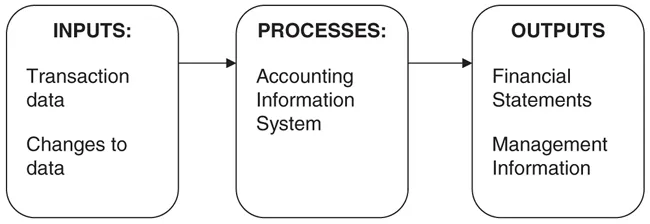
To make a decision, a manager needs information, which is provided to the manager from an information system. It will be an item of output from the information system. For example, a manager who is in charge of ordering inventory will be told by the information system how much inventory is currently held by the business and how much will be needed. The manager then decides how much inventory to order and from which supplier. This decision is entered into the information system by the manager; the order is then sent to the supplier by the information system and is updated to show that an order has been placed.
A company will usually have multiple systems such as purchasing and marketing, all of which must operate in an effective and efficient manner. The accounting system is one of the systems within an organization. The accounting information system will be part of the organization’s information system. Whereas the information system will process a combination of quantitative and qualitative data, the accounting information system focuses on processing quantitative data.
The accounting information system will produce various outputs. Some of the output will be for internal stakeholders such as monthly variance reports and created according to the desires of the management. Other output will be for external stakeholders such as lenders and follow statutory formats such as financial statements. The former is known as management accounting, while the latter is called financial accounting, which is the focus of this book.
1.2 Ethics in Accounting
At the heart of Accounting is Ethics, which are the beliefs that distinguish right from wrong; these are accepted standards of good and bad behavior. The role of accounting is to provide useful and timely information for decision-making. Therefore, there should be ethics in accounting, and as the old adage states, “good ethics are good business”. Being providers of accounting information, professional accountants usually encounter ethical choices as they prepare financial statements. For example, these choices can affect the price a customer pays and the bonus paid to employees.
1.3 Accounting Principles
These principles are the common rules that must be followed when producing financial statements, especially for external stakeholders, such as lenders or stockholders.
Generally Accepted Accounting Principles (GAAP) are rules that indicate acceptable accounting practices. GAAP aims to make information in financial statements relevant, reliable, and comparable. The two major bodies that establish GAAP in the United States are:
•Financial Accounting Standards Board (FASB): a private group that sets both broad and specific principles.
•Securities and Exchange Commission (SEC): a government entity that determines reporting requirements for companies that issue stock to the public.
The International Accounting Standards Board (IASB) issues International Financial Reporting Standards (IFRS) that identify preferred accounting practices, used, for example, when companies wish to raise money from investors in different countries. There is much academic and practical work being undertaken to facilitate the convergence of U.S. GAAP (and other countries’ GAAP) to IFRS; however, this topic is outside the scope of this work and will be covered in advanced financial reporting courses or books.
Cost Principle. According to this principle, accounting information is based on actual cost, which is measured on a cash or “equal-to-cash” basis. For example, you pay $20 cash for a service and thus the cost is measured as the amount of cash paid.
If something besides cash is exchanged (i.e., a car), the cost is measured as the cash value of what is given up or received, such as the car. The cost principle stresses reliability and verifiability, and information based in cost is considered objective.
Objectivity Principle. Under this principle, information is backed by independent, unbiased evidence and is more than a person’s opinion.
Revenue Recognition Principle. Revenue (sales) is the figure received from selling services and products. Revenue is only recognized or recorded:
1.when it has been earned
2.and proceeds from selling services and products can be cash or credit
3.and when it is measured by the cash value of any other items received.
Matching Principle. A company must recognize its expenses incurred to generate the revenue reported.
Full Disclosure Principle. This principle demands that a company must report the details behind financial statements that would influence users’ decisions.
As stated earlier in the United States, accounting principles also include the many complex detailed rules that are established and maintained by the FASB. The combination of the basic underlying guidelines and the complex detailed accounting rules are referred to as U.S. GAAP.
1.4 Accounting Assumptions
Key accounting assumptions state how a business is structured and functions. They provide the structure as to how business transactions are recognized. If any of these assumptions are false, it may be necessary to change the financial statements. The significant assumptions are:
Accrual Assumption—Transactions are recorded using the accrual basis of accounting, where the recognition of revenues and expenses arises when earned or used, respectively. If this assumption is false, a business should instead use the cash basis of accounting to develop financial statements that are based on cash flows.
Conservatism Assumption—Revenues and expenses should be recorded when earned; profits should not be overstated; and losses should not be understated.
Consistency Assumption—The same method of accounting will be used from period to period, unless it can be replaced by a more relevant method. If this assumption is false, the financial statements produced over multiple periods are not comparable.
Economic Entity Assumption—The transactions of a business and those of its owners must be separate. If this assumption is false, it is impossible to develop accurate financial statements.
Going Concern Assumption—A business will continue to run for the foreseeable future. If this assumption is false due to impending bankruptcy, deferred expenses should be recorded immediately.
Reliability Assumption—Only those transactions that can be sufficiently proven should be recognized. If this assumption is false, a business is probably manipulating the recording of revenue to enhance its short-term results.
Monetary Unit Assumption—Transactions should be expressed in monetary or money units such as dollars ($). This ensures consistent and comparable financial statements.
Time Period Assumption—The financial results reported by a business should cover a uniform and consistent period of time, such as a year. If this is not the case, financial statements will not be comparable across accounting periods.
Although the aforementioned assumptions appear obvious, they can easily be violated and lead to the production of financial statements that are fundamentally flawed.
When a company’s financial statements are audited, the auditors will be looking for breaches of these accounting assumptions and will refuse to submit an unmodified opinion on the statements unless any issues found are corrected. This may require new financial statements being produced that use the corrected assumptions.
CHAPTER 2
Financial Statements
Financial statements represent a prescribed record o...
Table of contents
- Cover
- Half Title Page
- Title Page
- Copyright Page
- Dedication
- Contents
- Acknowledgments
- Introduction
- Chapter 1 Fundamentals of Accounting
- Chapter 2 Financial Statements
- Chapter 3 Major Adjustments
- Chapter 4 Case Study 1—Applying the Major Adjustments
- Chapter 5 The Corporation
- Chapter 6 Case Study 2—Corporation Accounting
- Chapter 7 Interpretation of Financial Statements
- Chapter 8 Case Study 3—Ratio Analysis
- Appendix 1 Applying the Major Adjustments
- Appendix 2 Corporation Accounting
- Appendix 3 Solution of Case Study 3—Ratio Analysis
- Appendix 4 Glossary of Key Financial Accounting Terms
- Index
Trusted by 375,005 students
Access to over 1.5 million titles for a fair monthly price.
Study more efficiently using our study tools.
Frequently asked questions
Yes, you can cancel anytime from the Subscription tab in your account settings on the Perlego website. Your subscription will stay active until the end of your current billing period. Learn how to cancel your subscription
No, books cannot be downloaded as external files, such as PDFs, for use outside of Perlego. However, you can download books within the Perlego app for offline reading on mobile or tablet. Learn how to download books offline
Perlego offers two plans: Essential and Complete
- Essential is ideal for learners and professionals who enjoy exploring a wide range of subjects. Access the Essential Library with 800,000+ trusted titles and best-sellers across business, personal growth, and the humanities. Includes unlimited reading time and Standard Read Aloud voice.
- Complete: Perfect for advanced learners and researchers needing full, unrestricted access. Unlock 1.5M+ books across hundreds of subjects, including academic and specialized titles. The Complete Plan also includes advanced features like Premium Read Aloud and Research Assistant.
We are an online textbook subscription service, where you can get access to an entire online library for less than the price of a single book per month. With over 1.5 million books across 990+ topics, we’ve got you covered! Learn about our mission
Look out for the read-aloud symbol on your next book to see if you can listen to it. The read-aloud tool reads text aloud for you, highlighting the text as it is being read. You can pause it, speed it up and slow it down. Learn more about Read Aloud
Yes! You can use the Perlego app on both iOS and Android devices to read anytime, anywhere — even offline. Perfect for commutes or when you’re on the go.
Please note we cannot support devices running on iOS 13 and Android 7 or earlier. Learn more about using the app
Please note we cannot support devices running on iOS 13 and Android 7 or earlier. Learn more about using the app
Yes, you can access A Refresher in Financial Accounting by Faisal Sheikh in PDF and/or ePUB format, as well as other popular books in Business & Financial Accounting. We have over 1.5 million books available in our catalogue for you to explore.