![]()
CHAPTER 1
Introduction: A Complex World
A Digital Reality
In 2015, around 600 billion dollars were spent on advertising worldwide. Of this, 170 billion dollars were accounted for by digital marketing (that is, marketing activities where distribution of ad content is done through digital channels). And, the assumption is that, by 2019, half of all global advertising spend will take place in digital media.
The top five spenders in each advertising category by territory are the United States, China, Japan, Germany, and the United Kingdom, but in any market with Internet access, from Vietnam to Argentina, digital marketing is a relevant and growing phenomenon.
For this reason, Big Data and digital marketing are key areas to understand for every marketing professional out there. Past is the era where those were terms only applicable to technology companies or specialized firms in Silicon Valley. Any enterprise that aspires to be effective in its industry vertical or business needs to integrate data and digital functions in-house and have a strategy to deal with them.
The reason is fairly simple: consumers now inhabit a digital world and companies have no option but to follow them there.
Regardless of what a brand offers or sells in the real, offline world, chances are that it also has to contact its consumers in the digital sphere (a vast and anonymous space that keeps growing larger and larger), so finding them there is the first challenge. And, if that brand maintains a website or any other digital resources, data about those same consumers is being created constantly, with every visit and every page view, with every product that is placed in a virtual basket. That is all data that can be analyzed in order to obtain insights and improve the relationship with the consumer, which in turn will result in better business.
Simply put, digital marketing is the capability to reach and connect with consumers in the digital environment, and Big Data (or just data because it is all becoming so enormous that the adjective will soon lose its meaning) is the stream of information that allows that connection to be relevant and effective.
Both terms Big Data and digital marketing have become buzz words, not too dissimilar to what Internet was at the turn of the century. Every self-respecting company needs to have them listed in their mid-term strategy plan, but there are many that, although under pressure to be digitally relevant, have no clear understanding of what that means.
There is an oft-quoted joke that says: the worst kept secret in the digital marketing industry is that nobody really understands what is happening. This is, of course, an exaggeration, but it highlights the complexity of an industry that, although still in its infancy, is tasked with steering the future of marketing. Because the digital world is a complex one, and the same as happens in finance or politics, its players can hope to get some understanding of it, but figuring it all out is quite the challenge. Probably the best way to understand this intricacy is by looking at the Luma landscape. Created in 2010 by Terence Kawaja as a tool for his investment firm to keep track of all the companies involved in the digital marketing industry, it features a chart showing a staggeringly large number of technology company logos in different roles according to their function (DMPs, DSPs, SSPs, data providers, ad networks, ad exchanges, etc.) and area of work (display, mobile, video, etc.). There are hundreds of players competing and collaborating with each other in a constant flux, which is a reflection of the speed that possesses the industry.
In 2014, there were around 950 companies in the marketing technology industry. By 2015, the number had doubled to 1,800 companies. Although consolidation happens and large players absorb smaller ones, fresh technologies bring out an increasing number of new companies.
A part of the reason behind this congestion is the huge business opportunity (as reflected by the numbers mentioned), which goes hand-in-hand with the progressive accessibility of technology resources.
The Changing Face of Marketing
Marketing and advertising have been with us for a long time, since the ancient Egyptians started using papyrus to stick sales ads to the walls of their cities. They have gone through different stages in their history, but for the purposes of this book, we will divide their evolution into three periods.1
Stage One: The Age of Mass Media
Stage one includes most of human history advertising efforts. From word-of-mouth promotion and ads displayed on the street, technology and communication developments like printing, radio, and TV brought about the era of mass media. During this period, traditional large-scale media advertising has been dominant, with contents being broadcasted to a wide audience through a limited number of publishers and channels.
Stage Two: Adtech Digital Media
Stage two started during the mid-1990s. When the adoption of the Internet got to a scale large enough to provide a sustainable consumer audience, digital advertising was born. The same as printing, TV, and radio had done before, this new technology opened the door to innovative forms of ad distribution, which included e-mail, search, display, video, and more recently, mobile and social.
Doug Weaver is the founder of the Upstream Group2 and has the honor of being one of the first people to have sold a display digital ad (in 1994 for Hotwired magazine).
Currently a digital analyst and public speaker, he summarizes the difference between digital media and every other type of marketing channel that has come before like this: the great advantage (and also the big complication) brought by digital media is that it created an advertising medium where there is virtually no limit to the ad space that can be put up for sale.
Advertising inventory (the number of content units that a publisher has available to sell to an advertiser) in traditional mass media is determined by space. Whether it is the number of copies and surface area in a printed newspaper or magazines, or time on a radio or TV program, the inventory that could be assigned to advertising content was limited and finite. The technology that makes digital marketing possible broke down this barrier. In digital media, the publisher prepares a set of contents and makes them available to the users by publishing them on a website. A copy of the content does not exist until the user takes an action (opening the website in a browser). This means that, as opposed to traditional mass media, digital channels have a virtually endless number of copies they can generate. What is more, while mass media has a generic content set for all audience (hence the name mass), in digital media, each copy can change content according to the profile of the person who is accessing it. The impact of this difference is tremendous, and it lies at the core of the mechanics in play for digital marketing.
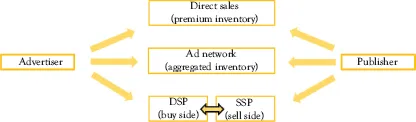
The one challenge that pioneers of the online advertising business could not overcome was how to optimize the sale of digital ad space. Initially, e-publishers followed the traditional, well-tested process of newspapers and TV, so this ad space was sold through direct sales teams. A sales person would contact advertisers and agencies and offer to place an ad creative at a certain cost. The price will vary according to visibility and estimated number of visitors to the website.
But, because the number of ad spaces available for sale was related to page views, accurate planning was nearly impossible, and after selling directly to some advertisers, websites often ended up with a small portion of left-over unfilled ad inventory. A new solution under the form of ad networks came into play as a way to aggregate this unused inventory. A group of publishers would pool together all their unused inventory to gain scale and offer it to advertisers, so they could increase the reach of their ads in a one-stop solution. Unfortunately, one of the effects of the ad network was that ad space was aggregated simply based on availability, and the context or nature of the channel was not always taken into account. Some advertisers were unhappy to see that their brands were being announced in websites of unsuitable content.
Also, because of the scale and the large number of publishers involved in the process, advertising in digital media either via direct purchase or via ad networks was very labor-intensive, and some kind of automatization was required. In around 2008, the digital industry got its wish granted and the digital advertising technology industry (this rather unwieldy name is usually shortened to simply adtech) was born. This automatization, although necessary, brought an unprecedented level of complexity to the whole advertising process.
The date is not coincidental; the financial crisis that shock Wall Street left out of work a large number of stock market system engineers and entrepreneurs who turned their hungry gaze to the increasingly rich digital ad industry. Looking to increase the effectiveness of the ad purchase process, they devised a new approach inspired by their financial sector backgrounds. What if advertisers could proactively choose the ad exchange inventory and pay based on the value they considered it was worth?
Taking a cue from the stock market, a new system called real-time bidding (RTB) allowed publishers (anybody with ad space to offer) to put their inventory in an ad exchange, a neutral trading ground for buying and selling ad space instead of giving it to an ad network. Advertisers would come to the same ad exchange and bid for the best ad location and impressions (also called a view, impressions count the number of times a particular ad is displayed on a website), which would go to the highest-paying bidder. Specialized technology companies were set at each end (DSP or demand-side platform in the advertiser end, and SSP or supply-side platform in the publisher end) to regulate the auction-like process.
The real time part of the name comes from the process itself. In the milliseconds that it takes for a user to open a new page, this freshly created ad space is presented to the advertisers in the ad exchange, and based on bidding prices set by each advertiser according to their interest, the ad space is assigned to the highest-paying client.
Stage Three: Data-Driven Digital Marketing
Stage three is where we found ourselves now. This is a stage that can be described as data-driven and includes those new marketing processes where the use of data defines how an ad is distributed to the consumer in order to reduce waste and inefficiency. All new marketing trends and developments that have exploded in the last decade, like cross-device tracking, one-to-one targeting, and addressable TV advertising, rely on data.
The driving force behind this third stage of advertising is an increased demand for transparency and accuracy in the marketing process by advertisers. One common characteristic to all stages of marketing is that the whole ecosystem is sustained by the economic engine of the advertising companies. Their role is key as they are, with their investment, the ones who support the contents and free services we have come to expect. These companies (from large brands running global campaigns to small-to-medium businesses and even mom-and-pop shops posting localized ads) have been looking at the changes in media consumption that have taken place in the last 15 years and have realized that consumers inhabiting the digital world demand a higher degree of personal communication. Because they are keen to recapture the attention that in the past traditional mass media like TV and newspapers commanded, these advertisers want to leverage the characteristics of digital marketing to create a conversation-like contact with the consumer.
As mentioned before, a new ad space is created every time one of us accesses digital content, and it is now technically possible to do something never done before. The content of the ad can be changed in the milliseconds before it is served, based on the profile of the audience looking at it. For the first time in the history of marketing, the message is not fixed and immutable as it traditionally was, when placed on the walls of an Egyptian city or the pages of a Victorian newspaper, waiting for the right person to come along and read it. Technology has made it ductile and flexible and advertisers can now look at consumers and modify the message to fit their particular tastes.
Stage three of marketing is, therefore, characterized by allowing personal targeting advertising through the use of data.
Finding an Audience: Lessons from Direct Marketing
In reality, advertisers are just looking to use the same principles of personalized communication that have been around for decades in direct marketing.
Direct marketing is the type of advertising used to sell directly to consumers. Originally done though mail channels like order catalogs starting in the 18th century, it has grown together with technological developments to encompass other media like e-mail, text messaging, call centers, and so forth.
Because of the cost involved in designing, printing, and sending marketing materials by post, direct marketers became early on very skilled in identifying...