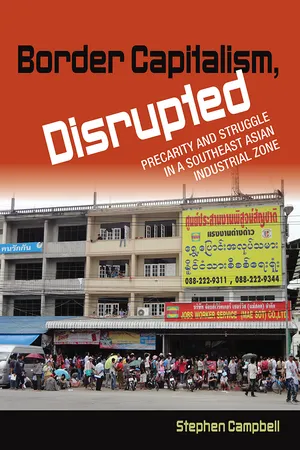
Border Capitalism, Disrupted presents an insightful ethnography of migrant labor regulation at the Mae Sot Special Border Economic Zone on the Myanmar border in northwest Thailand. By bringing a new deployment of workerist and autonomist theory to bear on his fieldwork, Stephen Campbell highlights the ways in which workers' struggles have catalyzed transformations in labor regulation at the frontiers of capital in the global south.
Looking outwards from Mae Sot, Campbell engages extant scholarship on flexibilization and precarious labor, which, typically, is based on the development experiences of the global north. Campbell emphasizes the everyday practices of migrants, the police, employers, NGOs, and private passport brokers to understand the "politics of precarity" and the new forms of worker organization and resistance that are emerging in Asian industrial zones.
Focusing, in particular, on the uses and effects of borders as technologies of rule, Campbell argues that geographies of labor regulation can be read as the contested and fragile outcomes of prior and ongoing working-class struggles. Border Capitalism, Disrupted concludes that with the weakened influence of formal unions, understanding the role of these alternative forms of working-class organizations in labor-capital relations becomes critical.
With a broad data set gleaned from almost two years of fieldwork, Border Capitalism, Disrupted will appeal directly to those in anthropology, labor studies, political economy, and geography, as well as Southeast Asian studies.
That borders are contingent products of historical political processes is but a point of departure for my analysis. What anthropologists have pushed further, and what I seek to advance in this book, is the understanding that borders—in their immediate effects, the meanings they come to hold, and the relations that coalesce around them—are also social constructs produced through the everyday practices of border residents, passers-by, and individuals operating farther afield.1 In just such a manner, the geopolitical border at Mae Sot, Thailand, has come to be meaningful and material in particular ways. But the practices that have here produced the border’s specificity—the often mundane practices of border residents, government officials, business owners, migrants and refugees, aid workers, and others—have themselves been shaped by broader political movements, enduring civil wars, globalized capitalist transformations, and shifting regional economic arrangements, as I will outline in this chapter. Despite, consequently, the area’s long history of population movement, the arrangement of the border at Mae Sot and the concentration of migrants therein are distinctly modern phenomena.
In precolonial Southeast Asia, by contrast, mainland polities were organized as constellations of city-states whose power diminished as it radiated out from their political centers, leaving gaps between spheres of authority lying effectively outside any sovereign control.2 Under this arrangement, the various states of what later became Thailand and Myanmar were never able to effectively assert their rule at the local level among upland communities along what would eventually become the Thai-Myanmar border.3 Instead of demarcating an established geopolitical border, these mostly ethnic Karen–populated mountains served as a buffer zone between antagonistic kingdoms in Siam and precolonial Burma.4
What are now demarcated as the Thai districts of Mae Ramat, Mae Sot, Phop Phra, Tha Song Yang, and Umphang are situated along the contemporary Thai-Myanmar border in and around a large valley in the Dawna mountain range. In Mae Sot District, established in 1898, the border follows the Moei River, with the Myanmar town of Myawaddy now located on the opposite bank. As a sleepy border outpost in a bucolic valley at the margins of northwest Thailand, Mae Sot did not experience significant growth until well after World War II. As a consequence, the mountainous border area around Mae Sot remained throughout the early postwar era an “insurgent backwater,” wherein various armed ethnic and communist opposition groups maintained rear bases far from the main sites of conflict.5 During the 1970s, at a time of increased activity by the Communist Party of Thailand (CPT), the Thai government initiated a series of counterinsurgency measures and infrastructure projects around Mae Sot as means of improving surveillance of CPT units operating in the area. Hence, the paved roadways that now connect Mae Sot with the neighboring towns of Mae Sarieng, Tak, and Umphang and have enabled the district’s growth as a regional hub for trade, industry, and migration were originally built as counterinsurgency infrastructure in the 1970s.6 As there were no vehicle bridges across the Moei River at this time, the cross-border movement of trade goods and people was facilitated by long-tail boats ferrying between a series of unofficial piers. This is a practice that has continued to this day despite the completion in 1997 of the Thai-Myanmar Friendship Bridge, which now serves as the official immigration checkpoint between Mae Sot and Myawaddy.
In addition to this infrastructure development, the Thai military began in the mid-1970s to support the avowedly anticommunist Karen National Union (KNU) and Karen National Liberation Army (KNLA) in eastern Myanmar as a means to prevent a linking up of the CPT and the insurgent Communist Party of Burma, which was operating across the border.7 Due in part to their close relations with the Thai military, various KNLA commanders were able to assert control at this time over much of the trade going across the Thai-Myanmar border.8 This trade had become especially voluminous and lucrative due to the vibrant black market that developed when restrictions on imports and exports were introduced in Myanmar under the Burmese Way to Socialism following the country’s 1962 military coup. It was this coup that notoriously established conditions for direct military rule in Myanmar—conditions that endured for nearly a half century, notwithstanding important changes along the way.
The border arrangement in the Mae Sot area began to drastically change in the late 1980s. It was, in particular, the 1988 popular uprising against authoritarian rule in Myanmar that set in motion new social, economic, and political processes along the border. This occurred in two significant ways. First, the military crackdown that followed the uprising instigated a mass exodus of thousands of politicized students. The majority of these students fled to rural areas of eastern Myanmar, which were then under the control of various armed ethnic opposition groups, with some students crossing over into Thailand. Many of these students became involved in the All Burma Students’ Democratic Front (ABSDF), an armed opposition group founded in 1988 that linked up with the KNU and KNLA and established an office alongside allied political and military groups near the KNU headquarters at Manerplaw in eastern Karen State, about one hundred kilometers northwest of Mae Sot.
The alliance of mostly ethnic Burman students with various non-Burman opposition groups motivated the Myanmar Army to intensify its military campaign to finally take those lands held by the KNU and other insurgent groups in eastern Myanmar. The Myanmar Army’s efforts in Karen State at this time were aided by a split in 1994 within the ranks of the KNLA. A large section of the KNLA’s majority Buddhist infantry left the group over issues of discrimination and a lack of responsiveness by the KNU and KNLA’s Christian-dominated leadership. Having been encouraged by the Myanmar Army as a means to divide the Karen resistance, these former KNLA soldiers established a new military faction, the Democratic Karen Buddhist Army, allied with the Myanmar Army, with which it engaged in a joint attack on the KNU headquarters at Manerplaw beginning in January 1995. The fall of Manerplaw in February of that year triggered a mass flight of Karen refugees into Thailand.9 Along with these civilian Karen refugees, the political and military organizations that had formerly operated out of Manerplaw likewise crossed the border at this time, with many relocating to Mae Sot, where they established new offices to continue their operations.
The 1995 refugee exodus from Manerplaw was but one moment in a continuous (though intermittent) movement of refugees into western Thailand from the mid-1980s to the second decade of the twenty-first century—a period that overlaps with the simultaneous transborder movement of migrants. Research into the motivations for migration of those from Myanmar who have taken on employment in Mae Sot and elsewhere in Thailand have shown the overlapping categories of the individuals who sought to escape armed conflict, forced labor, extortion, and a lack of opportunities for livelihood; they variously became “refugees” (registered in camps along the border as “displaced persons temporarily fleeing fighting”) or “migrants” (those who lacked such registration and thus remained outside the camps).10 Blurring these categories further, individuals registered in the camps have at times also left the camps in order to seek employment in nearby agricultural areas or in urban centers like Mae Sot; meanwhile, some individuals who upon arrival in Thailand took on work as migrants have subsequently been able to obtain camp registration.
Figure 3. The Thai-Myanmar Friendship Bridge, connecting Myawaddy and Mae Sot. Author’s photograph.
Figure 4. Myanmar migrants returning from Thailand “unofficially” cross the Moei River by boat. Author’s photograph.
Within the dynamic of migration as evasion, migrants-cum-refugees seeking to escape extortion, forced labor, armed conflict, and other forms of violence have made strategic use of the Thai-Myanmar border and the protection it affords them from human rights abuses in Myanmar.11 It was, in fact, as early as 1984 that Karen refugees began arriving in western Thailand. At that time, a consortium of nongovernmental organizations (NGOs) that had been providing aid to Indo-Chinese refugees in eastern Thailand began delivering food and medicine to the new arrivals on the western border under a mandate from the Thai Ministry of Interior.12 As the population of Karen and other refugees from Myanmar grew throughout the 1990s, the number of organizations seeking to deliver aid to these groups increased significantly. As one border-based writer remarked, the situation along Thailand’s western border had by the early twenty-first century developed into something of a humanitarian “industry.”13 In addition to the presence of international NGOs (and soon the Office of the United Nations High Commissioner for Refugees), numerous war refugees, political asylum seekers, and migrants—though, as noted above, these categories are blurred—established their own community-based organizations to provide various forms of assistance to the refugee-migrant population that was expanding along the border. Among such organizations was the Yaung Chi Oo Workers Association, which student activists and U Moe Swe, a former member of the ABSDF, established in Mae Sot in 1999.
The second way in which the 1988 uprising in Myanmar served to significantly reshape border dynamics was by catalyzing a process of economic liberalization in the country. Seeking to garner popular legitimacy in the face of continued domestic calls for political liberalization, the new military junta, which took power in Myanmar amid the uprising, initiated a series of liberalizing economic reforms.14 These reforms catalyzed far-reaching transformations in the country’s political economy and severely weakened the black market trade that had enriched the KNU, the KNLA, and other insurgent groups along the border.
The economic transformation within Myanmar that these reforms set in motion produced both winners and losers. Certain business owners and landowners—and especially those with high-level military connections—were well positioned to take advantage of the new economic opportunities and thus prospered. At the same time, the liberalization process fueled disparities in wealth and, in some areas, an increase in absolute poverty.15 This occurred as the government removed subsidies on staple goods and as inflation drove up the price of basic commodities and agricultural land. The resulting economic hardships fueled a growing movement of people out of Myanmar in search of employment opportunities abroad. Most of these individuals went to Thailand, while others headed to China, Malaysia, Singapore, and elsewhere.
For those from Myanmar migrating to work in Thailand, Mae Sot served as the primary point of entry into the country. Estimates of the proportion of Myanmar migrants in Thailand who have entered via Mae Sot are as high as 90 percent.16 Myanmar migrants arriving in the Mae Sot area at the beginning of the 1990s found work primarily as agricultural laborers, domestic servants, or independent market sellers and petty traders. There were initially no factories in Mae Sot, as the first of these was established only in 1995.17 There was also no system of migrant registration in place at the time. Human smuggling operations quickly emerged, largely run by the police, that would take migrants from Mae Sot to factories and other employment opportunities in central Thailand. For those migrants who remained in Mae Sot, the experience of violence and extortion from local police became an everyday occurrence.
Given what I have recounted here of the interconnected processes of economic transformation, civil war, and military expansion in Myanmar that have motivated the movement of migrants and refugees out of the country in various ways, the question arises of who Mae Sot’s migrants actually are. As a consequence of the widespread lack of documentation among migrants in Thailand, estimates of the country’s overall migrant population range from less than two million to more than four million.18 In the five border districts of Mae Sot, Mae Ramat, Phop Phra, Tha Song Yang, and Umphang, estimates of the local migrant population range from 150,000 to 300,000.19 Based on research he conducted in Mae Sot in 2008 and 2009, Dennis Arnold has provided an occupational distribution ratio of 40:40:20 for migrants employed in these districts—representing industry, agriculture, and domestic work and services, respectively.20 Employing a conservative population estimate of 200,000 migrants of working age, this occupational distribution would suggest that about eighty thousand migrants in this area work in factories, a similar number work in agriculture, and about forty thousand are employed in domestic work and services. In addition, in 2013 there were between fourteen thousand and fifteen thousand migrant children attending seventy-two migrant schools in the five border districts.21 Within these five districts, there are an estimated three hundred registered factories (mostly garment and textile manufacturing firms) employing from one hundred to one thousand migrants each, with another two hundred or so unregistered “home factories,” each typically employing between five and twenty migrants.22
Figure...
Table of contents
Acknowledgments
Abbreviations
Map
Introduction
1. Producing the Border
2. Capitalist Recuperation
3. Mobility Struggles
4. Coercive Policing
5. Class Recomposition
6. Organizing under Flexibilization
Conclusion
Postscript
Notes
Bibliography
Index
Trusted by 375,005 students
Access to over 1.5 million titles for a fair monthly price.
Study more efficiently using our study tools.
Frequently asked questions
Yes, you can cancel anytime from the Subscription tab in your account settings on the Perlego website. Your subscription will stay active until the end of your current billing period. Learn how to cancel your subscription
No, books cannot be downloaded as external files, such as PDFs, for use outside of Perlego. However, you can download books within the Perlego app for offline reading on mobile or tablet. Learn how to download books offline
Perlego offers two plans: Essential and Complete
Essential is ideal for learners and professionals who enjoy exploring a wide range of subjects. Access the Essential Library with 800,000+ trusted titles and best-sellers across business, personal growth, and the humanities. Includes unlimited reading time and Standard Read Aloud voice.
Complete: Perfect for advanced learners and researchers needing full, unrestricted access. Unlock 1.5M+ books across hundreds of subjects, including academic and specialized titles. The Complete Plan also includes advanced features like Premium Read Aloud and Research Assistant.
Both plans are available with monthly, semester, or annual billing cycles.
We are an online textbook subscription service, where you can get access to an entire online library for less than the price of a single book per month. With over 1.5 million books across 990+ topics, we’ve got you covered! Learn about our mission
Look out for the read-aloud symbol on your next book to see if you can listen to it. The read-aloud tool reads text aloud for you, highlighting the text as it is being read. You can pause it, speed it up and slow it down. Learn more about Read Aloud
Yes! You can use the Perlego app on both iOS and Android devices to read anytime, anywhere — even offline. Perfect for commutes or when you’re on the go. Please note we cannot support devices running on iOS 13 and Android 7 or earlier. Learn more about using the app
Yes, you can access Border Capitalism, Disrupted by Stephen Campbell in PDF and/or ePUB format, as well as other popular books in Politics & International Relations & Asian History. We have over 1.5 million books available in our catalogue for you to explore.