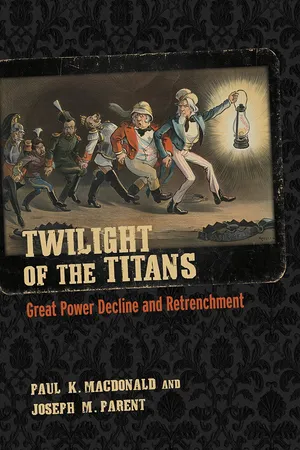
In Twilight of the Titans, Paul K. MacDonald and Joseph M. Parent examine great power transitions since 1870 to determine how declining powers choose to behave, identifying the strong incentives to moderate their behavior when the hierarchy of great powers is shifting. Challenging the conventional wisdom that such transitions push declining great powers to extreme measures, this book argues that intimidation, provocation, and preventive war are not the only alternatives to the loss of relative power and prestige. Using numerous case studies, MacDonald and Parent show how declining states tend to behave, the policy options they have, how rising states respond to those in decline, and what conditions reward particular strategic choices.
eBook - ePub
Twilight of the Titans
Great Power Decline and Retrenchment
- 278 pages
- English
- ePUB (mobile friendly)
- Available on iOS & Android
eBook - ePub
About this book
Information
CHAPTER 1
Desperate Times, Desperate Measures
Debating Decline
The first and most attractive response to a society’s decline is to eliminate the source of the problem. By launching a preventive war, the declining power destroys or weakens the rising challenger while the military advantage is still with the declining power.
—Robert Gilpin
In these more troubled circumstances, the Great Power is likely to find itself spending much more on defense than it did two generations earlier, and yet still discover that the world is a less secure environment…. Great Powers in relative decline instinctively respond by spending more on “security,” and thereby divert potential resources from “investment” and compound their long-term dilemma.
—Paul Kennedy
Since 2008, there has been vigorous argument about whether the United States is in decline. Some see clear evidence of an erosion of American power. Fareed Zakaria argues that “the distribution of power is shifting, moving away from U.S. dominance.”1 The National Intelligence Council asserts that one of the most important global trends will be the shift of power “to networks and coalitions in a multipolar world.”2 Others maintain that reports of America’s demise have been greatly exaggerated. Joseph Nye contends that “describing the twenty-first century as one of American decline is likely to be inaccurate and misleading”3 Josef Joffe reaches a similar conclusion about the “false prophecy of America’s decline,” noting, “The United States is the default power, the country that occupies center stage because there is nobody else with the requisite power and purpose.”4
While there are significant disagreements about the character of American decline, there are fewer disagreements about its potential consequences. Authors across the political spectrum worry about the repercussions of ebbing U.S. influence. Robert Kagan contends that “if American power declines, this world order will decline with it.”5 And Robert Lieber declares, “The maintenance of [the United States’] leading role matters greatly. The alternative would… be a more disorderly and dangerous world.”6 Christopher Layne concurs: “As [its] power wanes over the next decade or so, the United States will find itself increasingly challenged.”7 Charles Kupchan echoes the point: “U.S. leadership has always faced resistance, but the pushback grows in proportion to the diffusion of global power.”8 While their policy recommendations differ, there is broad consensus that if the United States declines, this will usher in a period of greater uncertainty, complexity, and potential danger in world politics.
Why do international relations scholars assume that decline will be dangerous? This pessimism is founded in the two main theories of how great powers respond to decline. The first contends that expansion and war are the most likely responses to shifts in power. Declining states find it hard to resist the siren song of preventive war because it holds the greatest hope that they will be able to slow or stop their decline. Rather than waiting until decline has taken its toll, states prefer to confront rising challengers while the balance of military capabilities remains favorable. The second argues that, when decline strikes, great powers stick to the status quo because they struggle with domestic dysfunction. A combination of entrenched interest groups, hidebound bureaucracies, and parochial governing coalitions prevent policymakers from altering course. Paralyzed at home, declining powers cling to untenable commitments despite sharp challengers and spiraling costs. Where domestic dysfunction scholars tend to see status quo policies as imprudent, preventive war theorists tend to see those courses of action as rational, if sometimes regrettable.
In this chapter, we challenge the assumptions and logic of both of these theories. We argue that the conditions that produce dysfunctional domestic dynamics or preventive war incentives tend to be rare, and even less common when great powers are in the midst of decline. Decline creates powerful incentives for leaders to overcome domestic intransigence and push through needed reforms. Few states are so vulnerable to capture from domestic interests that they can ignore structural incentives. Decline generates equally powerful incentives for states to adjust constructively within the international order, rather than risk the grave gamble that is preventive war. Seldom are states in the position where the risks of preventive war are manageable, and yet victory will be decisive enough to solve their underlying problems. These critiques find support in the empirical record, where preventive war and political paralysis are infrequent. The true puzzle is not why states struggle to respond to decline, but why retrenchment is the most common response.
To be clear, these two theories need not be mutually exclusive: domestic dynamics can reinforce international pressures. But to simplify matters, we consider each separately. In the first section, we investigate theories of preventive war, spelling out their logics and shortcomings. In the second section, we give similar treatment to theories of domestic dysfunction. And in the final section, we summarize the debate and the gaps it contains.
International Incentives: The Lure of Preventive War
Following Thucydides, many scholars contend that decline is dangerous because it promotes war. When the distribution of national power is stable and predictable, individual states have neither the incentive nor the capacity to challenge the status quo. When the hierarchy of great powers is in flux, rising and falling powers are tempted to use force to advance their interests. Yet the two exemplars of this tradition, hegemonic stability theory and power transition theory, disagree about the precise mechanisms linking decline to war. We explain the logic of each in turn.
Advocates of hegemonic stability theory argue that declining powers have no good options to stave off defeat apart from preventive war. Robert Gilpin maintains that declining powers confront a strategic dilemma: though they would prefer to “restore equilibrium to the system” through peaceful means, there are no good policies for doing so.9 Domestic options, such as increased taxation or institutional reform, are blocked by “vested interests.”10 International solutions, such as tighter alliances or retrenchment, are impractical and dangerous. The “utility of an alliance as a response to decline” is “severely restricted” due to free riding and cheating, while retrenchment is “by its very nature… an indication of relative weakness” and thus “a hazardous course” that is “seldom pursued by a declining power.”11 Unable to generate new revenues or reduce current costs, declining powers have few options short of force. “When the choice ahead has appeared to be to decline or to fight,” Gilpin concludes, “statesmen have most generally fought.”12
Dale Copeland also contends that declining powers have strong incentives to pursue antagonistic policies. When states are “declining deeply” and “will almost certainly be attacked later,” preventive war is the only option that can “maximize the state’s expected probability of survival.”13 Conciliatory strategies may reduce tensions, yet “sacrificing relative power in the process… lower[s] a state’s likelihood of winning any war that does occur.”14 Attempts to “buy the rising state’s goodwill” through concessions also tend to fail because declining powers cannot trust rising powers’ promises to remain at peace “after preponderance has been achieved.”15 In the final analysis, “the more severe a state’s decline will be in the absence of strong action, the more severe its actions are likely to be.”16 The faster and deeper great powers fall, the more likely and eager they are to fight.
In contrast, power transition theorists emphasize the incentives of rising powers to use force. A. F. K. Organski and Jacek Kugler argue that as rising challengers ascend the standings, they find that dominant powers refuse to accommodate their expanding interests.17 Incapable of revising the status quo through peaceful means and “unwilling to accept a subordinate position,” dissatisfied challengers are increasingly drawn to truculent policies.18 It is when a rising power has “finally caught up with the dominant country” that it will use force in an “attempt to hasten [its] passage” to the top rung of the great power ladder.19 Decline is dangerous not because leading powers will fight to defend their positions, but because rising powers will embark on destabilizing bids for hegemony.
At first glance, hegemonic stability theory and power transition theory appear to contradict one another. For Copeland, “major wars are typically initiated by dominant military powers that fear significant decline.”20 On the contrary, Organski and Kugler assert, “It is the weaker, rather than the stronger, power that is most likely to be the aggressor.”21 But in practice, the logic of each theory reinforces the other. They both agree that shifts in the balance of power are perilous but differ on who has the stronger incentives to fight. In both views, rising and declining powers are trapped in a security dilemma where one side’s moves decrease the security of the other and vice versa. Initiation seldom matters in such situations. Since abrupt shifts in power heighten uncertainty, fear, and mistrust, they encourage declining powers to hold the line or expand their ambitions, which inevitably clash with those of rising powers.22 Because both theories come out essentially the same, from this point on we will call them both preventive war theory as a shorthand. They share the same expectations: declining great powers will maintain ambitious grand strategies, in which rigid conceptions of interests foment war. The deeper the decline, the more aggressive the response will be.
Preventive war theories lay out a clear cost-benefit analysis, but their accounting is suspect in a number of respects. First, war is incredibly costly and risky. The preferred solution of preventive war theories is one of the most expensive and least predictable actions a state can take. This may be why Thucydides’s prototypical example ended badly. After decisively defeating Athens, Spartan power never recovered, losing to Thebes and Macedon not long after. And modern wars are worse. Even putting nuclear weapons to one side, great power wars have been exorbitantly costly for some time.23 As Gilpin and Copeland acknowledge, hardline foreign policies bring risks—defeat being the worst—and even victories can be pyrrhic.24 The use of force may alienate allies, alarm neutrals, and provoke rivals. It can saddle the victor with restive populations and costlier commitments. Shallow declines are not menacing enough to warrant war, while deep declines are hard to reverse with force. Because deep declines tend to be the product of fundamental social and economic deficiencies, foreign policy fixes are seldom silver bullets. Great powers will be most willing to accept the risks of hardline policies at precisely the moments when the benefits are likely to be minimal and unattainable.
Second, and related, preventive war theories underestimate the efficacy of mutual accommodation. The assumption tends to be that war, while rare, is to a large extent inevitable. The alternatives available to declining powers, as Gilpin emphasizes, are “seldom those of waging war versus promoting peace, but rather waging war while the balance is still in that state’s favor or waging war later when the tide may have turned against it.”25 But there are good reasons why rising challengers would see war as improbable. The capacity of rising powers to sustain their trajectory depends on domestic institutions, which must manage the dislocations associated with rapid growth, and the stresses of great power war are unlikely to help. Premature bids for hegemony can not only encourage the formation of hostile foreign coalitions but also upset the fragile domestic foundations of long-term growth. Windows of vulnerability rarely open as quickly or decisively as theories of preventive action anticipate, and even the most damaged declining power does not become a pushover. Rising powers have strong incentives to bide their time until they are in a decisively dominant position.26
On their side, declining powers have reasons to avoid confrontational responses as well. The growth of a rising challenger may slow or stall for a variety of reasons. Rising powers may acquire new and costly commitments, which can distract attention and drain resources. Domestic issues may siphon away disposable wealth and divert rising powers from challenging redoubtable great powers. While they may dominate by lesser margins, declining powers can still call upon their large and diverse economies as well as advanced and experienced militaries. They can draw on the support of longstanding allies, appeal to customary diplomatic practices and familiar rules, and concentrate resources on well-established interests. Hostile or unbending actions forfeit these advantages. Provocative actions require declining states to risk scarce resources and use dubious means in uncertain environments for quixotic goals.
Third, preventive war theories obsess over the appearance of credibility, not where it comes from or how much it is worth. For Gilpin, the “fundamental problem with a policy of appeasement or accommodation” is that it leads to “continuing deterioration in a state’s prestige and international position.”27 But commitments are checks: they only cash when there is something behind them. In world politics, power is the closest equivalent to money, and as a declining state’s power draws down, it has to be more frugal. Great powers cannot be fooled for long; com...
Table of contents
- List of Illustrations
- Acknowledgments
- Introduction
- 1. Desperate Times, Desperate Measures: Debating Decline
- 2. Parry to Thrust: The Logic of Retrenchment
- 3. The Fates of Nations: Decline by the Numbers
- Studies in Revival
- 4. A Hegemon Temporizes: 1872 Great Britain
- 5. A Hegemon Wakes Up: 1908 Great Britain
- 6. A Descending Whirligig: 1888 Russia
- 7. “Les Jeux Sont Faits”: 1893 France
- 8. Tsar Power: 1903 Russia
- 9. The Utopian Background: 1925 France
- Conclusion: Retrenchment as Reloading
- Notes
- Index
Trusted by 375,005 students
Access to over 1.5 million titles for a fair monthly price.
Study more efficiently using our study tools.
Frequently asked questions
Yes, you can cancel anytime from the Subscription tab in your account settings on the Perlego website. Your subscription will stay active until the end of your current billing period. Learn how to cancel your subscription
No, books cannot be downloaded as external files, such as PDFs, for use outside of Perlego. However, you can download books within the Perlego app for offline reading on mobile or tablet. Learn how to download books offline
Perlego offers two plans: Essential and Complete
- Essential is ideal for learners and professionals who enjoy exploring a wide range of subjects. Access the Essential Library with 800,000+ trusted titles and best-sellers across business, personal growth, and the humanities. Includes unlimited reading time and Standard Read Aloud voice.
- Complete: Perfect for advanced learners and researchers needing full, unrestricted access. Unlock 1.5M+ books across hundreds of subjects, including academic and specialized titles. The Complete Plan also includes advanced features like Premium Read Aloud and Research Assistant.
We are an online textbook subscription service, where you can get access to an entire online library for less than the price of a single book per month. With over 1.5 million books across 990+ topics, we’ve got you covered! Learn about our mission
Look out for the read-aloud symbol on your next book to see if you can listen to it. The read-aloud tool reads text aloud for you, highlighting the text as it is being read. You can pause it, speed it up and slow it down. Learn more about Read Aloud
Yes! You can use the Perlego app on both iOS and Android devices to read anytime, anywhere — even offline. Perfect for commutes or when you’re on the go.
Please note we cannot support devices running on iOS 13 and Android 7 or earlier. Learn more about using the app
Please note we cannot support devices running on iOS 13 and Android 7 or earlier. Learn more about using the app
Yes, you can access Twilight of the Titans by Paul K. MacDonald,Joseph M. Parent in PDF and/or ePUB format, as well as other popular books in Politics & International Relations & International Relations. We have over 1.5 million books available in our catalogue for you to explore.