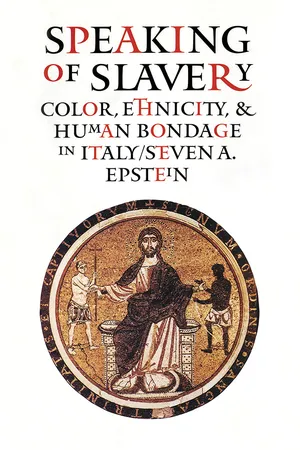
CHAPTER ONETHE LANGUAGE OF SLAVERY
Even the stupidest and most ignorant folk were following the whole thread of his argument. Now if you went and asked them to repeat the words he used ...
ALESSANDRO MANZONI, I promessi sposi
In late 1926 the fourth national congress of the Antislavery Society of Italy met in Rome. Egilberto Martire, a journalist and deputy in parliament, addressed the group on the subject of San Benedetto of Palermo, a Franciscan saint and patron of the Italian antislavery movement. Benedetto, also known as “il Moro” (the Moor) was, as Martire somewhat inexactly described him, “a black, an Italian, a freed slave, and a Franciscan monk.”1 A constant theme of Martire’s speech was that it was possible to be both black and Italian, and while there were timely reasons for this, especially Italy’s colonial ambitions in East Africa, what was really at stake were the definitions of what it meant to be black, and to be Italian. Martire observed that Benedetto was a black born in Sicily to Christian “Ethiopian” slaves of a Christian master. (Martire took from his sources the identifier “Ethiopian,” which in the sixteenth century applied to all of sub-Saharan Africa.) According to Martire, even though the blazing sun of his native island preserved intact the “shining blackness” (lucida nerezza) of his skin, Benedetto was a black of Italy, from a race that had suffered from and been proved by the horrors of slavery. Martire was ardently antislavery, so his use of Benedetto as a saintly symbol of the society’s crusade for Christian liberty was sincere, even if he was now compromised by membership in a fascist parliament—after all, the Antislavery Society itself patriotically displayed a congratulatory telegram from Mussolini at the beginning of its minutes. Italians could also be proud of the fact that the Spanish had taken San Benedetto’s cult to the New World, where he was honored in Mexico, Bahia, Peru, Cincinnati, and Kansas City.2 This meeting did not dwell on the slavery in Italy’s own past, and some smugness also intruded; the vice president of the society said “that American slavery had been the coarsest economic exploitation.”3 But there was considerable pride that Italy had produced a black saint whose cult was strong among ex-slaves and their descendants.
We will take a closer look at San Benedetto of Palermo later, for he is an interesting character in the history of Italian slavery. Martire’s speech launches us into the deep waters of just what it meant to be an Italian, to be a slave, to be black—questions as relevant in the Middle Ages as they were in the 1920s. Italy was barely fifty years old in 1926, and the idea of being an Italian in the centuries before unification had engaged writers from Machiavelli to Mazzini. Even when a nationalistic or cultural loyalty to the peninsula and its people was dim and a sense of common identity nonexistent, the Other—the slave, the black, the Tartar, Muslim, or Jew—helped define local loyalties. Was it possible to be a Genoese, a Venetian, a Palermitan, and also a black? In the 1930s fascism began to exclude Jews from the ranks of regular Italians, so questions of identity existed in every age, embedded in the common rhetoric of people and political leadership.
Many institutions over the centuries—the Church, the Franciscan order, the Spanish crown, Mussolini’s government—were eager to co-opt San Benedetto il Moro for their purposes. But just on the level of language, deciding what to call Benedetto and his parents, describing them by color, ethnic origin, or religion, helped the Italians to define themselves and what they were doing to other people. The approach to linguistics called pragmatics, which emphasizes looking at the meaningful use of language in its broadest context, encourages us to begin looking at Italian slavery by closely examining the words used to define, operate, and justify the various systems of slavery the Italians invented or borrowed, from the Romans to the slave labor camps of World War II. These cycles in the history of exploitation show how Italian society moved away from oppression toward a freer system of labor—though that journey is not yet over. Historians have been closely analyzing language for a long time and were among the first to chart changes in language over time and the use of words to demean and oppress people.
Here in the Italian experience we have the chance to look at a long historical dialogue with slavery—one of the most durable in world history—and to see how language defined some people as appropriate subjects for exploitation. Filippo Zamboni, who prefaced his late nineteenth-century account of slavery in the age of Dante with an autobiographical sketch, observed that when he was a boy his mother told him not to use the word “schiavo” because slavery “was a cruel and haughty thing.”4 Going back into the Italian past and searching for the meanings of words will help explain how color and slavery moved from facts of life to sources of shame, ever so slowly. Yet even by Zamboni’s youth (1850s), when the Italian translation of Uncle Tom’s Cabin was making a tremendous impression on liberal, reform-minded Italy, the language of Italian slavery had become permeated with other words and cultural discourses, be they the Latin of Roman slavery or the English of the American South. The broader context of Italian slavery must include those global and historical influences that affected the ways Italians understood what it meant to be a slave. Our contemporary perspective on Italian slavery must encompass recent events that permanently altered the ways Italians think about and describe slavery. Equally, the study of medieval and early modem slavery must reach forward to connect with modem slavery, or else we are left with fragmentary scholarship that means nothing.
WORDS
Our search for the language of Italian slavery must begin with individual words. The Italian word for “slave,” schiavo, is clearly related to esclavo in Spanish, esclave in French, Sklave in German, and slave in English, among other vernacular languages in Europe. The best analysis of the possible common origins of these words points to the Balkans, the home of the southern Slavs, who in the early Middle Ages provided slaves to Carolingian Europe, the Byzantine state, and via intermediaries to the Muslim East—hence also the Arabic sakaliba for “slave.”5
By a curious process, nearly everywhere the Latin for “slave,” servus, began to transfer its meaning to the medieval serf. This change was perhaps slowest in Italy, where into the thirteenth century the most common word for “slave” remained servus.6 As late as the Angevin kingdom of Naples, administrative documents referred to Saracens in the colony at Lucera as “servi” of the royal household.7 These “serfs” belonged to the monarch as surely as any slaves, as they learned when the colony was destroyed in 1300–1301 and most of the surviving population was sold as “schiavi.” But as early as the eleventh century, sclavus appeared in southern Italy as a word for “slave.”8 Even as Greeks, Arabs, and German-speaking peoples borrowed the root sklav-/slav- to refer to slaves and for the Arabs particularly to light-skinned ones, southern Italians adopted the word later and probably were the ones to share it with their northern Italian neighbors through commerce in people. One of the earliest uses of the word sclava, from Bari in 1088, suggests that the Adriatic slave trade brought the people and the words first to southern Italy.9 By the fourteenth and fifteenth centuries the Latin sclavus and the dialect forms of schiavo were in common use throughout the Italian peninsula.
Dictionaries are the humble but essential source for finding both words and their common meanings. In both subtle and blatant ways dictionaries also convey a broader context needed for using the words and understanding their meanings. The first dictionaries of the Italian Middle Ages were of course in Latin, still the unifying language for the peninsula’s educated elite. Hence the dictionaries carried a lot of the cultural inheritance of ancient Rome to the later period, and the literate knew that old Rome was a slave society. Our worries about words must include a cautious approach to medieval Latin in Italy, which may contain and perpetuate anachronistic features of ancient Latin. The classic problem concerns the word Servus—the ancient slave, but so often in medieval documents of practice the serf. This is not the place to become confused about serfs, whose status admittedly came at times perilously close to slavery.10 The law, and the words, tell us that serfs lived in the shadowy world of the semifree. The dictionaries, however, emerge in a period that found earlier medieval concepts like being “half free” to be unsatisfactory, so our sources seek clarity, another purpose of the dictionary.
Dictionaries supply important evidence on both the definition of slavery and the ways in which ideas about color and humanity shaped attitudes toward people. The oldest Latin dictionary from the central Middle Ages in Italy was completed by Papias in 1053.11 Papias defined slaves in the classical Western tradition as people taken in wars, born into slavery, or acquired from enemies. He simply defined famulus and manceps as servus (slave), and noted that ancilla (female slave) derived from the Greek for “prop” or “support.” This simple use of synonyms from the norms of classical Latin probably derived from Isidore of Seville. Papias defined albus (white) as candidus, which in turn meant without stain, and referred back to white. Niger (black) was not bright or fair but fuscus (dark), and again the meaning of fuscus simply pointed the reader back to niger and the classical aquilus (dark). “Black” and “white” contain almost no value judgments in this dictionary. In defining color Papias invoked the heat of the sun and what comes from fire as the causes of color in nature, but he did not extend this to explaining the different colors of people. To Papias populus is just a common humanity, and gens a group with a common origin, like the Jews. His dictionary gave a barebones definition of slavery and did not suggest that it might depend on ethnicity or color.
The great Latin dictionary of the Middle Ages, the Catholicon, was completed in 1286 by the Genoese Dominican monk Giovanni Balbi. Important changes in ideas about slavery and color enter into it. This dictionary is a good place to find the basic language of slavery, Latin.12 Balbi explained that servus (slave) came from the verb servo, and denoted a person saved, a captive not killed but put to work. Servus was also related to famulus, a slave member of the family, and mancipius, a person “seized by the hand” in battle or in a pillaging expedition—here Balbi sticks close to Papias. Famulus hence invoked the standard definition of the ancient family as including all the members of the household, slave and free. Also, a manceps might be a son not yet emancipated from paternal authority. At times the head of the family seemed to have the same power of life and death over his children and slaves. Balbi also distinguished a purchased slave from one born in the household. He clearly drew on Roman tradition by highlighting the original violence of slavery—losers taken in hand and turned into property. In his definition of servitus (slavery) Balbi noted that sin introduced slavery into the world, citing no less an authority than the sixth-century pope and saint Gregory the Great. Balbi stressed that nature brought forth all people as equal, but their sinful conditions placed them wherever they ended up in society, slave or free.13 This new comment on slavery encapsulates a great deal of medieval thought on sin, nature, and slavery. Balbi was not saying that slavery itself was a shameful and cruel practice, but that the slaves were getting what they deserved because of sin, that great medieval universal explanation.
The word for a female slave, ancilla, according to Balbi came from cilleo (to move), for a slave moved around to support and serve the master. The female slave was also curved or shaped for the service, bed, or support of the master. (Balbi goes far beyond Papias here!) Balbi only envisioned male masters of female slaves, and he resisted any mention of the word servus as he defined ancilla, for he knew they were not equal. No one wrote about male slaves as sexual partners to masters of either sex. Even in a dictionary, it was possible to learn that the female slave body was a special object for exploiting as the owner wished, and even Balbi may have been hard pressed to explain how original sin decreed a lifetime of rape for some women.
The races of humanity, as currently understood, are modern concepts, yet medieval people thought of blood, nationality, and above all, color, as ways of defining strangers. The medieval Italians inherited from the Romans a word rich ...