In The Arts of Cinema, Martin Seel explores film's connections to the other arts and the qualities that distinguish it from them. In nine concise and elegantly written chapters, he explores the cinema's singular aesthetic potential and uses specific examples from a diverse range of films—from Antonioni and Hitchcock to The Searchers and The Bourne Supremacy—to demonstrate the many ways this potential can be realized. Seel's analysis provides both a new perspective on film as a comprehensive aesthetic experience and a nuanced understanding of what the medium does to us once we are in the cinema.
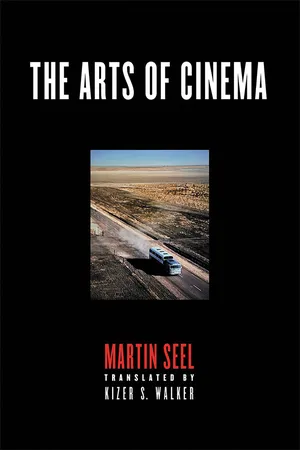
- 178 pages
- English
- ePUB (mobile friendly)
- Available on iOS & Android
eBook - ePub
The Arts of Cinema
About this book
Information
Subtopic
Literary Criticism Theory1
FILM AS ARCHITECTURE
A Beginning
After the opening credits of John Ford’s film The Searchers (USA, 1956), the screen goes black for a brief moment. A title fades in in white script: “Texas 1868.” The screen goes black again. In the next moment, three things happen at once. The sound of a door latch is heard, the bittersweet musical leitmotif is introduced; a door swings open, revealing the silhouette of the woman who has just opened it, and, with that, the space of the film is opened.
This first shot establishes a stark contrast between the interior space, which fills out three-quarters of the screen and remains completely dark, and the sharply demarcated exterior space of a wide-open landscape bathed in bright light. This visual composition alludes to a fundamental conflict of this film (and countless other films, well beyond the Western genre): a vulnerable protective space finds itself at the mercy of a threatening space of action; an ominous outside yearns for a pacified interior; an oppressive inside longs for a liberating exterior. The subsequent tracking shot follows the woman in her path to the front porch of the house, gradually widening the image of the landscape. Here again the movement of the film is anticipated: in the vastness of the country lurks a threat to its social and legal domestication. In the right half of the image, a rider can be seen approaching from the distance, followed by the woman’s nervous gaze. A man steps up next to her and, with a questioning intonation, utters the first word of the film, giving its hero a name: “Ethan?”
The film never explicitly answers the question of what is the matter with Ethan Edwards. Yet in these first thirty seconds of action, the door is opened for a view of the construction of a filmic world. It provides a glimpse not only of this film’s architecture, but that of films in general. This opening gesture holds a clue to the relationship between architecture and film. Each in its own way is an art of spatial construction. And like all arts, both are also temporal arts: they present a maneuver to their viewers and users or demand a maneuver of them that would be impossible without the construction of an edifice or a film.
Division of Space
Architecture’s fundamental operation lies in a process of dividing and organizing space. In the process, differences are established between inside and outside that can be repeated, modified, mirrored, and disrupted again and again. Every building gives rise to a space of spaces, separated from or open to each other in various ways. Many buildings not only establish a boundary between interior and exterior space; they bring about a replication of their space as well. At the same time, this ensemble of spaces forms a space for spaces by engendering linkages and passageways, parapets and thresholds, views out and views in, that relate to each other in various ways. They communicate not only inwardly, but outwardly as well: with buildings and trees, with light and shadow, with calm and noise, in short, with everything to which the building opens itself in the surroundings of its location. This shows us that every structure engenders a space within spaces. It places a plural space inside a larger space that is likewise a product of a diversity of forces. The places where the individual building realizes its effect are always geographical, cultural, historical, and quotidian places. These spaces where a structure stands, however, are ultimately always linked to a particular space: the space of a landscape that belongs to a building from the moment of its construction and to which, with its construction, it has lent its own accent.
As in the case of architectural spaces in the literal sense, the space through which filmic motion leads us is a constructed one through and through. No less than the space of architecture, it derives from operations of spatial division and spatial organization—and of the replication, opening up, and closing off of spaces as well. Like architecture, film generates a space of spaces and for spaces within the totality of a space that is incalculably vast. Thus every point in my outline of the dynamics of architectonic space applies as well to the space of movement that is characteristic of film. One of these spaces we can actually enter, however, bringing about continual shifts in perspective in relation to the movement of our bodies. In contrast, we are subjected to the movements of the other space within its own architectonic space—the cinema—with no influence whatsoever on the rhythm of its perspectives and its vistas. In the first case, we move within a space or in its vicinity; in the second, we are confronted with the autonomous motion of a visual space.
The parallels between architecture and film can thus only be illuminating if we are able to identify the decisive difference, beyond the obvious ones, between filmic and architectonic space. The salient point lies in the divergent operations for dividing space. The basic distinction between interior and exterior space in architecture corresponds to that between on screen and off screen in film. The movement of film proceeds as a constant interchange between that which appears on the screen and that which is not yet, no longer, or not at all visible on it (it is even active, as potential interchange, in the case of extreme static shots). The interior/exterior relationships that become visible in film—views out and views in, movement of the camera’s gaze, fade-ins, fade-outs, panning shots, saccades, and so forth—are organized in the medium of a differential between what is visible on the screen at that moment and what is invisible. By means of the framing and montage of image segments, films establish the specific space of their action: the space within which everything that occurs in films occurs, and at the same time a space which itself occurs as the filmic events unfold.
Ambient Sound
Ever since films in the cinema have been accompanied by music, and particularly since the advent of the sound film, the acoustic dimension has played an essential role in the filmic construction of space. Through music, speech, and other sounds, what is visible as well as what is invisible on the screen is accentuated and sculpted in various ways. Depending on how sound sources are localized with respect to the scenes appearing on the screen, acoustic effects establish complex interior/exterior relations that correspond in a number of ways to the visual organization of space. The sources of sound may be contained within the scene that is visible on the screen or located outside of it. Sounds that characterize a scene from the outside may likewise be located within the situations produced by the film or—as in the case of “film music” or forms of the voice-over—they may be deployed without such localization. These basic options for the acoustic organization of films may be held more or less distinct one from the other or they may run together fluidly. They may be combined within a single scene or over the course of a film. However sound is deployed, films’ acoustic sphere is always a dimension of the event space, which is opened up by means of these processes. From an aesthetic standpoint, one of the primary functions of the soundtrack is to broaden and enrich the filmic space of spaces—not only as an elaboration of what is taking place on the screen at any particular moment, but also by forging an interconnection of filmic space with the space that is presented in the film. In the cinema, the sound space becomes ambient sound.
Every type of building possesses a particular acoustics. Ideally, considerable attention is devoted to acoustics in the construction of concert and lecture halls, churches and cinemas. As resonance spaces for complex acoustic events, these structures are themselves sound chambers within which the effect of particular acoustic events can unfold in the most appropriate way possible. It was not without basis that Hegel, in his Lectures on Aesthetics, attributed an “architectonic character” to music, which he characterized as a “building of sound.” Paul Valéry is following the same trace in his dialogue “Eupalinos, or the Architect,” when he emphasizes music’s magic of forming and transforming spaces.1 This affinity between architectonic space and musical time sheds light on the particular architectures of film. Its acoustic motion allows the movement of the film image to intervene in the space of its perception. The sound of films fills the space of their appearing in an altogether literal sense: sound surrounds the audience and only in so doing draws it into the film’s visual landscape. In this way, the composition of acoustic events links the virtual space of films with the real space of their presentation, the space occupied by bodies. This is accomplished by means of sound sources that maintain an intimate relationship to everything that takes place on the screen.
Some Opening Credits
The click of a door latch, a musical leitmotif, the first words of dialogue—the opening of the plot of the film The Searchers strikes a three-note chord. A sound is audible, music sets a mood, verbal comments are made about an initial event as the audience is brought into the setting of the film. The opening of the film, on the other hand, does not give any insight into its space of action. Its opening credits run for a minute and a half. First the Warner Brothers seal and then the name of the producer appear against a plain background image (a conventionally painted brick wall). Next, the actor portraying Ethan Edwards is named in black print: John Wayne. Only then is the film’s title faded-in in bright red script. These initial twenty-three seconds are accompanied by dramatic orchestral music, which fades out and is replaced by Stan Jones’s sentimental Western song “The Searchers,” while the rest of the credits roll. The song dies away while the screen goes black twice; it is immediately followed by the film’s theme melody as the door to the fictional space is opened.
Even for the standards of the time, these are decidedly austere opening credits. They present a stark contrast to the artful opening of the film story. The three different musical themes, which will make their appearances again later in the film, foreshadow the unstable mood of the plot as it will develop. They fill the space of the cinema even before the visible space of the film has opened up. At the outset, everything remains visually flat. Before the narrative action begins, the acoustic events swing into action. The landscape of the film is there before its landscape is revealed. It enfolds the spectators even before they find themselves in it by sight.
Landscapes
Sound and resonance are the pillars of film architecture.2 Their function is to divide and connect spaces, to shift spaces and nest one within the next, to survey and conceal and in this way to generate a space of spaces and for spaces. This is, however, a space in which each of the respective visible spaces remains open to the intangible sphere of the world presented by the film. This status of filmic space is responsible for the landscape character of films’ presence. The experience of landscape essentially arises from a position amid a heterogeneous and variable profusion of conditions and events that always exceed its subjects’ capacity to take in and understand. Landscape experienced aesthetically has the character of a space that is occurring. With respect to buildings, this amounts to the presence of the breadth of the real world within which the edifice occupies a position and with regard to which it takes a position. In cinema, this effect arises from the fact that a film never offers its audience anything approaching a complete image of the space in which its story plays out, but only aspects of the same, which must be supplemented in a game of memory and anticipation, without ever coming together as a comprehensible whole. In the montage of visual and acoustic events, films produce a space in motion that also moves the audience, a space that is experienced as a fragment of the filmic world.
Filmic events possess this character independently of whether or the extent to which natural or urban landscapes play a role in them. Even in a film like The Man Who Shot Liberty Valance (John Ford, USA, 1962), which is concerned throughout with the right of land appropriation and the cultivation of the landscape, these processes are largely excluded from the visuals, apart from short sequences at the beginning and end. Instead, the concept of landscape character formally determines the type of spatial movement that characterizes the appearing of films in the cinema. Their architecture affords the possibility of establishing for their viewers a position within and amid a scene and sequence of events that are explored in the course of the film, producing constantly shifting relationships of interior and exterior, visible and invisible, familiar and uncanny, present and absent. In this way, the spectators can enter perceptually into a space that is beyond their bodily grasp and allow themselves to be animated, in their seeing and hearing, their feeling and understanding, by what happens in that space and how that space itself happens. The filmic division of space does not organize, accentuate, duplicate, and change an already-existing space, but rather produces—no less than literal architecture does, yet differently—an experience of space sui generis.
This is the source of a fundamental priority of the space of movement over the space of meaning. The settings in which film performances take place derive from films’ spatial movement. Anything that they might want to “say” to us, that they show us by documentary or fictitious means (or both), depends on the spaces through which they guide us—on spaces that are shown to us in such a way that they are always, at the same time, concealed from our gaze. This is how filmic architecture operates: it builds a world in which we are allowed to sojourn in our perception, without really being in it. This virtuality of filmic space, however, is extremely real. It is dependent on the appearing of a visual and sonic movement, which ensnares viewers in processes of a sensate apprehending3 that are thoroughly bound up with the improbable existence of this appearing.
Two Extremes
One of the most ingenious examples of filmic architecture is achieved in an almost completely empty space—in the famous cornfield scene, filmed near Bakersfield, California, in Alfred Hitchcock’s North by Northwest (USA, 1959). In this case, the landscape in the film serves as an object lesson in the formation of the landscape of a film. Roger O. Thornhill (Cary Grant), a supposed CIA agent, is sent by the beautiful double agent, Eve Kendall (Eva Marie Saint) into the clutches of spies who are out for his life. Having arrived at the appointed place, Thornhill stands alone in an open field and—in an editing sequence that begins with extreme calm and becomes increasingly frenetic—awaits his fate, which he ultimately escapes with a bang.
This nearly ten-minute sequence begins with a dissolve from a close-up of Kendall’s face to a long shot of an expanse of harvested cornfields bisected by a straight road. The last strains of music from the previous scene fade away. The action that follows forgoes music. From a static point of view we see the intercity bus approach and Thornhill get off in the middle of nowhere. The bus leaves the scene at the lower right edge of the screen. It can still be heard long after it is out of sight. This is followed by a calm alternation between objective and subjective shots that show the searching glances of the elegantly dressed New York adman as he stands there perplexed. The few vehicles that speed past on the dusty road only serve to underscore the emptiness of the farmland. Soon the crop duster that will attack Thornhill can be heard in the background, and then it comes into view. Initially, it functions as yet another spatial indicator marking the boundlessness of the scene. Then, with a distinct and steady rhythm, visible space contracts more and more tightly around the central figure as the would-be assassins close in from above. The space and time of the episode are artificially stretched, only to be concentrated, ultimately, at a single point.
Part of the irony of the scene lies in the fact that, in a terrain that appears to offer no protection to the beleaguered hero, two spaces of escape are still to be found. The first is a not-yet-harvested cornfield, which enters our field of vision in passing early in the scene, and there Thornhill seeks cover. The attacking plane drives him out with a dusting of pesticide. Coughing and wheezing, he looks for a way out. Through a window framed left and right by cornstalks, Thornhill can see a tanker truck approaching on the road; the suffocating interior space allows a view into the open. Thornhill saves himself by forcing the truck to a stop at the last moment. Close-up of the hood of the approaching truck; honking and the sound of screeching brakes. Cut. Close-up of Thornhill’s panicked face; honking, screeching brakes. Cut. Close-up of the hood; honking, brakes. Cut. Medium close-up: Thornhill lets himself fall beneath the driver’s cab; screeching brakes. Cut. Medium close-up: Thornhill lies under the truck; engine sound. The space has narrowed to the smallest possible scope. The vastness of the landscape has now disappeared entirely. Cut. Medium close-up: Thornhill looks in the direction of the approaching biplane; engine sound. Cut. Shot widens: the swaying airplane steers toward the truck; engine noise. Cut. Long sh...
Table of contents
- Opening Credits
- 1. Film as Architecture
- 2. Film as Music
- 3. Film as Image
- 4. Film as Spectacle
- 5. Film as Narrative
- 6. Film as Exploration
- 7. Film as Imagination
- 8. Film as Emotion
- 9. Film as Philosophy
- Closing Credits
- Translator’s Note
- Notes
- Name Index
- Film Index
Trusted by 375,005 students
Access to over 1.5 million titles for a fair monthly price.
Study more efficiently using our study tools.
Frequently asked questions
Yes, you can cancel anytime from the Subscription tab in your account settings on the Perlego website. Your subscription will stay active until the end of your current billing period. Learn how to cancel your subscription
No, books cannot be downloaded as external files, such as PDFs, for use outside of Perlego. However, you can download books within the Perlego app for offline reading on mobile or tablet. Learn how to download books offline
Perlego offers two plans: Essential and Complete
- Essential is ideal for learners and professionals who enjoy exploring a wide range of subjects. Access the Essential Library with 800,000+ trusted titles and best-sellers across business, personal growth, and the humanities. Includes unlimited reading time and Standard Read Aloud voice.
- Complete: Perfect for advanced learners and researchers needing full, unrestricted access. Unlock 1.5M+ books across hundreds of subjects, including academic and specialized titles. The Complete Plan also includes advanced features like Premium Read Aloud and Research Assistant.
We are an online textbook subscription service, where you can get access to an entire online library for less than the price of a single book per month. With over 1.5 million books across 990+ topics, we’ve got you covered! Learn about our mission
Look out for the read-aloud symbol on your next book to see if you can listen to it. The read-aloud tool reads text aloud for you, highlighting the text as it is being read. You can pause it, speed it up and slow it down. Learn more about Read Aloud
Yes! You can use the Perlego app on both iOS and Android devices to read anytime, anywhere — even offline. Perfect for commutes or when you’re on the go.
Please note we cannot support devices running on iOS 13 and Android 7 or earlier. Learn more about using the app
Please note we cannot support devices running on iOS 13 and Android 7 or earlier. Learn more about using the app
Yes, you can access The Arts of Cinema by Martin Seel, Kizer S. Walker in PDF and/or ePUB format, as well as other popular books in Media & Performing Arts & Literary Criticism Theory. We have over 1.5 million books available in our catalogue for you to explore.