Organizations, like people, sometimes get stuck. They get ensnared in routines and processes, and they fall back into old habits. Sometimes fatigue dominates, complexity overwhelms, and organizational energy is drained. In these instances, the capacity to innovate, move agendas, and push things forward is constrained by the security of routine and the comfort of the mundane. Leaders become risk averse, repeating what was successful yesterday or last year as the safest course of action. They have trouble recapturing the same zest, agility, and dynamic energy that were essential in the past. They become sluggish—they get trapped by inertia. Business theorist Jeffrey Pfeffer defines inertia as “an inability for an organization to change as rapidly as the environment.”1 Inertia connotes a certain sense of comfort with the familiar and a reticence to go beyond the tried and true.
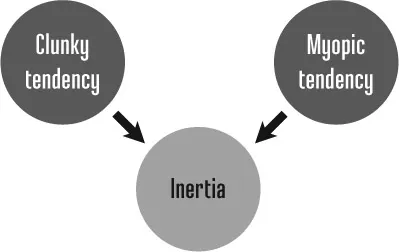
The real danger zone for organizations is the stage that precedes failure—that is, the period of inertia, the period in which the organization begins to show signs of sluggishness. They aren’t able to engage in discovery and delivery as agilely as they had in the past. If organizations do not deal with the challenges of inertia, they risk fading away. Structural clunkiness and the myopic mind-set are the two fundamental sources of organizational inertia and sluggishness. The clunky tendency is not a state of chaos but a state of organized anarchy. On the surface, there is a veneer of order, but underneath are overlapping structures, unclear decision processes, chaotic communication, and poor integration. The myopic tendency emerges when organizations are overly focused and consumed by their past successes and past behaviors. When the myopic tendency dominates, decision making is shaped by the blinder mind-set, and organizations find it difficult to adjust their goals or revisit their business model even though circumstances demand it. To break inertia, pragmatic leaders need to understand the sources of clunky and myopic tendencies.
The Inertia of the Clunky Tendency
When an organization tends toward clunkiness, it is often in a state of organized anarchy. Organized calls to mind a succinctly integrated, systematically efficient social order, while anarchy conjures up images of disordered chaos, sprawl, and turmoil. Looked at from the outside, organizations with clunky tendencies appear to be organized. When they are looked at from the inside out, however, or when someone tries to make sense of how to move agendas within the organization, their anarchistic qualities become apparent. That is, they are chaotic and have an element of sprawl. All the components are there, and the organization trucks along, but it is not clear how the organization functions.
In an organized anarchy, individual units, departments, or businesses may be successful. However, in the aggregate, the organization may be less than the sum of its parts. The businesses may not be integrated, accountability may be diffuse, turf and silos may dominate, goal confusion may be common, competing agendas may be in play, and different departments may pull the organization in different directions.
Clunky organizations may have a mission statement and a strategic vision, but when it comes to interpreting the mission statement or vision, there may be anarchy when units and subunits try to impose their specific agenda on the organizational intent. That is, the organization’s mission and strategic vision are subject to the intentions of individual units that may reframe the organizational goals to rationalize the unit’s specific course of action. This loose alignment of organizational and unit goals feeds the sense of clunkiness.
In the context of unclear alignment between organizational and unit goals, units and individuals may create their own procedures and processes as they see fit, losing operational consistency. In this context, actions define procedure rather than the other way around. Muddling through becomes the art of the day. That is, “participants arrive at an interpretation of what they are doing and what they have done while in the process of doing it.”2 In fact, from business to business, project to project, and unit to unit, authority constantly shifts, and the role of subtle interpersonal influence processes should not be underestimated. Essentially, the journey is defined as the organizational actor proceeds, one step at a time. In a clunky organization, muddling through is a survival tactic.3
Progress in an organization with clunky tendencies requires tremendous effort, continuous deliberation, and exhausting coordination. It can demand the energy of Sisyphus, who was tasked for eternity to push a stone uphill only to have it roll back before he could reach the top. But clunkiness does not necessarily doom an organization. Clunky organizations are disproportionally large, resource rich, and conventionally successful, but at the same time they are unwieldy and clumsily plod from project to project. That is, they are not necessarily failing, but they are not exactly thriving either. They are sluggish, and are unable to meet their potential because of their clunkiness.
The clunky tendency can make an organization sluggish because the flow of information may not be smooth and continuous, the allocation of resources is diffuse, responsibilities are duplicated, and efforts at developing and sustaining customer relationships, marketing and sales, and innovation are often uncoordinated. Clunky organizations are networked in such a disjointed way that they develop what sociologist Ronald Burt calls “structural holes”4—that is, gaps in information sharing across an organization. There are gaps between organizational units that possess complementary information and conduct corresponding activities. Burt observes, “The structural hole between two groups does not mean that people in the groups are unaware of one another. It only means that the people are focused on their own activities such that they do not attend to the activities of people in the other group. Holes are buffers, like an insulator in an electric circuit. People on either side of a structural hole circulate in different flows of information.”5
The combination of these elements results in an organization that never quite gets its act together. The organization never establishes a sense of continuous focus, leading to duplication and inefficiencies.
Before its 2011 restructuring, Cisco was a sluggish organization exhibiting clunky tendencies. Cisco’s structure was byzantine, sprawling, and bureaucratic. It was a classic organized anarchy operating as a clunky organization. The decision-making process was steered by “59 internal standing committees.”6 It was the norm for top executives to serve on ten or more committees and spend almost a third of their time dealing with committee work.7 This decision-making process enhanced Cisco’s clunky tendencies, making operations much more cumbersome. Brian White, an analyst with Ticonderoga Securities, observed at the time, “People at Cisco are constantly going to meetings…. I just wonder if everyone has the time to innovate as much as they would like or as much as the company would like.”8
In late 2007, rival HP upgraded the warranty for its switches to include free upgrades and support.9 Under Cisco’s then-clunky structure, a decision about how to respond to HP’s challenge was delayed as it worked its way through multiple committees. By the time a response to match HP’s promotion made it through the unwieldy bureaucracy in April 2009, Cisco’s market share had already fallen.
Unilever, the Anglo-Dutch consumer products company, has a global reach, and is another example of an obviously successful organization that has clunky tendencies. Its lack of integration, lack of consensus, and enormous catalog of brands—popular household items that stock cupboards from the Americas to Europe to the Near and Far East—make tight operational integration nearly impossible. The diversity of its product offerings makes even superficial collaboration difficult. For instance, what do Axe body spray and Ben & Jerry’s ice cream have in common?
The clunky tendencies of large multinational conglomerates like Unilever are not necessarily a result of their exhaustive catalog of products, but are due to the complexities that arise from internal structures and processes. By 2009, Unilever had over four hundred intranets, one for each country, product, group, brand, and function.10 While the cost of maintaining multiple sites was expensive, the complexity was not just hampering the financials. The silos were resulting in dysfunctional communication, and employees were unsure where to look for information. Not being able to access the right information quickly affects employee response time. Every country Unilever operates in has very different HR processes, which results in incomplete or inconsistent data records and consequently impedes its ability to manage talent effectively.
Unilever has undoubtedly been successful in establishing its global presence and offering a wide range of products. However, mounting internal complexity slowed processes and information flow. Unilever’s lack of integration, lack of consensus, and its size resulted in some inevitable clunkiness. Unilever’s clunkiness does not necessarily result in it being stuck, but there is no question that some degree of sluggishness and inertia occurs.
To understand why some organizations experience periods of clunkiness, it helps to trace their growth pattern. Incremental organic growth takes place when organizations can attract new customers, expand output, or increase sales, usually in a measured or incremental manner. When growth is planned, incremental, evaluated, and monitored, it is unlikely that the organization will develop clunky tendencies. Sprawling inorganic growth usually occurs when the ambitions of the organization or the demands of the market become the primary motivating apparatus.
Sprawling expansion that is likely to result in clunkiness occurs when an organization continuously expands its internal capacity without a thorough and thoughtful consideration of what the expansion means or it becomes an unthinking and voracious consumer of other firms. In either case, the organization is in danger of becoming clunky and losing not only its agility but also its reputation for innovation and creativity.
Sprawling Expansion
Starbucks experienced an episode of sprawling expansion. The company was founded in 1971 not as a coffee shop but as a place to sell coffee beans and coffee-making equipment. In 1982, Howard Schultz joined the company as head of retail operations and marketing. A year later, he traveled to Italy, and was greatly impressed by the Italian coffee culture. From this moment, the trajectory of Starbucks changed from being a retail outlet for coffee beans to becoming a purveyor of coffee drinks, with the first caffe latte served in 1984.11 While CEO from 1987–2000, Schultz inaugurated a period of aggressive growth and increased the number of Starbucks locations from seventeen to over 3,500. It wasn’t to last. By 2007 there were indications that the company had grown too fast, too quickly, and was becoming clunky. Individual stores did not share a cohesive, integrated feel. Too many ambitious innovations and a slew of new products overwhelmed customers, undermining the intimate coffee shop environment. This clunky tendency and lack of integration did not in any way inhibit growth. Indeed, it was a consequence of growth. Starbucks scaled up, but at the cost of losing its ability to sustain brand value. Without a thoughtful, guiding hand present in organic growth, the wild nature of inorganic growth led to a dilution of the core mission, killing the customer experience. Profits stagnated, and the stock price took a hit. Starbucks felt the brutal consequences of improperly managed growth.
Sprawling expansion resulted in the loss of a coherent mission. Individual stores competed against each other in areas with a Star-bucks on every corner, where a store manager’s efforts to build customer loyalty would be discounted as new stores appeared. Unfocused innovations and upscaling turned off old and new customers alike, driving consumers away and damaging their base. As John Quelch noted, “None of this need have happened if Starbucks had stayed private and grown at a more controlled pace.”12 In other words, Star-bucks became clunky.
If the Starbucks story was a movie, then this is the point where Schultz would swoop back in as CEO and save the day. And in 2008, that is exactly what happened. The Starbucks brand was defined by the quality of coffee and the customer experience, and Schultz directed multiple efforts to reemphasize these factors. He “temporarily closed 7,100 US stores to retrain baristas on how to make the perfect espresso.”13 He decided that Starbucks would only deliver whole-bean coffee to the stores so baristas would grind fresh coffee for...