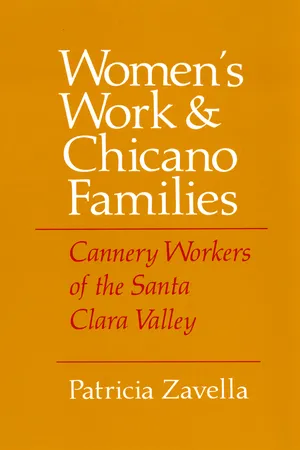
At the time Women's Work and Chicano Families: Cannery Workers of the Santa Clara Valley was published, little research had been done on the relationship between the wage labor and household labor of Mexican American women. Drawing on revisionist social theories relating to Chicano family structure as well as on feminist theory, Patricia Zavella paints a compelling picture of the Chicano women who worked in northern California's fruit and vegetable canneries. Her book combines social history, shop floor ethnography, and in-depth interviews to explore the links between Chicano family life and gender inequality in the labor market.
eBook - ePub
Women's Work and Chicano Families
Cannery Workers of the Santa Clara Valley
- 214 pages
- English
- ePUB (mobile friendly)
- Available on iOS & Android
eBook - ePub
About this book
Information
[1]
“Two Worlds in One”: Women’s Work and Family Structure
Various theories have attempted to explain the persistence of occupational segregation, the pattern whereby women or members of racial groups are concentrated in particular occupations, industries, or jobs within firms (Reskin 1984; Blaxall and Reagan 1976; Stromberg and Harkess 1978). Neoclassical economic theories attribute job segregation to imperfections in competitive labor markets and to exogenous factors such as sexism or racial prejudice by individual employers or in schools that produce workers with less “human capital.” Proponents of the neoclassical view argue that if women or minorities would get enough education, skills, or training, they could eventually have equal participation in the labor market. Labor-market-segmentation theory criticizes this view, claiming that the structure of labor markets discriminates against certain groups and that employers encourage racial or gender antagonisms. Feminist scholars are also concerned with discrimination in the labor market, but they view the behavior of men—whether they are employers, workers, or union members—or specific firm practices as playing key roles in excluding women from better-paying jobs or training programs that would provided the necessary skills for promotions (Hartmann 1979; Milkman 1976, 1982; Blau 1984; Strober 1984; Kan ter 1977; Roos and Reskin 1984). Other feminist theorists examine sex-role socialization or segregation in schools or training programs that orient or prepare women for certain occupations (Marini and Brin ton 1984). The pervasiveness and complexity of occupational segregation suggests that many factors contribute to the perpetuation of Women’s inferior position in the labor market (Oppenheim Mason 1984).1
Recent feminist scholarship has been concerned with how Women’s labor-force participation and family obligations are connected in ways that distinguish women from men workers. As paid workers, women are subject to the same economic forces as men. Yet precisely because of their female status, women are concentrated in lower-waged “women’s jobs”—occupations in which more than 70 percent of the workers are female (Oppenheimer 1970; Blau 1975). In addition, women bear the burden of responsibility for private household tasks beyond their labor for wages. Women, then, are simultaneously wage workers, women workers, and family members. The relationship between Women’s wage labor and “private” domestic labor is obscured under capitalism (Zaretsky 1976) and comprises two major processes: the family’s influence on female labor-force participation and the effect of wage work on women’s roles within the families. Elizabeth Pleck (1976) has suggested that women’s work and family are really “two worlds in one,” and recent scholarship shows the ways in which women combine work and family responsibilities have varied historically and regionally (Safilios-Rothschild 1976; Kamerman 1979; Tilly and Scott 1978; Smith 1982; Kessler-Harris 1982; Fernández-Kelly 1983; Lamphere 1987).
Previous research on Chicana workers has focused on working conditions or on how women’s employment affects their families but has not addressed the two-way relationship between women’s work and family (an exception is González 1983).2 In the following pages, I show how revisionist works on Chicano families have ignored the world of work, and I illustrate a perspective that would connect Chicanas’ work and family lives. Socialist feminist theory is a useful point of departure in analyzing the conditions of Chicana cannery workers because it directs analysis to who benefits from women’s labor and the mechanisms that create job hierarchies excluding women, and it focuses on conflict in social relations.3
Linking Women’s Domestic and Wage Labor
Socialist feminist theorists (Milkman 1976; Hartmann 1981b; Eisenstein 1979; Kuhn and Wolpe 1978) have argued that capitalist relations in the public sphere and patriarchal family relations are linked. Capitalist patriarchy is a system in which the control of wage labor by capital and men’s control over women’s labor power and sexuality in the home are connected. In the labor market, job segregation is the primary mechanism maintaining the domination of men over women, for example, in enforcing lower wages for women. Women’s labor-market activities are restricted through the bearing and rearing of children and men’s efforts to control home life. Therefore, we must examine the relationship of women to men in both the labor market and families. Heidi Hartmann has stated: “Patriarchy, by establishing and legitimating hierarchy among men (by allowing men of all groups to control at least some women), reinforces capitalist control, and capitalist values shape the definition of patriarchal good” (1981b:27–28).
According to this socialist feminist argument, the relationship between capitalism and patriarchy contains an inherent contradiction: capitalists and husbands have competing interests in women’s labor. In different historical periods, capitalists have preferred either that women enter the labor market (during World War II) or that they return to homemaking (immediately after World War II). In all periods, husbands have been interested in personal and family service. Hartmann (1979) has suggested that the “family wage’’ provided a resolution to this conflict. The family wage, which working men won in nineteenth-century struggles with capital, insured that men were paid wages high enough to support a family. Labor organizations guilds and later unions—were crucial in limiting Women’s participation in the labor market. Unions often excluded women from training programs and generally supported protective legislation that denied women access to difficult “male” jobs (Milkman 1976,1982; Hartmann 1979). The rationale for the family wage was the ideology of women’s “proper place”—the notion that women are moral guardians of the home and therefore should not enter the labor force (Welter 1973; Ehrenreich and English 1975; Milkman 1982). Thus the family wage secures the material basis of male domination and ensures Women’s economic dependence. Womens family responsibilities—housework, child care, consumption, and emotional nurturance, which benefit individual men—also reinforce women’s inferior labor-market position since it is assumed that women lack commitment to paid employment.
Socialist feminism also identifies inherent contradictions within families. Families are seen to be structured by gender and age, and this socially constructed “sex-gender system” changes over time (Rubin 1975; Thorne 1982). The gender and age of family members affects the family as an economic unit. As family members pool income and share resources such as housing or job benefits, common interests and interdependence are created. Yet women and men participate in the labor market differently, and these experiences also affect families. The domestic division of labor—who does the chores and the time spent doing them—reveals the amount of men’s control over women’s labor.4 The family is the locus of political struggle, for men do not voluntarily give up their domestic privileges. Societal contradictions, then, bring conflict to families, and family members must adapt.
Family ideology—the assumptions about proper men’s and women’s roles—most often supports the segregation of women in the labor market. In Western culture, the family is regarded symbolically in opposition to the public world of work (Collier, Rosaldo, and Yanagisako 1982). Families are seen as havens, providing nurturance for struggles in the labor market. Ideally, families are governed by feelings and moial values and form relationships that endure the vicissitudes of outside circumstances. The world of work is viewed as competitive, impersonal, temporary, contingent upon performance; in it, morality must be buttressed by law and legal sanctions. According to this ideology, families should be nuclear in composition, and women and men should marry for love rather than economic reasons (Rapp 1978). Within this view, “the concept of family is a socially necessary illusion which simultaneously expresses and masks recruitment to relationships of production, reproduction, and consumption” (Rapp 1982:170). According to this ideology, traditionally, men are breadwinners, whereas women are supposed to sacrifice their careers and minister to family needs, especially those of children.5 This opposition of family and work posits a contradiction between Women’s (and men’s) needs as individuals and the concerns of their families. This ideology is supported by institutions—schools, churches, media, and unions—in which women are socialized to defer to men. Family ideology serves dual purposes: It masks Women’s multiple statuses by defining women as secondary workers—women who work to supplement family income—and it rationalizes Women’s subordination in the labor force since women perform “women’s work.” At the same time, housework is devalued as not being “work,” and thus the double day of women is discounted.
Socialist feminism is a useful starting point in analyzing change and stability in Chicano families since these families are subject to the same political and economic forces as other families. Yet Chicanos differ considerably from other groups in how women and men have participated in the labor market.6 Chicanos face racism in its various manifestations in the labor market. They accept certain American values and beliefs, yet have a culturally specific version of family ideology. The distinct history of the Chicano people has created important differences in how Chicanos and Chicanas have participated in regional labor markets. The following discussion of Chicana labor history illustrates how a socialist feminist perspective must be modified to interpret the lives of Chicana workers.
Chicana Labor History
The particular process of incorporation of the southwestern United States (originally northern Mexico) into the capitalist world economy was critical for the development of a Chicano working class (Almaguer 1981; Borrego 1983). The conquest of the “new world” by Spain in the sixteenth century brought gold and silver to the Spanish state and fueled primitive capitalist accumulation (Chapa 1981). Almaguer (1975) has shown that in the feudal society of colonial Mexico, the class structure was based on a racial hierarchy as well: Spaniards (usually male) who were born in Spain or in Mexico (the criollos) held the positions of power, authority, and status, while Indians, Blacks, and “mixed races” (mestizos, mulatos, zambos) labored for the white landowners.7 As Mexico colonized what is now the American Southwest, these class and race categories were brought north and became the basis of class and racial stratification in the United States.
The U. S.- Mexico war of 1846–48 was instigated to further capitalist development in the Southwest (Barrera 1979; Borrego 1983). After this war, in which Mexico lost one-third of its territory to the United States, the Treaty of Guadalupe Hidalgo guaranteed certain rights to the Mexican citizens who lived in the annexed territory. Mexicans had the right to choose American or Mexican citizenship and to retain their property “without their being subjected to any contribution, tax or charge whatever” (Valdez and Steiner 1972:102). During the late nineteenth century, however, capitalist transformation of the region brought many changes for Chicanos. The United States was industrializing, while the Southwest was becoming a center of agriculture and mining. Chicanos were displaced from their land. They lost landholdings to Anglos either through legal means, such as their inability to pay taxes, or through fraud, such as the infamous “Santa Fe Ring” in which Anglo businessmen conspired to take over Mexican-owned land (Barrera 1979; Acuña 1981). Mexicans increasingly were proletarianized and incorporated into the burgeoning Southwest labor markets, serving as reserve labor pools. During this period, “Mexicans experienced downward occupational mobility, job displacement and entrapment in the lowest levels of the occupational structure throughout the region” (Almaguer and Camarillo 1983:6). The class structure institutionalized racial domination. These processes plagued the Mexican-American population for decades.
In the second half of the nineteenth century, Chicanos labored in developing the infrastructure of roads and railroads connecting the Southwest to the East Coast. Significant numbers of Chicanos worked in the mining and agricultural industries, especially after the Chinese Exclusion Act of 1882. In the late nineteenth century in southern California, Chicano sheepherders and vaqueros had to migrate in search of work that would use their traditional pastoral skills; women were forced to work as domestics or in canneries and packing sheds to support their families. These Chicana wives entered the local labor market even before their husbands did (Camarillo 1979).
It was common throughout the late nineteenth century for Chicano men to be paid lower wages than Anglo men for the same work or to receive lower wages because they worked in “Mexican jobs” (Barrera 1979).8 Urban Chicano workers were segregated into older areas of cities, which had cheaper but dilapidated housing. These workers were often forced to abandon Mexican customs and practices and to speak in English. Chicanos were also subject to exclusion from local political processes through various practices (Camarillo 1979; M. García 1981). These changes—proletarianization, occupational and residential segregation, cultural repression, and exclusion from political participation—characterized Chicano history through the early twentieth century, especially in California and Texas (Camarillo 1979; Montejano 1981).
After the Mexican Revolution began in 1910, the first wave of Mexican immigrants entered the United States, fleeing the instability in Mexico. This migration involved “class and cultural transitions from a peasant class with a feudal patriarchal culture of Mexico to the working class and capitalist culture of the U.S.” (González 1983:59)9 Mexican immigration to the Southwest contrasts with other immigrant histories of the time in an important way: rather than being solitary male immigrants, Mexican workers often brought their families with them. This was in part because the Santa Fe railroad line encouraged the migration of Mexican families to provide a stabilizing force on male workers. The fact that Mexico is on the U.S. border meant that it was easier for Chicano workers to bring their families to live near their places of work.10 “Greaser towns,” as they were called by Anglos, sprang up around various mines, and barrios grew on the “other side of the tracks. ” In contrast to Japanese and Filipino farm workers, Chicano farm workers often worked as families, and women and children labored alongside the men in the fields. Farm-worker families were forced to migrate thousands of miles in search of “la pisca”—the harvest.11
The use of wage differentials based on race and sex was common throughout the Southwest and continued into the twentieth century (Barrera 1979). Chicana workers, especially in border towns, were victimized by the payment of lower wages than Anglo women received for the same work (M. García 1981). Chicana urban workers experienced poor working conditions and miserable wages as domestics and laundresses (M. García 1981) and as workers in the food-processing industries (Ruiz 1982) and in Los Angeles factories (Taylor 1980).
With the high unemployment rate of the Great Depression, Mexican labor became regarded as superfluous. Thousands of Mexicans and their American-born children were deported or pressured to repatriate (Hoffman 1974). Before 1950, 90 percent of all Chicanos resided in the Southwest, and Chicano workers were characterized by seasonal labor migration. After World War II Chicanos began urbanizing, primarily because of ...
Table of contents
- Preface
- 1. “Two Worlds in One”: Women’s Work and Family Structure
- 2. Occupational Segregation in the Canning Industry
- 3. “It Was the Best Solution at the Time”: Family Constraints on Women’s Work
- 4. “I’m Not Exactly in Love with My Job”: Cannery Work Culture
- 5. “Everybody’s Trying to Survive”: The Impact of Women’s Employment on Chicano Families
- 6. Six Years Later
- 7. Conclusion
- References
- Index
Trusted by 375,005 students
Access to over 1.5 million titles for a fair monthly price.
Study more efficiently using our study tools.
Frequently asked questions
Yes, you can cancel anytime from the Subscription tab in your account settings on the Perlego website. Your subscription will stay active until the end of your current billing period. Learn how to cancel your subscription
No, books cannot be downloaded as external files, such as PDFs, for use outside of Perlego. However, you can download books within the Perlego app for offline reading on mobile or tablet. Learn how to download books offline
Perlego offers two plans: Essential and Complete
- Essential is ideal for learners and professionals who enjoy exploring a wide range of subjects. Access the Essential Library with 800,000+ trusted titles and best-sellers across business, personal growth, and the humanities. Includes unlimited reading time and Standard Read Aloud voice.
- Complete: Perfect for advanced learners and researchers needing full, unrestricted access. Unlock 1.5M+ books across hundreds of subjects, including academic and specialized titles. The Complete Plan also includes advanced features like Premium Read Aloud and Research Assistant.
We are an online textbook subscription service, where you can get access to an entire online library for less than the price of a single book per month. With over 1.5 million books across 990+ topics, we’ve got you covered! Learn about our mission
Look out for the read-aloud symbol on your next book to see if you can listen to it. The read-aloud tool reads text aloud for you, highlighting the text as it is being read. You can pause it, speed it up and slow it down. Learn more about Read Aloud
Yes! You can use the Perlego app on both iOS and Android devices to read anytime, anywhere — even offline. Perfect for commutes or when you’re on the go.
Please note we cannot support devices running on iOS 13 and Android 7 or earlier. Learn more about using the app
Please note we cannot support devices running on iOS 13 and Android 7 or earlier. Learn more about using the app
Yes, you can access Women's Work and Chicano Families by Patricia Zavella in PDF and/or ePUB format, as well as other popular books in Social Sciences & North American History. We have over 1.5 million books available in our catalogue for you to explore.