eBook - ePub
The Non-Technical Founder
How a 16-Year Old Built a Six Figure Software Company Without Writing Any Code
- English
- ePUB (mobile friendly)
- Available on iOS & Android
eBook - ePub
The Non-Technical Founder
How a 16-Year Old Built a Six Figure Software Company Without Writing Any Code
About this book
Everyone has an idea that they think is
the next big thing. The problem is, it's probably an app or software idea and most people probably don't know how to code and their record for managing programmers is little to none. Even if they do know how to code, they're not quite sure how to get their first one thousand customers.
The Non-Technical Founder walks readers through the stages of validating whether their
next big thing is good, bringing the idea to life, and getting those first customers.
Information
PART 1

The Ideation Stage
I would say the biggest misunderstanding [that non-technical people have about starting a software company] is probably that it’s easier than people think. The biggest hurdle I see from non-technical founders is the feeling of inferiority. You know, “I don’t understand this stuff, therefore, I can’t get it done.” And yet we see this every day. Lots of people come to Upwork and have great ideas but they don’t know how to get it done and are looking for people that will help them get it done. This happens millions of times per year and you know the success rate is extremely high. Probably the biggest thing is debunking the myth that you need to have a PhD in computer science to build a mobile app or launch a website or any of that. What you really need is to have a good idea, understand what the market needs and be able to find great people to find great people to help you execute the idea.
STEPHANE KASRIEL

CHAPTER 1
How To Think Of An Idea
Maybe you have an idea for a piece of software you’d like to develop. Maybe you don’t. If you do have an idea, you probably think that it’s the best idea and that it’s better than anyone else’s idea. You think that you just need a programmer to put it together, and you’ll be rich. (I’ve heard this story too many times.)
I think the issue is that some people get so excited by entrepreneurship that they start too early and in the end it discourages them from actually continuing as an entrepreneur. If you experience failure or if you have a few really bad failures a lot of people say “oh failures motivate you! You need to fail” but if you have tremendous amount of super bad failures then they’ll like totally discourage you. If you’re interested in being an entrepreneur make it a plan. So, say I want to be an entrepreneur in this industry but before I do that let me take a job, an internship, let me take courses, let me learn about this industry. A lot of times once you do that a year into the industry, you realize this is much harder than it looks or this is like pretty low barrier of entry business that I might start so my competition’s going to be heavy, stuff of that sort. Try to learn about industry very strongly because to be an entrepreneur you’re going to have to have a lot of passion and you’re going to have to wake up every morning thinking about it and fighting through it, through weekends and holidays. So if you’re not super motivated about it then you’re not going to be successful.
DAVID MARKOVICH
Ideas are Worthless Without Proper Execution
The #1 misconception most people have about software is that the best idea wins. Let me be clear: a solid idea with user interest is vital. But if you put together a group of highly-talented, passionate individuals who are working towards a single goal, they will change the direction of the first idea at will to make it work. Instagram actually started as an app called Burbn, which is nothing like the Instagram we know today.
“Burbn let users check in at particular locations, make plans for future check-ins, earn points for hanging out with friends, and post pictures of the meet-ups,” reported Megan Garber of The Atlantic. Soon after launch, the team at Burbn realized that most people were using the app to primarily share photos, so in late 2010, they relaunched Burbn as Instagram.
The world likes to find a hero who ideally works in a basement somewhere and came up with this brilliant idea and then the world changed. I have sympathy for the human desire to fit things in that mold but I believe that is not how innovation happens. I think innovation is much more a product of different people working together and coming up with stuff. It doesn’t happen within a single individual, it happens between people. We just have this undeniable desire to create heroes. It’s our part of our human god genes. We love to create heroes and we love to think of gods. It’s just sort of in our nature. I think fundamentally that’s not how it really happens.
FRANK VAN MIERLO
Once you have an idea—any idea at all—you should test it in a number of different ways to determine if it is viable or not. You can’t judge the idea yourself, especially if this is your first attempt at creating software. You will probably guess wrong. Luckily, there are certain procedures you can follow to objectively determine if your idea is viable. We will get to those soon.
Once you validate your idea, you must execute the idea. You can’t sit on it. If the idea is any good, someone else will think of it and execute it before you do. I’ve seen hugely successful projects on Kickstarter and said to myself, “I thought of that first.” Maybe you have, too. It’s not a nice feeling.
Understand now that ideas are worth nothing until executed. Zip. Zero. Zilch! Derek Sivers says it best…
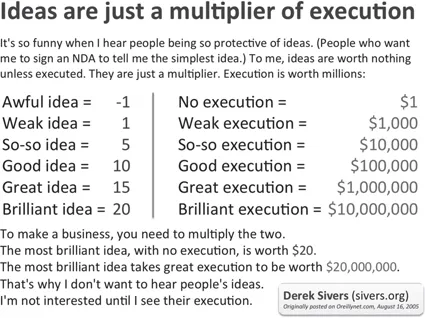
Ideas are Just a Multiplier of Execution
Paul Graham once wrote an essay that covered why some people think coming up with ideas is hard. In truth, the average entrepreneur comes up with several ideas every single month, and possibly more. Graham found the issue to be that the majority of people see successful companies and assume they are successful because of an awesome idea. They think the founders of that company were the very first people to think of an idea!
That’s rarely the case. Ideas are plentiful. You might think you have the best idea ever, but you can’t even determine if the idea is good by yourself (more on that soon). Use this newfound understanding of ideas to keep your sanity during your first projects.
I did not have much of an intention to start 87 AM. I had another job in Hollywood as a talent manager and I relocated from Los Angeles to New York for personal reasons but retained the job I had in LA. Long story short the company I worked for ran into a financial snag, structured and I lost my job, so I needed a job. I think I submitted 600 resumes for a first interview and I didn’t get one of them. So I needed something to do and that’s how the company came about. It was not some strong business plan that came about. It wasn’t a ‘when I was 12, I wanted to be a CEO’—it was never part of the plan. It’s just what happened.
ADAM CUNNINGHAM
Now you are aware that the average beginner egregiously overvalues ideas, and you can stop being so protective of your idea! No one cares, and if they do, they almost certainly do not have the knowledge or resources to act on it.
You may have heard of NDAs (non-disclosure agreements). They are contracts that both parties sign to confirm they will not share or act on the ideas presented. In essence, these contracts are how adults say “I won’t tell, I swear!” but with potential legal repercussions. Most beginners think they need one of these before they talk with an investor, because the idea is so incredibly valuable they cannot take any risks. If you actually manage to meet an investor and you ask for him to sign a NDA before speaking, he won’t care, and he will disregard you entirely like he does to thousands of other aspiring entrepreneurs every single year. He knows your idea is worthless without proper execution, and he won’t waste his time on you.
You know what’s interesting? Practically nobody asks us to sign one. If they do, we laugh and kick them out.
SANJAY SINGHAL
Instead, if you meet a potential investor or partner, just pitch the basics of your idea, whatever is needed get the point across, in roughly 15 seconds. If you manage to catch the interest of the other party, then you might think about asking to sign the NDA. You need to be able to catch interest before you are seen as someone worthy of asking for a NDA, though. You can use this same pitch to tell other people about your project in a satisfactory manner without talking their ears off.
I know, I know. You’re scared the investor will run off with the idea, but that will very rarely happen. For one, investors don’t have time for that, and even if they did, it would be difficult to find someone like you who is the brains powering the idea. Do you think a non-committed investor could have stolen the idea of Facebook and tried to compete with Mark Zuckerberg? I don’t think so. Maybe they could have made a replica, but as the mastermind, Zuckerberg would have quickly evolved to defeat them, in ways they could not think of without the mastermind helping them.
There are certain cases when talking about your idea might come back to bite you. If you mention anything to a competitor, like if I mentioned a new feature of Keyword Scout to another keyword research product owner, he might race to implement the feature before me. As another example, if I had a new software idea but I was hanging around with software developers exactly like myself, I might not mention the specifics. If someone has the time and resources to take your idea, he might take it. But these types of situations are rare. Don’t be scared to talk to friends and family about your idea, assuming they fall outside of the above criteria.
Now you know the basics of the ideas as a whole. Next, we will talk about where you should get your ideas. Some people can come up with their own ideas, but in the case that you haven’t, or you don’t think your ideas are any good, we will discuss a few bulletproof sources of ideas that you can call on at any time.
Listening to Friends and Family
The first way you can get ideas is by listening to your family and your friends. People love to tell you their ideas, because most of the time they have absolutely no intention of acting on them whatsoever. This strategy is good for coming up with broad ideas, but less useful when it comes to software development, because most of your friends and family are (probably) not thinking of new app and software ideas every day, and even if they are, technologically-challenged people usually have no idea what the limits of technology are; meaning their super-awesome ideas are usually wholly unrealistic.
Our CEO, Rick Perreault, had two ideas, this was back in 2009, and a whole group of us, maybe 10, sat around to debate them and agreed this was the better of the two. Then eventually, it whittled down to 6 of us, we have 6 co-founders.
OLI GARDNER
Use Your Personal Experience
With Keyword Scout, I built what I needed. I knew I needed a better keyword tool than what I could find on the market, so I made one. As luck had it, many other people needed the same thing. This phenomenon tends to hold true across all types of ideas—if you have a use for it, other people probably do, too. If you are using any products right now, start there. If you feel that a certain product is overpriced or lacking in features, maybe it’s something you should consider.
With this method of idea generation, you understand the idea in full. You know exactly what is needed, and exactly why it is needed. For a non-programmer, knowing these things is ideal, because it’s difficult to envision what is possible if you haven’t done it before. If there are already competing products on the market, you already know with near certainty that you can develop something similar.
I had been using Xenu for years to help with auditing websites and analyzing them to make informed SEO recommendations for clients. It was a great c...
Table of contents
- Cover
- Title
- Copyright
- Table of Contents
- Dedication
- Contributors
- Who Is This Book For?
- Who Am I, and How Did I End Up in the Software Industry?
- The Rise—And Fall—of Keyword Scout
- Part 1: The Ideation Stage
- Part 2: The Development Stage
- Part 3: The Marketing Stage
- Bonus: Cashing Out
- Closing Thoughts & Checklist
- Closing Thoughts From My Contributors
- Featured Interviewees
- Acknowledgements
Trusted by 375,005 students
Access to over 1.5 million titles for a fair monthly price.
Study more efficiently using our study tools.
Frequently asked questions
Yes, you can cancel anytime from the Subscription tab in your account settings on the Perlego website. Your subscription will stay active until the end of your current billing period. Learn how to cancel your subscription
No, books cannot be downloaded as external files, such as PDFs, for use outside of Perlego. However, you can download books within the Perlego app for offline reading on mobile or tablet. Learn how to download books offline
Perlego offers two plans: Essential and Complete
- Essential is ideal for learners and professionals who enjoy exploring a wide range of subjects. Access the Essential Library with 800,000+ trusted titles and best-sellers across business, personal growth, and the humanities. Includes unlimited reading time and Standard Read Aloud voice.
- Complete: Perfect for advanced learners and researchers needing full, unrestricted access. Unlock 1.5M+ books across hundreds of subjects, including academic and specialized titles. The Complete Plan also includes advanced features like Premium Read Aloud and Research Assistant.
We are an online textbook subscription service, where you can get access to an entire online library for less than the price of a single book per month. With over 1.5 million books across 990+ topics, we’ve got you covered! Learn about our mission
Look out for the read-aloud symbol on your next book to see if you can listen to it. The read-aloud tool reads text aloud for you, highlighting the text as it is being read. You can pause it, speed it up and slow it down. Learn more about Read Aloud
Yes! You can use the Perlego app on both iOS and Android devices to read anytime, anywhere — even offline. Perfect for commutes or when you’re on the go.
Please note we cannot support devices running on iOS 13 and Android 7 or earlier. Learn more about using the app
Please note we cannot support devices running on iOS 13 and Android 7 or earlier. Learn more about using the app
Yes, you can access The Non-Technical Founder by Josh MacDonald in PDF and/or ePUB format, as well as other popular books in Computer Science & Entrepreneurship. We have over 1.5 million books available in our catalogue for you to explore.