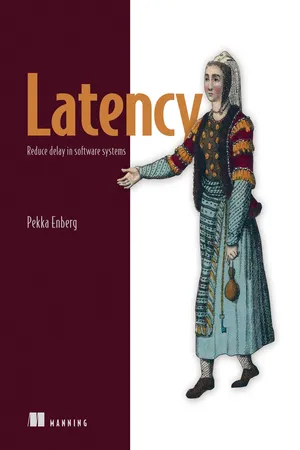
Practical techniques for delivering low latency software.
From first principles to production-ready code, Latency teaches you how to make your software faster at every layer of the stack. You’ll learn what latency really is, how it differs from bandwidth, and why it matters for user experience. Then, guided by practical examples, you’ll apply Little’s Law, design lock-free algorithms, and architect caching systems that scale. You’ll discover how your code runs differently on distributed systems, databases, and operating systems, and understand the common latency-causing issues in each situation.
In Latency you’ll learn how to:
• Define latency, distinguish it from bandwidth, and understand its impact on user experience
• Model performance with Little’s Law and Amdahl’s Law, then measure and visualize delays
• Optimize data access with colocation, replication, partitioning, and caching
• Accelerate logic with algorithmic improvements, memory tuning, and lock-free concurrency
• Minimize delays with asynchronous processing, predictive techniques, and speculative execution
Put simply, latency is the delay between a cause and effect. In practice, too much latency can create problems throughout a software system, ranging from inaccurate calculations and timeouts to impatient users simply abandoning your applications. Latency issues can be challenging to avoid and troubleshoot. This book balances theory with practical implementations, turning academic research into useful techniques you can apply to your projects.
About the technology
From lost microseconds routing server messages to page loads that keep users waiting, latency can kill good software. This one-of-a-kind book shows you how to spot, understand, and fix unwanted latency in your applications and infrastructure.
About the book
Latency: Reduce delay in software systems shows you how to troubleshoot latency in existing applications and create low latency systems from the ground up. In it, you’ll discover high-impact fixes for measuring latency and advanced optimizations in memory management, concurrency models, and predictive execution. The tips and tricks, hands-on projects, and personal insights make this book as enjoyable as it is practical.
What's inside
• How to model and measure latency
• Organizing application data for low latency
• Accelerating your code
• Hiding latency
About the reader
For software engineers with a working knowledge of backends. Examples in Rust.
About the author
Pekka Enberg has experience in operating systems, databases, and distributed systems, having worked on the Linux kernel and the Scylla and Turso databases.
Table of Contents
Part 1
1 Introduction
2 Modeling and measuring latency
Part 2
3 Colocation
4 Replication
5 Partitioning
6 Caching
Part 3
7 Eliminating work
8 Wait-free synchronization
9 Exploiting concurrency
Part 4
10 Asynchronous processing
11 Predictive techniques
A Further reading
Get a free eBook (PDF or ePub) from Manning as well as access to the online liveBook format (and its AI assistant that will answer your questions in any language) when you purchase the print book.

- English
- ePUB (mobile friendly)
- Available on iOS & Android
eBook - ePub
About this book
Trusted by 375,005 students
Access to over 1 million titles for a fair monthly price.
Study more efficiently using our study tools.
Information
Topic
InformatiqueSubtopic
MatérielTable of contents
- Latency
- copyright
- contents
- preface
- acknowledgments
- about this book
- about the author
- about the cover illustration
- Part 1 Basics
- 1 Introduction
- 2 Modeling and measuring latency
- Part 2 Data
- 3 Colocation
- 4 Replication
- 5 Partitioning
- 6 Caching
- Part 3 Compute
- 7 Eliminating work
- 8 Wait-free synchronization
- 9 Exploiting concurrency
- Part 4 Hiding latency
- 10 Asynchronous processing
- 11 Predictive techniques
- appendix Further reading
Frequently asked questions
Yes, you can cancel anytime from the Subscription tab in your account settings on the Perlego website. Your subscription will stay active until the end of your current billing period. Learn how to cancel your subscription
No, books cannot be downloaded as external files, such as PDFs, for use outside of Perlego. However, you can download books within the Perlego app for offline reading on mobile or tablet. Learn how to download books offline
Perlego offers two plans: Essential and Complete
- Essential is ideal for learners and professionals who enjoy exploring a wide range of subjects. Access the Essential Library with 800,000+ trusted titles and best-sellers across business, personal growth, and the humanities. Includes unlimited reading time and Standard Read Aloud voice.
- Complete: Perfect for advanced learners and researchers needing full, unrestricted access. Unlock 1.4M+ books across hundreds of subjects, including academic and specialized titles. The Complete Plan also includes advanced features like Premium Read Aloud and Research Assistant.
We are an online textbook subscription service, where you can get access to an entire online library for less than the price of a single book per month. With over 1 million books across 990+ topics, we’ve got you covered! Learn about our mission
Look out for the read-aloud symbol on your next book to see if you can listen to it. The read-aloud tool reads text aloud for you, highlighting the text as it is being read. You can pause it, speed it up and slow it down. Learn more about Read Aloud
Yes! You can use the Perlego app on both iOS and Android devices to read anytime, anywhere — even offline. Perfect for commutes or when you’re on the go.
Please note we cannot support devices running on iOS 13 and Android 7 or earlier. Learn more about using the app
Yes, you can access Latency by Pekka Enberg in PDF and/or ePUB format, as well as other popular books in Informatique & Matériel. We have over one million books available in our catalogue for you to explore.