Musings and autobiographically informed commentary on the human condition through the lens of the Kannon-gyo—chapter 25 of the Lotus Sutra—connecting Zen and Pure Land Buddhism through the practice of venerating and chanting the names of buddhas and bodhisattvas.
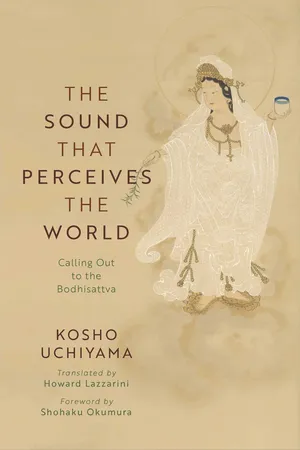
The Kannon-gyo is chapter 25 of the Lotus Sutra, and its focus is the bodhisattva of compassion, Avalokiteshvara, known in China as Guanyin, and in Japan as Kannon or Kanzeon. The text describes the many ways in which calling out the bodhisattva’s name—Namu Kanzeon Bosatsu—can relieve suffering.
Most schools of Zen Buddhism, and especially the Soto school, eschew such practices as chanting the names of buddhas and bodhisattvas, along with venerating such figures.
The eminent Soto Zen master Kosho Uchiyama Roshi, however, while doing hard physical labor early in his career, could not practice zazen—that is, formal sitting meditation. He came to appreciate the Kannon-gyo and the practices related to it. In particular, he took to reciting Kannon’s name, as recommended in the text of the Kannon-gyo.
Later in life, Uchiyama Roshi suffered from illness that again prevented him from practicing formal Zen, so he returned to the Kannon-gyo and the practice of chanting. He went so far as to assert that chanting Kannon’s name is completely equivalent to zazen, that the two practices are simply two sides of the same coin—a revolutionary idea seemingly at odds with Zen.
Chanting practice is especially accessible, as it can be done while working, traveling, or suffering from illness, and other activities that would ordinarily get in the way of formal Zen practice.
With these practices, the Kannon-gyo, and Kannon herself as a backdrop, Uchiyama Roshi muses about the purposes of religion, the goals of religious practice, and the meaning of enlightenment—and their relation to suffering itself.
- 272 pages
- English
- ePUB (mobile friendly)
- Available on iOS & Android
eBook - ePub
About this book
Information
Topic
Theology & ReligionSubtopic
BuddhismTable of contents
- Cover Page
- Title Page
- Contents
- Foreword
- Translator’s Preface
- Translator’s Introduction
- Appreciating the Kannon-gyo
- Preface
- Introduction
- 1. My Personal Connection with the Kannon-gyo
- 2. The Sound That Perceives the World
- 3. The Main Thread of the Buddhadharma
- 4. An Unobstructed View of Life and the World
- 5. The Religious Meaning of Suffering in the World
- 6. Resolving Problems with Money versus Emancipation through Religion
- 7. God’s Yardstick versus Our Human Yardstick
- 8. Before Yardsticks, Part 1
- 9. Before Yardsticks, Part 2
- 10. The Sound of Silence
- 11. “One Mind”
- 12. The Reality without Language and the Undefiled Self
- 13. The Buddha Who Practices within Delusion
- 14. The Scenery of My Life
- 15. The Difficulty of Maintaining Bodhisattva Vows
- 16. Single-Mindedly Chanting the Name of Kanzeon Bosatsu as the House Where We Live
- 17. Freedom and the Twelve Links of Dependent Origination
- 18. My Mind Is Like the Weather
- 19. The Relaxed and Spacious Life
- 20. Everything We Encounter Is Our Life
- 21. The Thirty-Three Forms of Avalokiteshvara
- 22. Where I Place My Weak Mind
- Afterword
- Afterword by Shusoku Kushiya
- Appendix 1. The Kannon-gyo, Chapter 25 of the Lotus Sutra
- Appendix 2. Uchiyama Roshi’s Postscript to the Kannon-gyo
- Appendix 3. Appreciating the Ten-Line Kannon-gyo
- Bibliography
- Index
- About the Author and Translator
- Copyright
Trusted by 375,005 students
Access to over 1.5 million titles for a fair monthly price.
Study more efficiently using our study tools.
Frequently asked questions
Yes, you can cancel anytime from the Subscription tab in your account settings on the Perlego website. Your subscription will stay active until the end of your current billing period. Learn how to cancel your subscription
No, books cannot be downloaded as external files, such as PDFs, for use outside of Perlego. However, you can download books within the Perlego app for offline reading on mobile or tablet. Learn how to download books offline
Perlego offers two plans: Essential and Complete
- Essential is ideal for learners and professionals who enjoy exploring a wide range of subjects. Access the Essential Library with 800,000+ trusted titles and best-sellers across business, personal growth, and the humanities. Includes unlimited reading time and Standard Read Aloud voice.
- Complete: Perfect for advanced learners and researchers needing full, unrestricted access. Unlock 1.5M+ books across hundreds of subjects, including academic and specialized titles. The Complete Plan also includes advanced features like Premium Read Aloud and Research Assistant.
We are an online textbook subscription service, where you can get access to an entire online library for less than the price of a single book per month. With over 1.5 million books across 990+ topics, we’ve got you covered! Learn about our mission
Look out for the read-aloud symbol on your next book to see if you can listen to it. The read-aloud tool reads text aloud for you, highlighting the text as it is being read. You can pause it, speed it up and slow it down. Learn more about Read Aloud
Yes! You can use the Perlego app on both iOS and Android devices to read anytime, anywhere — even offline. Perfect for commutes or when you’re on the go.
Please note we cannot support devices running on iOS 13 and Android 7 or earlier. Learn more about using the app
Please note we cannot support devices running on iOS 13 and Android 7 or earlier. Learn more about using the app
Yes, you can access The Sound That Perceives the World by Kosho Uchiyama in PDF and/or ePUB format, as well as other popular books in Theology & Religion & Buddhism. We have over 1.5 million books available in our catalogue for you to explore.