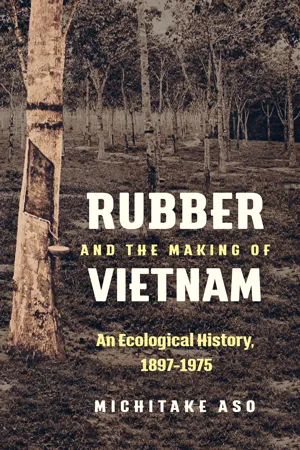
Dating back to the nineteenth-century transplantation of a latex-producing tree from the Amazon to Southeast Asia, rubber production has wrought monumental changes worldwide. During a turbulent Vietnamese past, rubber transcended capitalism and socialism, colonization and decolonization, becoming a key commodity around which life and history have revolved. In this pathbreaking study, Michitake Aso narrates how rubber plantations came to dominate the material and symbolic landscape of Vietnam and its neighbors, structuring the region’s environment of conflict and violence. Tracing the stories of agronomists, medical doctors, laborers, and leaders of independence movements, Aso demonstrates how postcolonial socialist visions of agriculture and medicine were informed by their colonial and capitalist predecessors in important ways. As rubber cultivation funded infrastructural improvements and the creation of a skilled labor force, private and state-run plantations became landscapes of oppression, resistance, and modernity.
Synthesizing archival material in English, French, and Vietnamese, Aso uses rubber plantations as a lens to examine the entanglements of nature, culture, and politics and demonstrates how the demand for rubber has impacted nearly a century of war and, at best, uneasy peace in Vietnam.
- 416 pages
- English
- ePUB (mobile friendly)
- Available on iOS & Android
eBook - ePub
About this book
Information
Part I
Red Earth, Gray Earth
CHAPTER ONE
Civilizing Latex
All around her was the hostile jumble of tall bamboo, the forest and its threats, solitude.
—François de Tessan, Dans l’Asie qui s’éveille
On all four sides was the ancient, untouched forest, empty of bird calls or the cold cries of the gibbons. Everywhere nothing but weeds, dust, and thorns.
—Trần Tử Bình, The Red Earth
The road, here as everywhere else, is the best instrument of civilization.
—Lieutenant-gouverneur de la Cochinchine, 1922
From the rice deltas of Southeast Asia to the swampy southern coasts of the United States, the spread of industrial agriculture during the nineteenth century revolutionized the world. In Southeast Asia, European capital, Chinese trading networks, and indigenous labor converted the great river deltas of the Mekong, the Chaophraya, and the Irrawaddy from biodiverse swamps and mangrove forests into vast monocultures of rice and sugar. Mining, forestry, and fisheries likewise expanded in size and intensity of activity. Similar forces reconstituted Southeast Asia’s upland forests as planters replaced them with monocrops of coffee, palm oil, tea, and rubber, and colonial governments cordoned them off as reserves and hunting parks, thus criminalizing common usage. Nature itself functioned as an agent of change and resistance, as disease environments imposed limits on human activity and roads and bridges sank into the quagmire of waterlogged soils.1
The Indochinese peninsula was not spared from this social and environmental change. In the eighteenth century, Nguyễn lords founded đồn điền, a Sino-Vietnamese term for agro-military settlements, near the Đồng Nai River to increase tax revenue and secure new territory. Chinese traders and Minh Hương in Biên Hòa and Mỹ Tho submitted to the rule of the Nguyễn, while the state equipped the outpost of Sài Gòn with a Vauban-style fort. Established in 1802, the Nguyễn dynasty sought further to colonize southern parts of Vietnam and to exert tighter administrative control over the region and its borders with Khmer lands. Gia Long, the first Nguyễn emperor, sent out emissaries to bring back smallpox vaccines not only to save lives but also to discipline Vietnamese bodies and their microbes. Although the Nguyễn dynasty focused more on consolidating its political hold on the nascent nation-state of Việt Nam than on spreading agricultural or medical improvements, government officials did import new crops and carry out agricultural experiments on maize, tobacco, and coffee. One Vietnamese official even grew a ficus elastica to produce latex at his residential garden.2
The arrival of global financial markets and European liberalism in the mid-nineteenth century also refashioned preindustrial views of nature and landscapes on the Indochinese peninsula. In 1858, a combined Franco-Spanish naval fleet bombardment of Đà Nẵng near the imperial capital of Huế hammered home the point that, to survive, states required the type of military and techno-scientific dominance that could be obtained only by further integrating human and nonhuman nature. The Nguyễn dynasty’s response to this challenge was ineffectual, and the French proceeded to conquer the kingdoms of Việt Nam, Cambodia, and Laos. The French military and political subjugation of the peninsula accompanied its concurrent quest to bring Indochinese natures under its own form of control. While several institutions such as the botanical gardens of Sài Gòn, the Grall military hospital, and the semiprivate Pasteur Institute helped remake social and ecological relationships in southern Indochina, rubber plantations proved to be one of the most effective tools of such transformation.3
This chapter analyzes how a latex frontier was formed and “civilized” by written natural histories and European conquest that allowed planters to establish rubber plantations on the Indochinese peninsula. Frank Uekötter has suggested that “learning by doing” informed early plantation efforts, and this was true of planters in Indochina as well.4 While planters relied on a process of trial and error and imitation, however, knowledge of nature framed as “science” provided them with a sense of purpose and mission. Colonial states established the legal, economic, and transport infrastructure necessary for planters to appropriate land and plant rubber. The incorporation of Indochinese forests into networks of exploitation and conservation, the instituting of European land tenure regimes, and the setting up of new practices of mobility and immobility all paved the way for plantations to replace forests. Conflicts arose between planters and officials, but the colonial state was mostly eager to use the forested regions of eastern Cochinchina for industrial agriculture. As planters and laborers cleared the southern forests, new biological and linguistic environments emerged on plantations, influencing in turn the surrounding region. These emerging environments replaced the existing habitats of both animals and non-hevea plants and more clearly delineated natural, social, and political borders. Finally, these hardening borders, along with texts of explorers, missionaries, and administrators, formed the basis for initial state approaches to the Montagnards, or uplanders, and influenced their interactions throughout the colonial period.5
Indochinese Natures
Curiosity about nonhuman nature in Southeast Asia predated the formation of colonial states; missionaries and scholars had long studied the airs, waters, soils, diseases, flora, and fauna of the region. The earliest textual attention came from China, where authors viewed the south as a source of spices and medical ingredients. Missionaries continued investigations into the plants and animals of southern Indochina, and Cristoforo Borri’s seventeenth-century writing about the south-central Vietnamese region of Đàng Trong represents one of the earliest European-language descriptions of Indochinese nature. In 1790, the Jesuit missionary João de Loureiro (1710–96) published one of the first catalogues of plants in Cochinchina to follow the Linnaean system of classification, providing names in both Latin and Vietnamese. These pre-nineteenth-century publications often combined observations relevant to botany, agriculture, medicine, and ethnography, tasks eventually divided up among distinct scholarly disciplines.6
A Vietnamese court official, Trịnh Hoài Đức, wrote Gia Định Thành Thông Chí, perhaps the earliest scholarly work in any language to consider southeastern Vietnam as a coherent social and environmental region. Trịnh characterized Gia Định and Biên Hòa, the two easternmost provinces of the Lục tỉnh (six provinces), as generally unhealthy and sparsely populated, and focused more attention on the four rice-growing provinces of the west, which were more densely populated and economically vibrant. Đông Nam Bộ (ĐNB), a more recent term for an area that is roughly isomorphic with Gia Định and Biên Hòa, forms a frontier zone where the central highlands meet the southern deltas. The region has distinct dry and wet seasons and is watered by three main rivers: the Sài Gòn, the Đồng Nai, and the Bé. Humans inhabited the area during the Neolithic period, and connections to the Óc Eo civilization further to the south have been found in the Đồng Nai River basin. In the seventeenth century, Minh Hương, or Ming loyalists who fled China after the rise of the Qing, began to arrive in urban centers such as Biên Hòa, and, even though Trịnh’s Viet-centric narrative omits their presence, the Stieng and other Mon-Khmer speakers had long inhabited the region. The region’s location between the plains of the delta and the central highlands has made it an important trading point for delta and coastal products, such as rice and salt, and forest products, such as timber and wildlife. The vegetal cover on the undulating hills and sloping plateaus of the southeastern uplands included both dense and open forests, stands of bamboo, agricultural plots, and tranh, or lalang, grass, and environmental boundaries helped divide up a land with few firm political borders.7
When the Vietnamese government ceded the final three provinces of the Lục tỉnh to the French in 1867, and southern Vietnam became known as the colony of Cochinchina, a French view of the region’s nature began to take shape. In 1876, the colonial government divided up the province of Biên Hòa into Biên Hòa, Bà Rịa, and Thủ Dầu Một (often in French these names were written as one word, Thủ Dầu Một becoming Thudaumot, or even Tudomot), which, together with Tây Ninh, produced most of Vietnam’s rubber during the twentieth century. These political divisions were initially fluid and had little basis in on-the-ground facts. To destabilize older geographical units and increase the intellectual coherence of these provinces, the French colonial state commissioned numerous missions to map their living and nonliving topography. During the twentieth century, maps, statistics, and infrastructure related to industry, commerce, and agriculture in general and rubber plantations in particular gave this region added reality.8
The colonial government further imposed European knowledge systems on the flora and fauna of Cochinchina when it established a botanical garden in Sài Gòn in 1864, a mere five years after France took possession of the city. In 1865, Jean-Baptiste Louis Pierre (1833–1905), who was born on Réunion but moved to India for employment, became the garden’s director, a position he held until 1877. Over those years, Pierre published an expansive, multivolume treatise called the Flore forestière de la Cochinchine as well as smaller works on specific plants. In 1878, a veteran of the navy artillery became the new director of the botanical garden and Sài Gòn’s stud farm. One of the new director’s first responsibilities was to organize Pierre’s disorderly notes and publish a catalogue of the exotic and native species that had been cultivated at the garden. This initial annual report of the botanical garden, written in French and Vietnamese, also referenced the first phenological (i.e., agricultural and botanical) calendar, which was published in 1866.9
French colonialism transformed the preindustrial meanings of nature. A common term for “nonhuman nature” in Vietnamese is thiên nhiên, and the calques in Mandarin (tianran, 天然) and Japanese (tenzen, 天然) are characters drawn from the Taoist understanding of “a logical, cosmologically ordered Universe … that operates according to a Way.” Another standard translation of nonhuman nature, especially as opposed to human invention, is tự nhiên. The equivalents in Mandarin (ziran, 自然) and Japanese (shizen, 自然) are older characters meaning “the thing itself,” “innately,” or “automatically,” “in the sense of without effort, or according to the innate characteristic of something or someone.” In Vietnamese, tự nhiên also means “naturally,” or “spontaneously,” as in “be natural” or tự nhiên đi, a shade of meaning also suggested by the Japanese and Chinese terms. Finally, the nature of something, its essence, and human nature can be translated as bản chất and bản tính, respectively.10
The Vietnamese word for “environment,” môi trường, is a more recent invention and can stand alone or be used in combinations such as môi trường sinh thái (the ecosystem), môi trường acid (the acid environment), or even môi trường công tác thuận lợi (the advantageous business environment). Lay terms for “nature” among Vietnamese f...
Table of contents
- Cover
- Series Page
- Title Page
- Copyright
- Dedication
- Contents
- List of Illustrations, Maps, and Tables
- Acknowledgments
- Abbreviations in the Text
- Introduction
- Part I: Red Earth, Gray Earth
- Part II: Forests without Birds
- Part III: Rubber Wars
- Conclusion
- Notes
- Bibliography
- Index
Trusted by 375,005 students
Access to over 1.5 million titles for a fair monthly price.
Study more efficiently using our study tools.
Frequently asked questions
Yes, you can cancel anytime from the Subscription tab in your account settings on the Perlego website. Your subscription will stay active until the end of your current billing period. Learn how to cancel your subscription
No, books cannot be downloaded as external files, such as PDFs, for use outside of Perlego. However, you can download books within the Perlego app for offline reading on mobile or tablet. Learn how to download books offline
Perlego offers two plans: Essential and Complete
- Essential is ideal for learners and professionals who enjoy exploring a wide range of subjects. Access the Essential Library with 800,000+ trusted titles and best-sellers across business, personal growth, and the humanities. Includes unlimited reading time and Standard Read Aloud voice.
- Complete: Perfect for advanced learners and researchers needing full, unrestricted access. Unlock 1.5M+ books across hundreds of subjects, including academic and specialized titles. The Complete Plan also includes advanced features like Premium Read Aloud and Research Assistant.
We are an online textbook subscription service, where you can get access to an entire online library for less than the price of a single book per month. With over 1.5 million books across 990+ topics, we’ve got you covered! Learn about our mission
Look out for the read-aloud symbol on your next book to see if you can listen to it. The read-aloud tool reads text aloud for you, highlighting the text as it is being read. You can pause it, speed it up and slow it down. Learn more about Read Aloud
Yes! You can use the Perlego app on both iOS and Android devices to read anytime, anywhere — even offline. Perfect for commutes or when you’re on the go.
Please note we cannot support devices running on iOS 13 and Android 7 or earlier. Learn more about using the app
Please note we cannot support devices running on iOS 13 and Android 7 or earlier. Learn more about using the app
Yes, you can access Rubber and the Making of Vietnam by Michitake Aso in PDF and/or ePUB format, as well as other popular books in Biological Sciences & Asian History. We have over 1.5 million books available in our catalogue for you to explore.