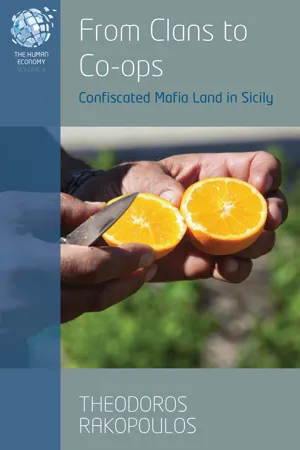
From Clans to Co-ops explores the social, political, and economic relations that enable the constitution of cooperatives operating on land confiscated from mafiosi in Sicily, a project that the state hails as arguably the greatest symbolic victory over the mafia in Italian history. Rakopoulos's ethnographic focus is on access to resources, divisions of labor, ideologies of community and food, and the material changes that cooperatives bring to people's lives in terms of kinship, work and land management. The book contributes to broader debates about cooperativism, how labor might be salvaged from market fundamentalism, and to emergent discourses about the 'human' economy.
A radical state-led initiative, the anti-mafia cooperatives of Sicily are hailed, throughout Italy, as symbols of the anti-mafia movement and are recognised as its most successful manifestation. Yet, while anti-mafia cooperativism1 unsettled the local labour market in positive ways, its achievements also led to contradictions, which are important to grasp in order to engage with the full meaning of anti-mafia social change in Sicily. A focus on this relationship between continuity and transformation (the bettering of people’s livelihoods and the incongruities that accompanied it), as well as on how this relationship was reflected in, and drew on, internal divisions of labour within the cooperatives, drive this book.
The ethnography explores the social processes of change enacted in San Giovanni and its surrounding area, the valley of Spicco Vallata, through a study of the activity of four work-based2 agrarian cooperatives. These organisations cultivate land plots that the Italian state confiscated from the powerful local mafia between the years 1996 and 2009, allowing local people direct access to land and work without the mediation of mafiosi. Focusing on this shift of access to resources (labour, land and reputation) offered to the cooperatives’ members and the unintended repercussions this entailed, this anthropological inquiry examines a politicised project of cooperativism that aimed to secure people’s livelihoods away from mafia’s influence. Some of these contradictions can be grasped in a phrase of Alberto Dalla Chiesa3 that anti-mafia activists repeatedly told me and had become a mantra of anti-mafia cooperativism: ‘The state gives as a right what the mafia offers as a gift’.
Cooperatives, Smaller than Life: The Untold Story
Cooperatives, like most institutions, often profess to do a lot. Their representatives claim social change, or egalitarianism of all kinds, or community economics as their dreamt aim or indeed achieved goal. Like all ideologies, cooperativism then appears larger than life; this is odd, as cooperativism has been seen as the end of -isms, as lived socialist practice (e.g., Whyte 1999; Zamagni and Zamagni 2010; Restakis 2010). Sociologists and anthropologists of cooperation and cooperativisation have often criticised cooperatives for not living up to what they profess (e.g, Kasmir 1996; Narotzky 2007; or MacPherson 2008, Errasti et al 2016). It is an accusation that this book is sympathetic to – and that comes from a slightly Marxian lineage. In this line, the general backdrop against which this book develops is to show how, through the prism of ethnography, cooperatives appear to be smaller than their representatives claim to be.
However, this critique, centred on labour and exploitation, or struggles against neoliberalism, would leave a lot behind4. While some (see, e.g., Checker and Hogeland 2004) note that removing co-ops from local context to strive for social change is problematic, if not redundant, not much has been said about that ‘local context’. This is why the anthropological eye of this ethnography is set on how co-ops are more fully engaged in the complexities of local life than often admitted. This engagement is done in silent and unseen ways that can fly in the face of the specific ideology on which cooperatives develop (in this case, the anti-mafia). The social fodder that cooperatives are embedded in comprises life outside the co-op work and within kinship networks, flows of reputation, neighbourhood issues and household organisation. The book thus discusses what has not been touched upon by critiques to cooperativism: the ‘local’ context, in the sense of co-op members’ lives, and hence in a framework that includes relationships beyond waged employment within them, entrenched as members’ lives are in a series of obligations around cooperative work. That around, I argue, is what determines the inside, the private life of cooperativism.
The book centres on exploring how cooperatives constituted themselves as enclaves of good practice and how this enclaving ideology regarding land and labour (Clemmer 2009) was met with attempts by workers to unwittingly embed the co-ops in local life. Examining the tension between enclaving and embedding mobilises issues central to economic anthropology today, as the Sicilian material offers a lens to questions concerning the social life of cooperatives. Like other junctures of co-ops and state, Sicily’s historically complex relationship with the Italian state is central: the legal confiscation of mafia land was intended to curb local mafiosi power and promote values of legality and transparency. In this juncture, state, mafia and cooperativism converge and clash. The co-op concern thus springs organically from a scrutiny of the grey zone of this stage, where my interlocutors lives unfold.
How the cooperative ideology of legality is embedded locally becomes then the core of our investigation – and it is through tracing co-op people’s lives in their community outside the time they dedicate to the co-op that this can be studied. Drawing on the idea of embeddedness (Polanyi 2001) of economic activity in social life (and the values associated with people’s grounded experience) can capture the distinct, and even contradictory, social realities sheltered under the same work cooperatives. This is especially so when we see resources as also embedded in socially arranged relationships (like land, as in Hann 1998b; 2007; 2009a). Attention is needed, though: embeddedness does not operate outside context (Peters 2009; de Sardan 2013). In cases of politicised cooperatives, like the Sicilian anti-mafia, it is even explicitly poised against a dis-embedding idea of forming enclave-like structures, sealed out from local life’s vices.
Cooperatives’ resources (labour, land and such) are not ‘embedded’ uniformly but across different contexts and different people encompassed in a cooperative. Despite tensions, the ‘informal’ aspects of their livelihoods, embedded in morals about land (Abramson 2000), mediated kinship (Carsten 1995), reputation (Schneider and Schneider 1996) and ‘mutual aid’ develop alongside rather than against anti-mafia cooperative (legality-oriented) activity. Rather than reifying ‘cooperatives’ as bounded units of analysis, the focus here is on their members and daily workers and their contradictory circumstances, as they bring different values into the organisations they compose. These are translated into diverse practices outside the co-op framework and different ideas on how this framework (should) operate. They are conditioned by the real live circumstances of people participating in them.
After all, the Polanyian embeddedness notion, convergent with the Maussian idea of institutions as total social facts, makes law a noneconomic institution that serves to incorporate economic life into society (Catanzariti 2015: 222). The very term ‘embeddedness’ is rarely used by Polanyi himself (Resta 2015: 10). It is often presented as a binary opposition between cases where material life is embedded and others where the market forces disembed it from the economy (Gudeman 2011: 17). The notion has been transformed (Beckert 2011: 40–44) and is here applied to trace how cooperative life, rooted in a sense and an ideology of material change, interacts with the lifeworlds of the people constituting cooperatives.
This is not a series of personal or ‘household’ strategies, simply; this exegesis would reduce the fullness of Sicilian life, with its plethora of grey areas (Rakopoulos 2017c) to rational maximisation, which is precisely what Polanyi would not argue (Robotham 2011: 273). Cooperatives’, like ‘livelihoods’ (and, again, Polanyian meditations are in order here, as per Polanyi 1957 and Graeber 2011) are influenced by values coming from their members’ experiences in their broader social milieux (including kinship, the informal economy and local codes and idioms), often different from, or indeed contradictory to, those claimed by their political principles. Some of these relationships, in the case of Spicco Vallata, are deemed to belong to a problematic ‘tradition’, which the cooperatives strive, in principle, to supersede. For example, kinship relations are seen by cooperativist ideologues as highly suspect because the loyalties they generate are seen to contradict the ideals of legality and meritocracy (see chapter 5), sidelined by promoting activism based on ethical food-production principles (chapter 4). But family is in fact constitutive of cooperatives in practice, giving meanings to the experience of workers’ participation in them – in terms of anti-mafia families (Rakopoulos 2017a).
I am not putting forward the idea that my interlocutors are slaloming across two opposed pillars, two different moral worlds, mafia and anti-mafia, and benefitting from both. Rather, their lives are caught in that zone where moral disinterestedness and a morality disassociated from the silences and speeches pertaining in Sicilian life are impossible (Di Bella 2011). It is thus the grounded cooperative life of Sicilians that elucidates our understandings of co-ops as egalitarian institutions and their contradictions (Kapferer 2003). Their actual, non-normative human economy (Hart 2015), beyond -isms, pertains to kinship, moralities over land, gossip and the richness of Sicilian lifeworlds, where mafia is a constant condition of local sociality. This is a lifeworld where law is often bypassed but also adhered to in a generic way (Blok 2010). My interlocutors navigate different situations that produce a grey zone, where knots of relations pertaining to mafia, anti-mafia and state both conflict and merge. The mafia is thus presented as a looming presence, a constant in people’s lives. People see it as a constellation of people with agrarian livelihoods – but not as a structural domain, as it is most often discussed (see, e.g., Gambetta 2009; Varese 2011; Travaglio 2014). ‘Its’ sociological construction, while analytically needed, urgently needs ethnographic backing, where real people do real things – and this book partly serves this aim.
Having said that, this work aspires to be the first ethnography of the anti-mafia movement that pays attention to livelihoods and production processes rather than civil society mobilisation (see Schneider and Schneider 2002b; 2008). This way, it contributes to the ongoing query into Italian neoliberalisms, in terms of work regimes, civic politics, and their moralities (Yanagisako 2002, as well as 2013). The politics of morality have been under constant scrutiny in current anthropology (from Osella and Osella 2011 to Zigon and Throop 2014), and an attention to the situatedness of ethical concerns is at play (see Fassin 2004). There are even attempts at resuscitating discussion on the ‘moral economy’ outside the discipline, with an attention on how moral concerns are present in contemporary capitalism (Götz 2015). The strongly moralised world of anti-mafia activism meets, in Spicco Vallata, the moral lifeworlds of those working in the co-ops, with often mixed results.
A burgeoning anthropological discussion among Italianists has brought about the intrinsic, everyday neoliberalism in divisive and unequally structured work relations (Molé 2012) and in the moralities of doing good and professing solidarity (Muehlebach 2012). The general trends of neoliberal cosmopolitanism (Harvey 2003; 2011) do acquire contradictory meanings on the ground. In the Sicilian case, mafia and anti-mafia can be two – granted, opposing – sides of an entrepreneurial coin, struggling over acquisitions of privileged access to markets and land management. In that process, access is negotiated through civic activism in times of austerity, a phenomenon also rampant in Italy, although livelihoods remain relatively in the shade of its scholarly discussion (Muehlebach 2013; Palumbo 2016). When this activism is indeed associated with Italian livelihoods becoming marginalised, it is often an urban phenomenon (Herzfeld 2009).
How this discussion can be sited in the specifics of nested structures of human cooperation, like work cooperatives, still requires critical inquiry, especially as such debate is often at some distance from livelihood concerns. The materiality of how people engage with and in civil society has been set aside, as debate has very creatively focused on the intricate ideological makings of activist morality (Schneider and Schneider 2001). These moralities are contradictory, and these contradictions remain ‘immaterial, but objective’ (to think in a Marxian sense), rooted in labour, in the widest sense of the term.
But cooperatives’ internal differentiation, their divisions of labour, are not simply the result of exposure to markets (Kasmir 2009). In fact, the workforce in these Sicilian cooperatives is composed of people embedded in different, often irreconcilable, social relations and circumstances. In the political context of a project whose lynchpin is legality with its consciously ‘enclaving’ force, legal categories do not have meanings or values shared universally. Politically driven cooperatives are founded on normative principles, in this case the state ideology of legality as well as a moral understanding of food production and agrarian economy (see Luetchford and Pratt 2013). Diverging from perceptions of the term in the relevant sociology (Jamieson 2000; Sciarrone 2009; Armao 2009; see also Pardo 2004), I nuance this idea of legality, suggesting that it is not neutral but socially ordered (and ordering), rooted in ideological perceptions of community (akin to reflections offered by Santino 2002). The ethnography therefore provides an account of a radical political project that challenges the mafia but largely fails to grasp the local social arrangements within which it unfolds.
Of Guns and Grapes: Imagining a Post-mafia Sicily
Confiscations
Palermo in the 1980s had the highest rates of violent crime among European cities (Sterling 1991; Dickie 2004; 2014). The mafiosi, coordinated in the vertical structure of Cosa Nostra (Lodato 2001; cf. Tilly 1974), selectively eliminated state bureaucrats, including investigating magistrates, who challenged their aims. The number of mafia victims, dubbed ‘excellent cadavers’ (Stille 1996; see also Sant Cassia 2007), included members of parliament such as Pio La Torre, who had sponsored an anti-mafia law in 1982 (Rizzo 2003) that initiated the formation of anti-mafia confiscations. His assassination that same year indicates just how important the law he had crafted actually was.5
The ‘Rognoni-La Torre’ Law (number 646/82, co-proposed with the Christian Democrat parlamentarian Virginio Rognoni) made two fundamental amendments to article 416 of the Italian Criminal Code. It introduced the specific crime of ‘mafia’ association, distinct from ‘organised crime’. It also introduced the power of the courts to confiscate the assets of persons belonging to the mafia, as well as those of their relatives, partners, and families who in the five years before a confiscation had acted as ‘straw persons’.6 In criminal proceedings against a person ‘for mafia’ – i.e., for any type of criminal offence related to article 416 bis of the Criminal Code – his assets are sequestrated when he (unexceptionally, a man) is formally charged, despite the presumption of innocence. They are then confiscated if the defendant is convicted for mafia, if he cannot show they have an innocent origin. Since then, when the mafioso is charged (indicted), his assets are sequestered, while upon conviction the property would then be confiscated.
La Torre’s collaboration with Rognoni also shows the convergence of the two major parties, Democrazia Cristiana (DC) and Partito Comunista Italiano (PCI),7 en route to an anti-mafia political consensus (Lane 2010: 34–36). La Torre belonged to the moderate faction of the PCI. The communists promoted ‘an alliance of democratic forces’ against mafia violence, raising awareness of mafia intimidation of the peasant movement (Rizzo 2003). Interestingly, as a trade unionist, La Torre had been imprisoned for his part in Spicco Vallata land occupations in 1948, an action aimed in part against mafia power. This shows how state policies on mafia shifted over time (Ginsborg 2003b: 205): by the mid-1990s, in response to intense mafia anti-state violence and civil society pressures, the state took a more active anti-mafia stance, and the confiscation...
Table of contents
Cover
Title Page
Copyright Page
Contents
List of Illustrations and Tables
Acknowledgments
Introduction
Chapter 1. Problems with Cooperatives
Chapter 2. The Anthropology of Co-ops, the Mafia and the Sicilian Lens
Chapter 3. Cooperatives and the Historical Anti-mafia Movement
Chapter 4. Worldviews of Labour: Legality and Food Ideologies
Chapter 5. The Limits of ‘Bad Kinship’: Sicilian Anti-mafia Families
Chapter 6. The Use of Gossip: Setting Cooperative Boundaries
Chapter 7. ‘Wage Is Male – But Land Is a Woman’
Chapter 8. Community Trouble: Cooperative Conundrum
Chapter 9. Divided by Land: Mafia and Anti-mafia Proximity
Conclusion. The Private Life of Political Cooperativism
Bibliography
Index
Trusted by 375,005 students
Access to over 1.5 million titles for a fair monthly price.
Study more efficiently using our study tools.
Frequently asked questions
Yes, you can cancel anytime from the Subscription tab in your account settings on the Perlego website. Your subscription will stay active until the end of your current billing period. Learn how to cancel your subscription
No, books cannot be downloaded as external files, such as PDFs, for use outside of Perlego. However, you can download books within the Perlego app for offline reading on mobile or tablet. Learn how to download books offline
Perlego offers two plans: Essential and Complete
Essential is ideal for learners and professionals who enjoy exploring a wide range of subjects. Access the Essential Library with 800,000+ trusted titles and best-sellers across business, personal growth, and the humanities. Includes unlimited reading time and Standard Read Aloud voice.
Complete: Perfect for advanced learners and researchers needing full, unrestricted access. Unlock 1.5M+ books across hundreds of subjects, including academic and specialized titles. The Complete Plan also includes advanced features like Premium Read Aloud and Research Assistant.
Both plans are available with monthly, semester, or annual billing cycles.
We are an online textbook subscription service, where you can get access to an entire online library for less than the price of a single book per month. With over 1.5 million books across 990+ topics, we’ve got you covered! Learn about our mission
Look out for the read-aloud symbol on your next book to see if you can listen to it. The read-aloud tool reads text aloud for you, highlighting the text as it is being read. You can pause it, speed it up and slow it down. Learn more about Read Aloud
Yes! You can use the Perlego app on both iOS and Android devices to read anytime, anywhere — even offline. Perfect for commutes or when you’re on the go. Please note we cannot support devices running on iOS 13 and Android 7 or earlier. Learn more about using the app
Yes, you can access From Clans to Co-ops by Theodoros Rakopoulos in PDF and/or ePUB format, as well as other popular books in Social Sciences & Political Economy. We have over 1.5 million books available in our catalogue for you to explore.