Despite high degrees of cultural and ethnic diversity as well as prevailing political instability, Guinea-Bissau's population has developed a strong sense of national belonging. By examining both contemporary and historical perspectives, A Creole Nation explores how creole identity, culture, and political leaders have influenced postcolonial nation-building processes in Guinea-Bissau, and the ways in which the phenomenon of cultural creolization results in the emergence of new identities.
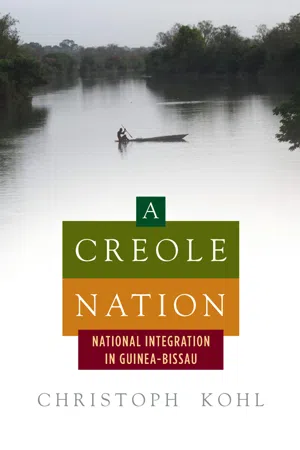
- 270 pages
- English
- ePUB (mobile friendly)
- Available on iOS & Android
eBook - ePub
About this book
Trusted by 375,005 students
Access to over 1.5 million titles for a fair monthly price.
Study more efficiently using our study tools.
Information
Chapter 1
Guinea-Bissau
A Creole Nation?

In many cases the postcolonial African state fostered national unity and a common national culture—sometimes under creole auspices, as was the case in Guinea-Bissau, which sets a good example in this respect. The West African country seems to correspond well to Benedict Anderson’s (1999) model of creole nation-building and the making of “Guineans”: creoles not only figured well in the victorious liberation movement that fought Portuguese colonial rule, they have also been prominent in postcolonial governments, administration, and among intellectuals. Apart from this successful creole nation-building from above, which has been described and analyzed by various authors, creoles and creole culture have also had a marked influence on national integration across ethnic (and religious) boundaries from below, i.e. from among the ordinary population, resulting in a strong collective imagination as “[Bissau-]Guineans.” Most notably, creole representations proved to be well suited to transcend ethnic particularities because they were not associated with specific ethnic groups but integrated cultural elements from different sources instead. Hence, creole groups resembled “small” nations in themselves. The African state thus often played a pivotal role in facilitating or provided the impetus for postcolonial nationhood from below.
Apart from the bottom-up integrative effects of creole popular features, creoles also played an important role in shaping and constructing modern Bissau-Guinean nation- and statehood from above, making it a creole project. This creole engagement and the historical references to events that were framed and marked by creoles have helped to construct both nation and state in Guinea-Bissau. Speaking about nationhood and nation-building, the state—or, more precisely, the nation-state—must be (almost) inevitably addressed. Nation and state are concepts that are characterized by a complex interdependence, affecting each other reciprocally.
In the following I will start by discussing how postcolonial nation-building was envisioned and achieved, analyzing particularly the role of African middle-class groups in creating and envisioning an independent nation and (nation-)state and how these interrelate. From both diachronic and synchronic perspectives I will investigate which factors have been conducive to successful nation-building and how they have interwoven both bottom-up and top-down approaches and perspectives. The focus will be on links between creoles and creole identity on the one hand and those between creoles and national identity on the other. More precisely, I will examine the political influence exerted by creoles and the way in which prominent creole leaders contributed to the conceptualization of the nation and state prior to independence. With regard to nation- and state-building, I will explore how creole, ethnic, religious, and national identities are interrelated in present-day Guinea-Bissau.
National cohesion is, in fact, quite strong in Guinea-Bissau despite the high degree of ethnic, religious, and cultural heterogeneity prevailing. Evidence suggests that the issue of ethnicity is largely exploited by politicians to serve their own purposes. The question arises as to how interethnic conviviality in people’s everyday lives is affected by the politicization of ethnic (and religious) ties. To this end, the case of the creole Cape Verdeans will serve as an example to be discussed. Ethnic heterogeneity, as I will show, is not necessarily an obstacle in the construction of Bissau- Guinean nationhood. Similarly, religious affiliation in Guinea-Bissau is not characterized by exclusivity. Bissau-Guinean metanarratives portray the war of independence as a nation-founding myth and Amílcar Cabral as a national hero and founding father. I will elaborate how, in the long term, struggles for independence, external threats, and the resulting shared suffering played a crucial part in defining national identity, facilitating the integration of various ethnic subidentities under a shared national umbrella identity despite dividing sociocultural factors and political maneuvers.
Envisioning and Building Postcolonial African Nationhood
After World War II, African nations were conceptualized and shaped by politicians standing for independence from European colonial rule. Even though nationalist ideas had already spread in the first half of the twentieth century, the years of World War II signaled a turning point for nationalism all over the African continent. African colonies that had been quite arbitrarily demarcated and seized by European colonial powers only a few decades before turned into arenas of rising nationalism after 1945. The national question was raised by numerically small groups of local elites that drew heavily on the Western concept of independent nationhood (and statehood) (Hobsbawm 1999: 137). Nationalist politicians had to cope with high degrees of cultural, ethnic, and religious diversity prevailing in the colonies, but they were also able to harken back to the (colonial) state’s efforts in creating a rudimentary, territory-based feeling of solidarity and belonging among the population, owed to common colonial languages, political arenas, media, and education system, among other things. Examples of such middle-class politicians include Kwame Nkrumah in Ghana, Ahmed Sékou Touré in Guinea, and Patrice Lumumba in Congo-Kinshasa. Some of them, such as Amílcar Cabral in Guinea-Bissau and Cape Verde, Julius Nyerere in Tanzania, Ahmed Sékou Touré, or Kwame Nkrumah, created powerful and ubiquitous ideologies for their independent states-to-be, appealing for national unity despite ethnic and religious plurality.
Many scholars have underlined the important contribution of creoles in the achievement of independence and the construction of postcolonial nation- and statehood in Guinea-Bissau (Chilcote 1972; Rudebeck 1974; Pirio 1983; Galli and Jones 1987; Trajano Filho 1993; 2005; 2006b; Duarte Silva 1997; Wick 2006; Keese 2007; Amado 2011; etc.). Consequently, creoles consider themselves, in some cases, to be the founding fathers of modern nationhood. This view was facilitated by the fact that creole ethnic groups not only perceived themselves as indigenized firstcomers to specific localities but were also generally regarded as a “small” nation on their own, for they united a plurality of ancestral ethnic identities (see also Kohl 2009a, b).
Indeed, tiny creole groups, strongly represented in colonial economies and civil services, were instrumental in playing decisive roles in the process of African nation- and state-building. While Americo-Liberians had dominated state- and nation-building in Liberia since the nineteenth century (Liebenow 1969), important segments of the Afro-Brazilians of Togo (Amos 2001: 302, 308) and the creole population of Guinea-Bissau and Cape Verde (Dhada 1993; Duarte Silva 1997; Lopes 2002; Keese 2007) advocated independence; the Aku in the Gambia, however, seemed to have an ambivalent attitude toward independence (Perfect 1991: 73, 75–78; Hughes and Perfect 2006: 108–9, 115, 131, 133–34, 138–140, 145–46). Conversely, the Krio of Sierra Leone (Wyse 1989: 105) and the Fernandino (or Krío) of Equatorial Guinea (Sundiata 1996: 183) largely opposed independence because they feared that they would be marginalized by other, numerically stronger ethnic groups.
Most African colonies were marked by high degrees of ethnic and cultural diversity. Nationalist movements advocated independence and sought to overcome ethnic divisions “from above.” One powerful method to unite heterogeneous societies during the struggle for independence was to “sacralize” (a word referring to nineteenth-century Europe) the nation-to-be (Weichlein 2006: 140–41; Berger 2008: 11). In some countries like Guinea-Bissau, Guinea, and Algeria, nationalist independence movements and the newly independent nation-state attempted to mobilize the population and increase people’s commitment to the nation by projecting an ideal of nationhood with religious connotations. Sometimes, as in the case of Guinea-Bissau, the population appropriated these top-down projections, internalizing and popularizing them. Political leaders reverted to languages with religious symbolism in order to produce strong emotional feelings of togetherness (cf. Graf 2004: 119–24). In many African countries, independence was believed to entail significant material and immaterial benefits for the disadvantaged population that had suffered from colonial oppression and exploitation. In other words, nationalists projected the image of a victimized nation by employing a rhetoric with religious undertones (cf. Reuter 2000: 139, 143, 154; Sundhaussen 2000: 70–71, 81–83; Wehler 2001: 55–69; Berger 2008: 11; Sand 2013). By doing this, it became possible to use victimhood in order to achieve national mobilization. The sanctification of the nation in combination with collective distress led to the depiction of this variant of nationalism as “political religion” (Hayes 1926; Vögelin 2007; cf. Weichlein 2006: 137–38; Kennedy 2008: 120–21; Sand 2013: 80–82).
The discursive victimization of the nation was all the more powerful when it was associated with a charismatic personality who represented a nation’s rescue and salvation from collective colonial distress. This applied to all national projects that were headed by charismatic leaders such as Amílcar Cabral, a creole, Kwame Nkrumah, Ahmed Sékou Touré, and Samora Machel, among others. The contemporary collective self-victimization of Bissau-Guineans as “underdogs,” regardless of ethnic or religious references, in light of a supposed “state failure” (socioeconomic difficulties, political instability, etc.) is one manifestation that preserves national cohesiveness (Kohl and Schroven 2014).
Despite the efforts of nationalist governments to create a new common culture and national identity following independence, ethnicity has nevertheless remained an important issue. Politicians in Africa have repeatedly attempted to exploit ethnicity for power purposes. Frequently, it was the “‘tribal’ imperative,” as Patrick Chabal called it, that has often been “represented as ultima ratio of African politics” (Chabal 1996: 48; emphasis omitted). In many cases, political entrepreneurs have strategically exploited ethnic ties for political and economic ends in postcolonial times—albeit without limiting the citizens’ commitment to nationhood. Moral ethnicity (Lonsdale 1996), as an internal dimension, can be specified as a “discursive and political arena within which ethnic identities emerged out of the renegotiation of the bounds of political community and authority” (Berman 1998: 324). Moral ethnicity is embedded in vertical moral- economic patterns of behavior among patrons and clients. In contrast, the diametrically opposed political tribalism, as an external dimension, depicts the ethnic basis of the horizontal competition between different patron-client networks (Lonsdale 1996; Berman 1998: 324–30, 338–39).
The long-term success of nationalist movements’ and governments’ endeavors to unite the nation is reflected in times of international armed or transnational social conflict. In such circumstances, the citizens’ commitment to the nation comes to the fore as people of different origin stand united as one nation against foreigners who are regarded as a common threat to their nation. This phenomenon vaguely resembles what came to be known as “balanced antagonism,” as referred to by Edward E. Evans-Pritchard (1940: 125, 134, 161; cf. Meeker 2004). This principle provides for the construction and maintenance of a social boundary and attempts to unite the nation across ethnic and religious boundaries and positioning it against a generalized, collective other.
State- and nation-building are not identical, yet they are often mutually dependent. For instance, while some states “failed” because they did not take into account local knowledge (Scott 1998: 34), Bissau-Guinean manjuandadi associations illustrate how the postcolonial state was quite successful in making use of local features, “vernacularizing” (cf. Merry 2006: 39) modernist models of “global north” political mass-movementism in local institutions and meanings. Historically, not every state-building process was connected to nation-building. In cases where nation-building occurred, the process was not continuous.
Thus, analytically, nations and states have to be distinguished (Gellner 1998: 5–6; Barrington 1997: 713; 2006: 4), although these notions are often used synonymously—particularly in English parlance (Wehler 2001: 25; cf. Gromes 2012: 26, 36–37). Hence, the people’s disaffection with the present manifestation of the state (governance) does not necessarily call into question the nation’s categorical commitment to conviviality in “its” state. A nation (or, respectively, the individuals constituting it) can have the will to live together in one state but can, at the same time, reject the everyday practice, i.e. the concrete functioning and performance of statehood (Abrams 1988: 82).
In European contexts, a shift from the state to the nation-state did not take place before the late eighteenth century (Langewiesche 2000: 27–28). This also holds for France, where a modern nation-state was created in the aftermath of the French Revolution (Weber 1976). Hence, the French were “created” after the foundation of the French nation-state. In other cases, the nation preceded the state, such as in Germany, Poland, or Italy.
In Africa, developments were different. Here,
the colonial state imposed the territoriality principle everywhere and demarcated state borders, but it was not a nation-state. The idea of the nation emerged only in the anticolonial movements. As a . . . result, . . . nation-states without an organically evolved nation developed in late colonial times. National independence was thus not the result of a consciousness of national identity and unity but rather preceded the latter. (Eckert 2006: 95; my own translation; cf. Osterhammel 2009: 77)
In other words, effective nation-building had to be pursued after independence, as the project of the nation had largely been confined to small groups of African politicians and intellectuals, usually benefitting from European-colonial education. In doing so, the secular, despotic, and bureaucratic colonial state became the father of its postcolonial successor. Nationalists necessarily had accepted “as the unit of self-determination the colonial territory” (Young 1988: 33). They reinterpreted the colonial state as a nation-state, and postcolonial politics eventually adopted the homogenizing claims of the European concept of the nation (Osterhammel 2009: 76–77). Thus, although the model of nation- and state-building was borrowed from Europe, it was often realized in ways quite different from it. Accordingly, many postcolonial African nation-states attempted to nationally integrate their ethnically and culturally diverse societies, contributing to the reshaping of identities. This task, in fact, had been initiated by the colonial state after achieving territorial integration in the early twentieth century. Hence, colonialism paved the way for this process by influencing, manipulating, and shaping ethnic identities (Ranger 1993: 63). Since the nation was supposed to be composed of an integrated people from a nationalist perspective, those individuals “who are to be unified or integrated are required to submit to a particular normative order” (Asad 2006: 496). Apart from integrating techniques, which the state can apply in the form of disciplinary acts, the postcolonial nation-state has the ability to weld ethnic options rigidly “on to the state structure and its formal procedures” (Elwert 2002: 40).
To summarize, creole identity and creoles played significant roles in postcolonial nation- and state-building processes. In a number of countries, as members of the middle class, they prominently figured in nationalist movements calling for independence, thus advocating political activism and national ideologies that stressed national unity without rejecting ethnic diversity. Nationalist movements employed the image of a population victimized under colonialism and combined it with millenarian anticolonialism, thus creating a basis for mass-mobilization and ensuring national cohesion. Already on the eve of decolonization, nationalist movements had started to employ certain cultural features that not only served to connect to the masses but also transcended ethnic diversity. The independent African nation-state managed to create a national culture (see also Knörr 2010a). In doing so it continued to discipline its population in order to form a governable nation, thus resuming a practice that had already been initiated by the colonial state.
Creole Contributions to Nation-Building
At an early stage in the history of Guinea-Bissau, from the sixteenth cen- tury onward, the creole population in the praças (literally “[market] square,” meaning the colonial, nominally Portuguese but creole-dominated commercial trading posts; the term refers nowadays to town centers) had indigenized to a sufficient degree to distinguish themselves from both the colonial rulers and the inhabitants in the countryside; they styled themselves as the de facto masters of the praças and, later on, of Guinea-Bissau. Although constituting only a tiny minority of the country’s total population, they followed the example of American creoles and advocated independence. What Bissau-Guinean creoles had in common with American creoles is the fact that they were born in the colonies and often opposed colonial rule. However, since Bissau-Guinean creoles are also connected to the European legacy (cf. Anderson 1999: 47–65), they have been influenced by European models of nation- and statehood: as shown before, the general idea and ideology of a people forming a nation and living in a nation-state has been borrowed from Europe. However, the case of Guinea-Bissau differs from European examples like Germany or Italy, where nation-building preceded, at least to some degree, state-building. Instead, in Guinea-Bissau, the nation could only be constructed from both above and below after independence—mainly on the basis of anticolonialism and discourses of shared suffering as well as local values and forms of sociability (such as manjuandadis and the carnival).
One of the first demonstrations of creole unity against colonial rule was the dismissal of the colonial administrator and appointment of his immediate replacement by an elected board of creole traders in Cacheu, which occurred as early as 1684–85 (Brooks 2003: 148–50). Long periods of the eighteenth and nineteenth centuries were characterized by the virtual absence of any effective Portuguese rule in the colony and repeated creole rebellions and insurgencies (see Pélissier 1989; Mendy 1994; Soares 2000; Cabral 2002: 171). This may have fueled ambitions among parts of the creole population to aspire to economic and political independence (Cardoso 2002: 13). The colony’s creole interim governor, Honório Pereira Barreto, drafted in 1843 a vehement critique of the Portuguese administration’s negligent governance and the increasing French influence (Pereira Barreto 1843; cf. Ribeiro 1986; 1993: 289–90; cf. Arassi Taveira 1989). The cession of the Casamance to France in 1888 evoked severe criticism of the colonial authorities from several of the urban creole inhabitants. Numerous Bissau-Guineans, among them many of creole ancestry, stress even today that Kriol continues to be spoken in Ziguinchor, the main city of the Senegalese Casamance that used to be part of Portuguese Guinea. In particular, those creoles and other Bissau-Guineans who are influenced by colonial ideology still emphasize the historical significance of creole presence in the former praça of Ziguinchor, ascribing the Senegalese city a special significance with regard to Bissau-Guinean history. In this manner, they construct both creole and Bissau-Guinean identity against the background of the loss of Portuguese Bissau-Guinean territory to (French) Senegal.
From 1911 onward until its militarily enforced dissolution in 1915, the Liga Guineense (Guinean League) actively advocated the social, political, and economic interests of urban middle-class Cape Verdean and Kriston traders (Mendy 1994: 329–43). The year 1912 had marked the end of the alliance between the Portuguese and the Kriston; in 1915 the Kriston became the targets of the Portuguese and their new Muslim allies’ pacification campaign. As early as the beginning of the 1890s, Kriston commercial control had started to erode (Havik 2011: 212–23), signaling the political, economic, and cultural sidelining of creoles in the course of Portugal’s increasingly successful colonization efforts. Some scholars regard the Liga Guineense as Guinea-Bissau’s first (proto-)nationalist movement because of its demand for a nationalized and “lusophonized” commercial setup and its call for administrative transparency and good governance (Cunningham 1980; Pirio 1983; Pélissier 1989: 295–302; Mendy 1994: 329–39; Havik 1995–99: 120–25). In contrast, Wilson Trajano Filho points out that the affiliations of the Liga protagonists were quite ambiguous: their identification with Guinea(-Bissau) was both encompassed and opposed by their Portuguese identity (Trajano Filho 1998: 309–11). In the late second decade of the twentieth century, the Partido Caboverdiano (Cape Verdean Party) opposed Portuguese occupation and aimed at the creation of a constitutional, Liberian-style republic; members of this party included Cape Verdean as well as Kriston residents (Bowman 1986: 476–77). From 1920 onward, Marcus Garvey’s Universal Negro Improvement Association (UNIA) became active in several praças. It had a predominantly Pan-African orientation and included many former leaders of the Liga Guineense. The colonial government labeled it an independence movement and therefore banned the organization in 1922 (Cunningham 1980: 41–42; Pirio 1983: 16–17). The so-called Revolução Triunfante (Victorious Revolution) of 1931—...
Table of contents
- Cover
- Title Page
- Copyright Page
- Contents
- List of Illustrations
- Acknowledgments
- Introduction
- Chapter 1 Guinea-Bissau: A Creole Nation?
- Chapter 2 Creole Identity in Guinea-Bissau
- Chapter 3 Building the Nation
- Conclusion
- List of Interviews
- Bibliography
- Index
Frequently asked questions
Yes, you can cancel anytime from the Subscription tab in your account settings on the Perlego website. Your subscription will stay active until the end of your current billing period. Learn how to cancel your subscription
No, books cannot be downloaded as external files, such as PDFs, for use outside of Perlego. However, you can download books within the Perlego app for offline reading on mobile or tablet. Learn how to download books offline
Perlego offers two plans: Essential and Complete
- Essential is ideal for learners and professionals who enjoy exploring a wide range of subjects. Access the Essential Library with 800,000+ trusted titles and best-sellers across business, personal growth, and the humanities. Includes unlimited reading time and Standard Read Aloud voice.
- Complete: Perfect for advanced learners and researchers needing full, unrestricted access. Unlock 1.5M+ books across hundreds of subjects, including academic and specialized titles. The Complete Plan also includes advanced features like Premium Read Aloud and Research Assistant.
We are an online textbook subscription service, where you can get access to an entire online library for less than the price of a single book per month. With over 1.5 million books across 990+ topics, we’ve got you covered! Learn about our mission
Look out for the read-aloud symbol on your next book to see if you can listen to it. The read-aloud tool reads text aloud for you, highlighting the text as it is being read. You can pause it, speed it up and slow it down. Learn more about Read Aloud
Yes! You can use the Perlego app on both iOS and Android devices to read anytime, anywhere — even offline. Perfect for commutes or when you’re on the go.
Please note we cannot support devices running on iOS 13 and Android 7 or earlier. Learn more about using the app
Please note we cannot support devices running on iOS 13 and Android 7 or earlier. Learn more about using the app
Yes, you can access A Creole Nation by Christoph Kohl in PDF and/or ePUB format, as well as other popular books in Social Sciences & Colonialism & Post-Colonialism. We have over 1.5 million books available in our catalogue for you to explore.