Northern Europe was, by many accounts, the birthplace of much of modern forestry practice, and for hundreds of years the region's woodlands have played an outsize role in international relations, economic growth, and the development of national identity. Across eleven chapters, the contributors to this volume survey the histories of state forestry policy in Scandinavia, the Low Countries, Germany, Poland, and Great Britain from the early modern period to the present. Each explores the complex interrelationships of state-building, resource management, knowledge transfer, and trade over a period characterized by ongoing modernization and evolving environmental awareness.
Trusted by 375,005 students
Access to over 1.5 million titles for a fair monthly price.
Often enough the literature on international environmental history and forest history treats scientific forestry, which prefers high stands and equal-sized, equal-aged monocultures, as ‘German forestry’.1 The same is true for forest history in Germany, which never grew tired of emphasizing that scientific forestry originated in Germany in the eighteenth century. This style of forestry was indeed widely practised, but forestry in Germany was never uniform, and it was never German in origin only, but an effect of transregional and transnational scientific exchange.2 However, it must be said that stereotypical German forestry was widely implemented in Prussia. But even within Prussia, the biggest and most powerful German state, different systems of forestry were practised in, for example, Prussia east of the Elbe River and in the Prussian Rhineland.
This raises the question of whether there is any real substance in what is considered to be ‘German forestry’. For many of the past centuries, it would be a kind of anachronism to speak of German forestry in general terms. Until German unification in 1871, Germany was not a nation state, and the German-speaking part of Europe consisted of more than a hundred different states, each with its own administration and forestry. Furthermore, from the German Empire (1871–1918) to today’s Federal Republic, forests continued to be managed on a state (i.e. regional) and not on federal (i.e. central) level; no centralized forest administration existed – with the marked exception of the twelve years of the Third Reich (1933–1945) and the (East) German Democratic Republic (1949–1990). The sub-department of forestry within the ministry of agriculture in West Germany after 1949 and in the reunited republic after 1990 wields no political clout on economic or silvicultural questions. Furthermore, the varying natural conditions caused large differences in woodland management techniques employed on the shores of the Baltic Sea when compared with those used in the Alps or in the Saxon Erzgebirge.
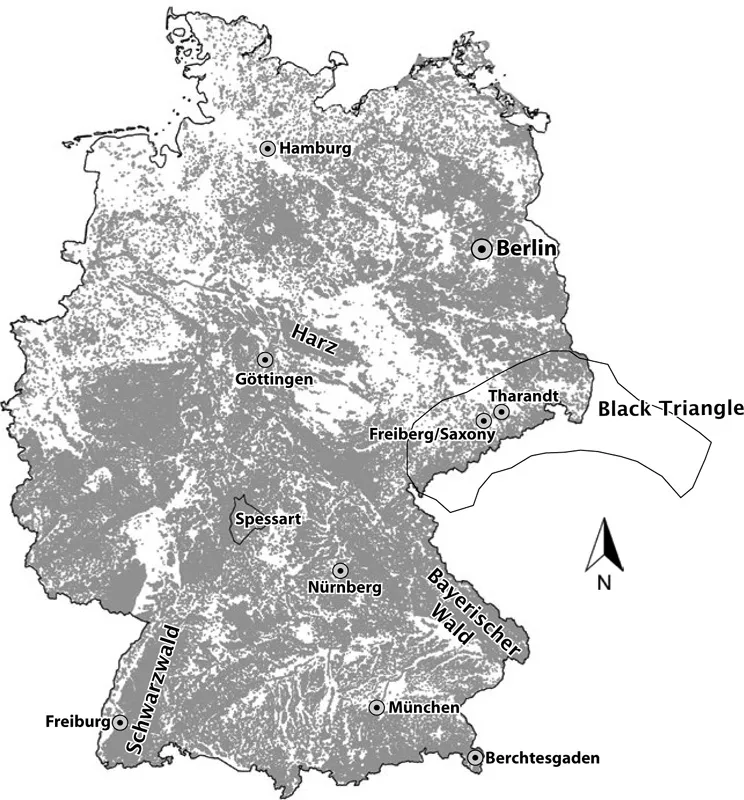
Map 1.1 Forest cover of Germany in the year 2000, showing places mentioned in the text. Map by K. Jan Oosthoek based on the CORINE Land Cover 2000 dataset, European Protection Agency.
As a result, scientific forestry developed a diversity of academic schools. There has never been any kind of national school of forestry like Nancy in France. Rather German forest sciences developed simultaneously in different places, offering a range of different solutions to similar problems. For these reasons, we prefer to speak of ‘forestry in Germany’ instead of ‘German forestry’, a term that suggests a consistency that has never existed. This chapter aims to provide a concise history of forestry in Germany during the past five hundred years, and for brevity we will not always be able to give sufficient credit to regional diversity.
Beginnings of Forest Management in Germany
In his famous book on modern capitalism (1916), the economist Werner Sombart described the entire era before industrialization as the ‘Wooden Ages’.3 He emphasized that wood and timber had been the basis of the pre-industrial reproduction. Up to the construction of railways and availability of coal after about 1850, wood was the most important source of energy. Early metal production in particular needed charcoal as fuel in order to achieve the high temperatures for smelting iron. Fuel was also needed for pottery and in brickworks, and to produce porcelain, glass and textiles. The everyday life of people cannot be imagined without firewood, and domestic fuel was undoubtedly the most important use for wood.
Timber was needed for construction and smaller crafts such as cartwrights, glaziers, coopers, joiners, carpenters, brush- and basket-makers, or spoon- and wood-carvers. The quality of their work depended on the quality of the material they used, on its strength, elasticity, and resistance to pressure and water. Each of these professions preferred special types of timber. In addition, forests delivered further materials that could hardly be replaced by other products: potash, for example, reduced the melting point of glass, but it was also needed to soften up textiles for dyeing or washing. Many trees were damaged in order to extract resin for the production of paper, and the bark of oak was used for tanning leather. Pitch and tar were used to make wood resistant to water, for instance in shipbuilding.4
Apart from delivering wood and timber, woodlands had many other functions in rural life. Forest historians and foresters of the past have denigrated the agrarian and pastoral uses of woodlands as secondary and harmful. These ligno-centred perspectives neglected the eminent value of fodder, grazing, and areas of shifting and circular cultivation for peasant economies. On the other hand, rural social and economic history often focused only on the acreage of arable land and excluded the forests from their studies. These restricted views are based on the academic separation of agronomy and forestry at the beginning of the nineteenth century. Woodlands in Early Modern Europe, however, were not places where only timber and fuel were produced. Agriculture and forestry were interwoven to an extent that made a forest or a pasture difficult to classify when land was surveyed. Generally, woodlands were not very dense but full of clearings, and these were actively used and managed. Walking on small paths through woodland in the eighteenth century one would have encountered cattle and horses grazing between the trees and pigs searching for acorns. Parts of the forest would have been cultivated for one or two years with wheat and then left to the trees again. Some women and children would have been cutting grass or collecting leaves from the branches to feed their livestock at home. Others would have been raking dead leaves and twigs to be used as litter in the barn, where it would absorb the excreta of the cattle and end up fertilizing the fields. On occasion one would have met wild-looking people with black faces – social outcasts living in the forests to burn charcoal and potash.5
Most of the woodlands were part of the agro-forestal system. Forests, which were owned by landlords or by the church, were also subject to agricultural use rights, which had been codified in legal documents since the Late Middle Ages. Wood pasture, for example, was often limited by the number of animals that were allowed to be driven into the forests, and other rights were limited to certain groups of people. These holders defended their rights not only against any attempt by a ruler to restrict them, but also against any outsiders who were not entitled to these rights.6
This situation provoked many conflicts when rulers started to tighten their grip on forests. From the sixteenth century, the major trend in the development of forestry in Germany was an increasing control by the emerging state on the woodlands in general, no matter to whom they belonged. This process took place very slowly and was not a linear development. An early and strong protest against the increasing power of rulers over the forest was the Peasants’ War of 1525 in Germany’s south-west. The revolting peasants complained in their ‘Twelve Articles’ – among other grieviences – about the forest policy of the rulers:
[W]e are aggrieved in the matter of woodcutting, for the noble folk have appropriated all the woods to themselves alone. If a poor man requires wood he must pay double for it. It is our opinion in regard to wood that has fallen into the hands of a lord, whether spiritual or temporal, that unless it was duly purchased it should revert again to the community. It should, moreover, be free to every member of the community to help himself to such firewood as he needs in his home.7
The peasants’ demands refer to three important developments in the history of German forests. First, the rebels accused rulers and landlords of usurpation of common woodlands. Common property should therefore either be paid for or given back. This idea of shared property that could be used equally by all the (entitled) members of the community was irreconcilable with the lords’ claim of unlimited control of the forests. It also ran counter to the idea of unrestricted private property, as the liberal movement had introduced by the end of eighteenth century. Only a few forests were not subject to use rights by people other than the owner. Whether the lords owned a forest legitimately (dominium directum) or not, they could not handle them arbitrarily as they had to accept that others had rights (dominium utile) in these woodlands.
Secondly, the claim of high wood prices referred to the early process of commercialization of timber and wood. From the fifteenth century onwards, in some regions and close to rivers and towns, timber and wood from the princely forests became a commodity. Because of high transportation costs, the price for wood rose with the distance to be covered for delivery. After a dozen or so kilometres overland the price would double. Peasants were far from accepting of the idea that firewood should be commericialized, but considered fuel as a bare necessity of life (Notdurft). Commercialization of timber was, however, implicitly accepted. The concept of free access to woodlands for legitimate necessities was an integral part of the ‘moral economy’ of the peasants. This explains why over the following three centuries peasants violated the forest ordinances and committed forest offences on a large scale. A large majority of the rural population (including many city dwellers who often made a living from agriculture) were still exempted from the commercialized wood market because they could meet their demand for fuel from their own or communal woodlands, by use right and by collecting dead wood.8
Thirdly, the process of regulating forests is set in the broader context of Early Modern state formation. This has been a major focus of German environmental history. Starting with a controversy about whether a wood and timber shortage actually existed in Germany at the end of the eighteenth century, or whether this ‘timber scare’ merely provided legitimacy for the princes to tighten the control over resource use and to integrate the territories politically.9
From this point, historians have looked back to the beginning of the modern state around 1500.10 The Early Modern ruler’s task was no longer limited to the maintenance of peace and justice, but princes claimed competence in regulating the whole of social and economic production. The new printing technology made possible not only the fast diffusion of political demands, such as the ‘Twelve Articles’, and an increasing number of new regulations and laws. From the 1530s onwards, hundreds of forest ordinances that regulated the management of the forests were enacted, and even the smallest territories introduced many consecutive forest laws. The most prominent argument to legitimize these new regulations and to extend the competence of the state was the claim of deforestation and wood shortage. The ‘state ordinance’ from Württemberg of 1495 referred to ‘the great shortage of wood for fuel and building’. Although this ordinance did not yet intend to establish full control of the woodlands, it paved the way for later forest regulations like the forest ordinance of 1540. Here again, ...
Table of contents
Cover
Title Page
Copyright Page
Contents
List of Tables, Maps and Figures
Acknowledgements
List of Abbreviations
Introduction. State Forestry in Northern Europe
1. Forestry in Germany, c.1550–2000
2. State Forestry in the Netherlands: From Liberalism to Nature Creation
3. State Forestry in Belgium since the End of the Eighteenth Century
4. Origins and Development of State Forestry in the United Kingdom
5. State Forestry in Denmark from the Late Eighteenth to the Early Twenty-First Century
6. State Forestry in Norway
7. Swedish State Forestry, 1790–2000
8. Finnish Forestry in a Long-Term Perspective
9. The History of State Forests and Forestry in Poland
Conclusion. National Histories, Shared Legacies: State Forestry in Northern Europe in Comparison
Glossary
Index
Frequently asked questions
Yes, you can cancel anytime from the Subscription tab in your account settings on the Perlego website. Your subscription will stay active until the end of your current billing period. Learn how to cancel your subscription
No, books cannot be downloaded as external files, such as PDFs, for use outside of Perlego. However, you can download books within the Perlego app for offline reading on mobile or tablet. Learn how to download books offline
Perlego offers two plans: Essential and Complete
Essential is ideal for learners and professionals who enjoy exploring a wide range of subjects. Access the Essential Library with 800,000+ trusted titles and best-sellers across business, personal growth, and the humanities. Includes unlimited reading time and Standard Read Aloud voice.
Complete: Perfect for advanced learners and researchers needing full, unrestricted access. Unlock 1.5M+ books across hundreds of subjects, including academic and specialized titles. The Complete Plan also includes advanced features like Premium Read Aloud and Research Assistant.
Both plans are available with monthly, semester, or annual billing cycles.
We are an online textbook subscription service, where you can get access to an entire online library for less than the price of a single book per month. With over 1.5 million books across 990+ topics, we’ve got you covered! Learn about our mission
Look out for the read-aloud symbol on your next book to see if you can listen to it. The read-aloud tool reads text aloud for you, highlighting the text as it is being read. You can pause it, speed it up and slow it down. Learn more about Read Aloud
Yes! You can use the Perlego app on both iOS and Android devices to read anytime, anywhere — even offline. Perfect for commutes or when you’re on the go. Please note we cannot support devices running on iOS 13 and Android 7 or earlier. Learn more about using the app
Yes, you can access Managing Northern Europe's Forests by K. Jan Oosthoek,Richard Hölzl in PDF and/or ePUB format, as well as other popular books in History & European History. We have over 1.5 million books available in our catalogue for you to explore.