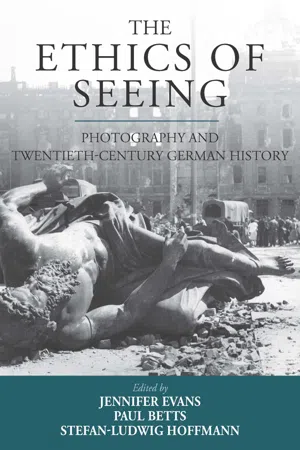
Throughout Germany's tumultuous twentieth century, photography was an indispensable form of documentation. Whether acting as artists, witnesses, or reformers, both professional and amateur photographers chronicled social worlds through successive periods of radical upheaval. The Ethics of Seeing brings together an international group of scholars to explore the complex relationship between the visual and the historic in German history. Emphasizing the transformation of the visual arena and the ways in which ordinary people made sense of world events, these revealing case studies illustrate photography's multilayered role as a new form of representation, a means to subjective experience, and a fresh mode of narrating the past.
eBook - ePub
The Ethics of Seeing
Photography and Twentieth-Century German History
- 306 pages
- English
- ePUB (mobile friendly)
- Available on iOS & Android
eBook - ePub
The Ethics of Seeing
Photography and Twentieth-Century German History
About this book
Trusted by 375,005 students
Access to over 1.5 million titles for a fair monthly price.
Study more efficiently using our study tools.
Information
Chapter 1
THOUGHTS ON PHOTOGRAPHY AND THE PRACTICE OF HISTORY

Photographic technology belongs to the physiognomy of historical thought … there can be no thinking of history that is not the same as thinking of photography
—Eduardo Cadava, Words of Light
The anatomical and structural resonances of Eduardo Cadava’s comment on Walter Benjamin’s interest in the philosophy of history and the philosophy of photography provides a useful starting point for the focus of this chapter – that is, the historiographical disturbance that photographs cause. What troubles me, and has done for some time, is how photographs seem to be sort of ‘bolt-ons’ within a wider landscape of historical method and historical thinking, when really photography and history, as that assessment of Benjamin suggests, belong to the same – or at least related – project. Little attention is given to what photographs actually do to historical method, and more particularly to the commonplaces of history’s disciplinary apparatus. This is remarkable given the saturating degree to which access to the past itself is increasingly texted by its visual other, and has been for a least a hundred years.1 I want to open up the relationship between photography and how we do history. This has profound implications for the ethics of seeing, especially the historiographical density offered by twentieth-century German history, and I hope that it will resonate with the other contributions to this volume. I want to take a step back and consider what happens when we look not at how we might or might not use photographs as historical sources, but what happens when we allow photographs to intersect with the commonplaces of historical apparatus – by which I mean the categories and assumptions that translate into practices. These practices have, of course, been extensively critiqued over the years – from the Annales school, through constructivism, post-modernism, post-post-modernism and so forth, not to mention the influences in and out of anthropology. My intention is simply to position aspects of these arguments in relation to photographs, because these historiographical commonplaces continue to resonate through the ways in which the past is accessed, photographs being no exception. I shall argue that these commonplaces are the sites of central methodological and historiographical anxieties around photographs; ‘how’, as Alan Trachtenburg puts it, ‘to make random, fragmentary, and accidental details of everyday existence meaningful without loss of the details themselves, without sacrifice of concrete particulars on the altar of abstraction’.2 Thus one must ask: what is the effect of photographs, and how do they destabilize the deep-held categories and assumptions of historical practice? This is clearly a huge question that sprawls over philosophy, theory of history, historiography and visual theory, so what follows is inevitably only a sketch that raises questions rather than gives answers. Yet I hope there is just enough to rattle a few cages a little bit.
Photographs are, as historical sources, strange and different. Indeed photographs are, perhaps, the discipline of history’s Other, as indicated by the way in which, in books on historiography and historical methods, they are sequestrated on the margins as ‘alternative’ sources.3 As such, photographs as historical sources are subject to the familiar cultural processes of othering: typifying, fetishising, normalizing and pathologizing. They are dynamic, difficult, slippery, ambiguous, incongruous and contradictory. It is easier to say what they are not, than what they are. Mitchell has described the engagement with photographs as a ‘double consciousness’, as photographs vacillate ‘between magical beliefs and sceptical doubts, naive animism and hard-headed materialism, mystical and critical attitudes’.4 Julia Adeney Thomas has expanded this repertoire, describing photographs as flirtatious. They lead on seductively. They reveal in ways texts never could. But they also face us with the dualities of the relationship with history – visceral yet discursive, instinctive yet interpretative, sensuous yet cognitive, voluptuous yet analytical.5
So how is the historian to think with and through photographs? What is it to write history in a world in which photographs exist? What do they do to our categories of understanding? Indeed the methodological fear of the photograph, as it resonates through ‘how-to’ advice for historians, perhaps indicates at a deep-seated unease lurking within the practice of history itself.6 Up against such a historiographical security alert, it is perhaps small wonder that many take an uncritical, illustrative, even careless approach to photographs, at the very margins of analysis, rather than engage with them in an intellectually creative way that places them at the centre. In attempting to grapple with this, historians have tended to look to photography itself, and the theorizing of photography, to help with historical explanations. This is, of course, useful and necessary, and photographic theory has much to recommend it in formulating certain questions and critical positions about photography and photographs.
However I would argue that when grappling with photographs as historical sources, photographic theory can only take us so far. This is because the problems that confront the historian when addressing photographs are not contained within medium specificity alone but grounded in the relationship between medium specificity and the apparatus and practices of history itself. I argue instead that it is necessary to think through the work of photographs at the intersection of photography and the historiographical and philosophical categories that cluster around a sense of the past, its sources and its articulation. How can we cope with the Janus face of history itself, and the frightening force of photography’s reality effect, that these intersections with history’s Other reveal?
Photographs and History’s Tools
Photographs have, of course, that Rankeian reach into the past, to tell it as it really or essentially was.7 They intersect temporal and spatial spheres. They have a ‘proximity effect’ – the there–then / here–now – the appearance of a direct experience of the past, not a merely glimpsed experience beneath the textual document.8 This is their historical seduction. There is a very substantial body of critical theory, from Baudrillard to Tagg, that has argued why this cannot or should not be so.9 Yet the promise of seduction remains – what kind of history, what kind of photography can allow us access to that physiognomy of the past in a comprehensible way? So in order to resist seduction and apply a more ordered response – and this is the core of my argument – it is necessary to explore more closely the way in which photography disturbs the core nodes of historical relations and the practice of history: the nature of event, happening, occurrence; the nature of context, narrative, temporal distance; the spatialization of time; fragmentation; and, above all perhaps, the concept of ‘presence’. How can thinking through photographs ‘stretch the habits of the discipline’?10 But this question demands that photographs are treated not merely as evidence ‘of’ something, but as think-spaces in the relations between the present and its pasts.
Such a position does not dispose of photographic categories, such as index, icon, trace and representation, but rather complicates them in an attempt to escape the methodological conundrum which is perhaps the basis of academic history’s uneasy relationship with photographs – that they are too raw, too visceral, too subjective, too fragmentary, too slippery. Indeed, there is a particular ‘hermeneutics of suspicion’ that has marked historians’ relationship with photographs, which has some similarity to the kinds of anxiety that afflict photography more generally.11 For as Didi-Huberman has argued, in the context of Holocaust photographs, we expect too much of photographs and too little. Ask the whole truth and we will be disappointed, for photographs are messy and inexact; or ask too little, and we ‘immediately relegat[e] them to the sphere of the simulacrum’.12 The net result is the same: an inattention to photographs, because they are found somehow inadequate for the task of doing history.
The idea of experience, and its correlate ‘presence’, is, I would suggest, central to the function of photographs as historical players. It intersects with the basic tenets of historical practice, as past experience is inscribed and traced in photographs. Integral to this is the ontological scream of photography – ‘it was there’ – from which can be argued, as Ulrich Baer does, that a photograph is an experience that someone lived through, however banal.13 This is surely a point of connection not alienation, because history is an essentially realistic discourse that is expected to convey ‘a certain notion about the nature of past [or present] reality’.14 However, despite its realist aspirations, historical knowledge and experience are also ‘impressionist’ in that they are acts of translation that must, at the same time, remain credible in relation to sources and practice. Thus if historical documents function as evidence of what the past might have been like, photographs allow us perhaps to reach further into that past in new ways because of the illusion of historical experience that exceeds other historical sources. That is their seduction, their flirtatiousness, their magic.15
Returning to ‘historical apparatus’, perhaps a primary disturbance is in relation to event and its temporal inflections. Photographs change the rhythm of the past, they destabilize what has conventionally been thought of as historically significant. If, as Reinhart Koselleck argued, event – a happening at a specific time and place – is separated from the infinity of circumstance, photographs still that infinity causing the separation on which event depends.16 But photographs challenge the sense of ‘event’; they do not simply provide happenings to be grouped, but constitute the very happening itself. However banal and inconsequential the subject matter, the photograph frames the fleeting instant. It heightens, projects, performs and pushes the moment into significance and analytical possibility. Photographs give the moment a stability and definition, identifying it as a ‘minimal unit … in historical discourses’.17 It thus gives these fleeting moments the look of ‘event’ or ‘happening’, as the trace is inscribed without hierarchy on the picture plane as spatial and temporal are intensified within the frame.
Consequently, in terms of history, the photography is part of the translational processes from non-event to event – indeed it arguably obliterates, or at least confuses, the distinction. Georg Simmel argued that there was ‘threshold of fragmentation’ below which event dissolves, while Martin Jay asks of an event, ‘How do photographs record and preserve what can justifiably be grouped under this rubric?’18 But the photograph contests this by holding the atomic structure of experience and happening clearly in place. It shapes a moment, giving the appearance and equivalence of an event to happenings that otherwise have ‘no properties, physical or otherwise: it is a null or non-event’.19 Defined in this way, all photographs become events in the historiographical sense, because they bestow the appearance of completeness and coherence of experience as historical detritus forces itself into the domain of present/pas...
Table of contents
- Cover
- Title Page
- Copyright Page
- Contents
- List of Illustrations
- Acknowledgements
- Introduction: Photography as an Ethics of Seeing
- 1. Thoughts on Photography and the Practice of History
- 2. Seeing the ‘Savage’ and the Suspension of Time: Photography, War and Concentration Camps in German South West Africa, 1904–1908
- 3. The ‘Face of War’ in Weimar Visual Culture
- 4. Documenting Heimkehr: Photography, Displacement and ‘Homecoming’ in the Nazi Resettlement of Ethnic Germans, 1939–1940
- 5. Visible Trophies of War: German Occupiers’ Photographic Perceptions of France, 1940–44
- 6. Gazing at Ruins: German Defeat as Visual Experience
- 7. Edmund Kesting’s Polyphonic Portraits, and the Abstract Face of the Socialist Self in East Germany
- 8. Seeing Subjectivity: Erotic Photography and the Optics of Desire
- 9. Photographing Reurbanization in West Berlin, 1977–84
- 10. The Diversification of East Germany’s Visual Culture
- 11. The Intimacy of Revolution: 1989 in Pictures
- Epilogue: Hope Flies; Death Dances: Moving towards an Ethics of Seeing
- Index
Frequently asked questions
Yes, you can cancel anytime from the Subscription tab in your account settings on the Perlego website. Your subscription will stay active until the end of your current billing period. Learn how to cancel your subscription
No, books cannot be downloaded as external files, such as PDFs, for use outside of Perlego. However, you can download books within the Perlego app for offline reading on mobile or tablet. Learn how to download books offline
Perlego offers two plans: Essential and Complete
- Essential is ideal for learners and professionals who enjoy exploring a wide range of subjects. Access the Essential Library with 800,000+ trusted titles and best-sellers across business, personal growth, and the humanities. Includes unlimited reading time and Standard Read Aloud voice.
- Complete: Perfect for advanced learners and researchers needing full, unrestricted access. Unlock 1.5M+ books across hundreds of subjects, including academic and specialized titles. The Complete Plan also includes advanced features like Premium Read Aloud and Research Assistant.
We are an online textbook subscription service, where you can get access to an entire online library for less than the price of a single book per month. With over 1.5 million books across 990+ topics, we’ve got you covered! Learn about our mission
Look out for the read-aloud symbol on your next book to see if you can listen to it. The read-aloud tool reads text aloud for you, highlighting the text as it is being read. You can pause it, speed it up and slow it down. Learn more about Read Aloud
Yes! You can use the Perlego app on both iOS and Android devices to read anytime, anywhere — even offline. Perfect for commutes or when you’re on the go.
Please note we cannot support devices running on iOS 13 and Android 7 or earlier. Learn more about using the app
Please note we cannot support devices running on iOS 13 and Android 7 or earlier. Learn more about using the app
Yes, you can access The Ethics of Seeing by Jennifer Evans, Paul Betts, Stefan-Ludwig Hoffmann, Jennifer Evans,Paul Betts,Stefan-Ludwig Hoffmann in PDF and/or ePUB format, as well as other popular books in History & German History. We have over 1.5 million books available in our catalogue for you to explore.