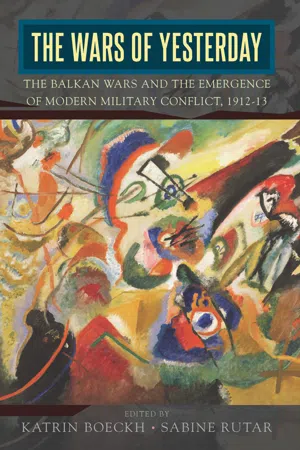
Though persistently overshadowed by the Great War in historical memory, the two Balkan conflicts of 1912–1913 were among the most consequential of the early twentieth century. By pitting the states of Greece, Bulgaria, Serbia, and Montenegro against a diminished Ottoman Empire—and subsequently against one another—they anticipated many of the horrors of twentieth-century warfare even as they produced the tense regional politics that helped spark World War I. Bringing together an international group of scholars, this volume applies the social and cultural insights of the "new military history" to revisit this critical episode with a central focus on the experiences of both combatants and civilians during wartime.
Trusted by 375,005 students
Access to over 1.5 million titles for a fair monthly price.
THE BALKAN WARS AND THE EMERGENCE OF MODERN MILITARY CONFLICT, 1912/13
An Introduction
Katrin Boeckh and Sabine Rutar
The Balkan Wars of 1912/13 and their outcomes have shaped much of the military and political thinking of the Balkan elites during the last century. At the same time, these wars were intimations of what was to become the bloodiest, most violent century in Europe’s and indeed humankind’s history. Wars often lead to other wars. Yet this process of contagion happened in a particularly gruesome manner during the twentieth century. In Europe, the Balkan Wars marked the beginning of the twentieth century’s history of warfare.
In the First Balkan War (October 1912–May 1913), Serbia, Montenegro, Greece and Bulgaria declared war on the Ottoman Empire; in the Second Balkan War (June–August 1913), Bulgaria fought Serbia, Montenegro and Greece over the Ottoman territories they had each just gained. From July onwards, Serbia, Montenegro and Greece were supported by Romania, who entered the war hoping to seize the southern Dobruja from Bulgaria. These hopes were realized. Albania, declared an independent state in November 1912, was thus a product of the First Balkan War. The borders of other territories were changed and obtained features that partially remain valid up to the present: the historical region of Macedonia, a main theatre of the wars, was divided among Greece (Aegean Macedonia), Bulgaria (Pirin Macedonia) and Serbia (Vardar Macedonia, corresponding largely to today’s Republic of Macedonia, established in 1991). The Ottoman Empire’s loss of most of its European territories in the conflict was one more warning sign of its inner weakness; it ceased to exist in the aftermath of the First World War, and was succeeded by the Republic of Turkey in 1923.
As this enumeration of territorial and political changes makes plain, the states existing today in the area can hardly offer a satisfactory framework for exploring the history of the two Balkan Wars, which in many ways exerted a more profound impact on the region than even the Great War. And yet, in Southeastern Europe, scholars addressing and researching these first European wars of the twentieth century have long adopted a traditional military and/or political history perspective, firmly rooted in the respective national master narratives of the former belligerents. Among the tasks of our volume is to challenge these master narratives.
The second war was not succeeded by much of a postwar period, for only slightly more than a year after the fighting ended, the First World War broke out. Once more, the Balkan countries engaged in war to pursue territorial claims that had remained unsatisfied. Territorial aspirations continued to be at stake in both the Second World War and, in yet another manner, the Yugoslav wars of the 1990s. As a result, the local populations in the region faced unstable living conditions, in both a social and a political sense, throughout nearly the full span of the twentieth century, interspersed with only a few decades that lacked violent conflict. All the wars caused destruction, displacement and death. State borders remained contested, and all too often the region’s political regimes ignored the rights of ethnic minorities.
These conflicts happened in the shadow of global events. Western scholars in particular have tended to interpret the two Balkan Wars of 1912/13 as a mere prelude to the Great War, a marginal event in the context of great power politics, hardly worth mentioning. Labelled ‘regional wars’, they quickly faded into the background as the echo of the shots fired in Sarajevo on 28 June 1914 rippled across the globe.1 Unsurprisingly, the attention directed to the centennials of these events followed the same pattern. Remarkably, recent histories of the origins of the First World War that do include the Balkan crises and even grant that they are worth focusing on in the narrative offer no comprehensive interpretation of the events. The Balkan peninsula, and Serbia in particular, retain the attributes that have invariably been ascribed to the region and have been used with greater frequency since the Yugoslav wars of the 1990s: the region is a powder keg, an accumulation of rogue states, a stage for melodramatic, squalid and bloody sequences.2 On the other hand, scholars in Southeastern Europe have built upon their respective national master narratives, in which the Balkan Wars are firmly rooted.
Thus, the Balkan Wars, the conflicts that intimated so many features of future wars, have yet to find their appropriate interpretative place within the European historiography of twentieth-century warfare. Christopher Clark, in his book The Sleepwalkers, has effected a remarkable integration of the diplomatic efforts of the European powers during the Balkan Wars into the immediate prehistory of the Great War. Referring to the political and psychological culture of the leading European politicians and to the question of how war entered their backroom discussions, Clark has transcended the European historiographies that have centred on the nation-state, adding to them a multilateral, comparative approach.3 And yet, among the responses he received were critical assessments, especially by scholars from Serbia, who noticed how, for example, his description of the gruesome details of the assassination of the Serbian King Aleksandar in 1903 reiterated many negative stereotypes about the Balkans.4 To be sure, the centenary in 2012/13 brought forth several noteworthy efforts to adopt comprehensive and comparative historical perspectives;5 these have given some fresh impetus to the few previous studies on the Balkan Wars.6
To achieve an open scholarly dialogue on the issues connected to the Balkan Wars of 1912/13, several of which remain quite sensitive, collaboration among historians from Southeastern Europe and Turkey as well as other countries needs to intensify. Such dialogue can transcend the boundaries of nation-state-centred historiographies and can place the wars in a genuinely European and global perspective. To foster such dialogue is one central aim of this volume. Its roots lie in the lively discussions at Yıldız Technical University İstanbul during the October 2012 centennial of the outbreak of war, generously supported by the Volkswagen Foundation (VolkswagenStiftung).7
The common methodological reference for all the authors in this volume is the field of New Military History, which, over the last two decades, has produced considerable discussion on how to study war and societies at war in a way that goes beyond the military and political spheres and aims at making war an integral part of social and cultural history.8 In this vein, going beyond the historical tropes that have long characterized the historiography of the Balkan Wars, the authors in this volume explore these wars in their sociopolitical and sociocultural contexts, placing societal, political and military actors at the centre of attention. In so doing, our book is of interest to academic fields beyond war history and military history. The core subject is social and political history, surveyed from varying angles that make for a comprehensive whole, though one that is rooted in the specific. Not least, our book is highly relevant to anyone interested in the First World War and its prehistory.
Equally importantly, the authors move beyond the national frameworks within which these wars have largely been researched; they entangle events and use microhistorical tools to examine local contexts.9 Given the traditional historiographic tropes related to the Balkan Wars, this methodological renewal can be achieved only through the collective framework offered in this volume, which overcomes the nationally organized settings of the writing of war history.
The volume is divided into four parts. Following Wolfgang Höpken’s vigorous demonstration of how the Balkan Wars should be placed within the broader framework of the European history of wars in the twentieth century, in Part II, Alma Hannig, Gül Tokay and Michael Hesselholt Clemmesen set the frame of diplomacy, international relations and domestic politics in the face of war breaking out on the Southeastern European periphery. They apply the tools of new diplomatic and geopolitical history to explore sources pertaining to Austria-Hungary, the Ottoman Empire and the periphery ‘at the other end’, the Nordic countries.
Part III focuses on the social history of military life, of the ‘Armies, Soldiers, Irregulars’. Mehmet Beşikçi discusses Ottoman recruitment practices and pays particular attention to the lessons the Empire learned from failures in the Balkan Wars, which were applied in the subsequent world war. Richard Hall gives a vivid account of one of the central battlefields of the First Balkan War, the Thracian war theatre, in today’s Bulgaria, Greece and Turkey. Spyridon Tsoutsoumpis provides in-depth insights into how Greek soldiers experienced war and violence. Claudiu-Lucian Topor focuses on the hubris with which the victorious Romanian army exited the Second Balkan War, which led to its all-too-confident conduct in the First World War, with catastrophic consequences. Alexey Timofeev recapitulates the traditions of Serbian guerrilla warfare and investigates how these practices were effectively used during the Balkan Wars.
In the fourth part, the authors turn to civilian lives during wartime (‘Civilians, Wounded, Invalids’). Sabine Rutar assesses the increased fear of rank-and-file soldiers-to-be in the multinational Austrian port city of Trieste in the face of war breaking out in the city’s ‘backyard’. Hers is a vivid microhistorical example of the final phase of what would soon become Stefan Zweig’s ‘world of yesterday’, a milieu ridden by feelings of existential threat and difficult loyalties.10 Vera Goseva and Natasha Kotlar-Trajkova trace the sufferings of the Muslim population in Salonica and its hinterland; and Iakovos Michailidis examines the effects of forced population transfers and displacement on the local population in one of the key disputed areas of the wars, Macedonia. Eyal Ginio considers Jewish philanthropy and assistance, focusing on aspects of loyalty to both Ottomanism and communal identities. Oya Dağlar Macar discusses the support provided by the British Red Cross to the Ottoman Empire. Heike Karge concludes the volume with a pioneering study on war neuroses suffered by participants in the Balkan Wars.
Recently, Raymond Detrez maintained that the ‘feeling of commonality and solidarity it [the Orthodox Christian or Romaic community] created was irreparably damaged during the Second Balkan War; what has remained of it is a masked unanimity vis-à-vis the real or imagined threat of Islam’.11 Nation-centred historiographies have contributed to such divisiveness by continuously re-digging the imaginary trenches between the belligerents after the fact. Thus, a major task of the authors in the present volume has been to engage with the military and civilian agency of all belligerents and make visible their parallel experiences: conscripted soldiers and their commanders as well as irregular fighters on the one hand; and on the other the civilian population, which was involved in the war to an extent previously unacknowledged. Violence in the form of mass expulsions and atrocities, as well as the demonization of the ‘other’, are among the miseries the war brought to civilians living in the contested regions. Methodologically, Reinhart Koselleck’s ‘spaces of experience’ and ‘horizons of expectation’ have paved the way for the collective exploring of such commonalities in this volume.12
So what makes these wars the Balkan Wars? And what makes them an integral part of the history of twentieth-century warfare in Europe? The authors look at a complex set of features to establish answers to these questions, such as the military procedures, the military technology, the equipment of the armies and of their irregular allies, the efforts of territorial ethnic homogenization, and the abounding propaganda intended to legitimize territo...
Table of contents
Cover
Title Page
Copyright Page
Contents
List of Tables
Acknowledgements
Part I. Introductions
Part II. Beyond the Balkans: Diplomatic and Geopolitical Aspects
Part III. Armies, Soldiers, Irregulars
Part IV. Civilians, Wounded, Invalids
Index
Frequently asked questions
Yes, you can cancel anytime from the Subscription tab in your account settings on the Perlego website. Your subscription will stay active until the end of your current billing period. Learn how to cancel your subscription
No, books cannot be downloaded as external files, such as PDFs, for use outside of Perlego. However, you can download books within the Perlego app for offline reading on mobile or tablet. Learn how to download books offline
Perlego offers two plans: Essential and Complete
Essential is ideal for learners and professionals who enjoy exploring a wide range of subjects. Access the Essential Library with 800,000+ trusted titles and best-sellers across business, personal growth, and the humanities. Includes unlimited reading time and Standard Read Aloud voice.
Complete: Perfect for advanced learners and researchers needing full, unrestricted access. Unlock 1.5M+ books across hundreds of subjects, including academic and specialized titles. The Complete Plan also includes advanced features like Premium Read Aloud and Research Assistant.
Both plans are available with monthly, semester, or annual billing cycles.
We are an online textbook subscription service, where you can get access to an entire online library for less than the price of a single book per month. With over 1.5 million books across 990+ topics, we’ve got you covered! Learn about our mission
Look out for the read-aloud symbol on your next book to see if you can listen to it. The read-aloud tool reads text aloud for you, highlighting the text as it is being read. You can pause it, speed it up and slow it down. Learn more about Read Aloud
Yes! You can use the Perlego app on both iOS and Android devices to read anytime, anywhere — even offline. Perfect for commutes or when you’re on the go. Please note we cannot support devices running on iOS 13 and Android 7 or earlier. Learn more about using the app
Yes, you can access The Wars of Yesterday by Katrin Boeckh, Sabine Rutar, Katrin Boeckh,Sabine Rutar in PDF and/or ePUB format, as well as other popular books in History & 20th Century History. We have over 1.5 million books available in our catalogue for you to explore.