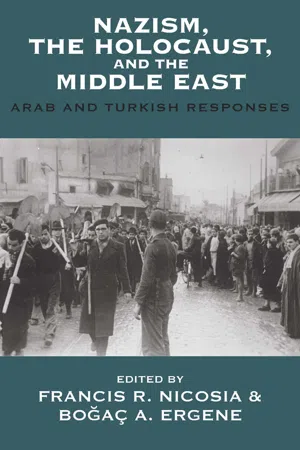
Given their geographical separation from Europe, ethno-religious and cultural diversity, and subordinate status within the Nazi racial hierarchy, Middle Eastern societies were both hospitable as well as hostile to National Socialist ideology during the 1930s and 1940s. By focusing on Arab and Turkish reactions to German anti-Semitism and the persecution and mass-murder of European Jews during this period, this expansive collection surveys the institutional and popular reception of Nazism in the Middle East and North Africa. It provides nuanced and scholarly yet accessible case studies of the ways in which nationalism, Islam, anti-Semitism, and colonialism intertwined, all while sensitive to the region's political, cultural, and religious complexities.
eBook - ePub
Nazism, the Holocaust, and the Middle East
Arab and Turkish Responses
- 320 pages
- English
- ePUB (mobile friendly)
- Available on iOS & Android
eBook - ePub
Nazism, the Holocaust, and the Middle East
Arab and Turkish Responses
About this book
Trusted by 375,005 students
Access to over 1.5 million titles for a fair monthly price.
Study more efficiently using our study tools.
Information
Chapter 1
ARAB REACTIONS TO NAZISM AND THE HOLOCAUST
Scholarship and the “War of Narratives”

Gilbert Achcar
IN STUDYING THE VAST RANGE of attitudes and responses toward Nazism and the genocide of European Jews that the Nazis orchestrated and perpetrated—the unspeakable tragedy that has become common, albeit disputable and arguably unfortunate, to designate as the Holocaust1—there is hardly a topic fraught with as much tension and passion and charged with as much topicality as that of the attitudes displayed in the Arab Middle East or by individuals originating from there. This issue continues to generate a lot of heated discussion—more so even than, say, French or Polish reactions to Nazism and the Holocaust. This is despite the fact that France and Poland were countries directly involved in the perpetration of the Holocaust, whereas none of the Arab or other populations of the Middle East were involved in it.
The main reason for this paradox, surely, is to be found in the Arab-Zionist/Arab-Israeli conflict. We know from common experience that the simple association of the words “Arabs” with “Nazism” or “Holocaust” brings immediately to mind this century-old conflict, which has persisted to this day and continues to generate violence. As for why the association of the aforementioned words brings that conflict to mind, it is, of course, because Israel itself is, largely, a consequence of the culmination of European anti-Semitism in Nazism and the Holocaust. It is indeed a state that was brought into being by the settler migration endeavor that lies at the heart of the Zionist project. The latter originated in a Jewish reaction to anti-Semitism and was therefore decisively propelled by the advent of Nazism as the most acute and extreme form of anti-Semitism, going far beyond anything the founders of the Zionist movement might have imagined in their worst nightmares.
From the time of the United Nations debates that preceded the creation of the state of Israel in 1948 until our time, the various advocates of Zionism have consistently referred to the Holocaust as a crucial legitimizing argument. Invoking the Nazi genocide of the Jews has indeed been Zionism’s principal answer to the Arab accusation that it has committed territorial usurpation and ethnic cleansing toward the Palestinians. One striking aspect of this confrontation between narratives is that the terms by which each side designates what it sees as its defining tragedy—the Hebrew term Shoah for the Holocaust, and the Arabic term Nakba for the Zionist takeover of most of Palestine, emptied of most of its original inhabitants—both mean “catastrophe.” A major argument on the Zionist side has always been that the alternative to what the Palestinians designate as the Nakba would have been a continuation of the Holocaust in Palestine.2
Thus, the war of narratives has indeed been a crucial dimension of the Arab-Israeli conflict since 1948. Although one can find a symbolic confrontation of this kind in every conflict, with each side needing a suitable narrative for the mobilization of its partisans, nowhere to my knowledge did the war of narratives acquire an importance such as the one in the Arab-Israeli conflict, and nowhere does it fulfill a function such as the one in that conflict. This is because war-related narratives in the Arab-Israeli conflict serve much more than the internal function of ensuring each side’s mobilization, cohesion, and determination. They serve also— as crucially, if not more so—an external function in the mobilization of support from abroad, beyond the sphere of those who are directly involved in the conflict. The Arab-Israeli war of narratives is indeed one that is fought largely overseas, on the battlefield of global public opinion and, principally, Western public opinion. The latter has been the most important historically because, on the one hand, of the European origin of Zionism, the location of the Holocaust in Europe, and Europe’s proximity to the Middle East and, on the other hand, of the multifarious connections of the United States with Israel and the Middle East during the Cold War and after.
The primary reason for the particular importance of the war of narratives in the Arab-Israeli conflict is, however, not a matter of historical, ethnic, or cultural ties. It is rather rooted in the constitutive physical—territorial, demographic, and military—asymmetry between the Zionist/Israeli side and the Arab side. The Zionist project is itself originally predicated on a war of narratives within Jewish communities, with Zionism as an ideological current competing with other views, whether liberal assimilationist or Marxist internationalist. Since its crux consisted of a project of mass resettlement on a territory under foreign control, Zionism needed and sought, from its foundation, a sponsor among contemporary imperial powers, especially powers actually or potentially in charge of Palestine. It thus sought the green light of the Ottoman Empire before World War I and most crucially, during the war and thereafter, of the United Kingdom, which coveted Palestine and ended up controlling it under a League of Nations colonial mandate. Before that, in November 1917, London had expressed official support for the Zionist project in the Balfour Declaration, the letter sent by Foreign Secretary Arthur James Balfour to Baron Walter Rothschild declaring that the British government viewed with favor the establishment of a Jewish National Home in Palestine.
After World War II, the Zionist movement needed the support of the victorious powers and the newly created United Nations for the partition of Palestine and the creation there of an independent Jewish state. During the first Arab-Israeli war, support in weapons from the Soviet Bloc proved crucial for the Zionist side.3 After it came into being, the state of Israel sided with the West in the Cold War, relying on Western support: French, British, West German, and, most decisively since the mid-1960s, American. A small state by territorial and demographic criteria compared to its Arab geopolitical environment, which Israel was officially at war with during the first decades of its existence and was replaced later on by the emergence of the Islamic Republic of Iran as its main enemy, the Zionist state is inherently based on a continuous structural dependence on foreign support. This support is indeed crucial in order to ensure the military preponderance with which Israel compensates for its relatively small size. Hence, the importance for Israel of winning Western hearts and minds: not those of Western rulers alone but the hearts and minds of the general public as well, since Western states are electoral democracies in which public opinion weighs on governmental policy, including foreign policy.
For their part, the Palestinians and Arabs in general were faced with Israeli military superiority as early as 1948. Defeated and scattered, the Palestinians relied on Arab nationalism, especially Nasser’s Egypt since the mid-1950s, while Arab nationalism relied in turn on the Soviet Bloc for its armament in the face of Western support for Israel. There was little need for narrative-building efforts in order to convince the Palestinians, or the Arabs in general, of the rightfulness of the Palestinian cause. The creation of the state of Israel and the Arab defeat in the 1948 Arab-Israeli War have consistently been construed as a climax of the Western colonial enterprise and perceived as a national trauma in all Arab countries. It did not take the Palestinians and other Arabs nearly as much ideological effort to reflect as “imagined communities” as it took the global “Jewish nation” postulated by Zionism. During the heyday of Arab left-wing nationalism, the Arab narrative abroad was mainly deployed toward communist states and movements, and therefore developed mostly anti-colonial and anti-imperialist themes.
After the defeat of the two strongholds of Arab left-wing nationalism, Egypt and Syria, in the Six-Day War of June 1967, at a time when it had become clear that Israel had acquired the nuclear bomb, the perspective of a “liberation of Palestine” by military means began to fade. This led liberal and left Palestinian and Arab intellectuals—of whom the most prominent was undoubtedly Edward Said—and, later on, the Palestine Liberation Organization (PLO)—in which such intellectuals came to play an important role—to the conviction that the Palestinians and the Arab side in general needed to devote much greater attention and effort to the ideological battle to win over a significant portion of Western public opinion and even Jewish-Israeli public opinion. This was seen as indispensable in order to pressure Israel into a compromise that would be acceptable for the Palestinians and hence for the Arabs. From the 1970s onward, this perspective was increasingly challenged by the rise of Islamic fundamentalism, which developed its own religious Weltanschauung and had little consideration for non-Muslim public opinion. Its rise was mirrored on the opposite side, in Israel itself, by the rise of Jewish fundamentalism and neo-Zionism, which showed increasing contempt for non-Jewish public opinion.4
A fierce “competition of victims” characterizes the Arab-Israeli conflict,5 with the Holocaust/Shoah invoked by one side and the Nakba by the other, and both sides projecting themselves as victims of continuous oppression. This claim is hardly disputable in the case of the Palestinians, who suffer as second-class citizens in Israel, as a population under direct or indirect occupation in the West Bank and Gaza and as refugees elsewhere, prevented from returning to the land from which they or their forebears were uprooted. The Zionist counterclaim maintains that Israel and the Jews are the target of Nazi-like hatred and genocidal schemes from the Palestinians, the Arabs, and Iran, if not Muslims at large. This counterclaim emphasizes the rise of a “new anti-Semitism,” a category that tends to lump together all brands of unfriendly critique of Israel, and for some of its most rabid users, even friendly critiques.6
In such a minefield topic as the Arab-Israeli conflict, no one can expect a discussion of Arab reactions to Nazism and the Holocaust to be a serene historical and factual examination, especially if persons holding contrasting views on the conflict itself are in some way involved. In the exploration of a topic in which two human tragedies are mingling—a gigantic one, fortunately terminated in 1945, and another one of obviously lesser scope but whose tragic consequences, such as people living in refugee camps and/or under protracted military occupation, are still with us seventy years after 1948—the traditional requisites of scholarship merge necessarily with politics and the question of ethics. To borrow Max Weber’s words, “axiological neutrality” in the discussion of the topic under consideration may be of the realm of the impossible, with the pretense of neutrality in presenting the facts being itself immediately suspected of partisanship in disguise. I would rather contend that, far from an impossible and illusory “axiological neutrality,” discussion of our topic requires a firm commitment to higher ethical values—humanistic values, that is—combined with an effort at reaching the scientific standard by way of introspection.
I will start with the last requirement—namely, reaching the scientific standard by way of introspection. This defines a key condition of sound scholarship. Self-critical awareness has been described by the French sociologist Pierre Bourdieu as a key requisite of what he called “scientificity” in social sciences.7 Researchers must practice self-analytical investigation in order to identify all possible sources of bias in their social and personal condition, in the same way that those who train to become psychoanalysts must undergo a personal analysis before practicing. In other words, if I am to pretend to scholarship on an issue like the one under discussion, I must first be fully aware of the biases that can result from my ethnic and social belonging, as well as from my upbringing and political views. This awareness aims at separating oneself from the partisan attitude of the activist engaged in political struggle, and strives to neutralize as much as possible one’s political stance in considering facts. It is intimately connected to intellectual honesty in not concealing any facts that might compromise one’s political stance while highlighting only those that serve it.
No one can be requested to abandon her or his political views for the sake of becoming a scholar. However, anyone pretending to be a scholar and to write a work of scholarship should be able to exercise political restraint in her or his scholarly practice. This relates directly to the crucial ethical imperative of departing from every form of self-centrism, be it egocentrism or ethnocentrism. An excellent statement of this ethical imperative is the famous precept from the Gospel of Matthew: “And why do you behold the mote that is in your brother’s eye, but do not consider the beam that is in your own eye?” In other words, let us be aware of the wrongs of the side to which we belong or with which we identify, or even merely sympathize, before exploring the wrongs of the opposite side. Let us always ask ourselves whether our own side is not guilty in one way or another of what we blame the other side for.
These are the very rules that I did my best to follow and urged my readers to follow in my work The Arabs and the Holocaust: The Arab-Israeli War of Narratives, which is why I used the above-quoted precept as epigraph to the book. Let me then conform with this same precept here again and start this exploration of the pitfalls of scholarship about our topic with a critical exploration of the problems that mar the narrative of the Arab side, the side to which I belong ethnically and culturally.
The major pitfall is, of course, ethnocentrism, which is indeed a universal disease; altruistic humanism and internationalism are indeed very admirable stances precisely because they are so rare. Ethnocentrism manifests itself most perniciously in the “competition of the victims,” when one has eyes only for the tragedy of one’s own people and fails to see the tragedy of others or acknowledge its importance. Let me illustrate this with an anecdote from a recent experience: I was participating in an international meeting on peace convened by a major trade union confederation in Istanbul with a high proportion of Kurds present among the participants. There, a Palestinian speaker blamed the audience for not paying enough attention to the Palestinian cause. This person did not realize that Kurds could blame the Palestinians much more for not supporting the Kurdish cause, especially against Arab oppression in countries like yesterday’s Iraq or today’s Syria. In fact, there has been much more Kurdish support for the Palestinian cause over decades than Palestinian support—or for that matter, Arab support in general—for the Kurdish cause. Likewise, ethnocentrism is striking in the attitude of those Arabs who denounce vehemently anti-Arab racism among Israelis or in Western countries while ignoring or, much worse still, denying the existence of anti-Kurdish or anti-Black racism among Arabs.
Another manifestation of the same ethnocentrism, a manifestation that is directly relevant to our topic, is the denial of the existence of anti-Semitism among Arabs. The phony argument that...
Table of contents
- Cover
- Title Page
- Copyright Page
- Contents
- List of Illustrations
- Preface
- Abbreviations
- Introduction: Responses to Nazism and the Holocaust in the Middle East and North Africa
- 1. Arab Reactions to Nazism and the Holocaust: Scholarship and the “War of Narratives”
- 2. Turkish Responses to the Holocaust: Ankara’s Policy toward the Jews, 1933–1945
- 3. Demon and Infidel: Egyptian Intellectuals Confronting Hitler and Nazism during World War II
- 4. The Persecution of the Jews in Germany in Egyptian and Palestinian Public Discourses, 1933–1939
- 5. Defining the Nation: Discussing Nazi Ideology in Syria and Lebanon during the 1930s
- 6. Mosul as Paradise: Nazis, Angels, Jewish Soldiers, and the Jewish Community in Northern Iraq, 1941–1943
- 7. Philo-Sephardism, Anti-Semitism, and Arab Nationalism: Muslims and Jews in the Spanish Protectorate of Morocco during the Third Reich
- Appendixes
- Index
Frequently asked questions
Yes, you can cancel anytime from the Subscription tab in your account settings on the Perlego website. Your subscription will stay active until the end of your current billing period. Learn how to cancel your subscription
No, books cannot be downloaded as external files, such as PDFs, for use outside of Perlego. However, you can download books within the Perlego app for offline reading on mobile or tablet. Learn how to download books offline
Perlego offers two plans: Essential and Complete
- Essential is ideal for learners and professionals who enjoy exploring a wide range of subjects. Access the Essential Library with 800,000+ trusted titles and best-sellers across business, personal growth, and the humanities. Includes unlimited reading time and Standard Read Aloud voice.
- Complete: Perfect for advanced learners and researchers needing full, unrestricted access. Unlock 1.5M+ books across hundreds of subjects, including academic and specialized titles. The Complete Plan also includes advanced features like Premium Read Aloud and Research Assistant.
We are an online textbook subscription service, where you can get access to an entire online library for less than the price of a single book per month. With over 1.5 million books across 990+ topics, we’ve got you covered! Learn about our mission
Look out for the read-aloud symbol on your next book to see if you can listen to it. The read-aloud tool reads text aloud for you, highlighting the text as it is being read. You can pause it, speed it up and slow it down. Learn more about Read Aloud
Yes! You can use the Perlego app on both iOS and Android devices to read anytime, anywhere — even offline. Perfect for commutes or when you’re on the go.
Please note we cannot support devices running on iOS 13 and Android 7 or earlier. Learn more about using the app
Please note we cannot support devices running on iOS 13 and Android 7 or earlier. Learn more about using the app
Yes, you can access Nazism, the Holocaust, and the Middle East by Francis R. Nicosia, Boğaç A. Ergene, Francis R. Nicosia,Boğaç A. Ergene, Francis R. Nicosia, Bogaç A. Ergene in PDF and/or ePUB format, as well as other popular books in History & Holocaust History. We have over 1.5 million books available in our catalogue for you to explore.