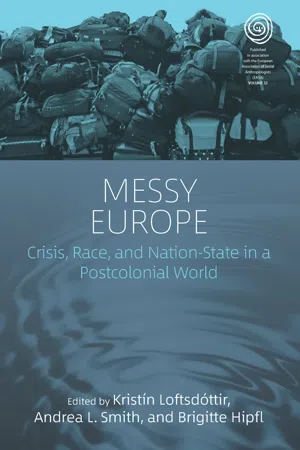
Using the economic crisis as a starting point, Messy Europe offers a critical new look at the issues of race, gender, and national understandings of self and other in contemporary Europe. It highlights and challenges historical associations of Europe with whiteness and modern civilization, and asks how these associations are re-envisioned, re-inscribed, or contested in an era characterized by crises of different kinds. This important collection provides a nuanced exploration of how racialized identities in various European regions are played out in the crisis context, and asks what work "crisis talk" does, considering how it motivates public feelings and shapes bodies, boundaries and communities.
eBook - ePub
Messy Europe
Crisis, Race, and Nation-State in a Postcolonial World
- 248 pages
- English
- ePUB (mobile friendly)
- Available on iOS & Android
eBook - ePub
Messy Europe
Crisis, Race, and Nation-State in a Postcolonial World
About this book
Trusted by 375,005 students
Access to over 1.5 million titles for a fair monthly price.
Study more efficiently using our study tools.
Information
1
Wise Viking Daughters
Equality and Whiteness in Economic Crisis
Kristín Loftsdóttir and Helga Björnsdóttir
Introduction
In 2011, three years after Iceland underwent massive economic meltdown, the Guardian published an article about Iceland under a headline asking, “Is Iceland the best country for women?” Not long before, Newsweek magazine had declared Iceland to be the “best place” in the world for women (Cochrane 2011). Iceland was the first European country to experience a severe economic crash in October 2008. The country was technically bankrupt, and the copious international media discussions of Iceland’s “fall” induced a widespread sense of humiliation (Chartier 2010) and consequently an urgent desire to repair the country’s reputation (Loftsdóttir 2014a). This feeling of humiliation engaged with historical anxieties revolving around Iceland’s past position as a colony, pushing Icelandic intellectuals to stress Iceland’s belonging as fully European (Loftsdóttir 2012).
In this chapter, we show that at times when national identity has suffered a serious blow, proclamations of “gender equality” can be an important means of re-establishing a respected European subject position. In Iceland, as we point out, reified notions of gender became one part of the nation’s re-establishment as a fully legitimate European nation. Furthermore, gender ideologies engaged with the plight of “other” women in the “post-conflict” or “developing” world have underscored Iceland’s belonging in modern Europe for the past decade. The sense of being European has to be understood as enmeshed with colonialism’s “imperial ruins,” to use Stoler’s (2013: x) terminology, where we seek to capture the “deeply saturated, less spectacular forms in which colonialism leaves it marks.” At the same time, the sense of being in “crisis” evokes the past and visions of the future by producing particular affects and spaces of engagement (Loftsdóttir 2014a: 13; see also introduction). However, this past is never passively brought into the present; rather, it selectively serves the needs of the present (Popular Memory Group 1982).
Our discussion draws attention to the reification of gender at times of crisis while also highlighting the interplay of gender and racialization. The above-mentioned Guardian article that refers to Iceland as the “best country in the world for women” can be located among persistent notions of the Nordic as marked strongly by gender equality (Holli, Magnusson, and Rönnblom 2005; Holter 2003; Holter, Svare, and Engeland 2009; Gullestad 2002) and also intersects with wider conceptions of the Nordic countries as exempt from imperialistic and colonial history (Loftsdóttir and Jensen 2012; Keskinen et al. 2009). This positioning of the Nordic as existing outside colonial history remains salient even though some Nordic countries, such as Denmark and Sweden, have been empires at particular times in history (Naum and Nordin 2013), and all the Nordic countries have in one way or another engaged with colonialism and the racism that was part of colonial and imperial thinking (Loftsdóttir 2013). The relatively recent research situating the Nordic countries within wider networks of colonial power and racism (see Gullestad 2002; Keskinen et al. 2009; Loftsdóttir 2013; McIntosh 2015), it firmly seeks to draw attention to Nordic subjects as part of a world that continues to be deeply racialized. Such a focus emphasizes Nordic identities as shaped by transnational processes that are embedded in the colonial encounter, while trying to understand how these links with the past are reanimated or contested in the present.
Our discussion also intersects with another discursive realm, one in which racism has been curiously absent. Globalized discourses of international development often seem to forget that the Enlightenment’s goals of modernization were embedded in violent colonial encounters between people from different parts of the world (Escobar 2007). This means that the “ruins” of colonialism (Stoler 2008) and the persistence of racism are seldom addressed in relation to international development (Goudge 2003). Development discourses are a part of the creation of subjects—and not only those targeted for assistance—and actively shape notions of what it means to be a European and Western subject (Escobar 1995; Ferguson 2006). Care by white European “strangers” often factors heavily into the popularization of the “suffering” of others that features so predominantly in the current media-saturated world (Bornstein and Redfield 2010: 3–4), suffering that is generally constructed as existing outside history or contemporary politics (Ferguson 2006). Whereas feminists have noted that humanitarian discourses on women in war-torn countries are often used to conceal Western countries’ brutal pursuit of their own political and economic interests (Moran 2010; Otto 2006), our discussion emphasizes that these discourses also contribute to creating a particular kind of subject “back home.” Racialization thus plays a part in a global construction of a particular people, for the most part socially categorized as “white,” as having a role in “helping” others, without concomitant acknowledgment of the entangled histories of colonialism and racism.
Socially categorized as white, Icelandic anthropologists working in the West, we are aware of our part in this global imaginary and classification of peoples and places through history, and therefore of the need to take a critical stance toward our own history, culture, and society. That is what we have attempted to do in our research on Icelandic society, of which this chapter is a part. Besides deconstructing the rigid construction of home and field that historically attached higher value to fieldwork in remote places (Gupta and Ferguson 1997), anthropologists have also critically engaged with the term “native” anthropologists, pointing out its consequential intersections with other cultural identifications like race, gender and class (Narayan 1993). While we recognize these important contributions, we also stress, as others have, that anthropology “at home” can be part of “decolonizing anthropology” (Jacobs-Huey 2002), which works to dislodge cultural difference as a key principle in the ethnographic project (Bunzl 2004: 439, 440). In line with the need to further decolonize the discipline and the recognition that “whiteness” often gains it power by its invisibility (Hartigan 1997), we find it important, as “white” anthropologists, to take a stand by deconstructing the way ideas of whiteness in Iceland engage with larger racial geographies. In the Icelandic context, the intersection of whiteness and gender becomes particularly salient in constructing the Icelandic body, perceived in its wider construction as a Nordic body. The data directly referred to here come from media analysis and form a part of a larger research project based on ethnographic fieldwork, participant observation, and interviews with immigrants and workers in the Icelandic financial and banking sector. For native anthropologists such as ourselves, the boundaries between participant observation and the everyday life that we share with those who are the focus of our research can be blurred and complicated. We also base our analysis on our previous anthropological research. Helga Björnsdóttir has studied ideas of masculinity and militarization in relation to peacekeeping in Iceland, and Kristín Loftsdóttir has done work on the historical formation of race and national identity in Iceland.
We start by focusing on Iceland’s historical contextualization of gender and its strong desire for recognition as a civilized, sovereign country in the early twentieth century. The discussion then relates this past deeply embedded in postcolonial anxieties to current interpretations of Iceland’s position within a globalized world, and to essentialized notions of Icelandic women that arose after the crash. The last section of the chapter explains how concern about gender equality became a way to rehabilitate Iceland as an important European player and thus preserved Iceland’s status as a “white,” privileged European country.
Historical Ideas of Gender and National Identity in Iceland
Iceland’s position as a Danish colony was instrumental in shaping Icelandic national identity and the country’s relationship with the outside world. The nationalistic movement, claiming independence from Denmark, emphasized Iceland’s medieval literature and language as signifying factors in the nation’s distinct identity (Sigurðsson 1996: 42) and considered the commonwealth period—more than a thousand years ago—to be Iceland’s golden age. After that, the story goes, Iceland’s subjection to Norwegian rule in 1262 and then Danish rule in 1380 led the country into a long period of decay (Hálfdánarson 2000). Inspired by romantic notions of Iceland’s past, Icelandic men of the upper classes saw themselves as leading Iceland’s transformation from one of Europe’s poorest countries into a state of modernity, and thus rehabilitating the country’s reputation (Matthíasdóttir 2004; Rastrick 2013). As is the case in nationalistic imaginings, Icelandic women were perceived as representing the country’s timeless traditions (Matthíasdóttir 2004; see also Björnsdóttir 1997).
European travel writing about Iceland historically described Iceland as wild and semi-savage, a depiction that has raised vehement objections from Icelandic intellectuals through the ages (Durrenberger and Pálsson 1989). This early stereotype clearly shows the importance of seeing whiteness as a historically and socially constituted and unstable category. These images must have been a particularly unfortunate association when Iceland was seeking recognition as an independent state fully compatible with other European states. As Pandey (2013) demonstrates, colonization rests on a racialized division of bodies, some seen as capable of modernizing and some not. The colonized were represented as incapable of “moving forward” on the path to modernization. Loftsdóttir (2012) has shown how the reproduction of racist European imaginings in Icelandic texts in the late nineteenth and early twentieth centuries located Icelanders more firmly within the category of “civilized,” even as it reflected Icelanders’ anxieties about not being recognized by other Europeans or Westerners as belonging with them. The reproduction of stories of male explorers in Icelandic texts during this period, for example, allowed Icelandic intellectuals to imagine themselves as part of a progressive, civilized Europe, and furthermore to visualize the colonized parts of the world as spaces where masculinity and European-ness were enacted and reified. Even though these Icelandic writers did not themselves participate in these conquests, they could still place Icelanders within this collective “us” of a progressive Europe (see Loftsdóttir 2009). Some Icelandic schoolbooks directly identify Icelanders as part of the “white” race in the early twentieth century, but many also reflect Icelandic intellectuals’ vision of themselves as intrinsically different from other Nordic people, in line with intense national sentiments at the time. Despite the shared origins, Icelandic character was seen as having been shaped over centuries by a “harsh mother,” and the land and climate themselves as giving Icelanders their uniquely characteristic independence, endurance, and “roughness” (Loftsdóttir 2012). Icelanders’ ability to position themselves within a particular racial category—white—and its increased reification in the late nineteenth and early twentieth century, bolstered by claims to a unique character, were necessarily important in strengthening claims to belong in the category of civilized European masculinity.
The Economic Boom in Iceland
The economic boom years in Iceland started gradually in the mid 1990s, expanded in scope and pace in the 2000s,1 and consequently ended abruptly in 2008. Icelandic banks were privatized and capital flows liberalized in a series of neoliberal reforms (Sigurjónsson and Mixa 2011), leading to a large influx of foreign capital and extensive public spending. The Icelandic government ignored foreign experts’ warnings about the considerable expansion of the Icelandic banking system as the media and politicians alike celebrated bankers and businessmen as national heroes (Loftsdóttir 2015; Einarsdóttir 2010). Both the new privatized banks and the older, state-owned conservative banks took enormous risks with their investments (Mixa 2015). All the while, propaganda drives touted Iceland as a “neoliberal success story” and potentially a new financial capital (Johnson, Einarsdóttir, and Pétursdóttir 2013: 183). Furthermore, the economic boom period was a time of reckoning with Iceland’s past as a Danish colony, and popular discourse, the media, and Icelandic politicians discussed Iceland as finally becoming an important player on the global stage (Loftsdóttir 2013; Björnsdóttir 2011). Such social discourse, focused primarily on the international success of Icelandic businessmen, also filtered into other spheres of Icelandic society, emphasizing Icelanders’ unique contribution to global arts and literature (Grétarsdóttir, Ásmundsson, and Lárusson 2014) and the foreign policy arena (Björnsdóttir 2011; Loftsdóttir and Björnsdóttir 2014).
Although articulated differently in the new global environment, such discourses insistently upheld Iceland’s status as a nation equal to other leading Western countries. Yet this mentality of the boom years was entangled with older historical anxieties centered on Iceland’s position as a dependency of Denmark and the need to align Iceland firmly with other powerful European countries (Loftsdóttir 2012). In addition, these discourses relied on notions of Icelanders as somehow different from inhabitants of other countries due to their settlement heritage and the roughness of the Icelandic landscape. Moreover, much like discourses produced during Iceland’s fight for independence in the late nineteenth and early twentieth centuries, boom-era discourses emphasized the masculine virility of men “going out” and conquering the world (Loftsdóttir 2012).
The economic boom stimulated rapid immigration to Iceland. This became particularly important once access to expanding Icelandic labor markets was facilitated by Iceland’s joining the Schengen Area in 2001 (Skaptadóttir 2011). The presence of increasing numbers of immigrants from more and more distant locales stimulated Icelandic discussions on multiculturalism in Iceland that drew from and engaged with wider European discourses on the “problems” and challenges of multiculturalism (Skaptadóttir and Loftsdóttir 2009). Migrants were often referred to as a “workforce” (Icelandic: vinnuafl) rather than as people, and their contributions to Icelandic society were still not connected to the wider ongoing discussions in Iceland that celebrated Icelandic economic prosperity. Rice (2007: 430...
Table of contents
- Cover
- Title Page
- Copyright Page
- Contents
- List of Illustrations
- Introduction
- 1. Wise Viking Daughters: Equality and Whiteness in Economic Crisis
- 2. “Latvians do not understand the Greek people”: Europeanness and Complicit Becoming in the Midst of Financial Crisis
- 3. Fairness and Entitlement in Neoliberal England, 2005–2015
- 4. Debating Refugee Deservingness in Post-Celtic Tiger Ireland
- 5. What Is a Life? On Poverty and Race in Humanitarian Italy
- 6. Policing Crisis in Austrian Crime Fiction
- 7. Crisis France: Covert Racialization and the Gens du Voyage
- 8. Navigating the Mediterranean Refugee “Crisis”: Alter-Globalization Activism and the Sediments of History on Lampedusa
- 9. Epilogue: Declining Europe
- Index
Frequently asked questions
Yes, you can cancel anytime from the Subscription tab in your account settings on the Perlego website. Your subscription will stay active until the end of your current billing period. Learn how to cancel your subscription
No, books cannot be downloaded as external files, such as PDFs, for use outside of Perlego. However, you can download books within the Perlego app for offline reading on mobile or tablet. Learn how to download books offline
Perlego offers two plans: Essential and Complete
- Essential is ideal for learners and professionals who enjoy exploring a wide range of subjects. Access the Essential Library with 800,000+ trusted titles and best-sellers across business, personal growth, and the humanities. Includes unlimited reading time and Standard Read Aloud voice.
- Complete: Perfect for advanced learners and researchers needing full, unrestricted access. Unlock 1.5M+ books across hundreds of subjects, including academic and specialized titles. The Complete Plan also includes advanced features like Premium Read Aloud and Research Assistant.
We are an online textbook subscription service, where you can get access to an entire online library for less than the price of a single book per month. With over 1.5 million books across 990+ topics, we’ve got you covered! Learn about our mission
Look out for the read-aloud symbol on your next book to see if you can listen to it. The read-aloud tool reads text aloud for you, highlighting the text as it is being read. You can pause it, speed it up and slow it down. Learn more about Read Aloud
Yes! You can use the Perlego app on both iOS and Android devices to read anytime, anywhere — even offline. Perfect for commutes or when you’re on the go.
Please note we cannot support devices running on iOS 13 and Android 7 or earlier. Learn more about using the app
Please note we cannot support devices running on iOS 13 and Android 7 or earlier. Learn more about using the app
Yes, you can access Messy Europe by Kristín Loftsdóttir, Andrea L. Smith, Brigitte Hipfl, Kristín Loftsdóttir,Andrea L. Smith,Brigitte Hipfl in PDF and/or ePUB format, as well as other popular books in Social Sciences & Politics. We have over 1.5 million books available in our catalogue for you to explore.