How does an urban community come to terms with the loss of its future? The former socialist model city of Hoyerswerda is an extreme case of a declining postindustrial city. Built to serve the GDR coal industry, it lost over half its population to outmigration after German reunification and the coal industry crisis, leading to the large-scale deconstruction of its cityscape. This book tells the story of its inhabitants, now forced to reconsider their futures. Building on recent theoretical work, it advances a new anthropological approach to time, allowing us to investigate the postindustrial era and the futures it has supposedly lost.
eBook - ePub
Back to the Postindustrial Future
An Ethnography of Germany's Fastest-Shrinking City
- 216 pages
- English
- ePUB (mobile friendly)
- Available on iOS & Android
eBook - ePub
About this book
Trusted by 375,005 students
Access to over 1.5 million titles for a fair monthly price.
Study more efficiently using our study tools.
Information
1
‘There Can Only Be One Narrative’
Postsocialism, Shrinkage and the Politics of Context in Hoyerswerda
I, as a political person, can change my politics
by … shifting my spatiotemporal horizon.
by … shifting my spatiotemporal horizon.
—David Harvey, Spaces of Hope
Demographic knowledge is powerful, particularly when it refers to the future in something that the title of this book describes as postindustrial times. During my fieldwork in 2008 and 2009, the demographic future of Hoyerswerda looked devastating: although the city had already lost more than half of its population over the previous twenty years, many of its citizens where expecting yet another wave of shrinkage in the years to come. Hoyerswerda’s population had reached one of the highest age-averages of all German cities, so what would happen, as a friend put it, once ‘all of these old people started to die’ (wenn die auch alle anfangen zu sterben)? Indeed, in the long run, there was no end in sight to the city’s demise, and dystopian narratives of decline were widely communicated in local, regional and national media. They had an impact on local thought about life and future prospects, but they did not take away people’s agency. As I claimed in the Introduction, the response to this kind of knowledge about the future and my informants’ everyday experiences of decline was not simply despair or lethargy. Rather, it sparked the production of new kinds of knowledge, deployed to make sense of the city’s problematic present and its unpromising future. Given the undeniably dramatic challenges ahead, such knowledge was in constant need for the right kind of midrange social metaphysics; in order to make (renewed) sense, it needed a context or narrative to fit in.
This chapter tracks the vast variety of contexts and narratives, in and through which my informants made sense of the problems and changes they faced. In its first half, I assemble a collage of short ethnographic examples in order to account for the local diversity and heterogeneity of such contexts. Instead of providing more ethnographic detail about the city’s demise, I focus, still ethnographically, on its inhabitants’ epistemic and conceptual responses to this demise. In its second half, I follow more closely what came to fruition during my time in Hoyerswerda – the emergence, establishment and final acceptance of one particular context: that of shrinkage. This chapter therefore pays tribute to the local diversity of expressions of epistemic or conceptual agency, and follows the contested social production of a context in an economy of knowledge one could rightly describe as ‘inchoate’ (Carrithers 2007), ‘unstable’ (Greenhouse et al. 2002), and characterized by a ‘loss of coherence’ (Lakoff and Collier 2004: 422) and a ‘crisis in meaning’ (Ferguson 1999: 14). It also constantly reflects upon potential academic contexts, which might and might not correspond with local ones. In lieu of a ‘normal’ first chapter, which would introduce the field through accounts of local history and geography, I offer an initial analysis of Hoyerswerda’s local economy of knowledge and ask which context is the best for this book to account for Hoyerswerda’s present.
However, as an epistemic tool, any context is simultaneously restricting and enabling, both for my informants and for me. A particular spatiotemporal context allows for a specific vision of the future, and has its specific repercussions on understanding one’s and others’ (temporal) agency. It affects what local inhabitants as well as external analysts can subject to thought and how they do it. This explains the clashes and conflicts that arise when different ideas about the city’s present collide. However, despite local contextual diversity and my own methodological interventions in search of a better or more promising context, the factual results of shrinkage and outmigration seem all too inevitable. Indeed, in times of postindustrial decline, one has to ask whether, after all, there can only be one narrative. The first ethnographic example of an art project in, and slightly out of, context will help me to expand on this question. It offers, for a start, a somewhat external perspective on the city’s past, present and future.
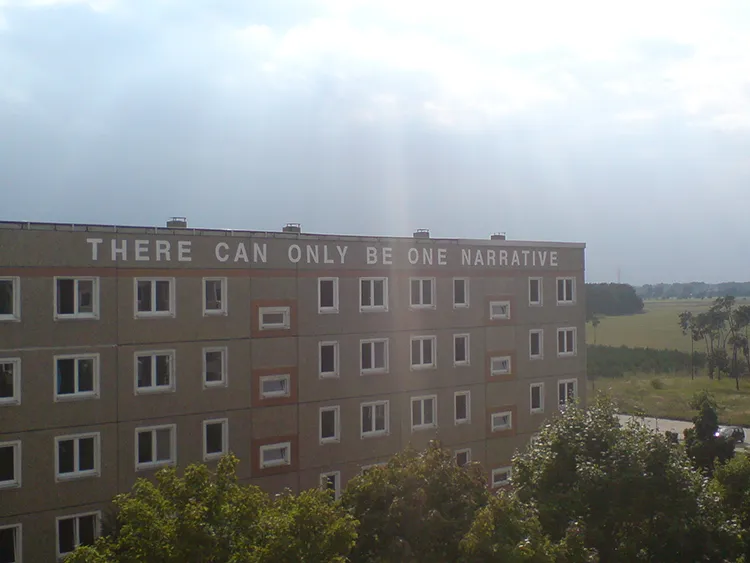
Figure 1.1 ‘ONE NARRATIVE’: ‘ArtBlock’ building, WK 10, Hoyerswerda Neustadt, August 2008
ONE NARRATIVE
In August 2008, Bjarke, a young Danish artist, attached the slogan THERE CAN ONLY BE ONE NARRATIVE in white capital letters onto the upper front of a soon-to-be-demolished five-storey apartment block in Hoyerswerda’s New City (Neustadt). His intervention was produced during an international student art residency, which took place in Neustadt’s youngest residential district WK 10. The district’s main landlord Lebensräume e.V., the LivingSpaces cooperation, temporarily offered thirty-six young international artists two abandoned apartment blocks, which gave the project its title: ‘ArtBlock’ (see http://www.art-block.blogspot.com). Initially, the project’s initiators had searched for other kinds of abandoned places. Such places, they told me, were increasingly common all over Western Europe and North America: places of no further use, redundant cities, factories and train stations, abject spaces of the postindustrial era. They had initially sought a dilapidated West German detached housing area, which in their understanding offered itself neatly for critical remarks on capitalist mainstream culture. Then they stumbled across the former socialist model city of Hoyerswerda and its other houses of other times and in other spaces. The officials and inhabitants of Hoyerswerda nonetheless happily provided the artists from Chile, Peru, Brazil, the United States, Israel, Botswana and several different European countries with ‘free space’ (Freiraum) in the German two senses of the word: physical and ‘conceptual space’ (Buyandelgeriyn 2008: 237).
The choice for Hoyerswerda changed the artists’ agenda as they suddenly confronted buildings arguably of – and in – a very different context from what they initially expected. Based at the outskirts, these blocks overlooked the fields towards an adjacent Sorbic village, only disturbed by a forest of young pine trees, which must have been planted here around the time of WK 10’s erection in the late 1980s. The two blocks – one housing the artists, the other supplying individual studios – were surrounded by either other abandoned apartment houses or the uncanny absences of those blocks that had already been torn down. The parking lot in the courtyard in front of the two blocks was empty and slightly overgrown with weeds; only Frau Meyer’s little silver car parked there regularly during the time of the project. Frau Meyer still lived in the third, neighbouring block (third entrance, fifth floor on the right). Of all the inhabitants of this courtyard, she was the last to move out with her young son, being relocated to a refurbished flat in WK IV a few days after the end of the two-week art project. The artists had suddenly parked their small, used student cars next to hers (not that there was a shortage of parking space) and the courtyard was revived one last time. But how were they to account for Hoyerswerda’s fate in general or Frau Meyer’s life and her current experiences in particular in the language of art?
When walking through the city, these artists saw more of the same, since they first had to cross the three districts most affected by deconstruction and decline before reaching the huge, shiny shopping centre in the New City’s central district or the Old City’s picturesque centre with castle, church and market square. In a city currently torn apart by demolition dredgers, they were as much in need of context in order to make their practices and interventions meaningful as were my informants in their everyday work and life. However, I think Bjarke had a very important point to make: both as a former socialist model city and as Germany’s fastest-shrinking city, Hoyerswerda did not fit the common paradigms easily – the changes were too dramatic and a superficial postmodern critique might not capture that.
WK 10 incorporates these changes. It can probably be described as the epicentre of Hoyerswerda’s shrinkage and deconstruction. Although it was only completed after the fall of the Berlin Wall in 1989, it was, according to plans in 2008, the first district to be completely dismantled by 2013 or, as German bureaucratic jargon has it, ‘area-wide back-built’ (flächendeckend zurückgebaut). During the ‘ArtBlock’ project most of the flats in WK 10 were already empty, because Hoyerswerda’s extreme loss in population specifically affected Neustadt’s outskirts, which housed the youngest and hence most mobile inhabitants. The buildings’ abandonment makes this loss blatantly visible. Bjarke’s initial idea, he confessed, stemmed from this apparent tragedy, capitalizing on the blocks’ totally unexpected life history: finished in the late 1980s and early 1990s, they were torn down less than twenty years after their erection. But the buildings did not embody the local context alone.
The artistic production of meaning was strongly influenced by the many reminders of the previous lives these blocks had housed – random household items, old posters, leftover furniture, wooden slides and personal memorabilia.1 In addition, many former and remaining inhabitants of WK 10 – as well as a wider Hoyerswerdian public – revisited this marginal part of Hoyerswerda during the time of the project and shared their memories with the new, though temporary residents. References to Hoyerswerda’s contemporary problems and the former inhabitants who embody them (again, many literally revisiting their old homes) thus abounded in the pieces of art: Christián from Chile painted Hoyerswerda’s official ‘Three Oaks’ crest with massively pruned branches; a German artist wrote excerpts from the GDR constitution’s sections on housing – then a constitutional right – over the walls of her studio to highlight the political and legal changes of the present; two other artists spanned a thread out of their fifth-floor workshop all the way across the courtyard to the adjoining forest, referencing the common local narrative that Neustadt is given back to – or reclaimed by – nature; in another exterior project and with the help of local firemen, an artist attached giant reproductions of photographs of trophies and socialist medals (all found in local homes he had visited) to adjacent blocks in order to, as he claimed, ‘honour their achievements’; an American art student built little miniature blocks out of sand (the main postmining residue) and her German friend used finely cut pieces of the blocks’ concrete walls to assemble a kit for building one’s own miniature castles – a project entitled ‘Make Your Self at Home’ – for those who were forced to leave. By relating meaningfully to the material and social spaces in which they intervened, the artists tried to ensure a dialogue with their local audience, particularly on the work-in-progress open days and the final weekend’s exhibition.
Meanwhile, the last inhabitants were moving out of next-door staircases, underlining that Bjarke had it right from the beginning: there is, after all, only one narrative that contains the many stories the Hoyerswerdians and the artists were telling one another, with only one directionality towards the future – that of decline and demolition. But how does the new surprise – the ‘ArtBlock’ building itself – fit into this narrative? And what other narratives could handle the heterogeneous complexity of the city’s present changes and the multiplicity of stories and perspectives produced in response?
When the Hoyerswerdians came to visit the ‘ArtBlock’ building, their reactions were shaped by their own experiences. People talked about how desirable these flats once were, how they already back then had come to take pictures of their allocated flat’s construction and how, with the changing times, they were now taking pictures of their demolition. But despite the apartments’ dilapidated state and the concrete’s much-discussed poor quality, most visitors remarked on the fact that they were ‘still OK’ (noch in Ordnung) and what a shame it was to tear them down. The context of art, which the artists had drawn them into, made them think about their city’s fate, its past, present and future. Just by coming to this site of demolition, it seemed, they halted the accepted changes for a moment and were invited to reflect on them.
This unexpected encounter thus provided different means for the production or reactivation of knowledge about their city. But, after all, there were no new narratives emerging – no ideas for alternative futures that could allow for the blocks’ survival (although one person suggested that the studios should remain opened indefinitely as a museum). Nonetheless, the Hoyerswerdians were impressed by the artists’ intervention: that the blocks could so unconventionally be used yet again seemed, if only for a moment, to challenge the idea of the one narrative of decline, even without factually overcoming it. Bjarke’s assertion might be contradicted by the unexpected premortem blossoming of those houses – and only the narrative of its final deconstruction held true. Still, I claim, even these blocks’ decline can be narrated, contextualized and directed towards the future in many different ways. Even in Hoyerswerda’s all too bleak present, one can find a whole variety of different contexts and narratives, a few of which I present in the next sections.
The differences between local forms of contextual reasoning partially resemble local political and spatial divisions: conservative Old City inhabitants and winners of the postsocialist changes contextualize their presents differently from left-wing Neustadt inhabitants, who have suffered from unemployment after the 1989 fall of the Berlin Wall. The following examples help to circumscribe the local economy of knowledge and some of its surprisingly far-reaching metaphysics. In them, specific local tropes such as ‘healthy shrinking’ (Gesundschrumpfen), ‘economic expulsion’ (Wirtschaftsvertreibung) and ‘the chances of shrinkage’ (Schrumpfungschancen) are used as epistemic tools and discursive armoury. Their analysis explicates differences in spatiotemporal reasoning. I focus on their explanatory and political value in their respective local sociopolitical contexts (see Strathern 1995b: 132) in order to assess whether Bjarke’s claim was right.
The Local Construction of Context
The contexts constructed for and in Hoyerswerda’s present situation are manifold; they involve both meaningful spatial and temporal relations. For example, spatial concerns in Hoyerswerda often involve the city’s actual distance from the Saxon and the federal capitals Dresden and Berlin respectively. This distance is bemoaned as a hindrance in Hoyerswerda’s development towards a better future. Another spatial imaginary stems from its citizens’ unparalleled outmigration, and the many better ‘imagined elsewheres’, where friends, relatives and colleagues had settled. The more than 50,000 inhabitants who have left Hoyerswerda over the last two decades link spatial distance and mobility to social relations and feelings of belonging. In contrast, temporal concerns, the overall focus of this book, include the considerations of different pasts, presents and futures. Giving a city a particular past or future, we often presume, helps to determine its existence in the present. Such positioning, however, is for many reasons far more complicated – and remains all the more contested. Although finding the ‘right’ context or narrative promises to stabilize the city’s existence in this crisis of meaning, the construction of context is highly contested and recurrently reproduces internal political fissures. In order to clarify this point, let me sketch out a few potentially more extreme and polemic examples. With them, I also show what is politically at stake for my informants.
Just before Christmas 2008, a group of young men dressed as Father Christmas stood on Neustadt’s central Lusatian Square (Lausitzer Platz), at the entrance to the city’s main shopping centre. They were handing out oranges and chocolate Santas, to which they had attached little propaganda leaflets. The narrative the leaflets told were about how democracy has led to the ‘fatal’ process of shrinkage, increasing poverty and inequality, and how it is to be blamed for harming the German Volks-body. The same group of local neo-Nazis propagated similar narratives at the 1 May Labour Day demonstrations. Hoyerswerda’s high unemployment, outmigration and subsequent physical deconstruction were presented as the results of the rule of ‘self-proclaimed democrats’ (selbsternannte Demokraten). For the future, the neo-Nazis’ historical implications evoked a swift return to National Socialism in order ‘to save the German people’. Otherwise, they predicted, ‘this system will bring us Volks-death’ (Das System bringt uns den Volkstod). As yet another flyer proclaimed, the Federal Republic of Germany is itself ‘planned Volks-death’ (geplanter Volkstod).
In the autumn of 2008 in the Seniors’ Academy (Seniorenakademie), an institution for lifelong education and concerted economic activity founded by a group of former engineers and miners after the changes of the early 1990s, a former hydrologist gave a talk entitled ‘Hoyerswerda – City on the Waterfront’. He informed his audience about current issues of climate change and their relation to the longstanding history of the extraction of coal and other resources in the area. In his contemplations, the retired expert reached much further into the past than the city’s right-wing youth in their nationalist ideas. In order to find a way out of the current crisis, he covered the period from the end of the last Ice Age, which left the region of Lusatia as a huge ‘swampland’ (the original meaning of the word ‘Lusatia’), the Stone Age, when coal extraction started, and the comparatively recent era of industrialization. Out of this long-term scope, the speaker developed an idea about how Hoyerswerda could tackle its present economic problems by being transformed into a city based on green energy and with new future perspectives. His strategy was hydrological; it implied that the many old waterways, in fact a geological result of the last Ice Age, can help restore Hoyerswerda to what it once was: the ‘Lusatian Venice’ (Venedig der Lausitz). They were to be revitalized by channelling water to Hoyerswerda from the distant river Elbe. Subsequently, tourism, the fishing industry, green energy production and large-scale CO2 reduction (the latter two points remained rather unclear) could create a renewed symbiosis between natural resources and the regional economy, determined, as history explained, by the region’s long-term natural conditions. By putting the current changes into an extensive geohistorical context, the hydrologist saw chances for the city’s future, but only ‘if one can understand the past and learn from it’ – as the academy’s head underlined in his introduction to the talk.
The third example follows this logic too. Seventy-year-old Helfried, a former mining engineer, embedded Hoyerswerda’s present more thoroughly in the region’s nineteenth- and twentieth-century history of industrialization. On our many tours through Hoyerswerda’s surroundings in his flashy black Mercedes Benz, he showed me two of the mines still working; several landmarks of the coal industry such as the huge F60 cool excavator; old villages recently abandoned by their inhabitants because of the progressing mines as well as new ones built from scratch for resettled communities in the 1990s; and former model towns and villages from the 1920s and 1930s whose construction then accompanied the industrialization of open pit mining and energy production in the region. He even pointed out the hardly discernible reforestation areas from the same historical period, where an early specialist in forestry successfully implemented measurements to ‘renaturalize’ the postmining landscapes. O...
Table of contents
- Cover
- Title Page
- Copyright Page
- Dedication
- Contents
- List of Illustrations
- Preface
- Acknowledgements
- Notes on Translations
- List of Abbreviations
- Introduction Anthropology and the Future: Notes from a Shrinking Fieldsite
- Chapter 1 ‘There Can Only Be One Narrative’: Postsocialism, Shrinkage and the Politics of Context in Hoyerswerda
- Chapter 2 Reasoning about the Past: Temporal Complexity in a City with No Future
- Chapter 3 ‘Hoyerswerda…?’ – ‘…Once Had a Future!’: Temporal Flexibility and the Politics of the Future
- Chapter 4 Enforced Futurism/Prescribed Hopes: Affective Politics and Pedagogies of the Future
- Chapter 5 Performing the Future: Endurance, Maintenance and Self-Formation in Times of Shrinkage
- Conclusion Coming to Terms with the Future/‘Zukunftsbewältigung’
- Bibliography
- Index
Frequently asked questions
Yes, you can cancel anytime from the Subscription tab in your account settings on the Perlego website. Your subscription will stay active until the end of your current billing period. Learn how to cancel your subscription
No, books cannot be downloaded as external files, such as PDFs, for use outside of Perlego. However, you can download books within the Perlego app for offline reading on mobile or tablet. Learn how to download books offline
Perlego offers two plans: Essential and Complete
- Essential is ideal for learners and professionals who enjoy exploring a wide range of subjects. Access the Essential Library with 800,000+ trusted titles and best-sellers across business, personal growth, and the humanities. Includes unlimited reading time and Standard Read Aloud voice.
- Complete: Perfect for advanced learners and researchers needing full, unrestricted access. Unlock 1.5M+ books across hundreds of subjects, including academic and specialized titles. The Complete Plan also includes advanced features like Premium Read Aloud and Research Assistant.
We are an online textbook subscription service, where you can get access to an entire online library for less than the price of a single book per month. With over 1.5 million books across 990+ topics, we’ve got you covered! Learn about our mission
Look out for the read-aloud symbol on your next book to see if you can listen to it. The read-aloud tool reads text aloud for you, highlighting the text as it is being read. You can pause it, speed it up and slow it down. Learn more about Read Aloud
Yes! You can use the Perlego app on both iOS and Android devices to read anytime, anywhere — even offline. Perfect for commutes or when you’re on the go.
Please note we cannot support devices running on iOS 13 and Android 7 or earlier. Learn more about using the app
Please note we cannot support devices running on iOS 13 and Android 7 or earlier. Learn more about using the app
Yes, you can access Back to the Postindustrial Future by Felix Ringel in PDF and/or ePUB format, as well as other popular books in Social Sciences & Anthropology. We have over 1.5 million books available in our catalogue for you to explore.