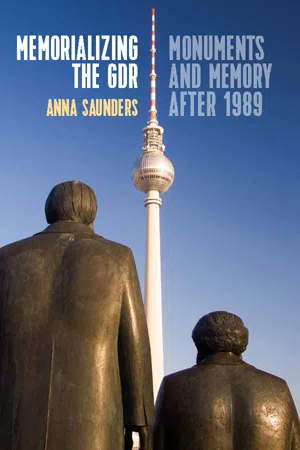
Since unification, eastern Germany has witnessed a rapidly changing memorial landscape, as the fate of former socialist monuments has been hotly debated and new commemorative projects have met with fierce controversy. Memorializing the GDR provides the first in-depth study of this contested arena of public memory, investigating the individuals and groups devoted to the creation or destruction of memorials as well as their broader aesthetic, political, and historical contexts. Emphasizing the interrelationship of built environment, memory and identity, it brings to light the conflicting memories of recent German history, as well as the nuances of national and regional constructions of identity.
Trusted by 375,005 students
Access to over 1.5 million titles for a fair monthly price.
Memory, it seems, is everywhere. It gives meaning to the present, shapes our everyday movements and conversations, provides a framework for our communities and ultimately defines where we come from and who we are. In short, memory is at the heart of identity, whether personal or collective. Unavoidably omnipresent in our contemporary lives, it appears to have found new currency in recent years, in the rise of historical documentaries and films, the heritage industry, museum exhibitions, popular biographies and autobiographies, the growth of amateur photography and the huge archiving potential of the internet, to name but a few examples. Scholarly references to the emergence of a ‘memory boom’, the rise of a ‘memory industry’ and even the outbreak of a ‘memory epidemic’ are commonplace today,1 denoting a trend in which, in Jeffrey Olick’s words, ‘novelty is associated with new versions of the past rather than the future’.2 Such is the contemporary interest in memory that no student can keep abreast of all the literature written on the subject. Indeed, critics have warned that the field of memory studies could face a ‘crisis of overproduction’,3 and that the term ‘memory’ is ‘depreciated by surplus use’.4 Yet as recently as the 1970s and early 1980s, the usage of this term in academic discourse was notably absent, apparently on the verge of extinction.5 What, then, has caused this rapid growth of interest in memory? If memory is core to identity, does this new obsession suggest a modern crisis of identity?
As Astrid Erll highlights, the main causes of the contemporary memory boom are threefold.6 First, historical transformation processes have caused notable changes in the way we think about the past. Above all, the generation that experienced the Holocaust and World War II first hand is now disappearing, causing subsequent generations to seek cultural forms of memory in order to remember this past. Additionally, the end of the Cold War has not only freed many sites of memory for alternative interpretations, but has also caused Western society to reassess its vision of past and future. As Gavriel Rosenfeld argues, the collapse of Eastern European regimes in 1989 saw not only the death of socialism, but also that of future-orientated projects for political change: ‘This death of the future … helped redirect the attention of Western society toward the past’.7 Recent times have also witnessed widespread decolonization and migration, resulting in a greater plurality of ethnicities, cultures and religions, and in turn a heightened awareness of different traditions and histories. Second, rapid technological developments have enabled greater storage space for our memories and more varied media for their transmission. Not only has the internet become a ‘mega archive’,8 but it has allowed a certain democratization of memory, enabling widespread access to historical data, documents and artefacts, as well as the creation of personal collections, and the reassertion of forgotten pasts. The use of film and television, as well as video games and mobile phone apps, have all contributed to a greater presence of memory.9 Yet technological progress has, in many ways, produced a commonly cited ‘acceleration of history’, in which ‘the most continuous or permanent feature of the modern world is no longer continuity or permanence but change’.10 In this respect, the past offers (at least on the surface) a safe haven of stability, and as Bill Niven suggests, ‘The more we rush headlong into the future, the greater the need to find an anchor in the past’.11 A third reason for the memory boom relates to the emergence of postmodernism, which – through the deconstruction of historical narratives – ushered in a more sceptical understanding of history, and challenged the very existence of historical truth. As such, the boundaries between history and memory have been dissipated, and many historians have turned rather to the study of the representation of history, and consequently memory. Most famously, perhaps, this movement led Jean-François Lyotard to pronounce the collapse of the ‘grand narrative’, and Francis Fukuyama famously to predict the ‘end of history’.12 While the end of history may not have come about, scepticism towards historical objectivity has clearly brought about a growth in memory, to the extent that ‘memory’, as Confino observes, is often understood to be little different to ‘ideology’.13
If the boundaries have become increasingly blurred between memory and history, or even memory and ideology, what do we actually understand by the term ‘memory’? The burgeoning field of memory studies has not been short of attempts to define and theorize the concept, resulting in numerous terms to denote specific types of memory, such as communicative, cultural, social, political, prosthetic, official, vernacular, multidirectional, hot and cold, to name but a few. What these terms all share is that they denote collective forms of memory – the subject of this book – as opposed to individual or biographical memory.14 Yet the very presence of multiple definitions highlights the complexity of any concept of ‘collective memory’, and indicates that it may be, in Jeffrey Olick’s words, an ‘over-totalizing’ concept, ‘obliterating finer distinctions’.15 This chapter aims to unpack some of the central theoretical understandings of what, for now, we shall call ‘collective memory’, in order to identify a set of productive theoretical and methodological tools for the following case studies. In a second section, the chapter turns to contemporary debates on monuments and the processes of memorialization, and identifies recent trends – particularly that of the ‘countermonument’ – which prove central to the examination of developments in eastern Germany.
Notions of, and Problems with, Collective Forms of Memory
In literal terms, collective memory cannot exist: an institution, an organization or a nation does not have a memory in the same way that an individual does. Instead, collective bodies create memories through signs, symbols, images, monuments, texts and other media, and in doing so, build identities for themselves. In methodological terms, we must therefore be careful not to reify collective memory; it is not a ‘thing’, but rather a process or a set of mnemonic practices. James Fentress and Chris Wickham, for example, highlight the danger of materializing memory by provocatively asking, ‘Do we hunt it with a questionnaire, or are we supposed to use a butterfly net?’, and Jay Winter proposes to substitute the term with the notion of ‘collective remembrance’, in an attempt to specify agency.16 Any investigation of collective memory must, thus, recognize it as a dynamic process, and understand it to be the outcome of different elements – individuals, organizations, spaces and symbolic media – coming into contact with each other at a specific time. In this sense, this book takes monuments and memorials as a starting point, not an end point, for the examination of memory dynamics in east Germany; the chosen monuments do not embody collective memory, but rather serve as a locus of interaction, discussion and meaning-making.
While the usefulness of the term ‘collective memory’ is likely to be debated for years to come, it provides a helpful starting point for the discussion of memory here. In particular, its emphasis on ‘collectiveness’ draws our attention to two central issues. First, collective memory does not, and cannot, function as individual embodied memory, yet this does not mean that individuals are powerless in the process of constructing collective memory.17 Through case studies of monument projects, this book seeks to examine the role of the individual as well as the collective in shaping shared memories of the past. In doing so, it hopes to highlight the important dynamics between individual action and collective acts of remembrance, in much the same way that Pierre Nora sees his lieux de mémoire to be ‘enveloped in a Möbius strip of the collective and the individual’.18 Second, the notion of ‘collective’ also implies an element of unity, or consensus, within a given group’s memory. Yet memory is never monolithic, and in increasingly democratic times, it is clear that multiple, and indeed competing, memories may jostle for position alongside each other. For this reason, Olick distinguishes between collected memories, as the aggregated individual memories of members of a group, and collective memory, which refers to the collective commemorative representations and traces themselves, concluding that we must remember that ‘“memory” occurs in public and in private, at the tops of societies and at the bottoms … and that each of these forms is important’.19 The notion of collective memory must thus be understood metaphorically rather than in any literal sense, and as Niven suggests, the very vagueness of the concept presents part of its appeal.20 Its use as an umbrella term may ensure a continued awareness of the interrelationship between different forms of memory – a question which is central to this book – yet these different forms prove, themselves, fraught with conceptual difficulty.
Attempts to refine and differentiate between different forms of collective memory find their roots in the work of sociologist Maurice Halbwachs and art historian Aby Warburg, whose seminal works shifted the discourse concerning collective knowledge out of a biological frame of reference into a cultural context. Indeed, despite their different approaches, their common conclusion that culture and its transmission were the products of human activity marked a significant new departure at the start of the twentieth century.21 It is above all to Halbwachs that most contemporary studies turn, not only because he introduced the term ‘collective memory’, but because he highlighted the importance of the social frameworks of memory.22 In contrast to Sigmund Freud, who believed that memories were stored in the unconscious of the individual, Halbwachs stressed that remembering is always an act of reconstruction, in which individual memories are constituted in communication with others. Memories are thus socially mediated, and shaped by the social context in which they are recalled; what we remember depends on the groups to which we belong. In this sense, Halbwachs’ concern was not the memory of groups, but rather the construction of memory within groups, thus highlighting the dynamic nature of memory construction.23
Halbwachs’ work remained largely unknown until the 1980s, however, when his work provided inspiration for Pierre Nora’s project Les Lieux de Mémoire, which in turn initiated a new wave of interest in collective memory.24 Nora’s concern was French national memory, which he saw to be crystallized in ‘sites of memory’, both mental and physical locations, ranging from places and objects to people and commemorative events. In his oft-cited words, ‘There are lieux de mémoire, sites of memory, because there are no longer milieux de mémoire, real environments of memory’, meaning that in the absence of ‘true memory’ (one which he sees to be spontaneous and embodied), we must create deliberate attempts to remember through symbols such as archives, anniversaries and monuments.25 Thus, ‘the less memory is experienced from the inside, the more it exists only through its exterior scaffolding and outward signs’.26 While his concept has been highly influential in the field of memory studies, it is clearly not unproblematic. On the one hand, his notion of milieux de mémoire is somewhat romanticized...
Table of contents
Cover
Title Page
Copyright Page
Dedication
Contents
List of Illustrations
Acknowledgements
List of Abbreviations and Key Terms
Introduction
Chapter 1. Memory, Monuments and Memorialization
Chapter 2. Socialist Icons: From Heroes to Villains?
Chapter 3. Soviet Special Camps: Reassessing a Repressed Past
Chapter 4. 17 June 1953 Uprisings: Remembering a Failed Revolution
Chapter 5. The Berlin Wall: Historical Document, Tourist Magnet or Urban Eyesore?
Chapter 6. Remembering the ‘Peaceful Revolution’ and German Unity
Conclusion. Beyond the Palimpsest
Bibliography
Index
Frequently asked questions
Yes, you can cancel anytime from the Subscription tab in your account settings on the Perlego website. Your subscription will stay active until the end of your current billing period. Learn how to cancel your subscription
No, books cannot be downloaded as external files, such as PDFs, for use outside of Perlego. However, you can download books within the Perlego app for offline reading on mobile or tablet. Learn how to download books offline
We are an online textbook subscription service, where you can get access to an entire online library for less than the price of a single book per month. With over 1.5 million books across 990+ topics, we’ve got you covered! Learn about our mission
Look out for the read-aloud symbol on your next book to see if you can listen to it. The read-aloud tool reads text aloud for you, highlighting the text as it is being read. You can pause it, speed it up and slow it down. Learn more about Read Aloud
Yes! You can use the Perlego app on both iOS and Android devices to read anytime, anywhere — even offline. Perfect for commutes or when you’re on the go. Please note we cannot support devices running on iOS 13 and Android 7 or earlier. Learn more about using the app
Yes, you can access Memorializing the GDR by Anna Saunders in PDF and/or ePUB format, as well as other popular books in History & 20th Century History. We have over 1.5 million books available in our catalogue for you to explore.