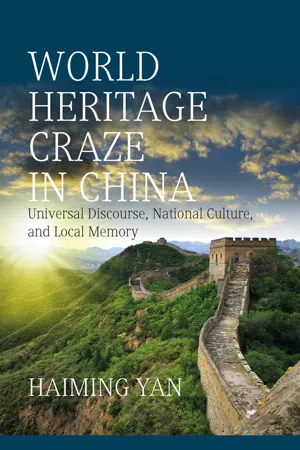
There is a World Heritage Craze in China. China claims to have the longest continuous civilization in the world and is seeking recognition from UNESCO. This book explores three dimensions of the UNESCO World Heritage initiative with particular relevance for China: the universal agenda, the national practices, and the local responses. With a sociological lens, this book offers comprehensive insights into World Heritage, as well as China's deep social, cultural, and political structures.
eBook - ePub
World Heritage Craze in China
Universal Discourse, National Culture, and Local Memory
- 304 pages
- English
- ePUB (mobile friendly)
- Available on iOS & Android
eBook - ePub
About this book
Trusted by 375,005 students
Access to over 1.5 million titles for a fair monthly price.
Study more efficiently using our study tools.
Information
1

From Relics to Heritage
The modern actors whose uniqueness and autonomy are most celebrated are precisely those most subject to the homogenizing effects of diffusion.
—John Meyer, “Diffusion: Institutional Conditions for Diffusion”
Cultural Heritage: A Stone from Other Hills?
On 11 June 2011, China’s sixth Cultural Heritage Day, the director-general of the State Administration of Cultural Heritage Shan Jixiang delivered a public speech at a ceremony in Shandong province, explaining that Cultural Heritage Day was an important cultural festival that drew wide public attention and active civic participation (SACH 2011). In another interview, Shan explicitly and frankly admitted that this national festival, which aimed at promoting and strengthening national pride and cultural identity, was externally introduced from the West. He metaphorically used a traditional Chinese saying “a stone from other hills” to describe the Western-derived idea of a cultural heritage day. The full saying is “A stone from other hills may serve to polish the jade of this one.” As Shan hinted, the central issue was not where the stone was from, but how the Chinese could polish their jade—cultural heritage.
Yet, where the stone is from has become a public concern in recent years. Some are worried that China’s cultural conservation system has been oriented too much toward Western standards and models. Du Yue, deputy secretary-general of China’s National Commission of United Nations Educational, Scientific and Cultural Organization (UNESCO), states that China’s nomination of sites for World Heritage and their conservation is very passive, being dominated by the Western discursive power that controls the making and manipulation of regulations. He feels that China is overwhelmingly constrained within the current cultural models derived from Western frames and has very little freedom in the construction and negotiation of the larger framing discourse (Du 2010).
The concern that heritage conservation is oriented in a Western discourse is not only a Chinese issue. This issue has led to a number of debates at the world level. The UNESCO World Heritage program, because of its role as an international initiative with a universalistic discourse, has been the core target of criticisms in recent years. As Laurajane Smith (2006) contends, the existing “authorized heritage discourse,” which is rooted in the Western elitist aesthetics of materiality, has impaired rather than promoted the conservation of non-Western heritage. In addition to Smith’s argument, which focused on the West’s dominance of cultural heritage’s cognitive and aesthetic values, Jan Turtinen characterizes UNESCO as a powerful actor in diffusing imposing models for world organizations, “a powerful producer of culture, and a highly influential actor, capable of defining and framing conditions, problems, and solutions, thus framing the interests and desired actions of others, especially those of the world’s nation-states’” (2000: 5).
World Heritage, therefore, is seen by these critics as a type of hegemonic cultural model that imposes its Western-centric values upon passive developing countries and institutionalizes them there. In this sense, Western cultural models of heritage conservation, including the World Heritage program, should be condemned as an instrumental strategy carried out by the West in order to culturally penetrate the Chinese society. The “stone from other hills,” in this sense, should be understood as a weapon that is not to “polish the jade” of China, but to “destroy its jade.”
This may lead to the conclusion that the West determines everything regarding cultural conservation issues for non-Western countries. However, the cultural colonialism statement may lead to two misunderstandings. First, it holds an ahistorical view of cultural heritage. Although it is generally agreed that modern uses of the concept of cultural heritage are derived from the West, it has to be noted that China has had its own cultural conservation practices over the course of its ancient history (Cao 2007: 4–5; Q. Wang 2008). As this chapter will reveal, since 1949, the People’s Republic of China has established a sophisticated nationwide system of cultural conservation. The introduction of the Western idea of World Heritage has to be considered as not an imposing process but a negotiating one, in which local historically rooted concepts and practices are entangled with the exogenous and new.
Second, it ignores the discursive power of national and local communities that resist the hegemony. UNESCO’s role as an intergovernmental organization is exaggerated here. As Askew indicates, the cultural colonialism theories “underestimate the persistence of nation-states’ uses of heritage sites at the expense of UNESCO’s universalizing illusions” (2010: 32). In fact, the nation-states are highly capable of manipulating the framed universal grammar. As Tunbridge and Ashworth point out, one major challenge to the ideal of fostering a World Heritage conservation program lies in the power states have in the production and manipulation of heritage.
To map out the relationship between the universal model of cultural conservation and national practices in China, we need to closely examine the discursive and institutional complexities of the processes. This chapter will examine the processes (since 1949) by which China’s cultural conservation system is shaped and reshaped by both domestic and exogenous forces and the extent to which this system is influenced by UNESCO’s World Heritage program, as well as how the Chinese government legitimizes this institutional and discursive imitation of the universal model.
First, I show how China’s cultural conservation has been conceptually and institutionally transformed: (1) the previously used term “cultural relics” is replaced with “cultural heritage,” and (2), consequently, government offices and research organizations have been either restructured or created with the title “cultural heritage.” Second, the chapter examines three cases of China-world interaction: (1) the creation of China’s Burra Charter, (2) the creation of China’s Cultural Heritage Day, and (3) the cross-cultural debate over the concept of authenticity. Using John Meyer’s institutionalization theory, I demonstrate how the transitional process of China’s heritage conservation is historically embedded and dynamically constituted with external cultural models, rather than being unidirectionally imposed on China by a universalistic World Heritage discourse.
New Vocabularies
Over the past decades, China’s cultural conservation has shifted its core concept from cultural relics to cultural heritage. The discursive transition is a manifestation of international influence. There are three phases: cultural relics phase (1949–1985), transitional phase (1985–2005), and cultural heritage phase (2005 to now). In 1985, China ratified the Convention Concerning the Protection of the World Cultural and Natural Heritage (World Heritage Convention), which marked the beginning of the transitional phase. In 2005, the State Council enacted the “Circular on Strengthening the Protection for Cultural Heritage,” using “cultural heritage” as the official term for cultural conservation for the first time. This narrative transition is manifested in narrative changes in official documents, including announcements, circulars, and speeches, as well as regulations, protective measurements, and laws.
The Relics-Heritage Transition
“Cultural heritage” is not a new term in the Chinese vocabulary. It has appeared in official documents since the beginning of the establishment of the People’s Republic of China. The Communist regime used terms such as “ethnic cultural heritage,” “historical cultural heritage” (State Council of PRC 2009 [1961b]: 28; 2009 [1974]b: 67), and “scientific cultural heritage” as general descriptions of historical artifacts and relics. However, while the term “cultural relics” was precisely defined and articulated in this period, the use of “cultural heritage” was ambivalent. In some cases, “cultural heritage” seemed to contain “cultural relics.” For example, the State Council of PRC’s “Circular on Strengthening the Protection of Cultural Relics” said, “Cultural relics discovered underground are the precious cultural heritage of the nation, of the people” (2009 [1974]a: 65). Likewise, “Ancient wooden architecture … is [the] precious cultural heritage of the Chinese people” (State Council of PRC 2009 [1980b]: 104). But in other cases, cultural heritage was often characterized as subordinate to cultural relics.
According to a Chinese encyclopedia, “cultural relics” was defined as “all valuable material heritage that is created by or associated with human activities, handed down along the course of human history” (S. Liu 2008: 85). In contrast to cultural relics, which had a precise definition, the concept of cultural heritage was never clearly and explicitly constituted. Therefore, it was common for the term “cultural relics” to be used as the central theme or the title of a document, with “cultural heritage” being an explanatory term to specify and elaborate on the general theme.
Even in the revised Law on the Protection of Cultural Relics of 2002, “cultural heritage” is mentioned only once (National People’s Congress Standing Committee 2002). Furthermore, similar terms were used in particular contexts, such as “cultural property” and “cultural remains” (Ministry of Culture 2009 [1984b]: 166). The government occasionally described revolutionary sites, architecture, and artifacts as “tangible cultural heritage” (Ministry of Culture 2009 [1985]: 181). Until 2005, the use of “cultural heritage” had been neither precise nor consistent.
During the transitional phase between 1985 and 2005, “cultural relics” was still the official term used in articulating cultural preservation issues, while generally “cultural heritage” appeared as part of the term “historical cultural heritage” (Ministry of Culture and Ministry of Public Security 2009 [1986]: 197; Supreme Court of PRC and Supreme People’s Procuraporate of PRC 2007 [1987]: 227; the Central Propaganda Department of CCP, Ministry of Culture, and SACH 2009 [1989]: 242; National People’s Congress Standing Committee 2009 [1989]: 248), indicating that it was not yet an independent term. It did not even appear in a crucial official document issued by the State Council of PRC, “The Circular on Strengthening and Promoting the Protection of Cultural Relics” (2009 [1997]).
Despite the consistent domination of “cultural relics” in cultural preservation discourse, a terminological transition was slowly in progress. This transition was largely initiated by the UNESCO World Heritage program; it was also associated with communications with other international organizations, such as ICOMOS. In 1989, an official Chinese document for the first time characterized the inclusion of five sites on the World Cultural Heritage List as proof of China’s rich and long-lasting civilization (The Central Propaganda Department of CCP, Ministry of Culture, and SACH 2009 [1989]: 242). Two years later, “cultural heritage” was independently mentioned in the memo on Management Regulations on Foreign Affairs of Archeology, revealing that at least in international affairs, the government had realized the importance of the term “cultural heritage.”
In 1997, the general secretary of the Communist Party Jiang Zemin, in his report at the Fifteenth Party Congress, promised to strengthen the undertaking of “the protection of scientific, historical, cultural heritage and revolutionary cultural relics” (Jiang 1997). This was the first time that “cultural relics” was ontologically separated from “cultural heritage.” Moreover, in 2003, a bilateral agreement was achieved between China and Peru. The main terms used in this agreement were “cultural property” and “cultural heritage” (SACH 2009 [2000]c: 366).
In 2000, the Beijing Consensus was promulgated during the International Conference on China’s Cultural Heritage Preservation and Urban Development, in which both “historical cultural heritage” and “cultural heritage” served as the principal concepts (SACH 2009 [2000]a: 370). It is evident, reading these documents, that the more internationally oriented, the more likely that cultural heritage is used as a core concept. International and transnational dynamics of cultural conservation constituted the major forces underlying the dissemination and prevalence of “cultural heritage” as a significant term in contemporary China.
This correlation between the conceptual elevation of cultural heritage and its international background is largely associated with the increasing adoption of the World Heritage program. In 2001, SACH announced the 10th Five-Year Plan and the Outline of Long-Term Goals on Cultural Relics Enterprises, which emphasized that all historical cultural sites, precious artifacts preserved in museums, and contemporary revolutionary sites were “cultural heritage” that should be honored and appreciated by the Chinese people. Regarding the accomplishments of China’s cultural preservation enterprise, the announcement characterized the ratification of four international conventions1 as an important breakthrough. And it promised to
keep nominating and managing World Cultural Heritage sites; keep adding more important Chinese cultural relics and historical sites into the World Cultural Heritage List; actively participate in activities of international cultural heritage organizations; and enhance international communications on cultural relics. All are expected to promote China, as a country of a great ancient civilization, to be a great nation in the world’s cultural heritage preservation. (SACH 2009 [2001]: 414)
This plan was revealing, as it explicitly associated China’s cultural heritage conservation with the UNESCO World Heritage program and other related international bodies and activities. World Heritage became more prevalent and influential for the discursive reformulation of China’s old cultural relics system. In 2002, Suggestions on Strengthening and Improving World Heritage Management was enacted as the first state-level directive for World Heritage management. Cultural conservation in China became “cultural heritage conservation” instead of “cultural relics conservation” in the same year (Ministry of Construction 2009 [2002]: 448). In 2003, two consecutive documents were issued by SACH, asserting that China’s World Heritage management was highly critical to the nation’s image status and cultural promotion in the world (SACH 2009 [2003]b: 473; 2009 [2003]a: 474–76). “World Heritage,” associated with the more precisely used and defined concept “cultural heritage,” started proliferating.
Other concepts directly embedded in World Heritage discourse also started to influence the Chinese system. One example is the rhetoric of “outstanding universal value,” referring to sites that have “cultural and/or natural significance which is so exceptional as to transcend national boundaries and to be of common importance for present and future generations of all humanity” (UNESCO 2008c: 14). The World Heritage Convention and its Operational Guidelines explicitly articulate that all World Heritage Sites should be evaluated based on this overarching standard (UNESCO 1972; 2008c). In spite of the challenges caused by the ambiguity of this term’s true meaning, China has actively incorporated it into its domestic narratives.
In 2003, the “Circular on Making Further Efforts on the Protection and Management of the Great Wall” reiterated the universal value of the Great Wall, which “not only represents Chinese fine culture, … but it also constitutes an important part of the cultural heritage of all human beings” (SACH 2009 [2003]: 477). Another example of the World Heritage’s discursive impact lies in the categorizations it imposes, namely the distinction between natural and cultural heritage. This rhetorical distinction has appeared in a Chinese official document as the state endeavored to “protect the nation’s outstanding cultural and natural heritage” (Ministry of Construction 2009 [2002]: 448).
These new (uses of) concepts were more precisely articulated step-by-step, and they were eventually institutionalized as the state moved forward to develop high-level regulations. It was during the year 2004 that World Heritage acquired remarkable popularity in the country. In February, nine ministries collaboratively promulgated the Suggestions on Strengthening World Cultural Heritage Preservation and Management (Ministry of Culture et al. 2009 [2004]: 509). In the same year, Suzhou hosted the twenty-eighth session of the World Heritage Committee, where “cultural heritage” started to become a regular part of the Chinese language.
In 2005, the “Circular on Strengthening the Protection for Cultural Heritage” was issued. Since then, “cultural heritage” has obtained official status, replacing “cultural relics” as the primary term for cultural conservation. The term “cultural relics” is still in use now, but it is largely limited to denoting the movable artifacts preserved in museums. Revealing evidence of the completion of the discursive transition is found in three nationwide surveys of cultural relics. While the first two surveys, respectively launched in 1956 and 1981, used “cultural relics” as the guiding term, the third one, launched in 2007, was articulated to promote “cultural heritage management” (State Council of PRC 2009 [2007]: 615).
However, the relics-heritage transition is not a simple terminological switch. Instead, it entails a series of discursive transformations. The use of cultural heritage reframes and expands the old cultural conservation system into a more domestically complex and exogenously associated form. The following analysis will reveal how the relics-heritage transition is entangled with and representative of a large-scale reformulation in discursive categories and practical measurements.
New Categories
As mentioned above, the categorical distinction between natural and cultural heritage emerged with the proliferation of World Heritage. In addition, a number of new categories were also developed during the relics-heritage transition. These new categories are a joint result of embedded domestic traditions and international associational and institutional processes.
Since the early 1960s, China has established a detailed categorical system for cultural relics. In 1961, the State Council promulgated the Temporary Regulations on Cultural Relics Protection and Management, the first state regulation on cultural relics conservation, which set out that cultural relics included (1) architecture, archeological sites, and artifacts that are associated with historical events, revolutionary activities, and personalities; (2) archeological sites, tombs, ancient buildings, and rock caves that are of historical, aesthetic, and scientific value; (3) valuable artifacts; (4) revolutionary and ancient documents that are of historical, aesthetic, and scientific value; and (5) materials that represent different social systems and economic and social activities (2009 [1961]: 30).
Obviously, t...
Table of contents
- Cover
- Title Page
- Copyright Page
- Contents
- List of Figures
- List of Tables
- Acknowledgments
- Introduction
- Chapter 1: From Relics to Heritage
- Chapter 2: From World Heritage to National Solidarity
- Chapter 3: Fujian Tulou: From Harmony to Hegemony
- Chapter 4: Mount Songshan: From the Center of Sacred Mountains to the “Center of Heaven and Earth”
- Chapter 5: The Great Wall: From Ethnic Boundary to Cosmopolitan Memory
- Conclusion: World Heritage as Discursive Institution
- References
- Index
Frequently asked questions
Yes, you can cancel anytime from the Subscription tab in your account settings on the Perlego website. Your subscription will stay active until the end of your current billing period. Learn how to cancel your subscription
No, books cannot be downloaded as external files, such as PDFs, for use outside of Perlego. However, you can download books within the Perlego app for offline reading on mobile or tablet. Learn how to download books offline
Perlego offers two plans: Essential and Complete
- Essential is ideal for learners and professionals who enjoy exploring a wide range of subjects. Access the Essential Library with 800,000+ trusted titles and best-sellers across business, personal growth, and the humanities. Includes unlimited reading time and Standard Read Aloud voice.
- Complete: Perfect for advanced learners and researchers needing full, unrestricted access. Unlock 1.5M+ books across hundreds of subjects, including academic and specialized titles. The Complete Plan also includes advanced features like Premium Read Aloud and Research Assistant.
We are an online textbook subscription service, where you can get access to an entire online library for less than the price of a single book per month. With over 1.5 million books across 990+ topics, we’ve got you covered! Learn about our mission
Look out for the read-aloud symbol on your next book to see if you can listen to it. The read-aloud tool reads text aloud for you, highlighting the text as it is being read. You can pause it, speed it up and slow it down. Learn more about Read Aloud
Yes! You can use the Perlego app on both iOS and Android devices to read anytime, anywhere — even offline. Perfect for commutes or when you’re on the go.
Please note we cannot support devices running on iOS 13 and Android 7 or earlier. Learn more about using the app
Please note we cannot support devices running on iOS 13 and Android 7 or earlier. Learn more about using the app
Yes, you can access World Heritage Craze in China by Haiming Yan in PDF and/or ePUB format, as well as other popular books in Social Sciences & Cultural Policy. We have over 1.5 million books available in our catalogue for you to explore.