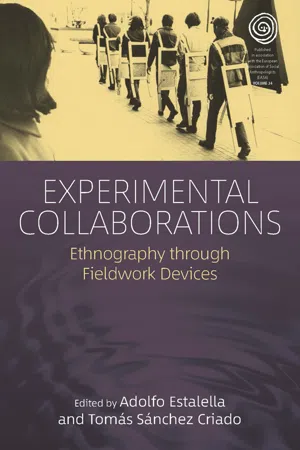
In the accounts compiled in this book, ethnography occurs through processes of material and social interventions that turn the field into a site for epistemic collaboration. Through creative interventions that unfold what we term as "fieldwork devices"—such as coproduced books, the circulation of repurposed data, co-organized events, authorization protocols, relational frictions, and social rhythms—anthropologists engage with their counterparts in the field in the construction of joint anthropological problematizations. In these situations, the traditional tropes of the fieldwork encounter (i.e. immersion and distance) give way to a narrative of intervention, where the aesthetics of collaboration in the production of knowledge substitutes or intermingles with participant observation. Building on this, the book proposes the concept of "experimental collaborations" to describe and conceptualize this distinctive ethnographic modality.
eBook - ePub
Experimental Collaborations
Ethnography through Fieldwork Devices
- 216 pages
- English
- ePUB (mobile friendly)
- Available on iOS & Android
eBook - ePub
Experimental Collaborations
Ethnography through Fieldwork Devices
About this book
Trusted by 375,005 students
Access to over 1.5 million titles for a fair monthly price.
Study more efficiently using our study tools.
Information
1
Experimenting with Data
‘Collaboration’ as Method and Practice in an Interdisciplinary Public Health Project
Interdisciplinary Data Practices of Air Pollution
Air is something we are embedded in and entangled with, whilst, at the same time, it is problematic to visualize and sense, always eluding any boundaries we attempt to build or fix around it. Air’s lapsing of spatial, temporal and analytical scales is interesting ethnographically, particularly in scientific knowledge making, because of the difficulty of materializing and measuring air in any authoritative way (Shapin and Schaffer 1985; Choy 2012). During my fieldwork with an interdisciplinary scientific project called Weather Health and Air Pollution (WHAP), different disciplinary approaches did not simply provide ‘another perspective’; rather than negotiating different epistemologies of air pollution as uncertain and ambiguous, I found researchers were engaged in what I have come to refer to as ‘modes of experimenting’. In this chapter, I explore the different scientific practices that construct air pollution as a research object, tracing the ways in which these contingent ‘versions of air’ were negotiated and reconfigured in the process of stabilizing a shared air pollution.
What is air pollution? That is a great question. What is a weed? A plant in the wrong place. What is dirt? Matter in the wrong place. Pollution is, gases and particles in the wrong place. (Peter, Interview 6 November 2011)1
Experimenting was both a sensibility and a series of practices, carried out through the making, sharing and reuse of ‘data’. The concept of experiment has been subject to examination in the history of science (Shapin and Schaffer 1985), social and cultural studies of science (Knorr-Cetina 1981, 1999; Rheinberger 1994, 1997) and more recently as a way of re-thinking interdisciplinary research endeavours more broadly (Fitzgerald and Callard 2014). In many sociological accounts of science, the concept has been used to empirically explore and theorize about the uncertain nature of socio-technical relations in the making. As Stengers (2005) and Rheinberger (1994) have described, experimenting allows us to pose new kinds of questions, and can enable us to speak and think otherwise about non-human entities. I found that it was these modes of experimenting that enabled researchers to engage explicitly with difference and multiplicity, and to think about others’ ways of knowing and doing in creative and productive ways.
Anthropological approaches to ontology (de la Cadena et al. 2015) have shown that when one focuses on practices and takes material agency seriously, other kinds of access points to the worlds of informants are made possible (Gad, Jensen and Winthereik 2015: 74). I found that data were informational and material forms that all researchers were involved in making, as well as the means by which scientists communicated, contested and conceptualized the research process.
The problem is that the modelled and monitored data aren’t measuring quite the same thing; we are not going to have the gold standard and we are not comparing like for like – and it’s a struggle to try and address this (Principal Investigator, liaison meeting, 2 April 2012)
As this quote highlights, data are embedded in heterogeneous relations, involving, for example, particular kinds of devices to sense and materialize air pollution. To study air pollution collaboratively, as an interdisciplinary matter of concern, was problematic because different data practices (what scientists made, used and shared) enacted different versions of air pollution. Because of the relational nature of data, the articulation of data’s material formation also shapes collaborative research relations. This shifts cross-disciplinary scientific practices into what can be characterized as an experimental mode. As Knorr-Cetina describes, the structure of knowledge making is entangled with the social relations of research:
The experiment becomes constituted as a distinctive and powerful structure in its own right … it is the work of rearranging the social order, of breaking components out of other ontologies and of configuring, with them, a new structural form. The repackaging of efforts accomplished during the birth of a new experiment is also the repackaging of social composition and the creation of a new form of life. (Knorr-Cetina 1999: 214)
That data were ontologically distinct things in WHAP meant that working with and through multiple data were moments where new constructions, social compositions and forms of life could potentially emerge.
This is also the case for the ethnographer, where difference and uncertainty are not only intriguing, but may also be fruitful in their ability to generate more creative ways of thinking about field sites. Ultimately, multiplicity was an ethnographic tool that enabled me to configure a sense of ‘otherness’ in the field, so that differences between and within data practices became my ethnographic focus. Taking data practices seriously, and as interesting anthropologically, also extended what counted as ‘the field’ during my research. Explicit attention to practices of making data offered an ethnographic vantage point from which to consider data ‘from within’, rather than as externally bounded forms. In this way, data practices emerged as both an analytical and empirical figure in my research.
As Fitzgerald and Callard (2014) have shown, experimenting is particularly applicable to interdisciplinary relations, or ‘interdisciplinary assemblages’, because it is in such arrangements that the boundaries between disciplines become fuzzy, and the affective and practical relations that hold them together become more pronounced. Indeed, it was the articulation and management of difference through the multiplicity of data practices that captured my attention: for how does this seemingly ‘successful research team’2 function in practice, when there are tensions between the ways of making data of air pollution and articulating air pollution through data?
From ‘Translation’ and ‘Difference’, to ‘Equivocation’
Studies of epistemic difference in other fields of collaborative inquiry have proposed a number of ways in which tensions are managed and worked through in practice. Star’s concept of ‘boundary objects’ has been the principal means of describing translation across very different kinds of fields of practice (Star and Griesemer 1989; Fujimura 1992; Star 2010). In such analyses, the metaphor of trade and exchange across borders has been dominant (see, for example, Galison 1996), where the role of boundary objects enables epistemological dialogue, and thereby the movement and mutual construction of knowledge. There has been less focus, however, on the role of boundary objects in the making and remaking of the boundaries between human and non-human relations in interdisciplinary research. These kinds of entanglements were fundamental in the coordination of different fields of practice in WHAP.
In WHAP, there were a number of boundary objects or ‘shared values’. Health was used by researchers in their explanations of their roles and reasons for participating in an interdisciplinary project. Research about health was an unquestioned ‘good’, and therefore working on a public health project was a socially and politically imbued act. Air pollution was a means of linking up ‘the environment’ and ‘human health’ – a useful coupling to orientate and justify the interdisciplinary nature of the project. However, although air pollution and health as shared matters of concern worked rhetorically, they functioned less well in everyday practice. As I have highlighted, in data practices air pollution was conceptualized, articulated and materialized in multiple ways, which meant that researchers on WHAP were not only engaging with different epistemologies of air pollution but with different kinds of air pollution altogether (Mol 2002; Law 2004).
Another way of approaching difference has been through the concept of ‘coordination’, which foregrounds the ontological dimensions of managing multiplicity in practice. As Mol’s (2002) ethnography of how the disease atherosclerosis multiplies in practice has detailed, different versions of objects can also be made to ‘hang together’3 in ways that do not imply fragmentation. Yet, our empirical problem remains rather different, because the aim of the interdisciplinary project was to produce shared knowledge on a singular air pollution, so that rather than seeking ‘coordination’ researchers confronted difference ‘head on’.
Viveiros de Castro’s concept of ‘equivocation’4 may be more appropriate for this ‘studying of studying difference’, for it enables the consideration of the material and ontological work of objects in the making, where what objects ‘are’ is also subject to boundary work. Thus, rather than epistemological impasse, where different perspectives represent a singular phenomenon in the world, equivocation suggests that the same epistemological term can be used to refer to different things (Viveiros de Castro 2004a). This shifting of the anthropologist’s focus can be useful for thinking through the multiplicity of research worlds that make up WHAP. Rather than supposing a plurality of views of a single world, a single view of different worlds is made possible when differential disjunction is located in bodily or instrumental differences (Viveiros de Castro 2004b: 6). Indeed, on using the concept in her research on indigenous cosmopolitics, de la Cadena shows how equivocation can bring into conversation a view from different worlds, and as a result extend anthropological knowledge production:
Thinking about Andean mountains as sites of equivocation that enable circuits between partially connected worlds without creating a unified system of activism, can build awareness of the also partially connected alliances between environmentalists and indigenous politicians in Andean countries, allowing for more than their definition as a movement for cultural or environmental rights. (de la Cadena 2010: 351)
In this way, approaching scientific research as configured by cosmopolitics rather than the politics of knowledge permits the anthropologist to extend rather than narrow the relations they follow, and thereby the partial connections they make through and with emergent research worlds.
‘Data’ as Fieldwork Device: Attuning to Practices of Experimenting
The WHAP project was based across several universities in the UK and their research coordinated as part of the ‘Environmental Health’ initiative of a leading UK research council. This was a joint research programme between several research councils and, as one senior researcher on the project explained, one of the first to combine ‘human health’ and ‘the natural environment’ in their call for bids. This required joining forces with several institutions and drawing upon different disciplinary expertise, including that of epidemiologists, atmospheric chemists, environmental chemists, building physicists, sociologists and an anthropologist. The interdisciplinary shape of the project was something researchers reflected on in my discussions with them, and was enthusiastically drawn upon to characterize the ‘trail-blazing’ nature of the WHAP project.
Nonetheless, my role as ethnographer on WHAP was rather ambiguous. My research was framed in the project protocol as an ‘independent component’ of the project. In this way I was not expected to contribute formally to the project outputs, nor participate in the production of knowledge on air pollution. My role was described in the project protocol as ‘producing knowledge on the knowledge production process’. The contribution of this research was therefore assumed to be ‘unscientific’ because it focused on the relations of the team of scientists, rather than the technological and material relations of air pollution. However, as my discussions of the data entanglements making up the WHAP project will highlight, interdisciplinary engagements are also socio-material processes, and it was the division between ‘administrative’ and ‘technical’ work (in terms of emails, the organization of meetings, and ‘who’ gets counted in these communication practices), and the instigation of disciplinary or institutional boundaries at particular moments, that demonstrated the ways in which distinctions, and thereby partiality, also compose, comprise and sustain interdisciplinary research relations.
Fieldwork involved attending weekly meetings and bi-annual ‘collaborators meetings’ (where we physically met at alternate institutions); following email threads and the online sharing of documents; physically moving between institutional sites, both within and external to the project, and observing different data-making practices across these; and tracing the material work of sharing and reusing data in the project. As the ‘social science’ component of interdisciplinary relations, I was both a data producer and field site enabler. My very presence on the project was part of doing collaborative interdisciplinary research, and reflecting on this process was considered to be a legitimate and perhaps valuable process. It was this simultaneous difficulty of carving out a field site on the project of which I was officially a member that led me to consider the meaning and affect of ‘collaboration’ as a scientific relation. As such, following data was also a way for me to move between situated practices; data functioned as particularly good devices because they were not only the end point of research but the very ‘stuff’ of researching. Data became a fieldwork device, functioning as a legitimate object of concern – being both the everyday labour of science as well as the form of scientific output – and as a material form through which I could articulate and make active anthropological knowledge making.
An Interdisciplinary Tension
On 18 May 2012, at another weekly liaison meeting, everyone was gathered round the table in the basement meeting room at the university.
General chatter livens up the sparse, white room, and coffee is being poured and distributed. The usual technical issues of the web-conferencing software are being worked out before the meeting begins. The meeting agenda lists a major item for discussion, ‘the modelled and monitored data issue’, which is something that has been taking shape for the last six months or so and requires contributions from all the researchers on the project. Everyone quietens down as the PI speaks slowly and clearly into the microphone to check whether ‘the modellers’ are there: ‘Can you see and hear us all from 400 miles away?’ They can. The PI [an epidemiologist] begins by detailing the main discussion item for today’s meeting, namely, how we are going to use modelled and monitored practices in the project. He explains that they, the epidemiologists need to use measures of air pollution to work out the relationship between levels of air pollution and negative health effects, and that they are unsure about using modelled data in their analysis, because, ‘as epis,5 what we trust is when we see measurements, because we see it and we know how it works; and that is a version of reality’. The modellers – a group of three today – start murmuring a response, and with a slightly exasperated sigh, Elizabeth [co-PI and atmospheric chemist] states: ‘The measurements made by monitors do not take into account the different chemical processes that make up concentrations of pollutants’. There is a silence that seems resistant to further discussion. To break this sense of impasse, the PI suggests that the team creates a shared document, starting out with the epidemiologists’ perspective, in order to conceptualize how we are thinking about air pollution on the project.
In this anecdote, claims to ‘reality’ and ‘the truth’ about air pollution are framed as relative, relating to different kinds of data. Indeed, the PI concludes that ‘you [modellers] might say it [monitored data] doesn’t represent all these different things, but epidemiologists don’t trust models – and the modellers, you say, you don’t trust the single point measurements’. However, this reduction of disciplinary difference to the epistemic contours of data occludes wider ontological dimensions of the tension between and within data, which was not about trusting either data more or less, but about what kinds of relations make up air in research practices.
Modelling and monitoring practices are different ways of making data of air pollution. Each involves an instrument making a numerical measurement of the amount (the concentration) of a particular air pollutant in an air sample under certain conditions. What is of interest for each practice is, in the first place, air rather than air pollution: how to ‘capture’ it (monitoring), and how to ‘simulate’ it (modelling). It is the measurement contexts – temperature, time of day, season, location, for example – that make the measurement meaningful and, as a result, ‘data’. Working out the right relations of air was one of the key components of making data of air pollution, and these are different for modelling and monitoring. In comparing the ways in which numerical readings were made, I found that different enactments of air pollution emerged from the particular research practices that make up data.
Monitored Data and Modelled Data
Making monitoring data of air pollution involves placing monitors in strategic locations, often in areas considered as having high levels of urban pollution. The stations are small cabins containing a number of different monitors, each of which measures specific pollutants. These monitors draw in samples of the surrounding air through tubes that connect the inside of the station to the world outside. Once in the tubes, the air sample goes through a process of purification, where the ‘wrong’ parts of air are taken away with a scrubbing device, so that the relations of interest – a particular pollutant – are separated and measured by the sensor inside the monitor (Garnett 2016). The sensor functions by passing a UV light beam through the tube, and the reaction that results from this process is a measure of the pollutant. A series of fluctuating numbers – unstable measurements – are shown on the screen on the front of the monitor, and in order to turn these numbers into data the numerical readings are checked to ensure they have not been unduly influenced by the instrument us...
Table of contents
- Cover
- Title Page
- Copyright Page
- Contents
- List of Illustrations
- Acknowledgements
- Foreword. Collaboration Mode 3: A Found Condition of Anthropological Field Research Today … and What Might Be Made of It
- Introduction. Experimental Collaborations
- Chapter 1. Experimenting with Data: ‘Collaboration’ as Method and Practice in an Interdisciplinary Public Health Project
- Chapter 2. The ‘Research Traineeship’: The Ups and Downs of Para-siting Ethnography
- Chapter 3. Finding One’s Rhythm: A ‘Tour de Force’ of Fieldwork on the Road with a Band
- Chapter 4. Idiotic Encounters: Experimenting with Collaborations between Ethnography and Design
- Chapter 5. Fieldwork as Interface: Digital Technologies, Moral Worlds and Zones of Encounter
- Chapter 6. Thrown into Collaboration: An Ethnography of Transcript Authorization
- Chapter 7. A Cultural Cyclotron: Ethnography, Art Experiments and a Challenge of Moving towards the Collaborative in Rural Poland
- Chapter 8. Making Fieldwork Public: Repurposing Ethnography as a Hosting Platform in Hackney Wick, London
- Afterword. Refiguring Collaboration and Experimentation
- Index
Frequently asked questions
Yes, you can cancel anytime from the Subscription tab in your account settings on the Perlego website. Your subscription will stay active until the end of your current billing period. Learn how to cancel your subscription
No, books cannot be downloaded as external files, such as PDFs, for use outside of Perlego. However, you can download books within the Perlego app for offline reading on mobile or tablet. Learn how to download books offline
We are an online textbook subscription service, where you can get access to an entire online library for less than the price of a single book per month. With over 1.5 million books across 990+ topics, we’ve got you covered! Learn about our mission
Look out for the read-aloud symbol on your next book to see if you can listen to it. The read-aloud tool reads text aloud for you, highlighting the text as it is being read. You can pause it, speed it up and slow it down. Learn more about Read Aloud
Yes! You can use the Perlego app on both iOS and Android devices to read anytime, anywhere — even offline. Perfect for commutes or when you’re on the go.
Please note we cannot support devices running on iOS 13 and Android 7 or earlier. Learn more about using the app
Please note we cannot support devices running on iOS 13 and Android 7 or earlier. Learn more about using the app
Yes, you can access Experimental Collaborations by Adolfo Estalella, Tomás Sánchez Criado, Adolfo Estalella,Tomás Sánchez Criado in PDF and/or ePUB format, as well as other popular books in Social Sciences & Anthropology. We have over 1.5 million books available in our catalogue for you to explore.