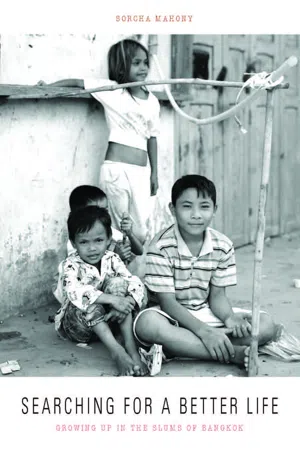
Life in Bangkok for young people is marked by profound, interlocking changes and transitions. This book offers an ethnographic account of growing up in the city's slums, struggling to get by in a rapidly developing and globalizing economy and trying to fulfil one's dreams. At the same time, it reflects on the issue of agency, exploring its negative potential when exercised by young people living under severe structural constraint. It offers an antidote to neoliberal ideas around personal responsibility, and the assumed potential for individuals to break through structures of constraint in any sustained way.
Trusted by 375,005 students
Access to over 1.5 million titles for a fair monthly price.
This chapter is divided into four sections. In the first, I offer an account of the key terms used in the book, with brief explanations of the reasons behind choosing the more contentious ones. In the second section, I briefly survey some of the key features of the religious context in which young slum dwellers endeavour to build a better life, highlighting some of the prevalent assumptions therein about the means of achieving it. In the third section, I describe the socio-economic context in which the notion of a better life has flourished, focusing on Thailand’s economic development during the second half of the twentieth century. Again, I point to the prevalent assumptions within this context about the means of achieving a better life. In the fourth section, I give a historical overview of the growth of slum settlements in Bangkok and introduce the slum in which this study took place. Through the chapter, I demonstrate that the notion of a better life has been embedded in Thai consciousness for many years, albeit with varied meanings attached to it, and that ideas about the way in which it can be achieved imply certain assumptions about the capacity of individuals to break through structures of constraint.
Key Terms
Young People and Youth
The majority of young people who form the core of this study were between fifteen and twenty-two years of age at the time of fieldwork. I also conducted research with slightly younger people (thirteen years old), but the focus is on those between fifteen and twenty-two. I refer to these participants as ‘young people’ and ‘youth’. It is widely recognized that defining ‘youth’ (and children or adults for that matter) solely in terms of chronological age provides an insufficient understanding of the ways in which lives are socially constructed. What it means to be a person of a particular age varies across space and over time, and what it means to be a person of a certain age living in a particular place and time varies according to, for example, the prevailing norms surrounding inter-generational and gender relations, and socio-economic positioning.
It is also recognized that the selection of labels with which to write about particular groups of people, not least young people, can be a far from neutral process (see Hall and Montgomery 2000; Bucholtz 2002). The terms we choose to write with carry meaning – the writer’s and the reader’s – which in turn reflect the broader connotations that prevail at a particular time in a particular culture. Labels can be used to strategic effect, to engender certain associations and emotions and invoke a reader’s sympathy – or otherwise – for the people about whom one writes. For example, labelling people in their teenage years or even in their early twenties as ‘street children’ (a category applied to young people living on the streets in the developing world) functions to construct them as innocent victims in need of support (see Hecht 1998), while the term ‘homeless youth’ (a category more readily applied to young people living on the streets in developed countries) carries connotations of delinquency and does not invoke the same sympathetic concern (Hall and Montgomery 2000). Furthermore, it has been argued that the term ‘child’ suggests a need for intervention, while the label ‘youth’ suggests an element of self-will and an absence of need for assistance (Ansell 2005).
In this book, I use the term ‘young people’ (or young woman, man or slum dweller) as this is the most neutral one available, and because it encompasses participants at the younger end of the age range as well as those in their early twenties. I use this interchangeably with the term ‘youth’, and employ the latter because this is widely used in the literatures with which this book connects. There are other terms employed in these literatures to refer to people of the same age as those discussed here, such as ‘adolescents’ and ‘teenagers’, but I refrain from using these because each of them carries associations that are not appropriate for this research. ‘Adolescent’ is associated with an emphasis on biological and psychological development and with related claims to universalism, while this study explores socio-economic, cultural and moral aspects of young people’s lives and recognizes these as products of history. The term ‘teenager’ technically refers to those between the ages of thirteen and nineteen and not those in their early twenties, who form an important element in this study. While I do discuss the phenomenon of the ‘teenage life’, and while participants use the Thai term wairoon (which is translated as ‘teenager’) to refer to people in their teens and early twenties, using this term may be misleading to English language readers.
Adult Carers
At the outset of this research, I worked with the term ‘parents’ when referring to those with responsibility for young people. However, this label took insufficient account of the multiple systems of care and forms of cohabitation that young slum dwellers experience. I settled on the term ‘adult carer’ because it points to generational differences between the two main groups of participants, and to one of the defining features of the ideal-type relationship between adults and the young people in their charge.
Although I use the term ‘adult carer’ and do so because, after considerable deliberation, it transpired to be the most appropriate, I use the term with some caution. At times during fieldwork, I questioned whether, and to what extent, some of those with responsibility for young people actually ‘cared’ for them at all, in a practical sense. Furthermore, there were cases where those caring for young participants, such as older siblings or cousins, were themselves not much older than the young people in their charge. Moreover, attaching the term ‘carer’ only to older generation participants and not to young people – many of whom had a significant duty of care for elders – is perhaps misleading given the bidirectionality of support between adults and young people. However, I have retained the term ‘adult carer’ because it appears to be the most suitable given what is available.
Slums, Slum Dwellers and the Urban Poor
The United Nations Centre for Human Settlements (UNCHS) defines ‘slum’ and ‘squatter’ settlements in the following ways:
Slum settlements usually consist of run-down housing in older, established, legally built parts of the city proper. Slum buildings are mostly old and poorly maintained. Most of the residents rent their accommodation, although owners occupy some space or detached structures. In some cases, many of the buildings have more than one floor and house several families. (UNCHS 1982, cited by Viratkapan and Perera 2006: 158)
Squatter settlements are mainly uncontrolled low-income residential areas with ambiguous legal status regarding land occupation. They are to a large extent built by the inhabitants themselves using their own means and are usually poorly equipped with public utilities and community services. The usual image of a squatter settlement is of a poor, under serviced, overcrowded and dilapidated settlement consisting of make-shift, improvised housing areas. The land occupied by squatter settlements is often, but not always, located further from the city centre than is the case with slums. Often, but not always, the houses are built and occupied by their owners. The land is often occupied illegally. (Ibid.)
Viratkapan and Perera (2006) note that in the context of Thailand, the label ‘slum’ is used to refer to what the UNCHS separately labels ‘slum’ and ‘squatter’ settlements. Pornchokchai (2003) notes that the National Housing Authority (NHA) and Bangkok Metropolitan Authority (BMA) define slums in the following ways:
A dirty, damp, swampy or unhealthy area with overcrowded buildings and dwellers [sic] which can be harmful for health or lives or can be a source of unlawful or immoral actions. (NHA, cited in Pornchokchai 2003: 13)
An overcrowded, unorderly [sic] and dilapidated community with unample [sic] environment which can be harmful for health and lives. The minimum number of housing units per rai is 15. (BMA, cited in Pornchokchai 2003: 13)
In 1982, Thai government ministers in the Department for Public Welfare suggested that the label ‘chumchorn ae at’ (‘crowded community’) should replace ‘slum’ in an attempt to diminish the negative connotations and prejudice experienced by residents. However, the term ‘salum’ (slum) continued to be widely used and the government continued to define the ‘crowded communities’ in the same way as they had previously defined ‘slums’, as communities that are:
… full of people with bad quality houses. People there lack money and assets, public utilities and food, have poor sanitation, low education, and have family problems and distorted behaviour. (Anon-DPF 2006)
Slums do not necessarily house the poorest of the poor in urban areas; indeed, it is argued that the poorest of the poor are not housed at all, they are homeless, or are itinerant workers on construction sites (Pornchokchai 2003). In Thailand, the NHA divides the urban poor into three levels: the ‘lowest’, which comprises homeless people and those who beg for a living; the ‘middle’, which comprises slum dwellers who earn low incomes; and the ‘highest’, which comprises those who rent low-cost housing that is not in slum communities and who earn more than those at the middle level (Anon-DPF 2006). Clearly, such rigid categorization breaks down once it is recognized that some homeless people live on the streets in slum communities, that some slum dwellers earn relatively large incomes (for example through money lending, drug trafficking or pimping), and that some who rent low-cost housing outside of designated slum areas earn less than some living in slums.
However, while slum communities are marked by considerable internal diversity (Askew 2002), and while there may be blurred boundaries between slums and non-slum communities, there are common characteristics within them. Incomes in slum communities tend to be very low, as does educational and occupational status. They are densely populated,1 tenure insecurity is a significant issue and housing and other physical infrastructure is of low quality. Social problems such as substance abuse, violence and family breakdown are common. House fires are a constant threat, as many dwellings are packed closely together and made of wood, and the cooking oil used is highly flammable. Pornchokchai (2003) identifies four overriding characteristics uniting the settlements labelled ‘slums’: overcrowding, limited privacy, substandard housing and a substandard environment.
In this book, I use the terms ‘slum’ and ‘slum communities’ and refer to participants as ‘slum dwellers’ for several reasons. First, ‘slum’ is the label that many of the participants used when referring to themselves, each other and their neighbourhoods – sometimes with mocking self-deprecation, sometimes with a painful awareness of how it signified their low social status, and sometimes with no obvious connotations at all. While their use of this label could arguably be a result of my identity as an outsider and someone they expected to perceive them in certain ways, it became a familiar term and did not seem to cause offence to the people who shared their stories and their lives with me. Second, it is a label commonly used by NGOs and their staff working in the slum. Third, the term ‘slum’ and its various permutations remains commonplace in the literature by Thai and foreign academics writing about low-income urban communities in Thailand, albeit sometimes with acknowledgement that there may be more appropriate labels.
Throughout the book, I also use the phrase ‘urban poor’ to refer to participants living in slum communities. In doing so, I have not measured them against an official, absolute poverty line, but take a relative approach, defining them as ‘poor’ on the basis that their incomes are significantly lower than the average in Bangkok (see Chestnut et al. 1997) and, from the data collected in this research, they have significantly less savings and fewer assets, and higher levels of unmanageable debt, than their wealthy counterparts. I also use the term ‘marginalized’ because this is widely employed within other studies of urban poverty (see, for example, Bourgois 1995) and speaks of the structural processes at work in its production and reproduction.
‘Wealthy’ Participants
The fieldwork for this study included research with wealthier families in Bangkok, and while the focus of this book is on the young people living in urban poverty, I do refer to wealthier youth and their parents throughout. Initially I used the term ‘middle class’ to refer to these participants, but it became apparent that the differences in material wealth between the two groups was vast, and that I had probably bypassed a middle stratum. I use the term ‘wealthy’ in order to convey the affluence of non-slum participants.
Agency, Culture and Structures
The focus in this book is mainly empirical, its emphasis being on the experiences of young slum dwellers in their attempts to create a better life, but I use the concepts of agency, culture and structure in order to analyse those experiences, and so it is worth outlining my understanding of them here. The literatures on agency, culture and structures are vast; they represent some of the core concepts in the social sciences, with which sociologists and anthropologists have grappled since the emergence of their respective disciplines.
I take ‘agency’ to refer to the capacity of individuals to make choices and act in the world, and importantly I recognize that this does not always entail positive or emancipatory outcomes. I take ‘structures’ to refer to the social systems – norms, values and institutions that persist over time – that determine and are determined by the exercise of agency. One of my key interests in this study is in the outcomes of agency as exercised by those in positions of material disadvantage, and in particular as exercised through cultural practice.
I take a broad approach to conceptualizing culture, understanding the term to refer to the way of life, practices and beliefs of a particular group of people in a particular place at a particular time. I use the phrase ‘cultural practice’ to refer to the everyday practices that people engage in, which are both manifestations of and constitutive of the beliefs and way of life of the broader culture. I refer to ‘youth cultural practice’ to denote the particular activities and related objects and meanings that young people engage with on an everyday basis.
The following sections turn to the prominent features of the Thai context in which the notion of a better life has gained such a foothold in the popular imagination.
Theravada Buddhism
The vast majority of people in Thailand practise Theravada Buddhism.2 While a minority follow other religions, notably Islam and Christianity as well as Hinduism, Sikhism, Judaism and some Chinese indigenous religions, over 95% of the Thai population are Theravada Buddhists. In a certain sense, the notion of a better life is central to Theravada Buddhism, albeit with a very particular conceptualization of what it means.
According to Theravada Buddhist thought, the starting point of the dhamma – the Buddha’s teachings, or ‘that which is true’ – is the recognition of four Noble Truths:
1. The first Noble Truth is that life is unsatisfactory and painful. This is known as dukkha and is commonly – and some argue misleadingly – translated as ‘suffering’ (L.K. Mills 1999). For Theravada Buddhists, the entirety of life, including past, present and future lives, is dukkha: to be born is a traumatic experience; to inhabit a physical body that constantly craves is miserable; to grow old, get sick and die are experiences that involve pain, sorrow and loss. Life is dukkha.
2. The second Noble Truth is that dukkha has its origins in desire, or the attachment to things and states that are actually impermanent, and this attachment keeps us locked in an endless cycle of rebirth.
3. The third Noble Truth is that it is possible to extinguish the desire that causes dukkha – to reach Nibbana, or true happiness/enlightenment/liberation from perpetual rebirth.
4. The fourth Noble Truth is that the way to extinguish the desire that causes dukkha and reach Nibbana is to follow the Eightfold Path, also known as the Middle Way. This entails ‘right view, right resolve, right speech, right action, right livelihood, right effort, right mindfulness and right concentration’.
Central to the four Noble Truths, and to the eightfold path towards the cessation of dukkha, is the concept of kamma. Kamma is intentional action and the thoughts and words that accompany it, which produces results. ‘Wholesome’ actions produce ‘wholesome’ results and ‘unwholesome’ actions produce ‘unwholesome’ results. Kamma and its results span past, present and future lives – that is, past actions can manifest in one’s past, present and future lives, and actions in the present can manifest in present and future lives.
Linked with the concept of kamma is the notion of merit (boon in Thai), or merit-making (tam boon). By engaging in wholesome kamma or actions, one accumulates merit, which in turn cleanses and purifies the mind and opens opportunities, such as getting a good education, obtaining wealth and being open to the dhamma (L.K. Mills 1999).
As a young person born in Thailand and following the Theravada Buddhist tradition, one grows up with the notion of a better life as both a spiritual and material concept. A better life is freedom from dukkha (the inherent suffering of life) and the gradual path towards that freedom, which may take many lifetimes, and it is the fruits of one’s wholesome actions that might manifest as financial wealth, educational status and the elevated social status these bring. One also grows up with the understanding that one’s kamma – one’s intentional actions, thoughts and words – is what brings about certain results and a certain stock of merit, both in this life and in subsequent lives. In this sense, the means of achieving a better life – either in a worldly sense in terms of achieving education and wealth, or in a spiritual sense in terms of liberation from dukkha – is the actions one takes, the thoughts one thinks and the words one utters. L.K. Mills (1999: 33) puts it thus:
It is true that we must experience the fruits of past kamma which certainly limits and influences our choice in the present. But it is in the present when we make our decisions, wholesome or otherwise and when if we take matters in hand instead of allowing them to overpower us, we can for instance decide to train ourselves this or that way. The religious life in Buddhism is not one for sitting down and resignedly letting whatever must be, happen. There is no room here for concepts of fate, doom or destiny. The Buddha urged his followers many times to make an effort, to strive diligently and this can be done only in the present moment.
While Theravada Buddhism does not explicitly employ the concept of agency, it is clear that the concepts of kamma and merit-making in the pursuit of freedom from dukkha and accruing merit, respectively, imply something akin to agency. There are distinctions; kamma refers to actions, thoughts and words that are intentional and it is only these intentional actions that produce results, whereas the relationship between agency and intentionality within social theory is both less prescriptive, with agency potentially encompassing unintentional as well as intentional actions and choices, and less explicit about the ‘results’ of exercising agency, even if there are implicit assumptions about its positive potential in the current political climate.
But despite these differences, the fundamental conceptualization of people as beings with the capacity to think and act in the world in such a way that produces outcomes that one has control over is common to both understandings of agency on the one hand and kamma and merit-making on the other. Thus, the notion of striving for a better life and the central role of the individual in achieving it has, in a certain sense, been a part of Thai culture and belief for many hundreds of years.
The Birth of the Tiger
In addition to its long history within Theravada Buddhist thought, the notion of a better life has enj...
Table of contents
Cover
Title Page
Copyright Page
Contents
List of Figures
Preface
Acknowledgements
Introduction
Part I
Part II
Part III
Bibliography
Index
Frequently asked questions
Yes, you can cancel anytime from the Subscription tab in your account settings on the Perlego website. Your subscription will stay active until the end of your current billing period. Learn how to cancel your subscription
No, books cannot be downloaded as external files, such as PDFs, for use outside of Perlego. However, you can download books within the Perlego app for offline reading on mobile or tablet. Learn how to download books offline
Perlego offers two plans: Essential and Complete
Essential is ideal for learners and professionals who enjoy exploring a wide range of subjects. Access the Essential Library with 800,000+ trusted titles and best-sellers across business, personal growth, and the humanities. Includes unlimited reading time and Standard Read Aloud voice.
Complete: Perfect for advanced learners and researchers needing full, unrestricted access. Unlock 1.5M+ books across hundreds of subjects, including academic and specialized titles. The Complete Plan also includes advanced features like Premium Read Aloud and Research Assistant.
Both plans are available with monthly, semester, or annual billing cycles.
We are an online textbook subscription service, where you can get access to an entire online library for less than the price of a single book per month. With over 1.5 million books across 990+ topics, we’ve got you covered! Learn about our mission
Look out for the read-aloud symbol on your next book to see if you can listen to it. The read-aloud tool reads text aloud for you, highlighting the text as it is being read. You can pause it, speed it up and slow it down. Learn more about Read Aloud
Yes! You can use the Perlego app on both iOS and Android devices to read anytime, anywhere — even offline. Perfect for commutes or when you’re on the go. Please note we cannot support devices running on iOS 13 and Android 7 or earlier. Learn more about using the app
Yes, you can access Searching for a Better Life by Sorcha Mahony in PDF and/or ePUB format, as well as other popular books in Social Sciences & Anthropology. We have over 1.5 million books available in our catalogue for you to explore.