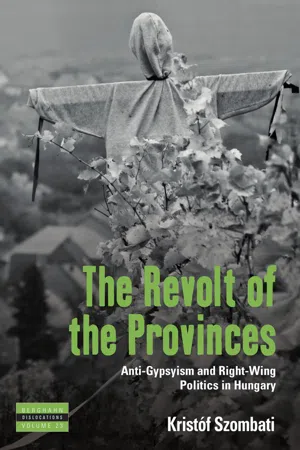
The first in-depth ethnographic monograph on the New Right in Central and Eastern Europe, The Revolt of the Provinces explores the making of right-wing hegemony in Hungary over the last decade. It explains the spread of racist sensibilities in depressed rural areas, shows how activists, intellectuals and politicians took advantage of popular racism to empower right-wing agendas and examines the new ruling party's success in stabilizing an 'illiberal regime'. To illuminate these important dynamics, the author proposes an innovative multi-scalar and relational framework, focusing on interaction between social antagonisms emerging on the local level and struggles waged within the political public sphere.
eBook - ePub
The Revolt of the Provinces
Anti-Gypsyism and Right-Wing Politics in Hungary
- 294 pages
- English
- ePUB (mobile friendly)
- Available on iOS & Android
eBook - ePub
About this book
Trusted by 375,005 students
Access to over 1.5 million titles for a fair monthly price.
Study more efficiently using our study tools.
Information
– Chapter 1 –
HISTORIC CONTEXTUALIZATION
“Gypsies,” “Magyars,” and the State

In this chapter, I heed Charles Tilly’s (2008: 420) argument that “all political processes occur in history and therefore call for knowledge of their historical contexts.” I highlight key elements of the historical process wherein ideas about race/ethnicity reemerged in Hungary after regime change. This historical contextualization focuses on one question: how to account for the figure of “the Gypsy” taking center stage in public life from the middle of the last decade. Some would say that this question is misplaced, given that Roma have been persistently subjected to persecution and discrimination over the centuries. I beg to differ. A recent effort to write a relational history of Romani groups in Hungary highlighted key differences in relation to the social relevance of ethnicity in different historical periods. This underscores the need to separate periods of “de-ethnicization” and “re-ethnicization” and to offer explanations for these historical dynamics. In what follows, I focus on two periods—late socialism (1961–1989) and liberal democracy (1990–2010)—in order to highlight economic and political forces that created space and incentives for the reconstruction of communal relations along ethnic lines. This contextualization will show that state-sponsored integration efforts generated racist sensibilities and that these were mitigated through informal mechanisms of segregation and control that relied on a discursive regime—which I propose to call “hegemonic Hungarianness”—which placed a taboo on the evocation of ethnicity in public discourse. I argue that the decentralization of the state after regime change allowed for the survival of these local hegemonies. In the final part of the chapter, I rely on secondary sources to highlight processes that may have plausibly eroded these hegemonies from the beginning of the new millennium. The first was the de-peasantization of the countryside (in connection to European enlargement) and the concomitant crisis of social reproduction of two reemergent social groups: the “post-peasantry” and the surplus population. These secondary sources also show that the dualization of the welfare state (which I discuss below) played a key role in the emergence of this social divide—in both fact and fiction—and that relations between the two groups were most acute in regions where the “post-peasantry” came to depend on institutionalized forms of solidarity. It will be the task of the next two empirical chapters to show how these groups came into friction and how this led to the “naming and blaming” of “Gypsies.”
Roma in History: In Defense of a Relational Realist Approach
In Hungary, where the discipline of “ethnology” has largely failed to reflect on its implication in the Orientalization of the other (see Prónai 2008), the task of analyzing the production of ethnic difference in history was taken up by a few sociologists and historians. Csaba Dupcsik, author of a monograph titled The History of Gypsies in Hungary (2009), used secondary sources to reconstruct the historically variable meanings that have been attributed to “Gypsyness” (a shorthand whereby he refers to the dominant representation of people categorized by others as “Gypsy” or, more recently, as “Roma”) and the transformation of Romani forms of life in the twentieth century. Dupcsik’s key point is that the policies of the nation-state have had an overdetermining influence on the cultural strategies of Roma and that those labeled “Roma” have had even less power over their representation in public life. Dupcsik blames nationalist elites—and the social scientists who supported their projects—for both participating in and fueling the stigmatization of the Romani minority.1 In a less direct form, he also accuses elites of enforcing an assimilationist politics that consistently hindered the project of Romani nation-building, thereby robbing Roma of the power to claim cultural and political rights based on an imagined collective identity. Although his monograph suffers from a lack of theorization and conceptual clarity, Dupcsik’s account is valuable in one important respect. By drawing a link between the cultural strategies pursued by Roma and the intentionality of the groups controlling the state, he indirectly questions the key claim of culturalist scholars who have exoticized Roma by investing them with the ability to transcend the constraints imposed by mainstream groups. While, as Michael Stewart (2002, 2013) argued, there clearly are Romani groups who have been successful in carving out spaces for economic and cultural autonomy, these groups represent a fraction of the people who are categorized as “Roma.” Moreover, even Vlach Romani entrepreneurs, who have been the most successful in maintaining cultural distance and autonomy, are limited by constraints imposed by mainstream groups. “We play the same games as other Roma,” one of my Vlach Romani informants told me; “the only difference is that we have been dealt a better hand.” This, I claim, was a particularly insightful way of saying that although they have different aspirations and strategies, traditional Roma must also take part in the struggle for symbolic recognition and material rewards controlled by non-Romani actors.
The implication is that we must pay attention to the ways in which Romani culture is objectified and contested in public life. Dupcsik’s (2009) monograph singles out one terrain of symbolic struggle. Relying on Foucault’s insistence on studying the nexus between knowledge and power, he asserts that ruling elites have—with the help of nationalist sciences—offered a particular type of mirror for Roma to look at themselves in. This mirror reveals the other through the lens of adaptability. It portrays those who deviate from “homogeneous society” (Bataille 1993) as backward and potentially dangerous. Dupcsik (2009: 20–26) stresses the ideological-political function of this “deviancy-oriented perspective,” which is most often manifested in a specific speech-act: the act of “naming the Gypsy” (ethnic categorization). He exhorts us to recognize that this speech-act serves an ideological function: to naturalize socially produced inequalities and hierarchies and thereby obfuscate the forces, mechanisms and agencies that are responsible for their reproduction. Dupcsik highlights the role of the state, more precisely its penal and scientific apparatuses, in the reproduction of ethnoracial boundaries and hierarchies. This is rendered apparent by the book’s cover photograph (taken in 1909), which depicts a Vlach Romani man and his two children standing in front of their tent in the company of two gendarmes and a female representative of a charitable organization. In the main text, he cites one of the few representatives of “critical ethnology,” who originally published the photograph with the aim of highlighting “the alliance between the state’s punitive apparatus, charitable bourgeois organizations and science” (Szuhay 1998: 95, translation mine). Although Dupcsik recognizes the historically contingent nature of this alliance as well the historically variable strategies of the nation-state, his text nonetheless gives the impression that the history of the interethnic relationship is similar to a perpetuum mobile: a musical piece that is intended to be repeated over and over again without modification.
Dupcsik is not alone in seeing Romani history as a self-perpetuating cycle of exclusion. Pál Nagy, one of the few historians who has made an effort to integrate this “people without history” into Hungarian history, claims that most modern accounts focusing on Roma fit into a moral-cum-heuristic approach he labels the “affliction and persecution paradigm” (Nagy 2007). On this view, “the dominant principle that guides Romani history is [the external environment’s] contempt towards Gypsies. . . . Romani history is the history of resistance to and escape from . . . the constraints imposed by a hostile environment” (Nagy 2007: 1–2, translation mine). Considering the many instances of state-induced oppression and violence that have targeted Roma in the twentieth century, it is easy to see why researchers sympathetic to the plight of a stigmatized minority may be prone to representing Romani history as a history of persecution encouraged or organized by the state—that is, to reduce it to the history of the “Gypsy question” (see Binder 2009).
This approach, much like analytic efforts that define the modern state as a “racial state” (Goldberg 2002), fails to situate exclusion, persecution, and violence within the larger historical process based on the conviction that the (national or colonial) state has an invariable interest in reproducing ethnoracial privilege and hierarchy. Nagy has convincingly shown such an approach to be untenable for the Hungarian case. In an overview of the history of Roma in Hungary, he highlights two historical periods wherein a process of “acculturation”—evidenced by the mixed marriages, the spread of residential cohabitation, and the rise of a shared material culture—was underway, as a result of which Roma were provided the opportunity to pass to the other side of an increasingly blurred and weakly policed ethnic divide. He stresses that in both cases—the period of enlightened absolutism (spanning the second half of the eighteenth century) and late socialism (1961–1989)—the central state actively sought to undermine the previously entrenched ethnic hierarchy through economic and social policies as well as the promotion of forms of representation that emphasized the “social dimension” of Gypsyness:
Some [historical] sources define “Gypsyness” in ethnic terms with reference to the Latin terms gens or natio . . . . Other sources emphasize the social dimension of “Gypsyness” with reference to the Latin terms conditio or professio. The equivalent for this in Hungarian sources is the word “állapottya” (referring to social situation or occupation). Professio can thus be taken to mean: craft, occupation or means of subsistence . . . . In the 18th century it is this latter definition that became dominant. (Nagy 2007: 6–7, translation mine)
The elites controlling the central state pursued similar goals in the two mentioned periods: they sought to convert Roma into wage-earning and tax-paying laborers and to promote their social inclusion by renaming them “new Hungarians.” Nagy (2007: 6, 10) suggests that concerted state action responded in both cases to powerful social and economic dislocations that generated antagonisms between Roma and other groups. In the eighteenth century, frictions were mainly caused by the effort of non-Romani members of guilds (which had been resurrected after the Turkish occupation) to exclude Romani blacksmiths and metalworkers (by far the most popular Romani professions) from the labor market. In the postwar period, it was the rise of petty criminality as a result of the collapse of Romani livelihoods (itself connected to declining demand for traditional products and services and stringent constraints on petty trade) that necessitated state intervention. This insight leads Nagy to offer an alternative to the “affliction and persecution paradigm.” This alternative, which he labels the “co-existence paradigm,” calls on researchers to analyze the impact of large-scale economic and political forces on the interethnic relationship (Nagy 2007: 2). Instances of discrimination and persecution should, he argues, be seen as responses to large-scale crises, which are most likely to manifest themselves in (ethnic) competition for economic opportunities and symbolic rewards. Although Nagy does not attempt to situate his approach in the wider body of literature on ethnicity, his take clearly echoes realist approaches to the study of ethnicity, which have identified large-scale historical processes and power differences within societies as determinants of ethnicity.2
The main strength of Nagy’s (2007) approach is that it historicizes the study of ethnoracial exclusion and decenters it by recasting the state as just one—albeit powerful—actor involved in a complex process of negotiation and struggle that takes place on a number of scales (local, regional, national, and, recently, European) that are connected through the agencies of social actors who have a stake in ethnic categorization. This approach is better equipped to deal with historic shifts than Dupcsik’s state-centered approach. It is also more encompassing than anthropological and microsociological studies of Roma, which have failed to question the ways in which the state may influence classification struggles and also become involved in the reproduction of complex forms of ethnicized (or racialized) exclusion. This is not to say that Nagy’s approach—inspired, I believe, by Weber—is free of problems or limitations. In what follows, I will argue that his narrow focus on the ethnic division of labor needs to be expanded in order to gauge the impact of large-scale historical transformations on social relationships in particular sociogeographic settings. His analysis, moreover, remains wedded to a unitary conception of the state, which, for instance, precludes the possibility that local power-holders may not always follow codified protocols but at times follow alternative agendas. Nagy, moreover, fails to take note of the fact that the state may itself become the object of social struggles, as when emancipatory movements push for antidiscrimination, desegregation, and cultural emancipation, or when nativist movements seek to overturn such policies. His framework, in other words, lacks a focus on process and, more particularly, struggle. The list of shortcomings could be continued. Nevertheless, the approach he outlines offers the advantage of foregrounding large-scale socioeconomic processes. This shift in perspective forces us to denaturalize the emergence of racism at a particular moment in time and to ask which kinds of structurally generated antagonisms it may respond to.
The task of rewriting the history of Romani groups in Hungary in the context of a realist relational theoretical framework obviously transcends the scope of this book. Therefore, I will limit myself to a limited number of remarks on the historical periods that are directly relevant for the study of the contemporary racist countermovement: the state socialist (1947–1989) and the liberal democratic (1989–2010) periods.
The Late Socialist Era: Proletarianization and De-ethnicization
I begin by noting that the capitalist mode of production exercised a powerful impact on the interethnic relationship from the end of the nineteenth century. Growing industrial output, and the development of light industry in particular, led to a steady decline in demand for traditional Romani products (e.g., tools and household appliances made of metal and wood). This trend hit rural Romani communities—who were directly dependent on peasant households for their subsistence—hardest. While Roma living in cities could rely on persistent demand for “Gypsy music”3 or take up industrial work, such options were not readily available in the predominantly agricultural countryside. Although we know surprisingly little about the history of Gadjo/Gypsy relations in rural areas—where the majority of those categorized as “Gypsy” lived—available studies suggest that a crisis of social reproduction was unfolding in many rural arenas and that this was worsened by the physical relegation of “Gypsies” to the margins of local communities (see Ladányi and Szelényi 2006: ch. 2). Capitalism, in other words, functioned as an invisible but nonetheless powerful “difference-making machine.” While encouraging economic integration and cultural assimilation in industrializing cities, it fostered the socioeconomic exclusion of the surplus population and its cultural differentiation from peasants in rural areas. It was also in this period that a discourse that portrayed “the Gypsy” as inferior emerged for the first time. Dupcsik rightly emphasizes the relevance of the “Dános case” (1907), which made the headlines of the country’s main newspapers. The murder of the owner of a roadside inn by a group of “Gypsies” led to calls for the severe punishment of perpetrators. Although a link between Gypsyness and criminality had already been established in an earlier period (Binder 2010), the case played a pivotal role in the emergence of a discourse that condemned Roma collectively and called for a radical solution to what journalists began referring to as “the Gypsy question,” as in this example from the Budapest Gazette of 20 May 1908:
Based on the lessons of the case we call for putting an end to truculence and for a radical solution to the Gypsy question. . . . What sympathizers say is not true; these are not humans or our fellows. The Gypsies from Dános—like their race—have been stalled in their development and now constitute an intermediary race between man and animal. They are, however, not like monkeys—who are gentle and mild in comparison—but more like wolves or jackals in that they are vicious, ferocious, thievish and murderous. (Pomogyi 1995: 36–37, translation and emphasis mine)
This novel representation of Roma within a racialized exclusionary discursive framework drew inspiration from the transnational discourse of “scientific racism” (see Miles 1982). This is an important development. Omi and Winant (2015: 13) have rightly noted that the race concept carries a crucial corporeal dimension: race is “ocular in an irreducible way. Human bodies are visually read, understood, and narrated by means of symbolic meanings and associations.” While the typologization of Roma clearly differed from that of black people—commonly called “Blacks”—in many regards, it was also dominated by an insistence on biological inferiority and on genetically coded proneness toward social aggression and criminality. The racialization of Gypsyness was significant in that it counterbalanced the previously hegemonic image of the “noble savage,” which had been promoted by ethnologists who wanted to preserve traditions they saw as being on the verge of disappearance.4
Although the practical effects of racialization are still not well understood, the new topos of the “Gypsy criminal” clearly exercised an impact on the policy domain, especially penal policy.5 The nexus between racial discourse and policy became more apparent in the 1930s,...
Table of contents
- Cover
- Title Page
- Copyright Page
- Dedication
- Contents
- List of Tables and Maps
- Foreword
- Preface
- Introduction
- Chapter 1. Historic Contextualization: “Gypsies,” “Magyars,” and the State
- Chapter 2. Popular Racism in the Northeast: The Case of Gyöngyöspata
- Chapter 3. Redemptive Anti-Gypsyism: The Transposition of Struggles from the Social to the Political Domain
- Chapter 4. Right-Wing Rivalry and the Dual State
- Chapter 5. The Limits of Racist Mobilization: The Case of Devecser
- Chapter 6. From Racism to Ultranationalism: Jobbik’s Transformation through an Ethnographic Lens
- Epilogue
- References
- Index
- Photographs
Frequently asked questions
Yes, you can cancel anytime from the Subscription tab in your account settings on the Perlego website. Your subscription will stay active until the end of your current billing period. Learn how to cancel your subscription
No, books cannot be downloaded as external files, such as PDFs, for use outside of Perlego. However, you can download books within the Perlego app for offline reading on mobile or tablet. Learn how to download books offline
Perlego offers two plans: Essential and Complete
- Essential is ideal for learners and professionals who enjoy exploring a wide range of subjects. Access the Essential Library with 800,000+ trusted titles and best-sellers across business, personal growth, and the humanities. Includes unlimited reading time and Standard Read Aloud voice.
- Complete: Perfect for advanced learners and researchers needing full, unrestricted access. Unlock 1.5M+ books across hundreds of subjects, including academic and specialized titles. The Complete Plan also includes advanced features like Premium Read Aloud and Research Assistant.
We are an online textbook subscription service, where you can get access to an entire online library for less than the price of a single book per month. With over 1.5 million books across 990+ topics, we’ve got you covered! Learn about our mission
Look out for the read-aloud symbol on your next book to see if you can listen to it. The read-aloud tool reads text aloud for you, highlighting the text as it is being read. You can pause it, speed it up and slow it down. Learn more about Read Aloud
Yes! You can use the Perlego app on both iOS and Android devices to read anytime, anywhere — even offline. Perfect for commutes or when you’re on the go.
Please note we cannot support devices running on iOS 13 and Android 7 or earlier. Learn more about using the app
Please note we cannot support devices running on iOS 13 and Android 7 or earlier. Learn more about using the app
Yes, you can access The Revolt of the Provinces by Kristóf Szombati in PDF and/or ePUB format, as well as other popular books in Politics & International Relations & Conservatism & Liberalism. We have over 1.5 million books available in our catalogue for you to explore.