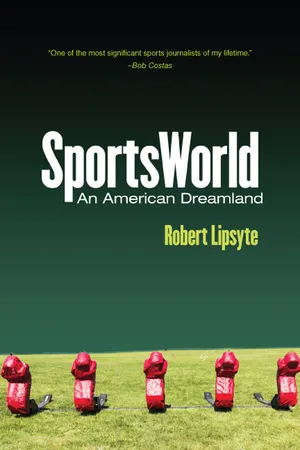
Tough and witty, SportsWorld is a well-known commentator’s overview of the most significant form of mass culture in America—sports. It’s a sweaty Oz that has grown in a century from a crucible for character to a complex of capitalism, a place where young people can find both self-fulfillment and cruel exploitation, where families can huddle in a sanctuary of entertainment and be force fed values and where cities and countries can be pillaged by greedy team owners and their paid-for politicians. But this book is not just a screed, it’s a guided visit with such heroes of sports as Muhammad Ali, Billie Jean King, Kareem Abdul-Jabbar, and Joe Namath, who the author knew well, and with some he met in passing, like Richard Nixon, who seemed never to have gotten over missing the cut in college varsity football, a major mark of manhood. We see how SportsWorld sensibilities help elect our politicians, judge our children, fight our wars, and oppress our minorities. SportsWorld is a book that will provide the foundation for understanding today’s world of sports and the time of Trump. In the America of 2017—where the SuperBowl is worth billions, athletes are penalized or forced out of sports for political and anti-racist activism, and Title IX is constantly questioned and undermined—Robert Lipsyte’s 1975 critique remains startlingly and intensely relevant.
- 300 pages
- English
- ePUB (mobile friendly)
- Available on iOS & Android
eBook - ePub
SportsWorld
About this book
Information
1
Welcome to SportsWorld
1
I was never an avid spectator sports fan. Although I grew up in New York while there were still three major league baseball teams in town, I didn’t attend my first game until I was 13 years old. I was profoundly disappointed. Mel Allen on the radio had prepared me for something grander—lusher outfields, a more imposing spectacle, certainly larger men. I went to only one more game as a paying customer. The third one I covered for The New York Times.
I attended few sports events as a child, but there was no escaping SportsWorld. That’s in the air. I grew up in Rego Park, in Queens, then a neighborhood of attached houses, six-story apartment buildings, and many vacant jungly lots. We played guns in the lots, Chinese handball against the brick sides of buildings, and just enough stickball in the streets and schoolyard to qualify, years later in midtown bars, as true natives. There was no great sporting tradition in the neighborhood, few organized sports of any kind, and only one sports temple, the West Side Tennis Club in adjacent Forest Hills, which accepted neither Negroes, of whom we saw few; nor Jews, which most of us were. It was an early lesson, although I’m not sure what I learned; I hope that I’m not playing tennis today to compensate for a rejection that at the time merely seemed the way of the world.
Even if they didn’t play well, boys growing up in the forties and fifties were expected to talk sports to prove they weren’t “fags.” Since Queens had no resident team, as did Manhattan, Brooklyn, and the Bronx, we had the luxury of rooting for—or paying lip-service to—the Dodgers, the Giants, or the Yankees. Years later, it would become almost a psychological parlor game to guess who picked which team, since local SportsWorld fake-lore had assigned each a distinct image.
The Dodgers represented beer, sweat, unaltered cigarettes, raucous laughter, and all joyful animal pleasures. Their “bitter rivals,” the Giants, stood for Ivy League cool, pseudo-intellectuals, unlit pipes, and a loyalty based entirely on the current standings. Dodger fanatics were loyal, win or lose; in fact, they were more heroic in defeat, which was their culturally assigned lot. Giant aficionados (cognoscenti?, certainly not fans) were predictably insufferable in victory; in defeat they might weasel, claim that their interests lay with the National League as a whole.
The Yankees were simply professionals, the team for tourists and the rich; much later the Yankees would be depicted as corporate Amerika cranking up.
I was a Yankee fan. If pressed, I would attribute it to my Bronx birth, to the way DiMadge “drifted” under a high fly, or, smart-aleck, that it was a cover for my love for the St. Louis Browns. Actually, I was a Yankee fan because I perceived that sports was based on verifiable achievements, not on pull or hooks or clout, not on how adroitly you brown-nosed the teacher or buttered up the landlord or greased the butcher, but on how well you performed and how often you won. If that was the name of the game, I thought, only a fool wouldn’t go with the best.
In 1957, a few days after graduation from Columbia, I answered a classified ad for a copy boy at The Times. I wanted a summer job to pay my way out to graduate school in California, but the personnel interviewer assumed I was seeking a career foothold. The job was most coveted, he told me; there were dozens of Rhodes Scholars, Fulbright Scholars, and Ph.D. candidates clawing at his door. Despite my inferior credentials, he said, he would keep my application on file. He was very nice, and he told me I might hear from him in five or six months, with a little luck.
I walked a block south to Forty-Second Street and erased The Times with a brace of Republic westerns. I took a subway home to Queens. My mother was perplexed. A man had called a few hours earlier and left a message directing me to report to The Times for a pre-employment physical. If I passed it, I would start work next week.
The job was at night, from 7 to 3, and it was in the sports department, filling paste-pots, sharpening pencils, and fetching coffee for the night sports copy desk, the cranky, wretched ground mechanics of sports journalism, a dozen men who sat around an island of wooden desks correcting, shortening, and usually improving the hot dispatches of the Aces and Flying Tigers, the traveling sportswriters whom they envied and hated.
The deskmen rarely saw games and sought their salvation in philately, gardening, and Other Women. Individually they were delightful men—Bourbon raconteurs, ex-managing editors of defunct newspapers, former soldiers of fortune—but as a group they breathed only dyspepsia and disgust. It was a very hard, very unrewarding job, and the pressure was killing. More and more baseball games were being played at night, and at more and more cities with unfavorable time differentials, just as The Times, itself expanding, instituted earlier and earlier editions to make suburban and out-of-town deliveries. The stories clattering into the office through telegraph receivers were being written ever more hastily in press boxes around the country. Because The Times was The Newspaper of Record, there could be no margin for error, not even in the Toy Department, as we were called by the rest of the paper, which we called Outside. And the ultimate responsibility for getting all the news that fit into the paper, and getting it right, fell upon the deskmen.
Some died with their green eyeshades on, and some simply declared emotional bankruptcy and went crazy. When I started, the head of the desk—or slot man as he was called because traditionally (although not in the Toy Department) he sat on the inside curve or slot of a large horseshoe-shaped table—told me quite proudly that he was too mean to go nuts, as had his three predecessors. They were weaklings, to his way of thinking, not man enough to stand the gaff.
One had run screaming into the night, never to be seen again, the story went. Another had put his head down, minutes to deadline, and cried. He was in a state institution, and every Christmas the deskmen took up a collection to send him a box of cigars. The most recent former slot man had taken his place in the slot one morning, nine hours ahead of schedule, and in the dim quiet sports corner of the block-square city room began begging for copy from his invisible rim men. As janitors warily circled, he tore stories off the wire service machines, edited them, wrote headlines for them, stuffed them into plastic and leather canisters, and fired them through the pneumatic tubes to the silent composing room upstairs where they thumped into a padded well, bounced out, and rolled across the deserted stone floor.
He screamed, “Copy, I need copy, we’re on deadline, we’ll never make it, we’ll never make it.” He finally collapsed, exhausted, and was gently led upstairs to Medical. He was transferred to less demanding work in the Sports Department, and performed brilliantly.
The current slot man loved that story, and told it often in his high, needling voice. He was forever digging at the manhood of others, how they had frozen or become hysterical at deadline, how a young reporter “wrote like a quiff,” how a deskman’s sensitivity to the nuance of a story or headline was proof of his effeminate qualities. The slot man never told the story of the makeup editor who, after warning the slot man to stop harassing him, punched him in the nose and within days was assigned a prime beat on the writing staff. This slot man was vicious and personally inelegant—he could pick his ear, his nose, and his teeth simultaneously, and often did. But could he keep that copy moving, filling the newshole, whipping the philatelists and philanderers into melees of editing, snapping off perfect headlines like chocolate squares, and protecting tomorrow morning’s egg eaters from minor upsets due to words. Cod help the writer who allowed a game to “reach a climax,” or a team to “come from behind”; the linotypist who clumsily—puckishly?—made Stan Musial “line a shit to right field” or Phil Rizzuto “start a double lay.”
Between editions, needling and picking, the slot man declared all games fixed, all athletes cretins, all reporters on the take, all fans suckers. His expressions of sexism, racism, and anti-Semitism were often ingenious, but no one ever considered his misanthropy specialized. He was a sour man in a sour job, and he was surrounded by The Times’ version of the Rogues Regiment, drunks from National News and the chronically quarrelsome from Foreign, and a picture editor who had slipped a cheesecake photo into a lobster edition and a cityside reporter who had mishandled an important Communist conspiracy trial and some young sharpies who had opted for the quicker promotions in Sports instead of the longer, surer ladders of Outside. It was a rather traditional sports desk of its day, contemptuous of its subject, of any reader who took it seriously, and, ultimately, of itself. It was also a very fearful desk; the slot man fed that insecurity, which he himself felt. Any word, paragraph, quote, that seemed somehow different, questionable, vaguely provocative, that might cause someone to ask the Sports Editor the next day, “Say, what was that all about?,” that might elicit a complaint from a local college athletic director, a local ball club’s public relations man, an executive of Madison Square Garden, or a reader with embossed stationery, was quickly scratched out of stories. Thus the hunky-dories of SportsWorld bobbed charmingly on placid rivers of ink, not because of conspiracy or payoff, but because no one in the Sports Department wanted to rock the boat and no one from Outside cared.
The aphorism about the best and the worst of newspaper journalism appearing on the sports page was still true in the late fifties. The spirit of the so-called Golden Age of the Twenties and Thirties still clung to the press box like stale smoke, but its greatest excesses were long gone. Newsmen still accepted—sometimes solicited—meals and gifts, but as far as I knew no one was actually demanding percentages of hot fighters, as had Damon Runyon and his pals. The most blatant image-spinning and buildups had given way to a kind of breezy hackery in which beat writers accepted the news source’s premise, and tried to coat it with angles and twists. Meanwhile, such stylists as Jimmy Cannon, Joe Palmer, and Red Smith were writing prose as good or better than anything else on newsprint But it would take the skeptical professionalism of the 1960s to finally dispel the stale smoke and bring the sports pages up to the level of the rest of the paper.
For a son of the so-called silent generation, too independent to work for a corporation yet lacking a Beat poet’s confidence, journalism was a compromise that seemed like a calling. By the end of that first paste-pot summer I knew I would stay. It probably came down to something as romantic as the tremor in my bowels each night when the great machines in the subbasement roared to life with the start of the press run. I felt emotionally, intellectually, viscerally part of something big and good and even a little daring. I would be a Newslinger, too.
It was a good time to break in. Gay Talese and Howard Tuckner had opened the way for what traditionalists would call “bright, irreverent” sportswriting at The Times, and many of the old sacred scribes were about ready to be retired to their halls of fame. Attendance figures, ticket prices, and endorsement fees were climbing as the first American middle-class generation with both leisure and money sought family entertainment. Sports and television discovered each other, and the traditional interface between business and sport, between politics and sport, between education and sport became larger and more complex and more important. This was the period of SportsWorld’s greatest growth; Sputnik justified the ruthless crusade to be No. 1.
It was hot times then for a young sportswriter. Bill Russell and Wilt Chamberlain were leading professional basketball out of dank gyms, and Jim Brown’s hard black anger was smashing through fat Sundays. The Yankee era was still in flower. Harness racing was being citified by crooked lawyers. College administrators were declaring “whole man” concepts to justify swollen athletic budgets. Sonny Liston and Cassius Clay were inexorably punching their way toward each other. Hank Aaron was hitting home runs, though no one heard them yet. People were playing golf, and even watching it. Tennis was still chic, and would remain so until drip-dry clothing put whites on everyone. Bowling was becoming a big-time sport as automatic pin setters made hangar-sized buildings profitable, and advances in heating and air-conditioning made it possible to build them throughout the country; a growing circuit flourished for touring pro bowlers. Horse racing, auto racing, boat racing. I moved from copy boy to statistician to night rewrite reporter. I wrote high school sports and occasional features, often on my own time, and I was sometimes let out to catch a celebrity passing through town or make a fast grab between editions for a quote to freshen up someone else’s limp story. On such an adventure one night at Yankee Stadium, Mickey Mantle avoided my eyes and said, “Go fuck yourself,” in answer to a question.
I was 22 and astounded. I read the papers. I knew athletes didn’t always speak in complete sentences, but golly, holy mackerel, they never talked like this. My question, of course, was not entirely innocent, but it was certainly not hostile, or even particularly probing. It had to do with a recent incident in centerfield in which Mantle and a fan might have exchanged punches. A public event. In any case, Mantle came out of it with a swollen jaw, and the team had gone on the road for a few days, where The Times’ regular Yankee writer would no sooner bother the great man than would the White House correspondent try to grill the President. Now the Yankees were back home, and I had been shot uptown to check on Mantle’s jaw, and his feelings about turning his back on some bleacherites who might like to use it as a target. But Mantle did not care to discuss the matter, and he had been conditioned by his press claque to disregard questions he did not deign to answer. I didn’t know the rules yet; my hands were not long out of the paste-pot. When I persisted, Mantle signaled Yogi Berra, and they began to play catch in front of the dugout, firing the ball back and forth an inch over my head. I sensed that the interview was over.
Mantle was more cooperative later, when the pressure was off, when everyone knew he would never be the new Babe Ruth, not even the new Joe DiMaggio. By then, everyone was climbing over a teammate, Roger Maris, who had the poor grace to hit 61 home runs in 1961, beating Ruth’s single-season record of 60. Because Roger was merely a fine ballplayer, nothing mythic about him, and a stiff in public, it was not hard to disqualify his feat in the public mind. SportsWorld can be pathologically protective of its heroes. The asterisk attached to Maris like a scarlet letter reminded all fans that he needed 159 games to tie the Babe, 163 to surpass him. The Babe’s 1927 season was only 154 games long.
Lecher, glutton, braggart, the Babe looks better every year. In 1974, when Hank Aaron surpassed Ruth’s career total of 714 homers, the Babe’s shadow all but eclipsed the new champion. There was a Ruthian renaissance, and a number of serious book-length studies of the man, his legend, and his time that conflicted substantially in theory and interpretation with each other. About Aaron there were the predictable reissues of fan-mag books, and a collection of reportage vignettes by George Plimpton. The black slugger’s boast to his trading press corps, “I’m not Roger Maris, I can handle you guys,” missed the point. Thirteen years earlier, a less sophisticated Sports World had to diminish Maris to protect the Babe. Now, it built up Aaron’s feat to regild the Babe’s statue.
Poor Maris, betrayed by SportsWorld, turning inward for his remaining years with the Yankees. He had believed that an athlete was judged by his achievements; now his life was something of an illusion. At the time, along with everyone else, I thought Maris was a narrow, suspicious bumpkin, quick to anger—what baseball players call a “red ass.” But, well, in those days I also wondered why Francis Gary Powers, the U-2 spy pilot, had dishonored Nathan Hale’s memory by allowing himself to be captured alive.
Yuri Gagarin first in space, the Bay of Pigs, the Berlin Wall and I was stuck on night rewrite, engine racing in neutral, waiting to be loosed on that world of benevolent owners and wise old coaches and hopeful rookies and modest heroes. I was not filled with social purpose, I did not see sports as a “microcosm of real life,” I wasn’t zeroing in on myths to debunk or muck to rake. I just wanted to get out there and see what was going on and write better stories about it than anyone else. A very socially acceptable SportsWorld attitude. I wanted to see what I could do against the heavyweights. I wanted to win.
2
The man who will do anything to win, the great competitor, has seen the locker-room slogans, the official graffiti of SportsWorld, and made them his Sutras and Proverbs.
—WINNING IS THE SECOND STEP,
WANTING TO WIN IS THE FIRST.
—TO EXPLAIN TRIUMPH,
START WITH THE FIRST SYLLABLE.
—WHEN THE GOING GETS TOUGH,
THE TOUGH GET GOING.
The man who will do anything to win will do nothing to rock the boat. He may lie, break rules, even kill, but his hostile energies are predictable and controllable. He will conform. He will not disrupt the team.
The player who will do anything to win may turn mad dog on the field, but he will not march in campus demonstrations during the season. The coach who will do anything to win may divert antipoverty grants to the athletic department slush fund but he will not disparage the educational standards of the university. The businessman who will do anything to win may steal a rival’s formula but he will not expose price-fixing in the industry. And the presidential candidate who will do anything to...
Table of contents
- Title Page
- Copyright Page
- Dedication
- Contents
- Introduction to the 2018 Edition
- Introduction to the Original Edition
- Chapter 1. Welcome to SportsWorld
- Chapter 2. Please Rise for Our National Pastime
- Chapter 3. Sport of the Sixties: Instant Replay . . . Replay . . . Replay . . .
- Chapter 4. The Heavyweight Crown Prince of the World
- Chapter 5. Sport of the Seventies: Sly, Midnight Moves
- Chapter 6. The Back Page
- Chapter 7. The Body Biz
- Chapter 8. Designated Heroes, Ranking Gods, All-Star Holy Persons
- Chapter 9. The Last American Dream
- Index
- About the Author
Trusted by 375,005 students
Access to over 1.5 million titles for a fair monthly price.
Study more efficiently using our study tools.
Frequently asked questions
Yes, you can cancel anytime from the Subscription tab in your account settings on the Perlego website. Your subscription will stay active until the end of your current billing period. Learn how to cancel your subscription
No, books cannot be downloaded as external files, such as PDFs, for use outside of Perlego. However, you can download books within the Perlego app for offline reading on mobile or tablet. Learn how to download books offline
Perlego offers two plans: Essential and Complete
- Essential is ideal for learners and professionals who enjoy exploring a wide range of subjects. Access the Essential Library with 800,000+ trusted titles and best-sellers across business, personal growth, and the humanities. Includes unlimited reading time and Standard Read Aloud voice.
- Complete: Perfect for advanced learners and researchers needing full, unrestricted access. Unlock 1.5M+ books across hundreds of subjects, including academic and specialized titles. The Complete Plan also includes advanced features like Premium Read Aloud and Research Assistant.
We are an online textbook subscription service, where you can get access to an entire online library for less than the price of a single book per month. With over 1.5 million books across 990+ topics, we’ve got you covered! Learn about our mission
Look out for the read-aloud symbol on your next book to see if you can listen to it. The read-aloud tool reads text aloud for you, highlighting the text as it is being read. You can pause it, speed it up and slow it down. Learn more about Read Aloud
Yes! You can use the Perlego app on both iOS and Android devices to read anytime, anywhere — even offline. Perfect for commutes or when you’re on the go.
Please note we cannot support devices running on iOS 13 and Android 7 or earlier. Learn more about using the app
Please note we cannot support devices running on iOS 13 and Android 7 or earlier. Learn more about using the app
Yes, you can access SportsWorld by Robert Lipsyte in PDF and/or ePUB format, as well as other popular books in Social Sciences & Sociology. We have over 1.5 million books available in our catalogue for you to explore.