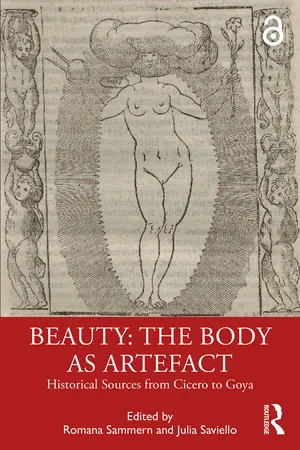
Beauty: The Body as Artefact
eBook - ePub

Beauty: The Body as Artefact

Historical Sources from Cicero to Goya

  1. 386 pages
  2. English
  3. ePUB (mobile friendly)
  4. Available on iOS & Android
eBook - ePub

Beauty: The Body as Artefact

Historical Sources from Cicero to Goya

About this book

Beauty: The Body as Artefact traces the history of physical beauty in Western art and thought from antiquity to the eighteenth century. Bringing together foundational texts and newly translated works accompanied by scholarly commentaries, this volume explores how the human body was understood as both a product of nature and an artistic creation.

Examining the intersections of aesthetics, art theory, medical practices and cosmetics, it reveals how ideals of beauty and beautification shaped conceptions of gender, the body and artistic creation. The book focuses on the early modern period, when the cosmetic transformation of the body became closely associated with artistic imagery and techniques. Drawing on art-historical, philosophical and cultural perspectives, the volume presents key writings by figures from Cicero and Alberti to Behn and Hogarth, highlighting shifting notions of imitation, ornament and naturalness.

Suitable for undergraduates, postgraduates, and scholars in art history, cultural history and gender studies, Beauty: The Body as Artefact offers a framework for understanding physical beauty as a historical and artistic category at the intersection of image, body and knowledge.

Trusted by 375,005 students

Access to over 1.5 million titles for a fair monthly price.

Study more efficiently using our study tools.

Information

Publisher
Routledge
Year
2026
eBook ISBN
9781040748022

Table of contents

  1. Cover Page
  2. Half-Title Page
  3. Endorsements Page
  4. Title Page
  5. Copyright Page
  6. Contents
  7. List of Figures
  8. Acknowledgements
  9. List of Contributors
  10. Introduction: The beautiful body as artefact
  11. 1 Cicero: Perfect beauty as compound (c. 86–84 BC)
  12. 2 Ovid: The appearance of natural beauty (first century AD)
  13. 3 Apuleius: The allure of beautiful hair (c. 160/170)
  14. 4 Isidore of Seville: Painting as make-up (c. 620)
  15. 5 Trota of Salerno: Transmitting beautifying knowledge (first half of the twelfth century)
  16. 6 Hildegard of Bingen: Hair and adornment of nuns (c. 1150)
  17. 7 Gerard of Cremona: Galen in translation – canonicity and race (before 1187)
  18. 8 Vincent of Beauvais: Make-up as the loss of the divine image (1247/1249)
  19. 9 Francesco Petrarca: Fragments and colours of beauty (c. 1336/1374)
  20. 10 Franco Sacchetti: Women’s art as a correction of creation (c. 1390)
  21. 11 Lorenzo Valla: The pleasure of beauty (1431)
  22. 12 Leon Battista Alberti: Genealogy of beauty (1433–1434)
  23. 13 Giovanni Borromeo: Male beauty, cosmetics and power (1468)
  24. 14 Leonardo Da Vinci: Unkempt and naturally beautiful (c. 1492)
  25. 15 Baldassare Castiglione: The charm of effortlessness (1528)
  26. 16 Albrecht DĂŒrer: The diversity of the human body (1528)
  27. 17 Erasmus von Rotterdam: The body as a moving image (1530)
  28. 18 Agnolo Firenzuola: The woman as a beautiful object (1541)
  29. 19 Benedetto Varchi: Grace and beauty (1540s?)
  30. 20 Giovanni Marinello: Cosmetic recipes (1562)
  31. 21 Alessandro Allori: A beautiful surface and bones that evoke sadness (1560s)
  32. 22 Lodovico Dolce: The beauty of the female complexion (1565)
  33. 23 Giovanni Paolo Lomazzo: Graceful folds—the textile shell of the body (1584)
  34. 24 Giovan Battista Della Porta: The physiognomy of the beautiful body (1586)
  35. 25 Peter Paul Rubens: The beauty of trained bodies (c. 1610)
  36. 26 William Shakespeare: The nature of the beautiful (c. 1610/1611)
  37. 27 Girard Thibault: Movement in harmony with the body (1630)
  38. 28 Gian Lorenzo Bernini: Similarity and idealization (1665)
  39. 29 Marie Meurdrac: Teaching ladies the art of beauty (1666)
  40. 30 Gérard Audran: Measuring the ideal body of antiquity (1683)
  41. 31 Aphra Behn: Slavery and ‘the standard of true beauty’ (1688)
  42. 32 Gerard de Lairesse: The colours of nature (1707)
  43. 33 William Hogarth: Curls and other beautiful entanglements (1753)
  44. 34 Alexander Cozens: The end of the canon of beauty (1778)
  45. 35 Claude-Henri Watelet: Flesh tones and the beauty of white skin (1788)
  46. 36 Francisco de Goya: Painting as make-up (1794)
  47. Index

Frequently asked questions

Yes, you can cancel anytime from the Subscription tab in your account settings on the Perlego website. Your subscription will stay active until the end of your current billing period. Learn how to cancel your subscription
No, books cannot be downloaded as external files, such as PDFs, for use outside of Perlego. However, you can download books within the Perlego app for offline reading on mobile or tablet. Learn how to download books offline
Perlego offers two plans: Essential and Complete
  • Essential is ideal for learners and professionals who enjoy exploring a wide range of subjects. Access the Essential Library with 800,000+ trusted titles and best-sellers across business, personal growth, and the humanities. Includes unlimited reading time and Standard Read Aloud voice.
  • Complete: Perfect for advanced learners and researchers needing full, unrestricted access. Unlock 1.5M+ books across hundreds of subjects, including academic and specialized titles. The Complete Plan also includes advanced features like Premium Read Aloud and Research Assistant.
Both plans are available with monthly, semester, or annual billing cycles.
We are an online textbook subscription service, where you can get access to an entire online library for less than the price of a single book per month. With over 1.5 million books across 990+ topics, we’ve got you covered! Learn about our mission
Look out for the read-aloud symbol on your next book to see if you can listen to it. The read-aloud tool reads text aloud for you, highlighting the text as it is being read. You can pause it, speed it up and slow it down. Learn more about Read Aloud
Yes! You can use the Perlego app on both iOS and Android devices to read anytime, anywhere — even offline. Perfect for commutes or when you’re on the go.
Please note we cannot support devices running on iOS 13 and Android 7 or earlier. Learn more about using the app
Yes, you can access Beauty: The Body as Artefact by Romana Sammern,Julia Saviello in PDF and/or ePUB format, as well as other popular books in Histoire & Histoire prémoderne. We have over 1.5 million books available in our catalogue for you to explore.