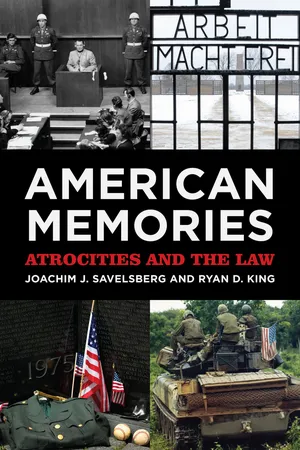
In the long history of warfare and cultural and ethnic violence, the twentieth century was exceptional for producing institutions charged with seeking accountability or redress for violent offenses and human rights abuses across the globe, often forcing nations to confront the consequences of past atrocities. The Holocaust ended with trials at Nuremberg, apartheid in South Africa concluded with the Truth and Reconciliation Commission, and the Gacaca courts continue to strive for closure in the wake of the Rwandan genocide. Despite this global trend toward accountability, American collective memory appears distinct in that it tends to glorify the nation's past, celebrating triumphs while eliding darker episodes in its history. In American Memories, sociologists Joachim Savelsberg and Ryan King rigorously examine how the United States remembers its own and others' atrocities and how institutional responses to such crimes, including trials and tribunals, may help shape memories and perhaps impede future violence. American Memories uses historical and media accounts, court records, and survey research to examine a number of atrocities from the nation's past, including the massacres of civilians by U.S. military in My Lai, Vietnam, and Haditha, Iraq. The book shows that when states initiate responses to such violence—via criminal trials, tribunals, or reconciliation hearings—they lay important groundwork for how such atrocities are viewed in the future. Trials can serve to delegitimize violence—even by a nation's military— by creating a public record of grave offenses. But the law is filtered by and must also compete with other institutions, such as the media and historical texts, in shaping American memory. Savelsberg and King show, for example, how the My Lai slayings of women, children, and elderly men by U.S. soldiers have been largely eliminated from or misrepresented in American textbooks, and the army's reputation survived the episode untarnished. The American media nevertheless evoked the killings at My Lai in response to the murder of twenty-four civilian Iraqis in Haditha, during the war in Iraq. Since only one conviction was obtained for the My Lai massacre, and convictions for the killings in Haditha seem increasingly unlikely, Savelsberg and King argue that Haditha in the near past is now bound inextricably to My Lai in the distant past. With virtually no criminal convictions, and none of higher ranks for either massacre, both events will continue to be misrepresented in American memory. In contrast, the book examines American representations of atrocities committed by foreign powers during the Balkan wars, which entailed the prosecution of ranking military and political leaders. The authors analyze news accounts of the war's events and show how articles based on diplomatic sources initially cast Serbian President Slobodan Milosevic in a less negative light, but court-based accounts increasingly portrayed Milosevic as a criminal, solidifying his image for the public record. American Memories provocatively suggests that a nation's memories don't just develop as a rejoinder to events—they are largely shaped by institutions. In the wake of atrocities, how a state responds has an enduring effect and provides a moral framework for whether and how we remember violent transgressions. Savelsberg and King deftly show that such responses can be instructive for how to deal with large-scale violence in the future, and hopefully how to deter it. A Volume in the American Sociological Association's Rose Series in Sociology.
- 238 pages
- English
- ePUB (mobile friendly)
- Available on iOS & Android
eBook - ePub
About this book
Information
Table of contents
- Cover Page
- Title Page
- Copyright Page
- Dedication
- Contents
- About the Authors
- Acknowledgments
- Introduction: How Maurice Halbwachs Died—and How We Remember Him
- Chapter 1 - From Law to Collective Memory: Breaking Cycles of Violence?
- Chapter 2 - What the Literature Tells Us, and Uncharted Terrain
- Chapter 3 - Constructing and Remembering the My Lai Massacre
- Chapter 4 - From Vietnam to Iraq: Bridging Metaphors, Mnemonic Struggles, and Haunting
- Chapter 5 - Slobodan Milosevic Through Lenses of Law, Diplomacy, and Media Reporting
- Chapter 6 - The Shape of American Memories—and a German Comparison
- Chapter 7 - From Collective Memory to Law: Theoretical Interlude
- Chapter 8 - How American Memory Shapes Hate Crime Law—and a German Comparison
- Chapter 9 - Commemorating Injustice and Implementing Hate Crime Law Across Jurisdictions in the United States
- Chapter 10 - Conclusion: Atrocities, Law, and Collective Memory in the United States and Beyond
- Appendix A: History Textbooks Used in My Lai Content Analysis
- Appendix B: Detailed Tables on Coverage of Milosevic
- Notes
- References
- Index
Trusted by 375,005 students
Access to over 1.5 million titles for a fair monthly price.
Study more efficiently using our study tools.
Frequently asked questions
Yes, you can cancel anytime from the Subscription tab in your account settings on the Perlego website. Your subscription will stay active until the end of your current billing period. Learn how to cancel your subscription
No, books cannot be downloaded as external files, such as PDFs, for use outside of Perlego. However, you can download books within the Perlego app for offline reading on mobile or tablet. Learn how to download books offline
Perlego offers two plans: Essential and Complete
- Essential is ideal for learners and professionals who enjoy exploring a wide range of subjects. Access the Essential Library with 800,000+ trusted titles and best-sellers across business, personal growth, and the humanities. Includes unlimited reading time and Standard Read Aloud voice.
- Complete: Perfect for advanced learners and researchers needing full, unrestricted access. Unlock 1.5M+ books across hundreds of subjects, including academic and specialized titles. The Complete Plan also includes advanced features like Premium Read Aloud and Research Assistant.
We are an online textbook subscription service, where you can get access to an entire online library for less than the price of a single book per month. With over 1.5 million books across 990+ topics, we’ve got you covered! Learn about our mission
Look out for the read-aloud symbol on your next book to see if you can listen to it. The read-aloud tool reads text aloud for you, highlighting the text as it is being read. You can pause it, speed it up and slow it down. Learn more about Read Aloud
Yes! You can use the Perlego app on both iOS and Android devices to read anytime, anywhere — even offline. Perfect for commutes or when you’re on the go.
Please note we cannot support devices running on iOS 13 and Android 7 or earlier. Learn more about using the app
Please note we cannot support devices running on iOS 13 and Android 7 or earlier. Learn more about using the app
Yes, you can access American Memories by Joachim J. Savelsberg,Ryan D. King in PDF and/or ePUB format, as well as other popular books in Politics & International Relations & American Government. We have over 1.5 million books available in our catalogue for you to explore.