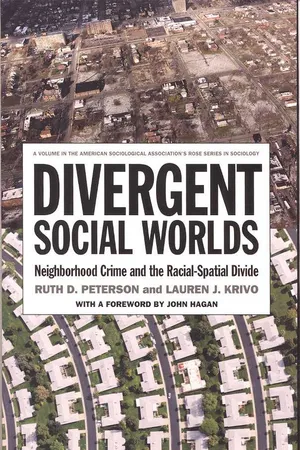
More than half a century after the first Jim Crow laws were dismantled, the majority of urban neighborhoods in the United States remain segregated by race. The degree of social and economic advantage or disadvantage that each community experiences—particularly its crime rate—is most often a reflection of which group is in the majority. As Ruth Peterson and Lauren Krivo note in Divergent Social Worlds, "Race, place, and crime are still inextricably linked in the minds of the public." This book broadens the scope of single-city, black/white studies by using national data to compare local crime patterns in five racially distinct types of neighborhoods. Peterson and Krivo meticulously demonstrate how residential segregation creates and maintains inequality in neighborhood crime rates. Based on the authors' groundbreaking National Neighborhood Crime Study (NNCS), Divergent Social Worlds provides a more complete picture of the social conditions underlying neighborhood crime patterns than has ever before been drawn. The study includes economic, social, and local investment data for nearly nine thousand neighborhoods in eighty-seven cities, and the findings reveal a pattern across neighborhoods of racialized separation among unequal groups. Residential segregation reproduces existing privilege or disadvantage in neighborhoods—such as adequate or inadequate schools, political representation, and local business—increasing the potential for crime and instability in impoverished non-white areas yet providing few opportunities for residents to improve conditions or leave. And the numbers bear this out. Among urban residents, more than two-thirds of all whites, half of all African Americans, and one-third of Latinos live in segregated local neighborhoods. More than 90 percent of white neighborhoods have low poverty, but this is only true for one quarter of black, Latino, and minority areas. Of the five types of neighborhoods studied, African American communities experience violent crime on average at a rate five times that of their white counterparts, with violence rates for Latino, minority, and integrated neighborhoods falling between the two extremes. Divergent Social Worlds lays to rest the popular misconception that persistently high crime rates in impoverished, non-white neighborhoods are merely the result of individual pathologies or, worse, inherent group criminality. Yet Peterson and Krivo also show that the reality of crime inequality in urban neighborhoods is no less alarming. Separate, the book emphasizes, is inherently unequal. Divergent Social Worlds lays the groundwork for closing the gap—and for next steps among organizers, policymakers, and future researchers. A Volume in the American Sociological Association's Rose Series in Sociology
eBook - ePub
Divergent Social Worlds
Neighborhood Crime and the Racial-Spatial Divide
- 157 pages
- English
- ePUB (mobile friendly)
- Available on iOS & Android
eBook - ePub
Divergent Social Worlds
Neighborhood Crime and the Racial-Spatial Divide
About this book
Information
Table of contents
- Cover Page
- Title Page
- Copyright Page
- Dedication
- Contents
- About the Authors
- Foreword: America's Deadly and Duplicitous Divide
- Preface
- Chapter 1. Introduction: One Hundred Years and Still Counting
- Chapter 2. Racial Structure, Segregation, and Crime
- Chapter 3. Divergent Social Worlds
- Chapter 4. The Links Between Racialized Community Structures and Crime
- Chapter 5. The Spatial Context of Criminal Inequality
- Chapter 6. Conclusion: Implications of the Racial-Spatial Divide
- Notes
- References
- Index
Trusted by 375,005 students
Access to over 1.5 million titles for a fair monthly price.
Study more efficiently using our study tools.
Frequently asked questions
Yes, you can cancel anytime from the Subscription tab in your account settings on the Perlego website. Your subscription will stay active until the end of your current billing period. Learn how to cancel your subscription
No, books cannot be downloaded as external files, such as PDFs, for use outside of Perlego. However, you can download books within the Perlego app for offline reading on mobile or tablet. Learn how to download books offline
Perlego offers two plans: Essential and Complete
- Essential is ideal for learners and professionals who enjoy exploring a wide range of subjects. Access the Essential Library with 800,000+ trusted titles and best-sellers across business, personal growth, and the humanities. Includes unlimited reading time and Standard Read Aloud voice.
- Complete: Perfect for advanced learners and researchers needing full, unrestricted access. Unlock 1.5M+ books across hundreds of subjects, including academic and specialized titles. The Complete Plan also includes advanced features like Premium Read Aloud and Research Assistant.
We are an online textbook subscription service, where you can get access to an entire online library for less than the price of a single book per month. With over 1.5 million books across 990+ topics, we’ve got you covered! Learn about our mission
Look out for the read-aloud symbol on your next book to see if you can listen to it. The read-aloud tool reads text aloud for you, highlighting the text as it is being read. You can pause it, speed it up and slow it down. Learn more about Read Aloud
Yes! You can use the Perlego app on both iOS and Android devices to read anytime, anywhere — even offline. Perfect for commutes or when you’re on the go.
Please note we cannot support devices running on iOS 13 and Android 7 or earlier. Learn more about using the app
Please note we cannot support devices running on iOS 13 and Android 7 or earlier. Learn more about using the app
Yes, you can access Divergent Social Worlds by Ruth D. Peterson,Lauren J. Krivo in PDF and/or ePUB format, as well as other popular books in Social Sciences & Criminology. We have over 1.5 million books available in our catalogue for you to explore.