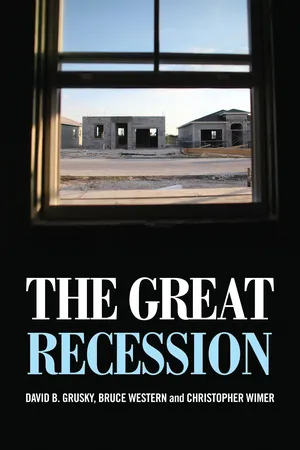
Officially over in 2009, the Great Recession is now generally acknowledged to be the most devastating global economic crisis since the Great Depression. As a result of the crisis, the United States lost more than 7.5 million jobs, and the unemployment rate doubled—peaking at more than 10 percent. The collapse of the housing market and subsequent equity market fluctuations delivered a one-two punch that destroyed trillions of dollars in personal wealth and made many Americans far less financially secure. Still reeling from these early shocks, the U.S. economy will undoubtedly take years to recover. Less clear, however, are the social effects of such economic hardship on a U.S. population accustomed to long periods of prosperity. How are Americans responding to these hard times? The Great Recession is the first authoritative assessment of how the aftershocks of the recession are affecting individuals and families, jobs, earnings and poverty, political and social attitudes, lifestyle and consumption practices, and charitable giving. Focused on individual-level effects rather than institutional causes, The Great Recession turns to leading experts to examine whether the economic aftermath caused by the recession is transforming how Americans live their lives, what they believe in, and the institutions they rely on. Contributors Michael Hout, Asaf Levanon, and Erin Cumberworth show how job loss during the recession—the worst since the 1980s—hit less-educated workers, men, immigrants, and factory and construction workers the hardest. Millions of lost industrial jobs are likely never to be recovered and where new jobs are appearing, they tend to be either high-skill positions or low-wage employment—offering few opportunities for the middle-class. Edward Wolff, Lindsay Owens, and Esra Burak examine the effects of the recession on housing and wealth for the very poor and the very rich. They find that while the richest Americans experienced the greatest absolute wealth loss, their resources enabled them to weather the crisis better than the young families, African Americans, and the middle class, who experienced the most disproportionate loss—including mortgage delinquencies, home foreclosures, and personal bankruptcies. Lane Kenworthy and Lindsay Owens ask whether this recession is producing enduring shifts in public opinion akin to those that followed the Great Depression. Surprisingly, they find no evidence of recession-induced attitude changes toward corporations, the government, perceptions of social justice, or policies aimed at aiding the poor. Similarly, Philip Morgan, Erin Cumberworth, and Christopher Wimer find no major recession effects on marriage, divorce, or cohabitation rates. They do find a decline in fertility rates, as well as increasing numbers of adult children returning home to the family nest—evidence that suggests deep pessimism about recovery. This protracted slump—marked by steep unemployment, profound destruction of wealth, and sluggish consumer activity—will likely continue for years to come, and more pronounced effects may surface down the road. The contributors note that, to date, this crisis has not yet generated broad shifts in lifestyle and attitudes. But by clarifying how the recession's early impacts have—and have not—influenced our current economic and social landscape, The Great Recession establishes an important benchmark against which to measure future change.
- 329 pages
- English
- ePUB (mobile friendly)
- Available on iOS & Android
eBook - ePub
The Great Recession
About this book
Information
Table of contents
- Cover Page
- Title Page
- Copyright Page
- Contents
- Contributors
- Preface
- Part I: Introduction
- Part II: Economic Effects: The Labor Market, Income and Poverty, and Wealth and Housing
- Part III: Social Effects: Consumption, Attitudes, and Family
- Part IV: The Collective Response: The Government and Charitable Giving
- Index
Trusted by 375,005 students
Access to over 1.5 million titles for a fair monthly price.
Study more efficiently using our study tools.
Frequently asked questions
Yes, you can cancel anytime from the Subscription tab in your account settings on the Perlego website. Your subscription will stay active until the end of your current billing period. Learn how to cancel your subscription
No, books cannot be downloaded as external files, such as PDFs, for use outside of Perlego. However, you can download books within the Perlego app for offline reading on mobile or tablet. Learn how to download books offline
Perlego offers two plans: Essential and Complete
- Essential is ideal for learners and professionals who enjoy exploring a wide range of subjects. Access the Essential Library with 800,000+ trusted titles and best-sellers across business, personal growth, and the humanities. Includes unlimited reading time and Standard Read Aloud voice.
- Complete: Perfect for advanced learners and researchers needing full, unrestricted access. Unlock 1.5M+ books across hundreds of subjects, including academic and specialized titles. The Complete Plan also includes advanced features like Premium Read Aloud and Research Assistant.
We are an online textbook subscription service, where you can get access to an entire online library for less than the price of a single book per month. With over 1.5 million books across 990+ topics, we’ve got you covered! Learn about our mission
Look out for the read-aloud symbol on your next book to see if you can listen to it. The read-aloud tool reads text aloud for you, highlighting the text as it is being read. You can pause it, speed it up and slow it down. Learn more about Read Aloud
Yes! You can use the Perlego app on both iOS and Android devices to read anytime, anywhere — even offline. Perfect for commutes or when you’re on the go.
Please note we cannot support devices running on iOS 13 and Android 7 or earlier. Learn more about using the app
Please note we cannot support devices running on iOS 13 and Android 7 or earlier. Learn more about using the app
Yes, you can access The Great Recession by David B. Grusky,Bruce Western,Christopher Wimer in PDF and/or ePUB format, as well as other popular books in Business & Business General. We have over 1.5 million books available in our catalogue for you to explore.